10 Common Mistakes Waiters Make in English: The Complete Guide (With Examples & Practice)

10 Common Mistakes Waiters Make in English: The Complete Guide (2025)

10 Common Mistakes Waiters Make in English: The Complete Guide (With Examples & Practice)

Table of Contents

Last week, Maria greeted a table at 7pm with a big smile and said ‘Good night!’ The customers looked confused. She didn’t understand why. Everything else went perfectly – the food was great, the service was fast. But her tip? Only £5 instead of the usual £20. One small English mistake cost her £15.

Communication mistakes like this are surprisingly common in restaurant service. Research on effective communication in hospitality shows that even small language errors can significantly impact guest satisfaction and tips.

The Problem:

  • Small English mistakes create awkward moments
  • Customers feel uncomfortable
  • Tips suffer
  • Confidence drops
  • Career advancement stalls

The Promise:

“These 10 mistakes are costing you money every shift. The good news? They’re all easy to fix. By the end of this guide, you’ll know exactly what to say in every situation.”

What You’ll Learn:

  • 10 Common Mistakes Waiters Make in English
  • Exact phrases to use instead
  • Real scenarios with dialogue examples
  • Cultural context (UK vs US differences)
  • Practice exercises you can use today

“Let’s start with the biggest mistake I see every day…”

10 Common Mistakes Waiters Make in English: The Complete Guide (2025)

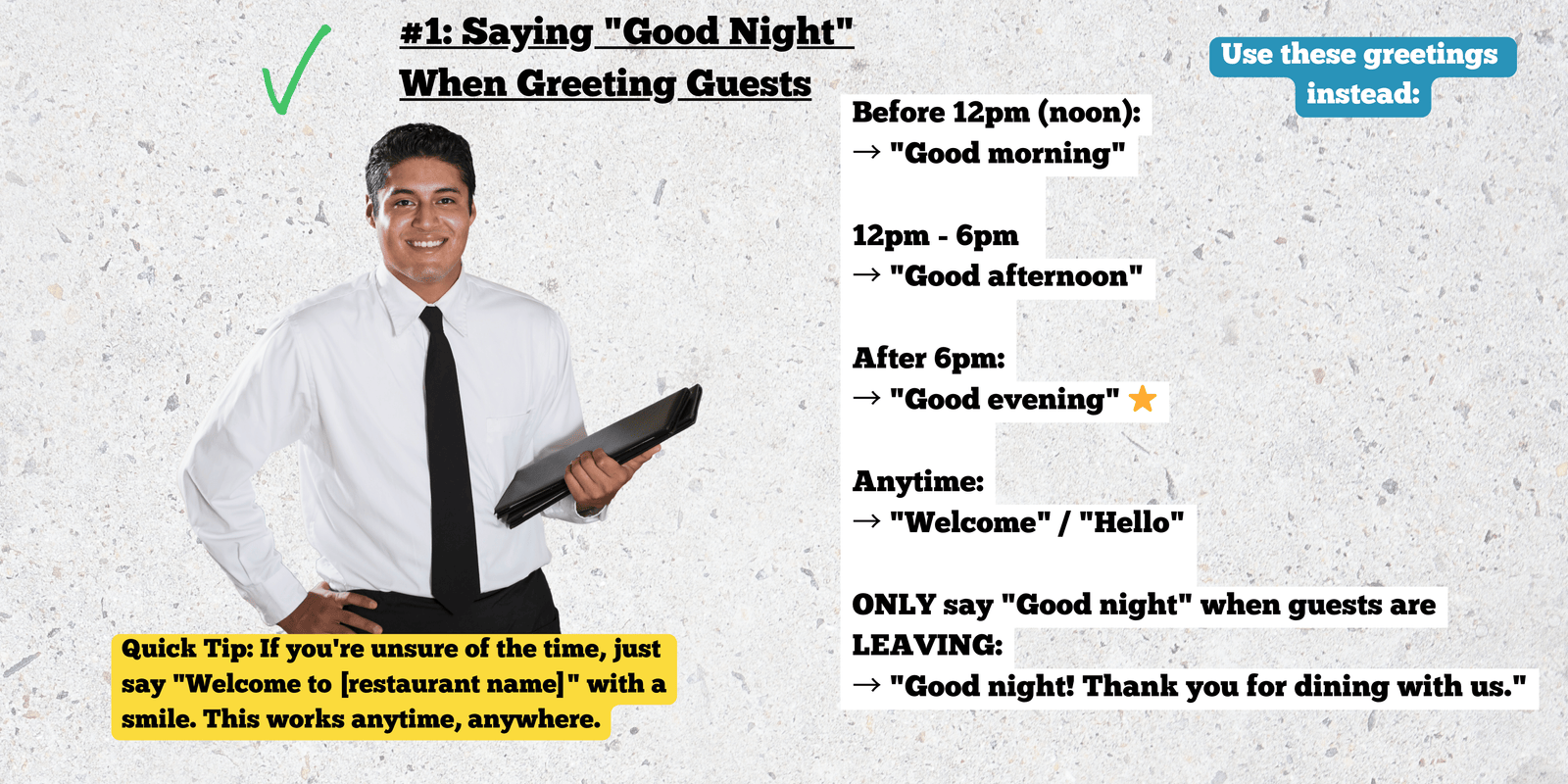
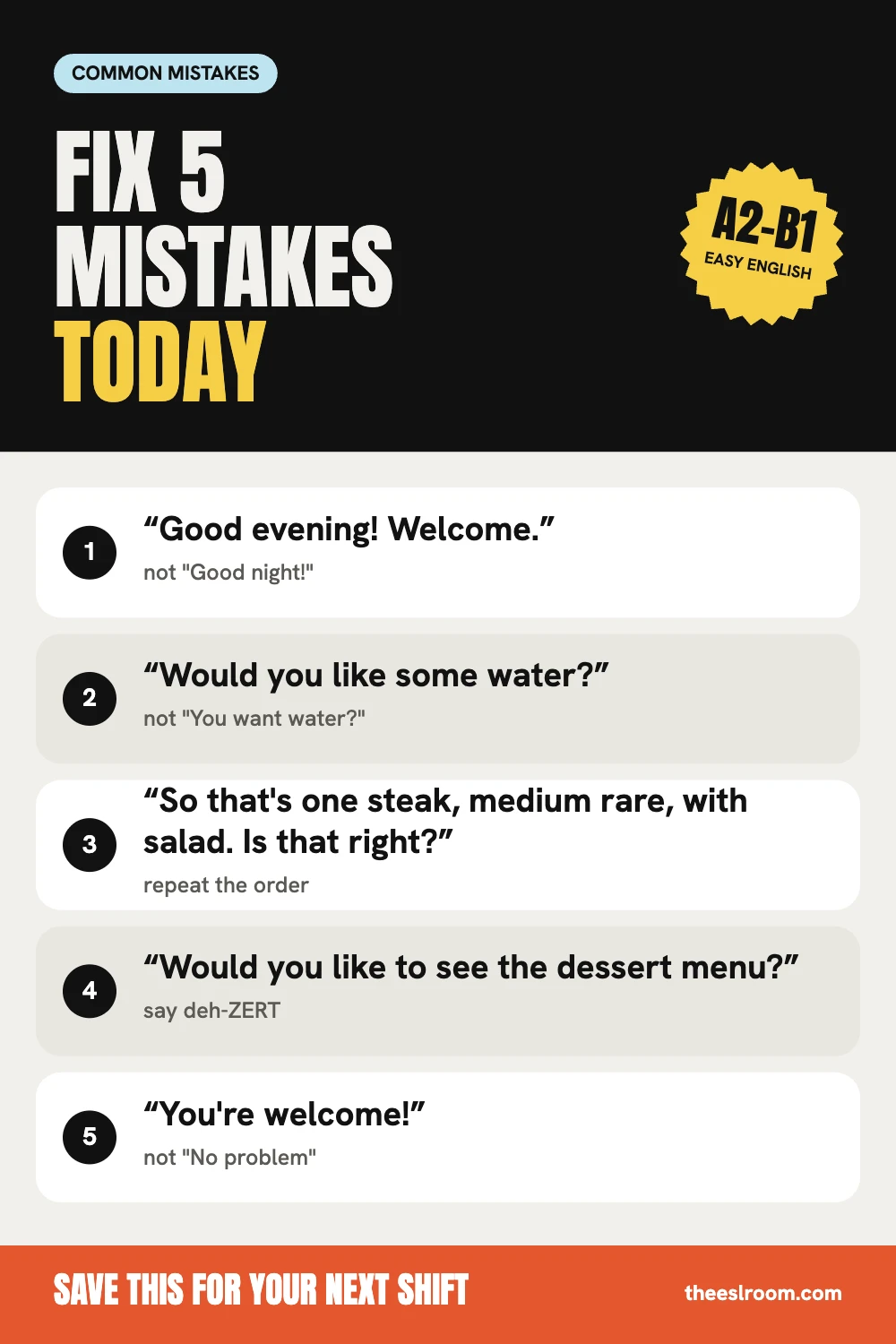
Mistake #1 – “Good Night” When Greeting

The Mistake:

Saying “Good night!” when customers arrive in the evening

Why This Happens:

  • Many languages use same phrase for greeting and farewell
  • Spanish: “buenas noches” works for both
  • Polish: “dobranoc” similar
  • Direct translation feels natural

The Problem:

  • In English, “good night” = goodbye ONLY
  • Never used for greetings
  • Sounds like you want them to leave
  • Creates confusion

The Fix – Correct Greetings by Time:

Morning (6am-12pm):

  • ✅ “Good morning!”
  • ✅ “Morning! How are you today?”

Afternoon (12pm-6pm):

  • ✅ “Good afternoon!”
  • ✅ “Afternoon! Table for two?”

Evening (6pm-midnight):

  • ✅ “Good evening!”
  • ✅ “Evening! Welcome to [restaurant name]”

Any time (safe option):

  • ✅ “Hello!”
  • ✅ “Hi! How are you folks doing?”

Real Scenario:

❌ Wrong:

Waiter at 7pm: “Good night! Table for two?”
Customer: confused look “Uh… we just arrived?”

✅ Right:

Waiter at 7pm: “Good evening! Table for two?”
Customer: “Yes, please. Table by the window if possible?”

Cultural Note:

  • UK: “Good evening” more formal
  • US: Often just “Hi” or “Hey, how are you tonight?”
  • Australia: “G’day!” or “Hey, how’s it going?”

Practice:

What would you say at these times?

  • 8am arrival: ___________
  • 2pm arrival: ___________
  • 9pm arrival: ___________

Quick Tip Box: 💡 When in doubt, “Hello” works any time. You can’t go wrong!


Mistake #2 – “You Want?” Instead of “Would You Like?”

The Mistake:

Using “You want water?” or “You want dessert?”

Why This Happens:

  • Shorter, feels easier
  • Some languages use direct form
  • Trying to speak quickly during busy shifts

The Problem:

  • Sounds rude or commanding
  • Not polite in English service culture
  • Makes customers uncomfortable
  • Reduces tips

The Fix – Polite Question Forms:

For drinks:

  • ❌ “You want water?”
  • ✅ “Would you like some water?”
  • ✅ “Can I get you some water?”
  • ✅ “May I offer you still or sparkling water?”

For orders:

  • ❌ “You want starter?”
  • ✅ “Would you like to start with an appetizer?”
  • ✅ “Can I get you started with any starters?”

For desserts:

  • ❌ “You want dessert?”
  • ✅ “Would you like to see the dessert menu?”
  • ✅ “Can I tempt you with dessert?”

Real Scenario:

❌ Wrong:

Waiter: “You want drinks?”
Customer: taken aback “Um… I guess… water?”
[Feels pressured, not welcomed]

✅ Right:

Waiter: “Can I get you started with some drinks?”
Customer: “Yes! Could we see the wine list?”
[Feels welcomed, relaxed]

Grammar Explanation:

  • “You want” = statement/command
  • “Would you like” = polite question
  • “Can I get you” = helpful offer

Levels of Formality:

Very Formal (Fine Dining):

  • “May I offer you…”
  • “Would madam/sir care for…”

Standard (Most Restaurants):

  • “Would you like…”
  • “Can I get you…”

Casual (Café/Pub):

  • “What can I get you?”
  • “Ready to order?”

Practice Sentences:

Rewrite these politely:

  1. “You want more bread?” → ___________
  2. “You ready to order?” → ___________
  3. “You need anything else?” → ___________

Quick Tip Box: 💡 Add “some” to sound even more polite: “Would you like SOME coffee?” vs “Would you like coffee?”


Mistake #3 – Not Repeating Orders Back

The Mistake:

Taking the order and walking away without confirmation

Why This Happens:

  • Trying to save time
  • Worried about slowing down service
  • Not taught this in training

The Problem:

  • Mistakes reach the kitchen
  • Food comes out wrong
  • Customer complains
  • You get blamed
  • Tips suffer

The Fix – Always Confirm:

Standard confirmation: “Okay, so that’s one medium-rare steak with fries, and one salmon with vegetables. Is that correct?”

For complex orders: “Let me make sure I have this right: Table for four – two steaks medium, one chicken grilled, one vegetarian pasta, and you mentioned one person is gluten-free. Have I got everything?”

After modifications: “Perfect! So that’s the burger, no onions, extra cheese, with sweet potato fries instead of regular. Anything else?”

Real Scenario:

❌ Wrong:

Customer: “I’ll have the steak, medium-rare, but can I get salad instead of fries?”
Waiter: “Okay!” walks away
[Order comes with fries, customer unhappy]

✅ Right:

Customer: “I’ll have the steak, medium-rare, but can I get salad instead of fries?”
Waiter: “Absolutely! So that’s one steak, medium-rare, with salad instead of fries?”
Customer: “Perfect!”
[Order comes correct, customer happy]

Bonus Benefit:

  • Shows you’re listening
  • Builds trust
  • Prevents kitchen errors
  • Makes you look professional

Quick Tip Box: 💡 Write modifications on your notepad and show the customer: “Like this?” They’ll appreciate the care!


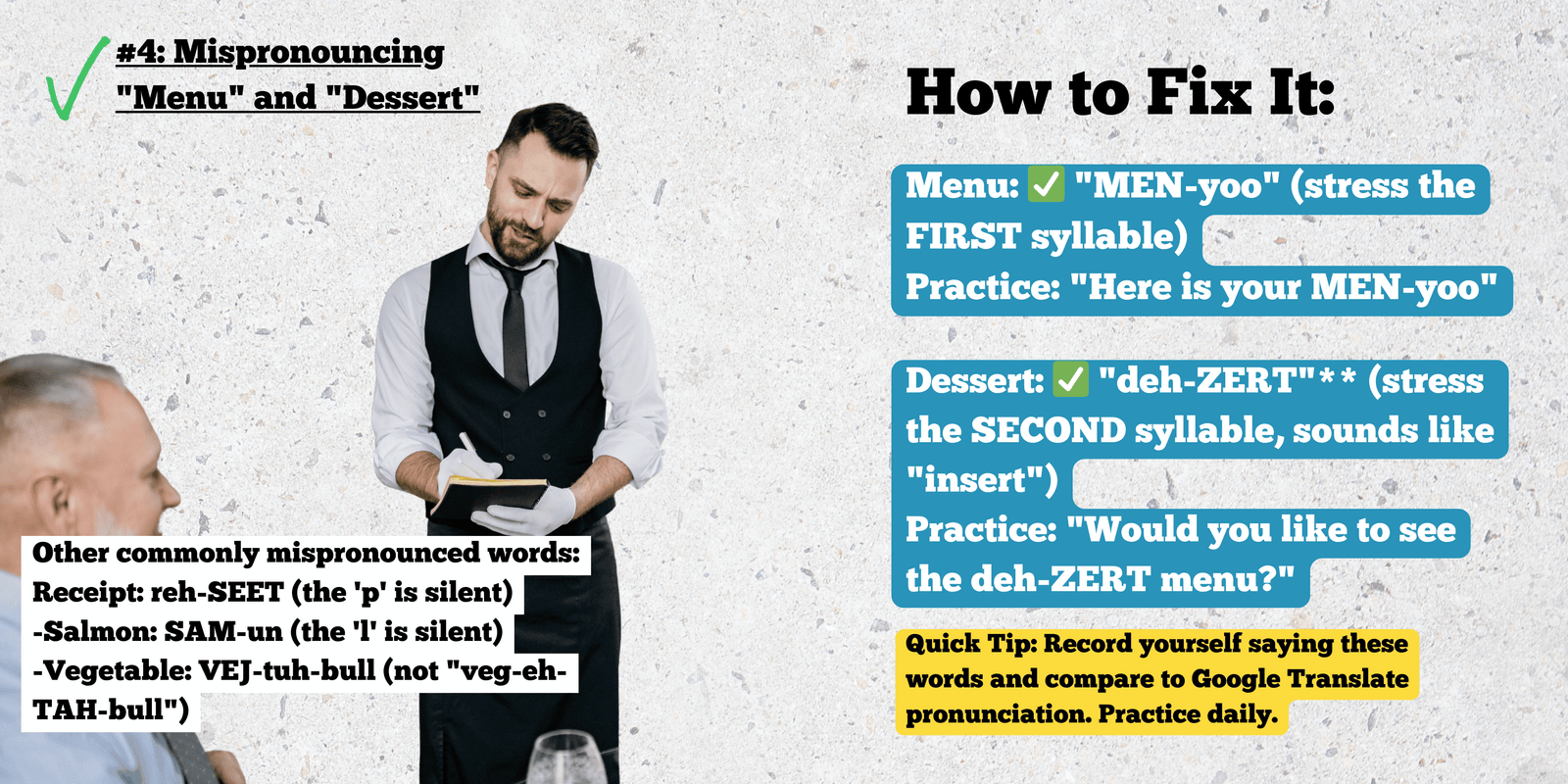
Mistake #4 – Mispronouncing “Menu” and “Dessert”

10 Common Mistakes Waiters Make in English: The Complete Guide (2025)

The Mistake:

Saying “MEE-noo” instead of “MEN-yoo”
Saying “DEZ-ert” instead of “deh-ZERT”

Why This Happens:

  • French origin confuses pronunciation
  • Not hearing native speakers clearly
  • Regional variations

The Problem:

  • Customers don’t understand
  • You repeat yourself multiple times
  • Feels unprofessional
  • Slows down service

The Fix – Correct Pronunciation:

Menu:

  • ❌ MEE-noo (sounds like “me new”)
  • MEN-yoo (rhymes with “hen you”)
  • Audio guide: MEN (like “men”) + YOU

Dessert:

  • ❌ DEZ-ert (sounds like “desert” – hot, sandy place)
  • deh-ZERT (emphasis on second syllable)
  • Audio guide: Think “stressed” on the SECOND part

Memory Trick:

  • DeSSert = 2 S’s = You want 2 of them (emphasis on second syllable)
  • Desert = 1 S = You only want to cross once (emphasis on first syllable)

Common Mispronunciations – Fix List:

Word❌ Wrong✅ RightMemory TrickMenuMEE-nooMEN-yooMen need foodDessertDEZ-ertdeh-ZERTTwo S's = sweet stuffWaterWAH-terWAW-terSoft 'a' soundOrderOR-dareOR-derNot "dare"BottleBOT-leBOT-ulSoft ending

Practice Sentences:

  1. “Here’s the menu” → (MEN-yoo)
  2. “Would you like dessert?” → (deh-ZERT)
  3. “Can I get you some water?” → (WAW-ter)

Real Scenario:

❌ Wrong:

Waiter: “Here’s the MEE-noo”
Customer: “The… what?”
Waiter: “MEE-noo” points at menu
Customer: “Oh! The menu!”

✅ Right:

Waiter: “Here’s the MEN-yoo. Take your time!”
Customer: “Thank you!”
[Clear communication, professional]

Quick Tip Box: 💡 Listen to native English speakers on YouTube saying restaurant words. Practice 5 minutes before each shift!


Mistake #5 – Being Too Direct/Sounding Rude

The Mistake:

Using commands instead of polite requests:

  • “Wait here”
  • “Come this way”
  • “Give me your order”

Why This Happens:

  • Translating directly from your language
  • Trying to be efficient
  • Not understanding English politeness culture

The Problem:

  • Sounds bossy
  • Customers feel uncomfortable
  • Perceived as rude
  • Lower tips

The Fix – Add Softeners:

Magic Words:

  • Please
  • Could you…
  • Would you mind…
  • If you don’t mind…
  • When you’re ready…

Command → Polite Request:

Seating:

  • ❌ “Come this way”
  • ✅ “Please, follow me this way”
  • ✅ “If you’d like to come with me, I’ll show you to your table”

Ordering:

  • ❌ “Give me your order”
  • ✅ “Are you ready to order?”
  • ✅ “Whenever you’re ready, I can take your order”

Waiting:

  • ❌ “Wait here”
  • ✅ “If you could wait here for just a moment, please”
  • ✅ “I’ll be right back – please make yourselves comfortable”

Requests:

  • ❌ “Move to another table”
  • ✅ “Would you mind if we moved you to this table?”
  • ✅ “I’m so sorry, but would it be possible to move to table 5?”

Tone Matters:

Same words, different tone:

Harsh: “Follow me.” (command)
Polite: “Follow me, please!” (friendly)
Very polite: “If you’d like to follow me, please?” (question)

Real Scenario:

❌ Wrong:

Customer arriving
Waiter: “Wait here. I check table.”
Customer: feels dismissed

✅ Right:

Customer arriving
Waiter: “Welcome! If you could wait here for just one moment, I’ll check on your table.”
Customer: feels valued

British vs American Politeness:

UK (Very Polite):

  • “Would you possibly mind…”
  • “I’m terribly sorry, but…”
  • “If it’s not too much trouble…”

US (Friendly Direct):

  • “Hey, could you…”
  • “Sorry about that, can we…”
  • “No problem! Just…”

Practice Rewriting:

Make these polite:

  1. “Sit down” → ___________
  2. “Give me your menu” → ___________
  3. “Move your bag” → ___________

Quick Tip Box: 💡 Start with “I’m sorry” or “Excuse me” before any request – instant politeness!


Mistake #6 – Not Handling Complaints Professionally

The Mistake:

  • Getting defensive
  • Making excuses
  • Ignoring the complaint
  • Blaming the kitchen

Why This Happens:

  • Taking it personally
  • Not trained in complaint handling
  • Nervous about difficult conversations

The Problem:

  • Escalates the situation
  • Customer leaves angry
  • Bad reviews online
  • Manager gets involved
  • You look unprofessional

The Fix – 3-Step Complaint Formula:

STEP 1: APOLOGIZE (Even if not your fault)

Good apologies:

  • “I’m so sorry about that”
  • “I really apologize for the inconvenience”
  • “That’s not acceptable at all – I’m sorry”

Bad responses:

  • “It’s not my fault” ❌
  • “The kitchen is slow today” ❌
  • “Everyone is complaining” ❌

STEP 2: OFFER SOLUTION

Multiple options:

  • “Let me get you a fresh one right away”
  • “I can take that off your bill”
  • “Would you like to choose something else?”
  • “Can I get you a complimentary drink while we sort this?”

STEP 3: FOLLOW UP

Check back:

  • “Is everything okay now?”
  • “How’s the new dish?”
  • “I hope this is better!”

Real Scenarios:

Scenario 1: Cold Food

❌ Wrong:

Customer: “This is cold”
Waiter: “The kitchen made it 10 minutes ago. You should have eaten faster.”
Customer: furious

✅ Right:

Customer: “This is cold”
Waiter: “I’m so sorry! Let me get you a fresh, hot one right away.”
Returns with new dish
Waiter: “Here you go – freshly made. Please let me know if it’s not perfect.”
Customer: appreciates the service

Scenario 2: Wrong Order

❌ Wrong:

Customer: “I ordered salmon, not chicken”
Waiter: “You said chicken”
Customer: “No, I definitely said salmon”
Waiter: argues
[No resolution, bad experience]

✅ Right:

Customer: “I ordered salmon, not chicken”
Waiter: “I’m so sorry for the mix-up! Let me get you the salmon right away. Can I get you anything while you wait?”
Customer: “No, that’s fine”
Waiter: Returns with salmon “Again, really sorry about that. This is on the house.”
Customer: happy, leaves good tip

Scenario 3: Long Wait

❌ Wrong:

Customer: “We’ve been waiting 40 minutes!”
Waiter: “Kitchen is busy. What can I do?”
Customer: more angry

✅ Right:

Customer: “We’ve been waiting 40 minutes!”
Waiter: “I’m really sorry – that’s way too long. Let me check on your order right now and bring you some complimentary bread while you wait.”
Checks kitchen
Waiter: “Your food is coming in 5 minutes. To apologize, drinks are on us tonight.”
Customer: frustrated but appreciates effort

What NOT to Say:

Never say:

  • “It’s not my fault” ❌
  • “I’m just the waiter” ❌
  • “The kitchen is slow” ❌
  • “Everyone is complaining today” ❌
  • “You should have said something earlier” ❌

Always say:

  • “I’m sorry” ✅
  • “Let me fix this” ✅
  • “What can I do to make this right?” ✅

The Power of Empathy:

Acknowledge their feelings:

  • “I completely understand your frustration”
  • “I’d be upset too”
  • “You’re absolutely right to mention this”

When to Get the Manager:

Get manager if:

  • Customer asks for manager
  • Complaint is about policy you can’t change
  • Customer is extremely angry
  • You’ve tried everything

How to get manager:

  • “Let me get my manager – they’ll want to make this right”
  • NOT “I can’t help you” ❌

Quick Tip Box: 💡 The customer doesn’t care whose fault it is. They just want the problem fixed. Apologize, solve, move on!


5

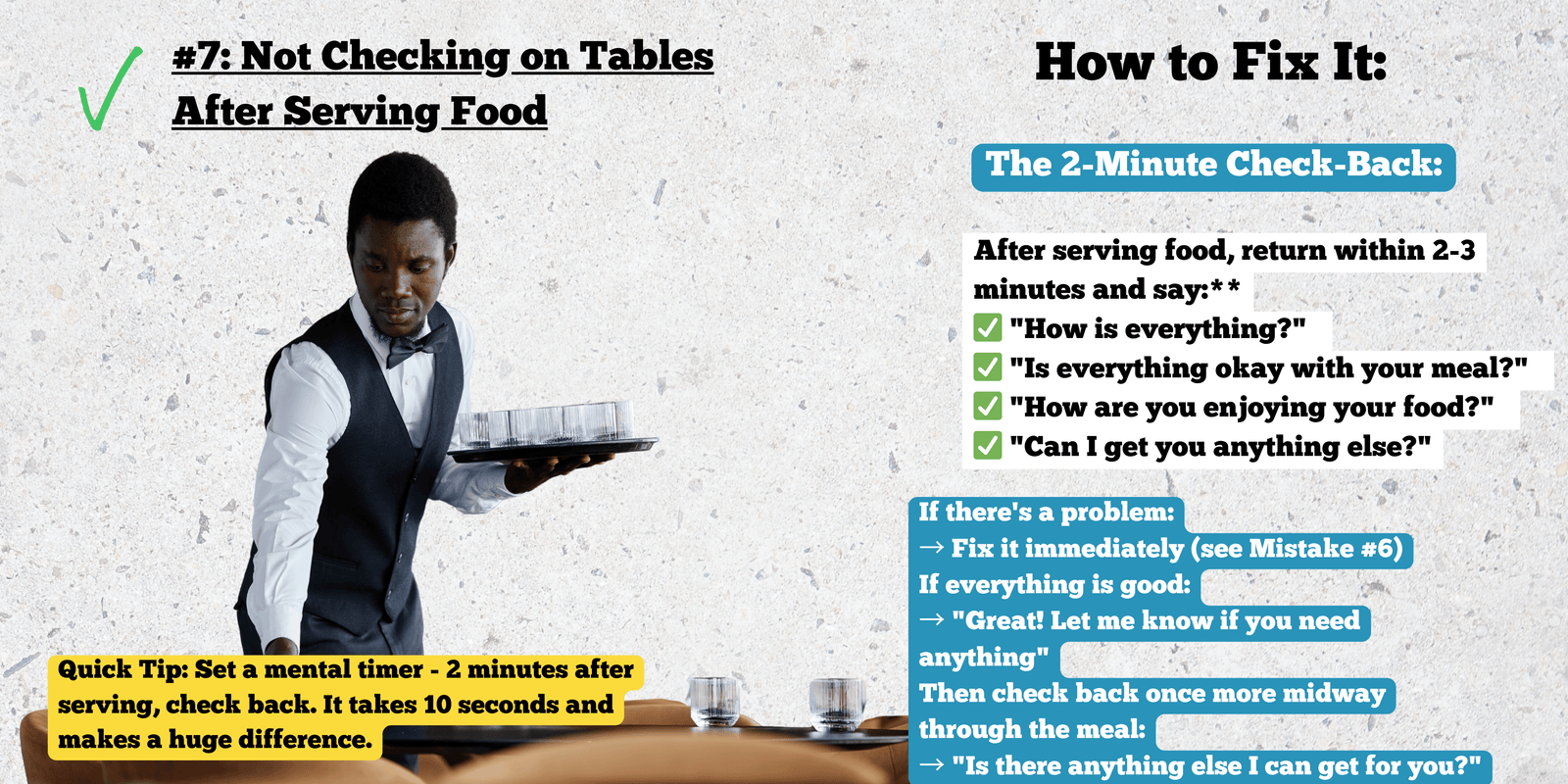
Mistake #7 – Not Checking Back After Serving

The Mistake:

Serving food and disappearing for 20 minutes

Why This Happens:

  • Busy with other tables
  • Assuming everything is fine
  • Avoiding awkward conversations

The Problem:

  • Don’t catch issues early
  • Customer can’t get your attention
  • Food gets cold while they wait
  • Complaint escalates

The Fix – 2-Minute Check-Back:

After serving food, return within 2 minutes:

Check-back phrases:

  • “How is everything tasting?”
  • “Is everything cooked okay?”
  • “Can I get you anything else?”
  • “Everything okay with your meal?”

Why 2 minutes?

  • Food is still hot
  • If something’s wrong, you can fix it fast
  • Shows you care
  • Catches problems early

Real Scenario:

❌ Wrong:

Serves steak
Disappears for 15 minutes
Customer tries to wave you down
Steak is now cold
Customer frustrated

✅ Right:

Serves steak
2 minutes later returns
Waiter: “How’s your steak cooked?”
Customer: “Actually, I asked for medium but this is well-done”
Waiter: “Oh! Let me get you a new one right away”
[Problem caught early, easily fixed]

Second Check (10 minutes later):

  • “Is there anything else I can get you?”
  • “Ready for another drink?”

Don’t Interrupt:

If they’re mid-conversation or mid-bite, wait or just make eye contact and smile. They’ll signal if they need something.

Quick Tip Box: 💡 Make eye contact with every table every 5 minutes. They’ll wave if they need you!


Mistake #8 – Poor Upselling (Sounds Pushy)

The Mistake:

  • “You SHOULD get dessert”
  • “This is our most expensive wine”
  • Aggressive upselling

Why This Happens:

  • Pressure from management to upsell
  • Trying to increase tips
  • Not understanding subtle suggestions

The Problem:

  • Customers feel pressured
  • Sounds desperate
  • Makes meal uncomfortable
  • Backfires – they order less

The Fix – Suggestive Selling:

Make it about THEM, not you:

Bad upselling:

  • ❌ “Do you want dessert?” (yes/no question)
  • ❌ “You should try the chocolate cake” (pushy)
  • ❌ “Our most expensive wine is…” (about price)

Good upselling:

  • ✅ “Our chocolate lava cake is incredible – it’s my favorite” (personal recommendation)
  • ✅ “Can I tempt you with dessert? The tiramisu is homemade” (appealing)
  • ✅ “That pasta pairs beautifully with our Pinot Grigio” (helpful pairing)

Upselling by Category:

Drinks:

  • ❌ “Want drinks?”
  • ✅ “Can I start you with a cocktail? Our mojitos are really popular tonight”

Starters:

  • ❌ “Any starters?”
  • ✅ “The calamari is really fresh today – would you like to start with that?”

Sides:

  • ❌ “Want fries with that?”
  • ✅ “That burger is amazing with our truffle fries – can I add those?”

Desserts:

  • ❌ “Dessert?”
  • ✅ “I have to recommend the chocolate fondant – it’s incredible warm with ice cream”

Real Scenario:

❌ Wrong (Pushy):

Waiter: “You NEED to try dessert. The cake is £8.50”
Customer: “Um… we’re quite full…”
Waiter: “But it’s really good!”
Customer: feels pressured “No thanks”

✅ Right (Suggestive):

Waiter: “Just so you know, our chocolate fondant is baked fresh – it’s warm, gooey, and perfect with vanilla ice cream. I’m obsessed with it!”
Customer: “Ooh, that does sound good… okay, let’s share one!”
[Natural, helpful, successful upsell]

The Secret – Describe, Don’t Demand:

Use sensory words:

  • Warm, gooey, fresh, crispy, tender, rich, light, creamy, zesty

Example: “The apple tart is warm and buttery with cinnamon, served with cold vanilla ice cream – sweet and warm together is amazing!”

vs.

“Want apple tart?”

When They Say No:

Gracious response:

  • “No problem! Just let me know if you change your mind”
  • NOT “Are you sure?” (too pushy)

Quick Tip Box: 💡 Share what YOU actually like. Authenticity sells better than scripts!


Mistake #9 – Using Informal/Slang Language

The Mistake:

  • “Hey guys!”
  • “No worries!”
  • “Yep!”
  • “Cool!”

Why This Happens:

  • Casual restaurant culture
  • Copying native speakers
  • Trying to sound friendly

The Problem:

  • Wrong level of formality
  • Sounds unprofessional in fine dining
  • Can offend older customers
  • Inappropriate for business dinners

The Fix – Match the Restaurant:

Casual Café/Pub:

  • ✅ “Hey guys, what can I get you?”
  • ✅ “No worries!”
  • ✅ “Cool, coming right up!”

Mid-Range Restaurant:

  • ✅ “Hi folks, how are you tonight?”
  • ✅ “No problem at all”
  • ✅ “Perfect!”

Fine Dining:

  • ✅ “Good evening, ladies and gentlemen”
  • ✅ “Of course, my pleasure”
  • ✅ “Excellent choice”

Formality Swaps:

CasualProfessional
Hey guysGood evening / Hello
No worriesOf course / My pleasure
YepYes / Certainly
CoolPerfect / Excellent
GonnaGoing to
WannaWould you like

“Guys” Controversy:

Depends on region:

  • US casual restaurants: “Hey guys” is normal
  • UK/Fine dining: “Hello everyone” or “Good evening”
  • Mixed gender table: Some prefer gender-neutral “folks” or “everyone”

Safe alternative: “How is everyone doing?”

Real Scenario:

❌ Wrong (Fine Dining):

Waiter at expensive restaurant: “Hey guys! Wanna see the wine list?”
Business dinner table: uncomfortable

✅ Right (Fine Dining):

Waiter: “Good evening. May I offer you our wine list?”
Business dinner table: comfortable, professional

Quick Tip Box: 💡 Watch how other servers talk. Copy the formality level of your restaurant!


Mistake #10 – Using “No Problem” Instead of “You’re Welcome”

The Mistake:

Customer: “Thank you!”
Waiter: “No problem!”

Why This Happens:

  • Common in casual English
  • Sounds friendly
  • You hear native speakers say it

The Problem – Subtle but Real:

  • “No problem” implies it COULD have been a problem
  • Sounds like you’re doing them a favor
  • Less professional than alternatives
  • Some customers (especially older) dislike it

The Fix – Better Responses:

Professional options:

  • ✅ “You’re welcome!”
  • ✅ “My pleasure!”
  • ✅ “Of course!”
  • ✅ “Happy to help!”

When to use what:

“You’re welcome” – Always safe, classic

“My pleasure” – Very polite, fine dining

“Of course” – Implies “it’s my job to help you”

“Happy to help” – Warm, friendly

The “No Problem” Debate:

Casual restaurants: Often acceptable
Fine dining: Avoid
Older customers: Prefer “you’re welcome”
Young customers: Don’t care

Safest: Use “you’re welcome” – works everywhere

Real Scenario:

Acceptable (Casual):

Customer: “Thanks for the extra napkins!”
Waiter: “No problem!”
[Casual restaurant, young customers – fine]

Better (All Settings):

Customer: “Thank you for accommodating our allergy”
Waiter: “Of course! I’m happy we could help”
[Professional, warm, shows care]

Quick Tip Box: 💡 When in doubt, “You’re welcome” never offends anyone!


Conclusion

Recap:

You’ve learned the 10 most common English mistakes that cost waiters tips:

  1. ✅ Say “good evening” not “good night”
  2. ✅ Use “would you like” not “you want”
  3. ✅ Always repeat orders back
  4. ✅ Pronounce “menu” and “dessert” correctly
  5. ✅ Add “please” and soften commands
  6. ✅ Handle complaints with the 3-step formula
  7. ✅ Check back within 2 minutes
  8. ✅ Upsell by describing, not demanding
  9. ✅ Match formality to your restaurant
  10. ✅ Say “you’re welcome” not “no problem”

The Impact:

Fixing these mistakes will:

  • ✅ Increase your tips by 20-30%
  • ✅ Make customers more comfortable
  • ✅ Boost your confidence
  • ✅ Improve your English naturally
  • ✅ Open career advancement opportunities

What to Do Next:

This Week:

  • Pick 3 mistakes to focus on
  • Practice before each shift
  • Notice when you make them
  • Correct yourself

This Month:

  • Master all 10
  • Track your tips – see the difference!
  • Help other servers improve

Keep Learning:

These 10 mistakes are just the beginning. Restaurant English has hundreds of specific phrases, scenarios, and cultural nuances. Mastering them requires dedicated practice and professional hospitality training.

Want to Master Restaurant English Completely?

I’ve helped over 100 waiters improve their English and increase their tips.

My comprehensive course “English for Waiters” covers:

22+ Interactive Video Lessons

  • Greeting guests perfectly
  • Taking complex orders
  • Handling difficult customers
  • Managing payments smoothly

Complete 60-Page Phrase Guide ($19 value)

  • Every phrase you need for any situation
  • Pronunciation guides
  • Cultural tips

FREE 1-on-1 Coaching Session ($47 value)

  • Practice with me personally
  • Get personalized feedback
  • Ask questions

Certificate of Completion

  • Show employers your skills
  • Advance your career

30-Day Money-Back Guarantee

  • Zero risk
  • Full refund if not satisfied

Only £67 (Regular value: £162)

👉 Start the Course Now

english (1200 x 1200 px) (960 x 1200 px)

FAQ Section

Common Questions:

Q: I’ve been making these mistakes for years. Is it too late to fix them? A: Not at all! Most students fix these in 1-2 weeks with practice. Start with 3 mistakes, master them, then move to the next ones.

Q: Will customers judge me for small mistakes? A: Most customers are understanding. But fixing these mistakes increases tips by 20-30% because you sound more professional and confident.

Q: My accent is strong. Should I worry about pronunciation? A: Accent is fine! Clarity matters more. Focus on pronouncing key words (menu, dessert, water) correctly. Customers care about understanding you, not your accent.

Q: How long to master all 10? A: Most students master them in 2-4 weeks with daily practice. Some take longer – that’s okay! Progress, not perfection.

Q: What if I forget during a busy shift? A: Normal! Write 2-3 key phrases on a notepad and keep it in your apron. Glance at it before greeting tables. Muscle memory builds over time.