The Interview That Changed Everything
Carlos sat in his car outside Bella Vista Restaurant, fifteen minutes early for his server interview. He’d been in the country for eight months. His English was good – he could hold conversations, understand customers, take orders. But an interview? That was different.
His hands were shaking. What if they asked about his accent? What if he didn’t understand a question? What if they asked something he hadn’t prepared for?
He walked in at exactly 2:00 PM. The manager, Jennifer, greeted him with a warm smile.

“Tell me about yourself,” she said.
Carlos froze.
He had prepared answers about customer service. About handling busy shifts. About teamwork. But “tell me about yourself”? He hadn’t practiced that. It seemed too simple. Too open.
“Uh… I am… I worked before in my country… I mean… I have experience…”
The interview went downhill from there. Carlos left knowing he wouldn’t get the job. And he was right.
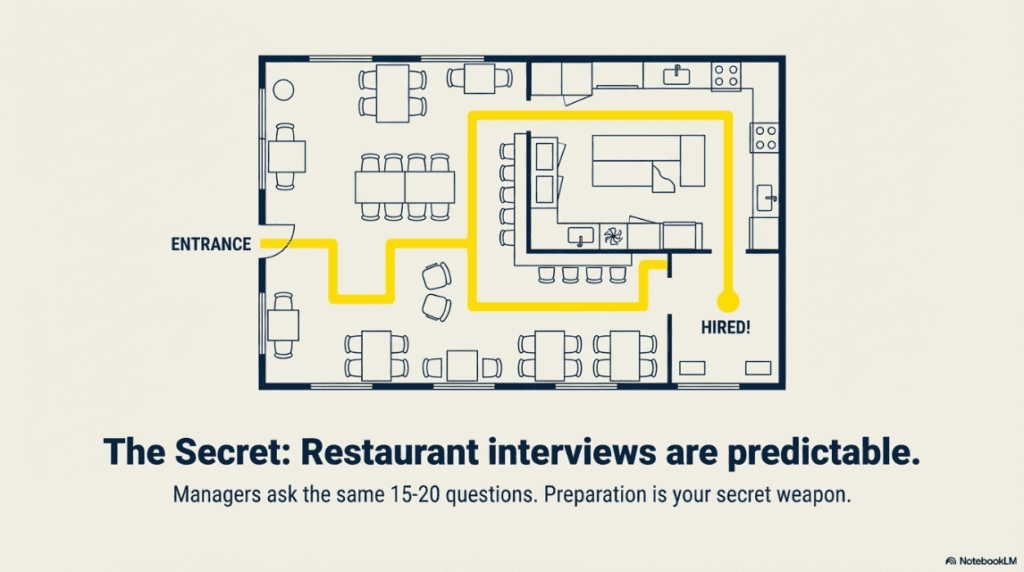
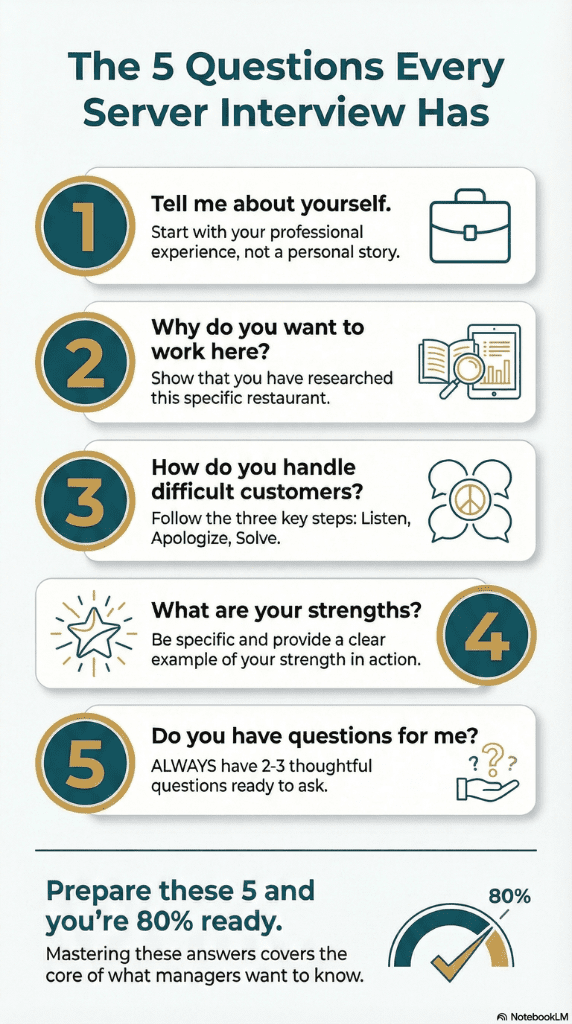
But here’s what Carlos learned: Restaurant interviews follow predictable patterns. There are about 15-20 questions that managers ask in almost every server interview. Once you know these questions and prepare strong answers, the interview becomes much easier – even in your second language.

This guide teaches you:
- The 15 most common server interview questions (with complete answer scripts)
- How to talk about your English level professionally
- What to wear and how to present yourself
- Questions YOU should ask the interviewer
- How to follow up after the interview
- Red flags that tell you NOT to take the job
By the end of this article, you’ll walk into your next server interview with confidence, knowing exactly what to say and how to say it professionally.
Prefer to listen? Here’s our podcast.

Part 1: Before the Interview – Preparation Checklist
Research the Restaurant
What to research:
| What to Find | Where to Look | Why It Matters |
|---|---|---|
| Menu prices | Website, Google | Shows restaurant type (casual vs fine dining) |
| Dress code | Photos on website/Instagram | Helps you dress appropriately |
| Busy times | Google “popular times” | Shows when you’d work hardest |
| Reviews | Google, Yelp | Reveals customer complaints and strengths |
| Company values | Website “About Us” | Helps you align your answers |
Time needed: 20-30 minutes
Why this matters: When you mention specific details about the restaurant, it shows genuine interest. “I noticed your lunch menu focuses on fresh, local ingredients” is much stronger than “I want to work here because I need a job.”
Prepare Your Documents
Bring these to every interview:
- Resume (2 copies – one for you, one for interviewer)
- Reference list (3 people with phone numbers and emails)
- Work authorization documents (if applicable)
- Food handler’s certificate (if you have one)
- Notebook and pen (shows professionalism)
- Questions for the interviewer (written down)
Store in a clean folder or portfolio – not a crumpled plastic bag or backpack.
Make sure you have professional references and recommendation letters ready in case the employer requests them during or after the interview.
What to Wear

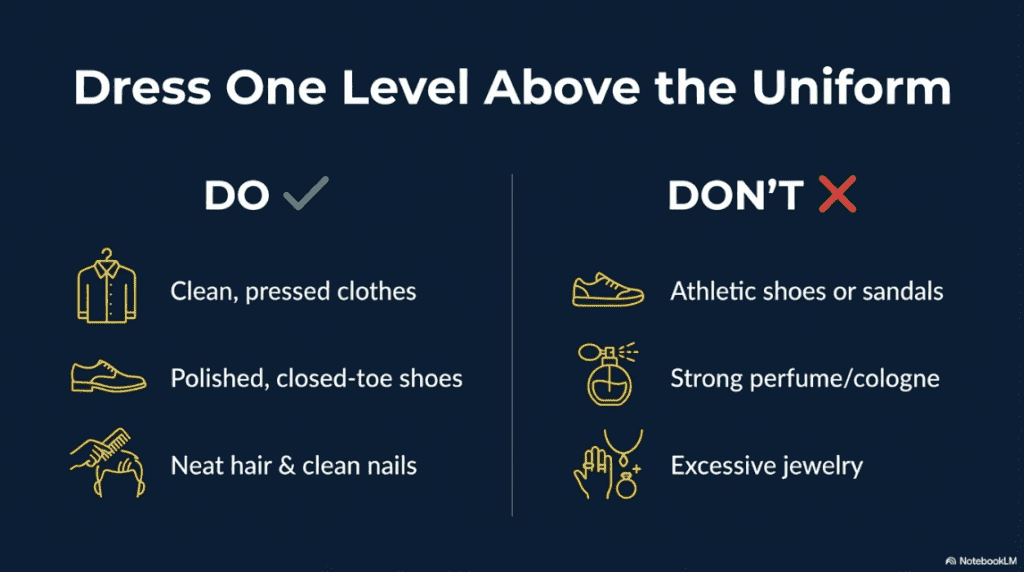
The Rule: Dress one level above what servers wear at that restaurant.
| Restaurant Type | Server Uniform | Your Interview Outfit |
|---|---|---|
| Casual (Diner, Cafe) | Jeans + T-shirt | Clean dark jeans + button-down shirt |
| Casual-Upscale (Chain) | Black pants + polo | Black pants + dress shirt (no tie needed) |
| Fine Dining | Black suit/dress | Black suit + dress shoes (polished) |
Universal rules:
- ✅ Clean, pressed clothes (no wrinkles)
- ✅ Closed-toe shoes (polished, no scuffs)
- ✅ Minimal jewelry (watch is fine, no large earrings/chains)
- ✅ Neat hair (tied back if long)
- ✅ Clean nails (short, no chipped polish)
- ✅ Light or no perfume/cologne
What NOT to wear:
- ❌ Athletic shoes or sandals
- ❌ Visible tattoos (cover if possible)
- ❌ Strong perfume or cologne
- ❌ Excessive jewelry
- ❌ Wrinkled or stained clothing
Practice Your Answers Out Loud
This is critical for ESL speakers.
Why practicing out loud matters:
- Reading answers in your head ≠ saying them smoothly
- You discover which words are difficult to pronounce
- You build muscle memory for professional phrases
- You reduce anxiety by hearing yourself succeed
How to practice:
- Read the answer scripts in Part 3 of this guide
- Record yourself answering on your phone
- Listen back – do you sound confident?
- Practice until answers flow naturally (not memorized robotically)
Time needed: 1-2 hours total spread over 2-3 days

Part 2: Understanding What Interviewers Really Want
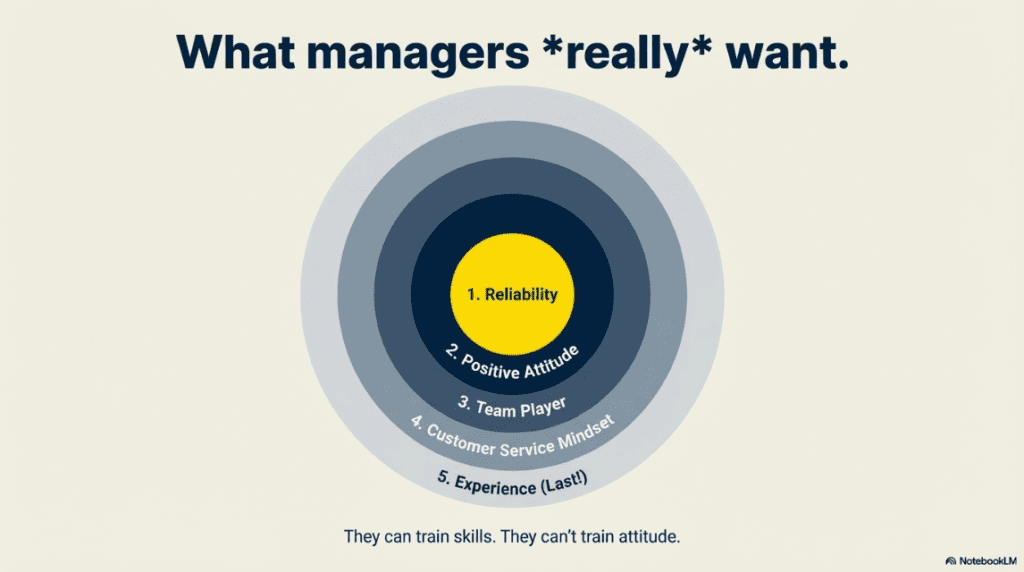
The 5 Things Every Manager Looks For
Restaurant managers hire based on these priorities (in order):
1. Reliability
- Will you show up on time?
- Will you call if you’re sick?
- Can they count on you for difficult shifts?
2. Positive Attitude
- Do you smile naturally?
- Are you pleasant to talk to?
- Will guests enjoy interacting with you?
3. Team Player
- Will you help coworkers?
- Can you handle stress without drama?
- Will you fit the team culture?
4. Customer Service Mindset
- Do you genuinely care about making guests happy?
- Can you stay calm with difficult customers?
- Do you take pride in good service?
5. Experience (Last!)
- Experience matters LESS than you think
- Managers can train technical skills
- They can’t train attitude and reliability
Your interview strategy: Focus your answers on reliability, attitude, and teamwork FIRST. Then mention experience.
According to interview experts at The Interview Guys, restaurant managers consistently prioritize attitude and interpersonal skills over technical experience when evaluating server candidates – which is why your answers should emphasize reliability, teamwork, and customer service mindset first.

How Managers Evaluate English Level
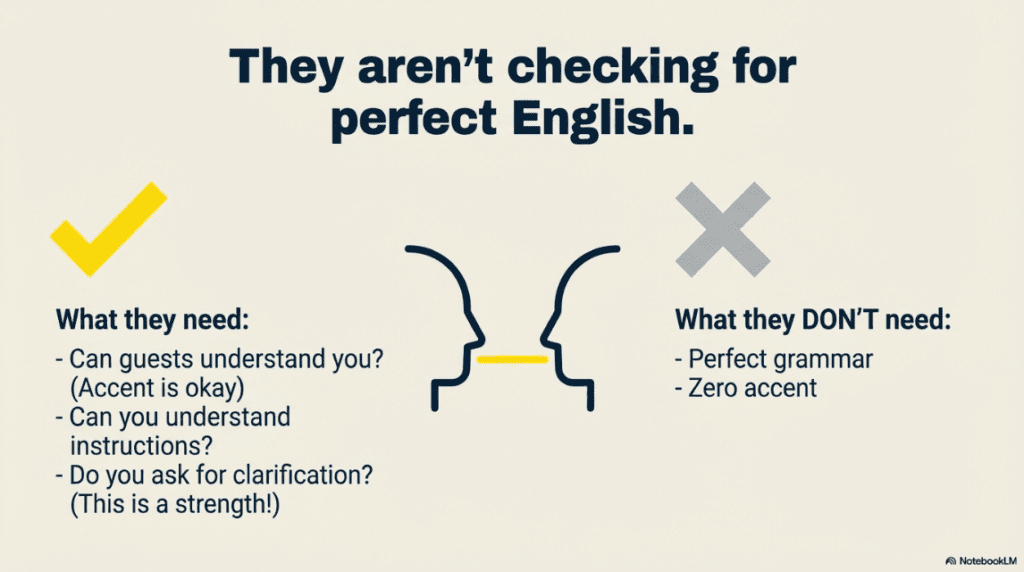
What they’re actually checking:
✅ Can you communicate clearly? (not perfectly) ✅ Can guests understand you? (accent is okay) ✅ Can you understand instructions? (listening skills) ✅ Do you ask for clarification when needed? (shows maturity)
What they’re NOT checking: ❌ Perfect grammar ❌ Zero accent ❌ Advanced vocabulary ❌ Native-level fluency
The truth: If the manager can understand you during the interview, guests will understand you during service. Don’t apologize for your accent or English level unless directly asked.
Part 3: The 15 Most Common Interview Questions (With Complete Answer Scripts)
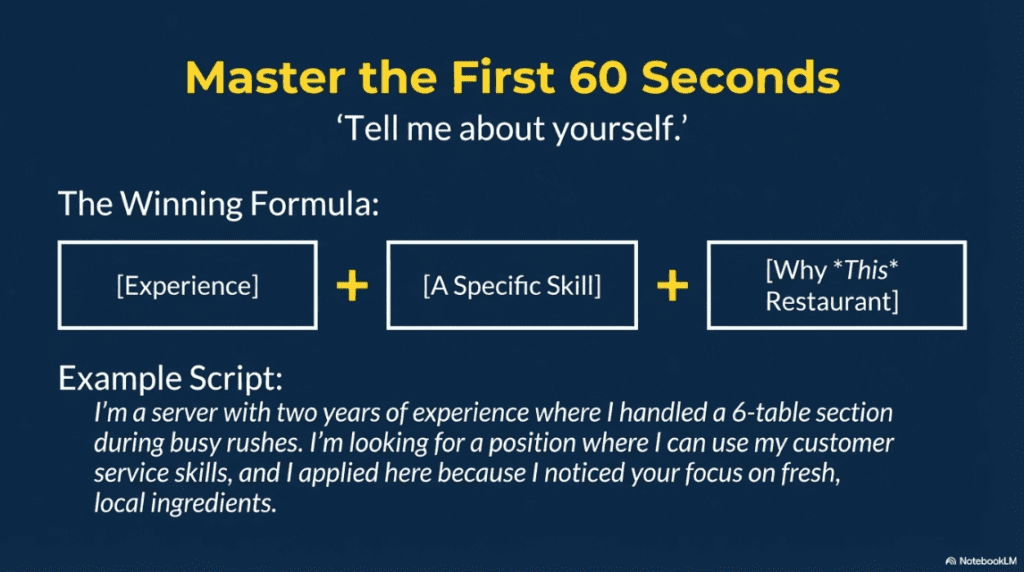
Question 1: “Tell me about yourself.”
What they’re really asking: Give me a 60-second professional summary.
Bad answer: “I’m from Mexico. I came here last year. I need a job. I have worked before as a server.”
Why it’s bad: Too personal, focuses on need rather than value, no specifics.
Good answer script: “I’m a server with two years of restaurant experience. I worked at a busy family restaurant in [city/country] where I regularly handled 6-table sections during weekend rushes. I moved here eight months ago and recently completed my food handler certification. I’m looking for a position where I can use my customer service skills and grow with a team. I chose to apply here because I noticed your focus on fresh, local ingredients, and I’d love to be part of that mission.”
Why it’s good: Starts with value (experience), mentions specific skills, shows research, ends with enthusiasm.
Template: “I’m a server with [X years/months] of experience. I worked at [type of restaurant] where I [specific achievement]. I [recent qualification/move/change]. I’m looking for [what you want]. I applied here because [restaurant-specific reason].”
Question 2: “Why do you want to work here?”
What they’re really asking: Did you research us, or are you just applying everywhere?
Bad answer: “I need a job and this restaurant is close to my house.”
Why it’s bad: Shows zero interest in THIS specific restaurant.
Good answer script: “I’ve eaten here twice, and both times I noticed how your servers interact with guests – they’re friendly but professional, which is exactly the service style I believe in. I also read your reviews, and customers consistently mention the team’s knowledge about the menu. That tells me you invest in training, which is important to me because I want to grow my skills. Plus, your focus on seasonal ingredients means the menu stays interesting, which I think makes the job more engaging.”
Why it’s good: Shows research, mentions specific observations, focuses on mutual benefit (you want to grow, they offer training).
Template: “I [visited/researched] and noticed [specific observation about service/food/atmosphere]. I also [second specific detail]. This tells me [what it means about the workplace]. Plus, [third reason that shows alignment with their values].”
Question 3: “What is your experience in restaurants?”
What they’re really asking: Can you handle the basic job functions?
If you have restaurant experience:
Good answer script: “I worked at Rosa’s Family Restaurant for two years as a server. It was a casual dining restaurant with about 80 seats. During my time there, I typically handled a 5-6 table section during dinner service. I took orders, entered them into the POS system, ran food, and processed payments. I also trained three new servers during my last six months. The busiest shift I handled was a Saturday dinner rush where we served 150 guests in three hours.”
Why it’s good: Specific restaurant name, specific duties, specific numbers (shows real experience).
If you have NO restaurant experience:
Good answer script: “I don’t have formal restaurant experience yet, but I worked in retail customer service for three years at [store name]. In that role, I helped 50-60 customers per shift, handled complaints professionally, and worked as part of a team during busy holiday seasons. I understand serving is different from retail, but the core skills – staying calm under pressure, communicating clearly with customers, and working efficiently as a team – are the same. I’m a fast learner and I’m willing to start in any position to prove myself.”
Why it’s good: Acknowledges lack of restaurant experience honestly, draws connections to transferable skills, shows eagerness.
Question 4: “What are your strengths?”
What they’re really asking: What specific value do you bring?
Bad answer: “I’m a hard worker and I’m friendly.”
Why it’s bad: Too vague, everyone says this.
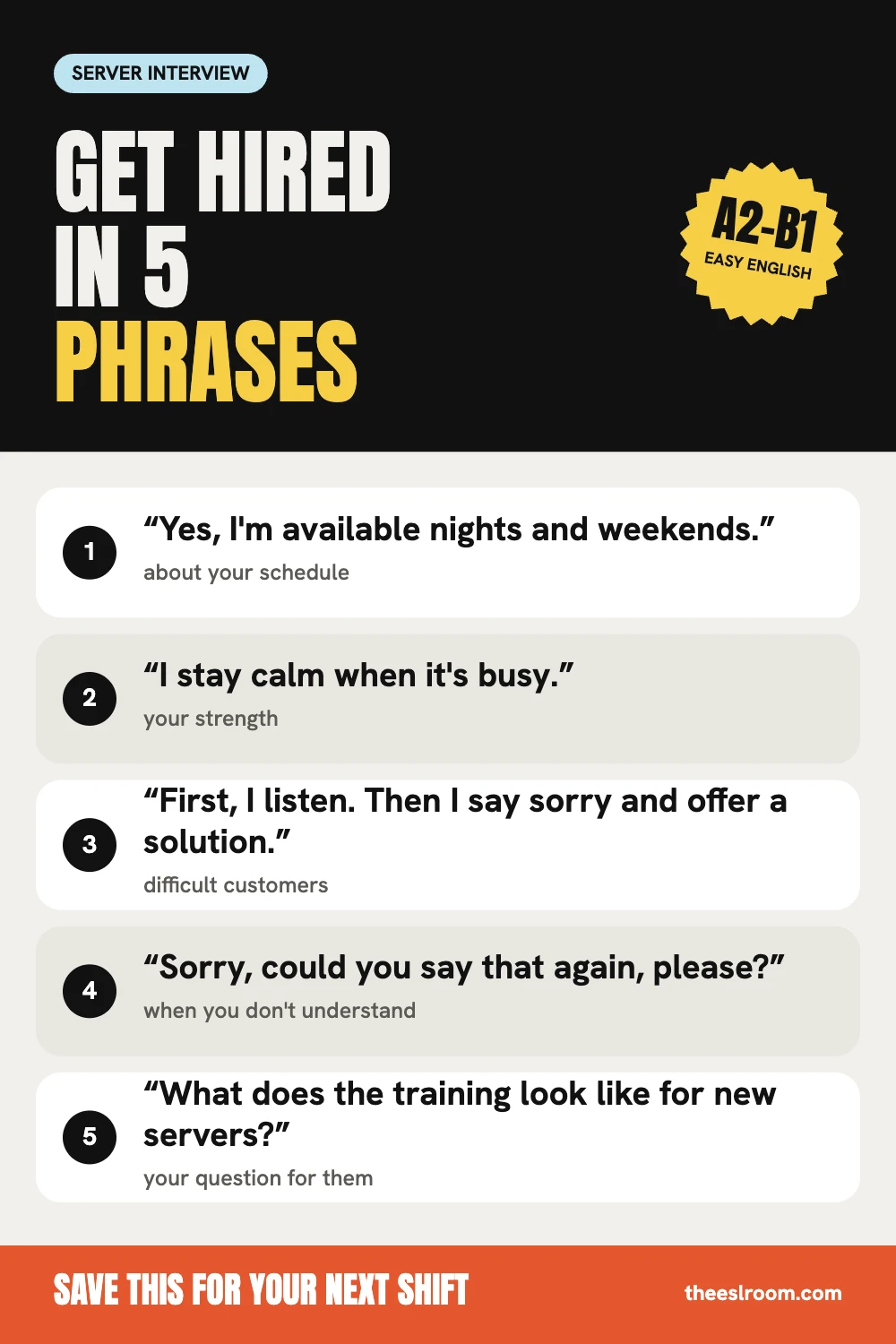
Good answer script: “My biggest strength is staying calm during busy shifts. At my last restaurant, Friday and Saturday nights could get chaotic – we’d have a 30-minute wait and every table full. I learned to prioritize tasks, communicate clearly with the kitchen, and still make each guest feel like they had my full attention. My manager often scheduled me for the busiest shifts because I didn’t get flustered. I also think I’m good at reading guests – knowing when someone wants quick service versus when they want to relax and chat.”
Why it’s good: Specific strength (calm under pressure), specific evidence (scheduled for busy shifts), includes a second relevant strength (reading guests).
Template: “My biggest strength is [specific skill]. At my last job, [specific situation where you demonstrated this]. My manager/team [recognition you received]. I also think I’m good at [second relevant strength].”
Question 5: “What are your weaknesses?”
What they’re really asking: Are you self-aware? Can you improve?
Bad answers:
- “I don’t have any weaknesses.” (Arrogant)
- “I’m a perfectionist.” (Cliché, insincere)
- “I’m always late.” (Red flag)
Good answer script: “I’m still working on my wine knowledge. At my last restaurant, we had a limited wine list, so I didn’t get much experience making wine recommendations. I’ve started reading about wine pairings online, and if I’m hired here, I’d love to learn more about your wine program. I learn quickly, and I’m comfortable asking questions when I don’t know something rather than guessing.”
Why it’s good: Real weakness (not fatal), shows self-awareness, demonstrates you’re already working on it, frames it positively.
Alternative answer (for ESL speakers): “Sometimes I ask guests to repeat themselves if the restaurant is very loud, especially during busy times. I’ve learned to position myself where I can hear clearly and to repeat the order back to confirm I understood correctly. I’d rather take an extra five seconds to get it right than bring the wrong dish.”
Why it’s good: Honest about language challenge, shows you’ve developed a system to manage it, focuses on accuracy.

Question 6: “How do you handle difficult customers?”
What they’re really asking: Will you stay professional under pressure?
Bad answer: “I would call the manager immediately.”
Why it’s bad: Shows you can’t handle problems independently.
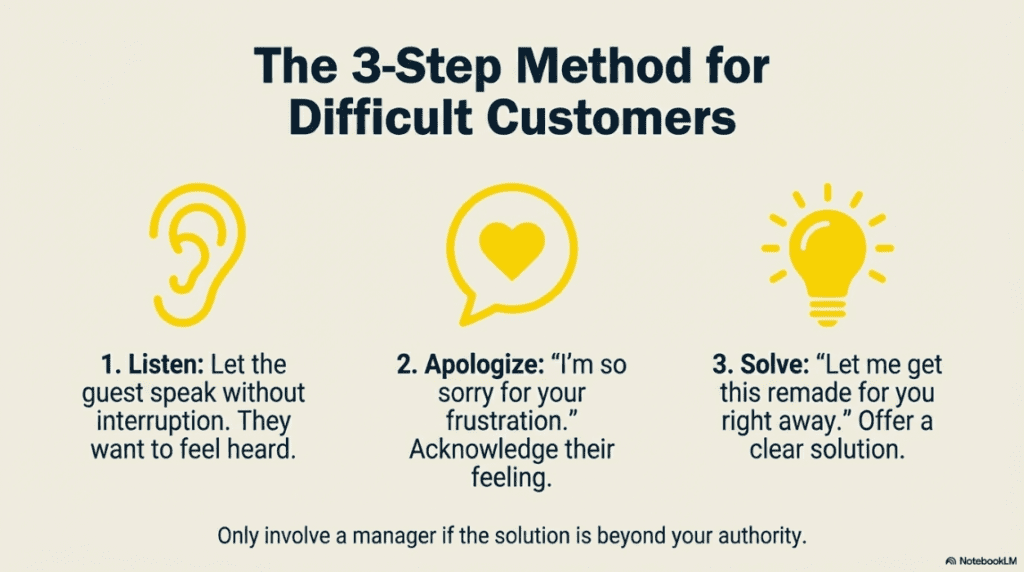
Good answer script: “First, I listen without interrupting, even if I think the guest is wrong. Most of the time, people just want to feel heard. Then I apologize for their frustration – not necessarily for the problem, but for how they feel. Then I offer a solution. For example, if food came out wrong, I’d say, ‘I’m so sorry about that. Let me get the kitchen to remake this right away. Can I bring you something else while you wait?’ If it’s beyond my authority, that’s when I involve a manager. But I’ve found that staying calm and focusing on solutions resolves most situations before they escalate.”
Why it’s good: Shows a clear process (listen, apologize, solve), gives specific example, knows when to escalate.
Template: “First, I [initial response]. Then I [second step]. For example, [specific scenario and how you handled it]. If [escalation point], that’s when I involve a manager. But I’ve found that [what usually works].”
Question 7: “Why did you leave your last job?” / “Why are you looking for a new job?”
What they’re really asking: Are you running from problems?
If you left on good terms:
Good answer: “I learned a lot at my last restaurant, and I’m grateful for the experience. I’m looking for a new opportunity because [I moved/the restaurant closed/I want more growth opportunities]. I left on good terms – my former manager is actually one of my references.”
If you left on bad terms:
Good answer: “The management style at my last restaurant wasn’t a good fit for me. I prefer a team environment where communication is clear and everyone supports each other. From what I’ve seen and heard about this restaurant, that’s the culture here, which is why I’m excited about this opportunity.”
Why it’s good: Honest without being negative, focuses on what you’re looking FOR (not running from).
What NOT to say:
- ❌ “My manager was terrible.”
- ❌ “The job was too hard.”
- ❌ “They treated me unfairly.”
Even if these things are true, negativity makes you look like a problem employee.
Question 8: “Can you work nights and weekends?”
What they’re really asking: Are you available when we need you most?
Bad answer: “I prefer not to work nights.”
Why it’s bad: Nights and weekends are core restaurant shifts.
Good answer (if you can work nights/weekends): “Yes, I’m available for nights and weekends. I understand those are the busiest shifts in restaurants, and I actually prefer busy shifts – the time goes faster and I make better tips.”
Good answer (if you have SOME limitations): “I can work most nights and weekends. The only exception is that I need to leave by 9 PM on Tuesdays for a class I’m taking, but I’m flexible every other day of the week. Would that schedule work with your needs?”
Why it’s good: Shows flexibility while being honest about limitations.
If you can’t work nights/weekends at all: Be honest, but understand this may disqualify you from most server positions. Consider applying for breakfast/lunch-only positions instead.
Question 9: “How do you handle stress?”
What they’re really asking: Will you fall apart during a dinner rush?
Bad answer: “I don’t really get stressed.”
Why it’s bad: Unrealistic. Everyone gets stressed.
Good answer script: “I handle stress by staying organized and focusing on one task at a time. During a rush, I write everything down – I don’t trust my memory when it’s busy. I also communicate with my team. If I’m getting overwhelmed, I’ll ask a coworker to run drinks to table 5 while I take payment at table 3. After the shift, I reset – I don’t carry stress home with me. The next day is a fresh start.”
Why it’s good: Specific strategies (write things down, communicate, prioritize), acknowledges stress exists, shows maturity.
Question 10: “Where do you see yourself in five years?”
What they’re really asking: Are you serious about this industry, or is this just temporary?
Bad answer: “I don’t know.”
Why it’s bad: Shows no ambition or planning.
Good answer (if you want to stay in restaurants): “In five years, I’d like to be a lead server or trainer at a restaurant like this one. I enjoy the hospitality industry, and I want to develop my skills to the point where I can mentor newer servers and help maintain high service standards. I also want to keep learning – maybe get certified in wine service or take management courses.”
Good answer (if this is temporary): “Honestly, I’m using restaurant work to support myself while I [finish school/get certified in X/save money]. But that doesn’t mean I’ll just show up and do the minimum. When I commit to a job, I give it my full effort. I plan to be here at least [timeframe], and while I’m here, I want to be the best server on your team.”
Why the honest answer works: Shows respect for the interviewer’s time, demonstrates work ethic, gives realistic timeframe.
Question 11: “Tell me about a time you went above and beyond for a customer.”
What they’re really asking: Do you care about service, or just the paycheck?
Good answer script: “A couple came in for their anniversary dinner. During the meal, I overheard them mention it was their first anniversary. After they finished dessert, I asked the kitchen to write ‘Happy Anniversary’ on a plate with chocolate sauce, and I brought it out with a candle. It only took two minutes, but they were so happy – they even took a photo. The wife left a note on her receipt thanking me. It didn’t cost anything extra, but it made their night special. That’s what I love about this job – small gestures can create memorable experiences.”
Why it’s good: Specific story, shows initiative, demonstrates values (creating experiences), includes the outcome.
If you have no restaurant experience: Use an example from ANY job where you exceeded expectations for a customer.
Question 12: “How would you describe your customer service style?”
What they’re really asking: What kind of server are you?
Good answer script: “I’d describe my style as friendly but professional. I like to make genuine connections with guests – asking how their day is going, making recommendations based on what I learn about their preferences – but I also read the room. If a table wants quick service so they can get to a movie, I don’t chat. If they’re relaxed and want to linger, I’m happy to engage. I think the best service is almost invisible – guests leave happy without thinking about the mechanics of how it happened.”
Why it’s good: Shows flexibility (reading the room), demonstrates understanding of service philosophy.
Question 13: “What would you do if you made a mistake on an order?”
What they’re really asking: Do you take responsibility or make excuses?
Bad answer: “I would tell the customer it was the kitchen’s fault.”
Why it’s bad: Blaming others, lying to customers.
Good answer script: “I would apologize to the guest immediately and take full responsibility, even if it was the kitchen’s mistake. I’d say something like, ‘I’m so sorry – I’ll have the kitchen remake this right away. It’ll be about 5 minutes, and this won’t be on your bill.’ Then I’d let my manager know what happened so they could decide if we needed to offer anything additional. I’d also make sure to check on that table frequently to ensure they were satisfied. Mistakes happen, but how you handle them is what matters.”
Why it’s good: Takes ownership, has a clear process, knows when to involve manager, focuses on the guest’s experience.
Question 14: “Do you have any questions for me?”
What they’re really asking: Are you genuinely interested in this job?
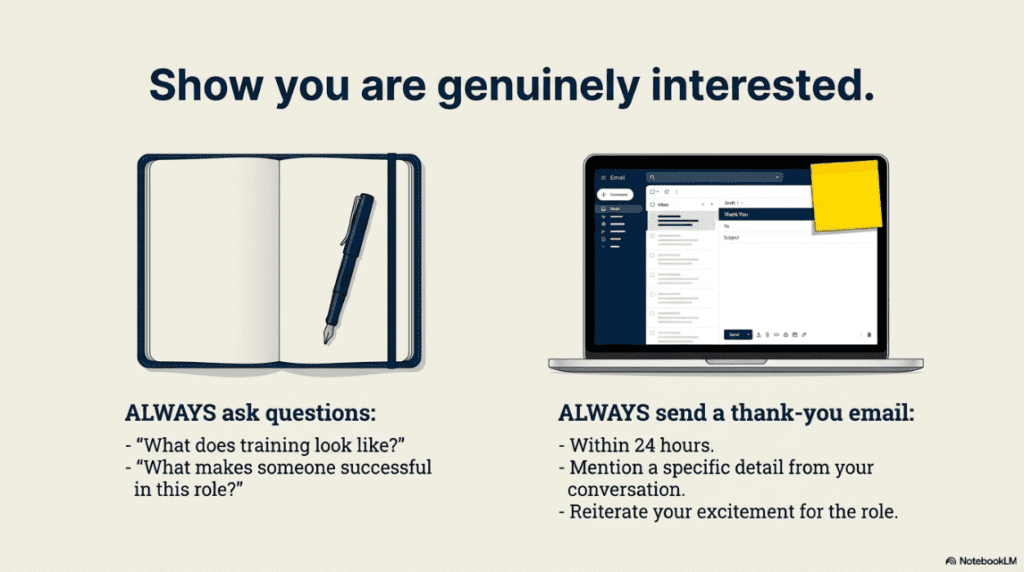
ALWAYS have questions prepared. Asking nothing suggests you don’t care.
Good questions to ask:
| Question | What It Shows |
|---|---|
| “What does a typical training period look like?” | You want to succeed |
| “What do you think makes someone successful in this role?” | You want to understand expectations |
| “How long have your current servers been here?” | You care about team stability |
| “What’s your favorite thing about working here?” | You want to understand culture |
| “What are the next steps in the hiring process?” | You’re organized and planning ahead |
Questions to AVOID:
❌ “When do I get paid?” (Seems only focused on money) ❌ “How soon can I take vacation?” (You haven’t even been hired) ❌ “Is the manager nice?” (Awkward if you’re talking to the manager) ❌ “What’s the hardest part of this job?” (Too negative)
Question 15: “Is there anything else I should know about you?”
What they’re really asking: Last chance to sell yourself.
Good answer script: “Just that I’m really excited about this opportunity. I’ve done my research, I think this restaurant has a great reputation, and I believe I’d be a strong addition to your team. I’m reliable, I work well under pressure, and I genuinely enjoy making people’s dining experiences better. I hope I get the chance to prove that to you.”
Why it’s good: Enthusiastic without being desperate, reinforces key strengths, ends on a positive note.
According to Indeed’s career research, these questions appear in over 80% of restaurant interviews

Part 4: Talking About Your English Level (If Asked)
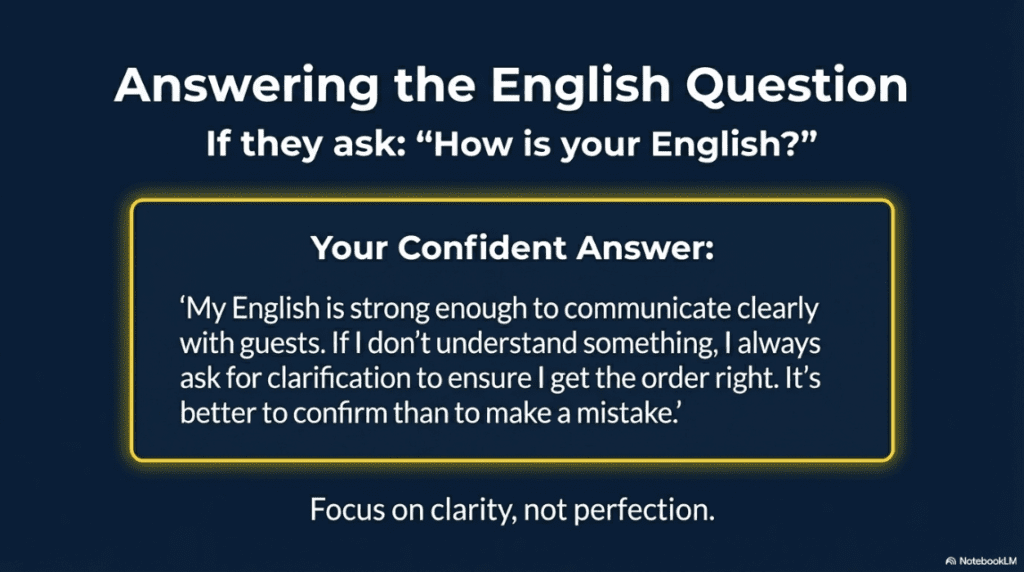
If They Ask: “How is your English?”
Bad answer: “It’s not very good. I’m sorry.”
Why it’s bad: Apologetic, focuses on weakness.
Good answer: “My English is strong enough to communicate clearly with guests and understand instructions. I’ve been speaking English for [X years/months], and I work hard to improve every day. If I don’t understand something, I ask for clarification rather than guessing. That’s actually good customer service – it’s better to confirm than to make assumptions.”
Why it’s good: Confident, focuses on communication (not perfection), frames asking questions as professional.
If They Ask About Your Accent
Good answer: “I do have an accent, yes. In my experience, most guests don’t mind as long as I speak clearly and confirm their orders. I always repeat orders back to ensure accuracy, and I’ve found that slowing down slightly when the restaurant is loud helps everyone understand each other better.”
Why it’s good: Acknowledges accent without apologizing, shows you have strategies to ensure clear communication.
If They Express Concern About Language
Good answer: “I understand your concern. Can I suggest this – give me a chance to shadow for an hour or do a working interview? That way, you can see how I communicate with guests in a real situation. I’m confident you’ll see that my English skills are appropriate for this role.”
Why it’s good: Offers a solution, shows confidence, lets your actual ability speak for itself.
Part 5: During the Interview – Professional Behaviors
Body Language That Shows Confidence
DO:
- ✅ Sit up straight (not slouched)
- ✅ Make eye contact (70-80% of the time)
- ✅ Smile naturally (shows positive attitude)
- ✅ Nod when interviewer speaks (shows active listening)
- ✅ Keep hands visible on table or in lap (not crossed arms)
- ✅ Lean slightly forward (shows engagement)
DON’T:
- ❌ Look at your phone (even if it’s off, put it away)
- ❌ Cross arms (looks defensive)
- ❌ Fidget with hands or objects (nervous habit)
- ❌ Avoid eye contact (seems dishonest or nervous)
- ❌ Touch your face excessively (distracting)
How to Answer Questions You Don’t Understand
If you don’t understand a question:
Don’t: Guess or answer what you THINK they asked.
Do: Ask for clarification politely.
Script: “I want to make sure I understand your question correctly. Are you asking [rephrase what you think they meant]?”
Or: “Could you rephrase that question? I want to give you the best answer.”
Why this works: Shows you care about accuracy, demonstrates maturity, gives them a chance to reword.
How to Handle Salary/Tip Questions
If they ask: “What are your salary expectations?”
For tipped positions: “I understand servers here are paid [minimum wage/tipped wage] plus tips. That’s standard for the industry, and I’m comfortable with that structure. My main priority is finding a restaurant with good training and a strong team.”
Why it works: Shows you understand the industry, shifts focus from money to culture.
If they ask about tips: “Can you give me a general range of what servers typically make in tips during an average week?”
Why this question works: Reasonable question, helps you understand earning potential.

Part 6: After the Interview
The Follow-Up Thank You
When: Send within 24 hours of the interview.
How: Email is professional (text is too casual).
Template:
Subject line: Thank you – Server Interview
Body: “Hi [Manager’s name],
Thank you for taking the time to meet with me today about the server position at [restaurant name]. I enjoyed learning more about your team and the restaurant’s focus on [specific thing they mentioned – fresh ingredients/family atmosphere/etc.].
After our conversation, I’m even more excited about the opportunity to join your team. I believe my [specific strength you discussed] would be a strong fit for the role.
Please let me know if you need any additional information from me. I look forward to hearing from you about next steps.
Best regards, [Your name] [Your phone number]”
Why it works: Professional, references specific conversation details, reiterates interest, includes contact info.
When to Follow Up Again
Timeline:
| Day | Action |
|---|---|
| Day 1 | Send thank you email |
| Day 3-5 | Wait (don’t contact) |
| Day 7 | If they said “we’ll contact you in a few days” and haven’t, you can follow up |
| Day 10-14 | If no response, assume you didn’t get the job and continue applying elsewhere |
Follow-up email (Day 7):
“Hi [Manager’s name],
I wanted to follow up on my interview last [day of week]. I remain very interested in the server position and wanted to check if there’s any additional information I can provide or if there’s a timeline for your hiring decision.
Thank you again for your consideration.
Best regards, [Your name]”
If You Don’t Get the Job
Ask for feedback (optional but valuable):
“Hi [Manager’s name],
Thank you for letting me know about your decision. While I’m disappointed, I appreciate you taking the time to interview me. If you’re willing, I’d love to hear any feedback about my interview that might help me improve for future opportunities.
Best regards, [Your name]”
Why this is smart: Shows maturity, helps you improve, keeps the door open (they might call you if someone quits).

Part 7: Red Flags – When NOT to Take the Job
Warning Signs During the Interview
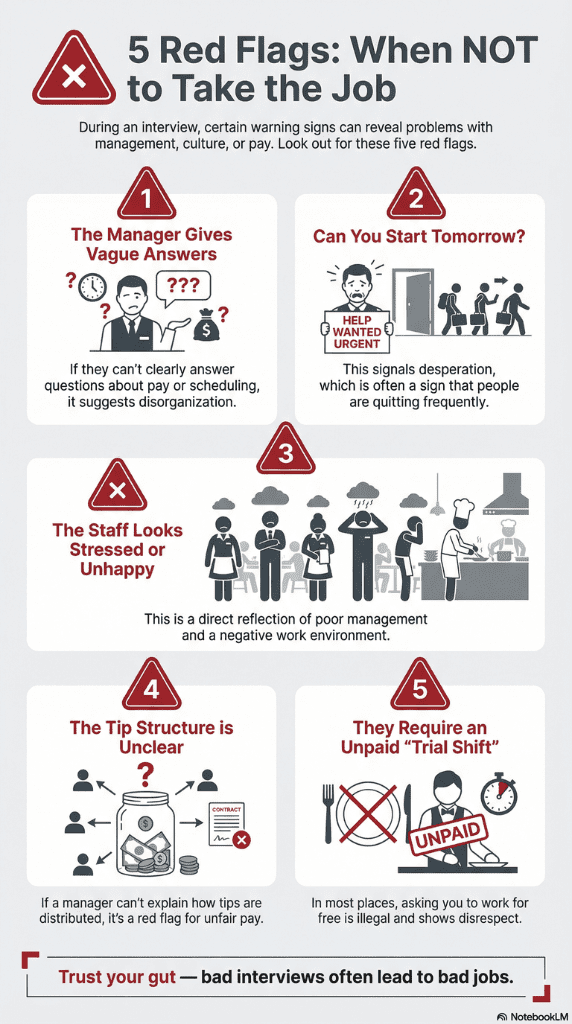
🚩 Red Flag 1: High Turnover
What to notice:
- Manager mentions “we’re always hiring”
- You see multiple job postings for the same restaurant
- Current staff looks stressed or unhappy
What it means: Poor management or bad working conditions
🚩 Red Flag 2: Vague or Evasive Answers
What to notice:
- Manager can’t answer basic questions about pay, tips, or schedule
- Manager avoids discussing training period
- Manager seems annoyed by your questions
What it means: Disorganized management or something to hide
🚩 Red Flag 3: Pressure to Start Immediately
What to notice:
- “Can you start tomorrow?”
- “We need someone right now”
- No formal training mentioned
What it means: Desperation (probably because people keep quitting)
🚩 Red Flag 4: Unclear Payment Structure
What to notice:
- Can’t explain how tips are distributed
- Mentions “tip pooling” but won’t explain percentages
- Vague about hourly wage
What it means: Potentially illegal tip practices
🚩 Red Flag 5: Unprofessional Interview
What to notice:
- Manager takes phone calls during interview
- Interview happens in chaotic environment (middle of service)
- Manager seems unprepared or doesn’t remember your application
What it means: You won’t be valued as an employee
Trust your instincts. If something feels wrong during the interview, it will likely feel worse once you’re working there.
Part 8: Special Situations
If You Need a Working Interview
Some restaurants ask you to work a trial shift.
What this means:
- You work 2-4 hours to demonstrate your skills
- They evaluate you in a real environment
- Should be PAID (in most places, unpaid trials are illegal)
What to ask: “Will I be paid for the trial shift?”
If they say no: “I understand you want to see my skills, but I believe trial shifts should be compensated. Would you be willing to pay [minimum wage] for the trial period?”
If they refuse: This is a red flag. Consider walking away.
If You’re Asked to Fill Out an Application After Interview
This is normal and professional.
Tips:
- Bring all your information (addresses, dates, references)
- Write neatly (or type if it’s online)
- Double-check for spelling errors
- Be honest (lying can get you fired later)
- If you don’t have a Social Security Number yet, ask: “I’m in the process of obtaining my work authorization. What information do you need from me in the meantime?”
If You Get a Job Offer On the Spot
This can be legitimate OR a red flag.
Before accepting immediately, ask:
- “What’s the starting wage and tip structure?”
- “When would I start training?”
- “Can I see a copy of the employee handbook?”
- “Can I have 24 hours to consider the offer?”
Taking 24 hours shows professionalism, not hesitation.
Part 9: Interview Day Checklist
Morning of Interview
- Shower and groom (clean appearance)
- Put on interview outfit (check for stains, wrinkles)
- Brush teeth, check breath
- Eat something (low energy shows in interviews)
- Review your prepared answers one more time
- Gather documents (resume, references, ID, food handler card)
- Check restaurant location and parking
- Leave early (arrive 10-15 minutes before appointment)
Arriving at Restaurant
- Turn off phone completely (not just silent)
- Check appearance in car mirror
- Take 3 deep breaths (reduces anxiety)
- Walk in with confident posture
- Greet host/manager with smile and firm handshake
- Make eye contact
- Say: “Hi, I’m [name]. I have an interview with [manager name] at [time].”
During Interview
- Sit up straight
- Make eye contact 70-80% of the time
- Smile naturally
- Listen carefully to each question
- Take a breath before answering (prevents rambling)
- Reference your research about the restaurant
- Ask your prepared questions
- Thank interviewer for their time
- Ask: “What are the next steps?”
- Shake hands before leaving
After Leaving
- Note anything important they mentioned (for follow-up email)
- Assess: Do you actually want this job?
- Send thank you email within 24 hours
- Continue applying to other restaurants (don’t wait)
Part 10: 40 Essential Interview Phrases
Opening & Greeting
- “Thank you for meeting with me today.”
- “I’m excited to learn more about this opportunity.”
- “I appreciate you taking the time to interview me.”
Discussing Experience
- “In my previous role at [restaurant], I…”
- “I handled a [number]-table section during busy shifts.”
- “I was responsible for…”
- “I regularly received positive feedback about…”
- “I trained new servers on…”
Showing Enthusiasm
- “What excites me most about this position is…”
- “I’m particularly interested in…”
- “I’d love the opportunity to…”
- “I’m eager to learn more about…”
Demonstrating Skills
- “I stay calm under pressure by…”
- “I handle difficult situations by…”
- “My approach to customer service is…”
- “I prioritize tasks by…”
Asking for Clarification
- “Could you tell me more about…?”
- “Can you explain what you mean by…?”
- “I want to make sure I understand – are you asking…?”
- “Could you give me an example of…?”
Discussing Availability
- “I’m available [days/times].”
- “I can be flexible with my schedule.”
- “The only exception would be…”
- “I’m able to work nights and weekends.”
Addressing Weaknesses
- “I’m working on improving…”
- “I’ve learned to manage this by…”
- “This is something I’m actively developing.”
- “I’ve found that [strategy] helps me with…”
Handling Salary/Benefits
- “I’m comfortable with the standard industry pay structure.”
- “Can you tell me about the tip distribution system?”
- “What does the training period typically involve?”
- “Are there opportunities for advancement?”
Showing Teamwork
- “I believe strong teams communicate clearly.”
- “I’m always willing to help coworkers when needed.”
- “I work well both independently and as part of a team.”
Closing Strong
- “I’m very interested in this position.”
- “I believe I’d be a strong fit for your team.”
- “What are the next steps in the hiring process?”
- “When can I expect to hear from you?”
- “Thank you again for this opportunity.”
Part 11: 4-Week Action Plan
Week 1: Research & Preparation
Day 1-2:
- Make a list of 10 restaurants you’d like to work at
- Research each restaurant (menu, reviews, culture)
- Check which ones are currently hiring
Day 3-4:
- Update your resume
- Prepare reference list with contact information
- Gather work authorization documents
Day 5-7:
- Read through all interview questions in this guide
- Write out your answers to the top 10 questions
- Practice answers out loud
Week 2: Practice & Polish
Day 1-3:
- Record yourself answering interview questions
- Listen back and identify areas to improve
- Practice until answers sound natural (not memorized)
Day 4-5:
- Plan your interview outfit
- Try it on and check for fit/cleanliness
- Polish shoes, iron clothes if needed
Day 6-7:
- Practice the entire interview start to finish
- Ask a friend to conduct a mock interview
- Prepare 5 questions to ask interviewers
Week 3: Apply & Interview
Day 1-3:
- Apply to 5-10 restaurants
- Follow up on applications after 2-3 days
- Respond promptly to any interview requests
Day 4-7:
- Attend interviews
- Send thank you emails within 24 hours
- Continue applying while waiting for responses
Week 4: Follow Up & Decision
Day 1-3:
- Follow up with restaurants if you haven’t heard back
- Continue interviewing at other locations
- Compare offers (if you receive multiple)
Day 4-7:
- Make your decision
- Accept the offer professionally
- Notify other restaurants you’re no longer available
- Prepare for your first day

Conclusion: Confidence Comes From Preparation
Six months after that failed interview at Bella Vista, Carlos tried again. Different restaurant. Different Carlos.
This time, when the manager asked “Tell me about yourself,” Carlos smiled.
“I’m a server with three years of experience, including two years at a busy family restaurant in my home country and six months here in the U.S. I recently earned my food handler certification and completed an online hospitality course. I’m looking for a position where I can use my customer service skills and grow with a professional team. I chose to apply here because I’ve noticed how your servers engage with guests – they’re knowledgeable and friendly, which is exactly the service style I believe in.”
The manager smiled back. “That’s a great answer. Tell me about a time you went above and beyond for a customer.”
Carlos had that answer ready too.
He got the job.
What changed? Not Carlos’s English level. Not his accent. Not his experience.
What changed was his preparation.
The interview questions are predictable. Once you know what managers ask and how to answer professionally, the interview becomes much less scary – even in your second language.
Your action items:
- Read through the 15 common questions in Part 3
- Write your own answers using the templates provided
- Practice out loud until they sound natural
- Apply to restaurants with confidence
You have the skills. You have the experience. You have the work ethic.
Now you have the interview answers.
Go get that job.

Once you get the job offer, your next challenge begins. Learn what to expect in your first 30 days as a new server to set yourself up for success from day one.
Quick Reference: 50 Interview Power Phrases
Confidence Builders
- “I’m confident in my ability to…”
- “I have strong experience in…”
- “I’ve successfully handled…”
- “I’m comfortable with…”
- “I excel at…”
Problem-Solving Language
- “When faced with [situation], I…”
- “I resolved this by…”
- “My approach would be to…”
- “I would handle this by first… then…”
- “The solution I found was…”
Team Player Phrases
- “I work well with diverse teams.”
- “I believe communication is key to…”
- “I support my coworkers by…”
- “I contribute to team success by…”
- “I’m always willing to help when…”
Customer Service Excellence
- “I prioritize guest satisfaction by…”
- “I make guests feel welcome by…”
- “I ensure every guest leaves happy by…”
- “I handle complaints professionally by…”
- “I create positive experiences through…”
Reliability Indicators
- “I have a strong attendance record.”
- “I’m known for being punctual and dependable.”
- “I take my commitments seriously.”
- “I communicate proactively if…”
- “I can be counted on to…”
Growth Mindset
- “I’m always looking to improve my…”
- “I’m eager to learn about…”
- “I welcome feedback because…”
- “I’ve developed my skills by…”
- “I’m interested in expanding my knowledge of…”
Handling Pressure
- “I stay organized during busy periods by…”
- “I remain calm under pressure by…”
- “I prioritize effectively when…”
- “I manage stress through…”
- “I thrive in fast-paced environments.”
Specific Skills
- “I’m proficient in POS systems.”
- “I have experience with…”
- “I’m knowledgeable about…”
- “I’m skilled at multitasking.”
- “I’m detail-oriented when it comes to…”
Cultural Fit
- “I align with your values of…”
- “I appreciate your focus on…”
- “I’m drawn to your commitment to…”
- “I share your philosophy about…”
- “I admire your reputation for…”
Closing Strong
- “I’m genuinely excited about this opportunity.”
- “I believe I would be an asset to your team.”
- “I’m ready to contribute from day one.”
- “I look forward to the possibility of joining your team.”
- “Thank you for considering me for this position.”
Remember: Every successful server started with their first interview. You can do this.
Ready to Master Restaurant English?
These free articles and scenarios are a great start, but if you want a complete, structured system for learning restaurant English, consider our full course.
English for Waiters includes:
✅ 22+ video lessons covering every restaurant situation
✅ Real restaurant scenarios with native pronunciation
✅ Interactive pronunciation practice
✅ Downloadable phrase guides
✅ Lifetime access with free updates