
How to Ask for a Raise or Promotion: A Server's Complete Guide to Getting What You Deserve

How to Ask for a Raise or Promotion: A Server’s Complete Guide to Getting What You Deserve

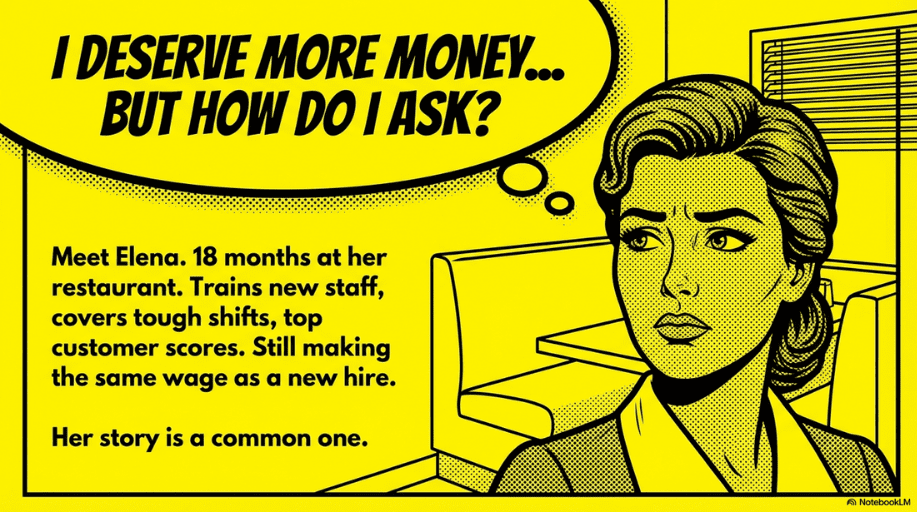
Elena had worked at the same upscale restaurant for eighteen months. She trained new servers, covered difficult shifts without complaint, and consistently earned the highest customer satisfaction scores on the team. Yet she was still making the same hourly wage as servers who had started last month.

How to Ask for a Raise or Promotion: A Server's Complete Guide to Getting What You Deserve

“I deserve more money,” she told herself every shift. “But how do I actually ask for it?”

This is one of the hardest conversations in the restaurant industry. The truth is, most servers never ask for raises because they don’t know how. They worry about sounding greedy, fear rejection, or don’t know what words to use.

But asking for a raise is a professional skill, just like taking orders or handling complaints. And like any skill, you can learn it.

This guide shows you exactly how to ask for a raise or promotion in a restaurant, with word-for-word scripts, timing strategies, and backup plans if your manager says no.

Prefer to listen? Here’s the podcast.


How to Ask for a Raise or Promotion: A Server's Complete Guide to Getting What You Deserve

Table of Contents

Part 1: Do You Actually Deserve a Raise?

Before you ask for more money, you need to answer one honest question: Have you earned it?

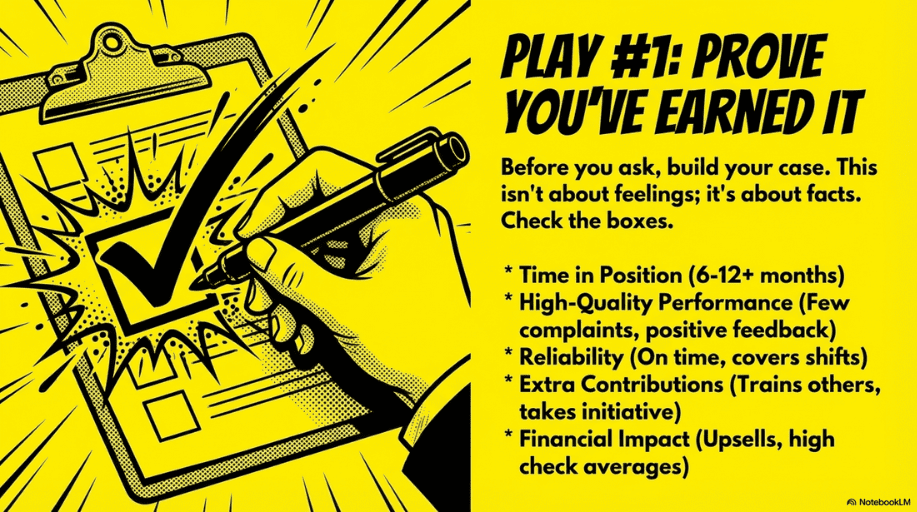
In restaurants, you deserve a raise when you meet these criteria:

The “Yes” List for Deserving a Raise

Time in position:

  • You have worked at the restaurant for at least 6-12 months
  • You are past the training period
  • You understand all your responsibilities

Performance quality:

  • Customer complaints about you are rare or zero
  • You receive positive feedback from guests regularly
  • Managers don’t need to correct your work often

Reliability:

  • You show up on time consistently
  • You rarely call in sick (except for real emergencies)
  • You stay until the end of your shift
  • You cover shifts when asked

Extra contributions:

  • You help train new employees
  • You take on additional responsibilities beyond your job description
  • You work difficult shifts others avoid (weekends, holidays, late nights)
  • You solve problems without always asking managers

Financial impact:

  • You upsell menu items effectively
  • Your tables spend more than average
  • You generate good tips, which shows customer satisfaction
  • You help the restaurant make more money

If you can say “yes” to most of these points, you have a strong case for a raise.

When You Don’t Deserve a Raise Yet

Be honest with yourself. You probably don’t deserve a raise if:

  • You have worked less than 6 months
  • You are frequently late or call in sick
  • You receive regular customer complaints
  • Managers correct your mistakes often
  • You only do the minimum required
  • You refuse to work weekends or difficult shifts
  • Your performance is average compared to other servers

The restaurant industry values reliability and performance above everything else. If you’re not strong in these areas, focus on improving first, then ask for a raise later.


How to Ask for a Raise or Promotion: A Server's Complete Guide to Getting What You Deserve

Part 2: Understanding Restaurant Raise Reality

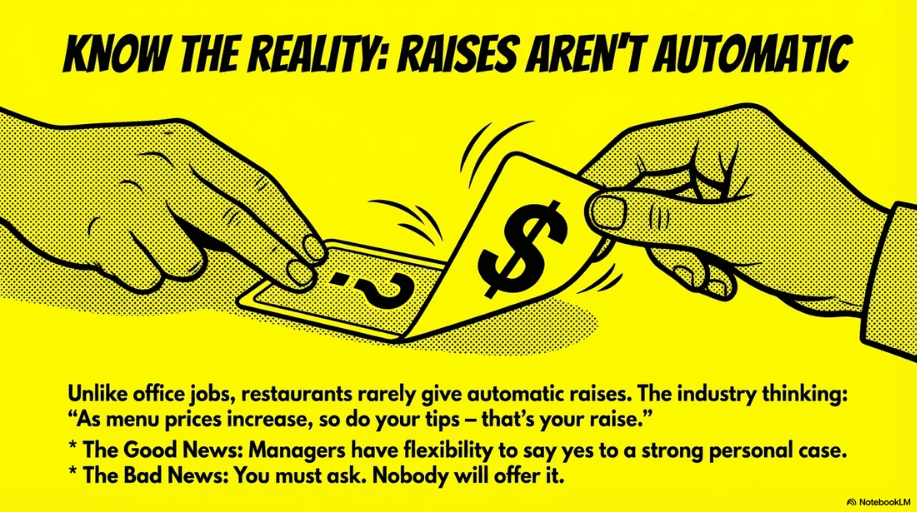
Here’s what most servers don’t know: restaurants rarely give automatic raises.

Unlike office jobs where annual raises are standard, restaurant culture is different. According to industry discussions on platforms like Glassdoor, many restaurant workers report that raises are uncommon for tipped positions. The thinking goes: “As menu prices increase, so do your tips – that’s your raise.”

This is frustrating, but it’s the reality you’re working with.

The good news: This means when you ask for a raise, you’re not competing with a standard policy. You’re making a personal case. If you present it well, managers have flexibility to say yes.

The bad news: Because raises aren’t automatic, you must ask. Nobody will offer you more money just because you’ve been there a year.

What Kind of Raise Is Realistic?

For hourly wage increases:

  • Small raise: $0.50 – $1.00 per hour (most common)
  • Medium raise: $1.00 – $2.00 per hour (requires strong performance)
  • Large raise: $2.00+ per hour (usually requires promotion to a new role)

For promoted positions (shift lead, trainer, server captain):

  • Typical increase: $1.00 – $3.00 per hour
  • Plus: Better shifts, more control over schedule
  • Plus: Additional responsibilities and resume building

These numbers vary by restaurant type, location, and cost of living. Research your specific market to know what’s fair.


How to Ask for a Raise or Promotion: A Server's Complete Guide to Getting What You Deserve

Part 3: When to Ask for a Raise (Timing Is Everything)

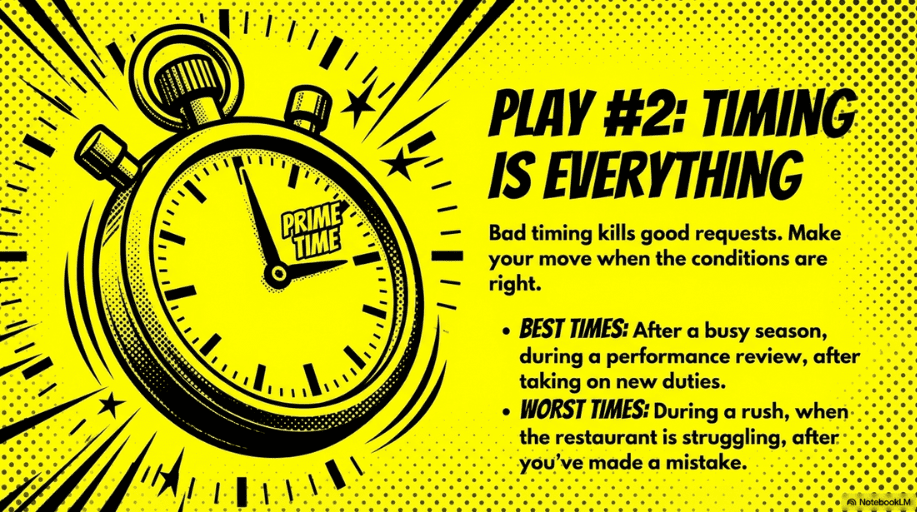
Bad timing kills good requests. Even if you deserve a raise, asking at the wrong time gets you rejected.

Best Times to Ask

After a successful busy period: When the restaurant just finished a profitable quarter or busy season (holidays, summer season, etc.), managers feel more generous. They’ve seen strong revenue and can justify the expense.

During your performance review: If your restaurant does performance reviews, this is the perfect time. The conversation is already about your work quality.

After taking on new responsibilities: Started training new servers? Became the go-to person for difficult tables? This is your moment.

When the restaurant is hiring: If management is actively looking for new staff, they know good employees are valuable. They don’t want to lose you.

After receiving specific praise: Did a manager or owner recently compliment your work? Strike while the iron is hot. Reference that recent praise in your conversation.

Worst Times to Ask

During a rush or busy shift: Never ask when your manager is stressed and running around. They can’t give you proper attention.

Right before a major event: Don’t ask the week before Valentine’s Day, Mother’s Day, or any high-pressure service.

When the restaurant is struggling financially: If you know business is down or the restaurant is cutting costs, wait for better timing.

After making a mistake: If you just broke something expensive, forgot an order, or got a customer complaint, wait at least a few weeks.

On a day you’re running late: If you showed up late today, don’t ask for a raise that same day. It looks terrible.

The Two-Week Rule

Give your manager advance notice. Don’t ambush them. Say:

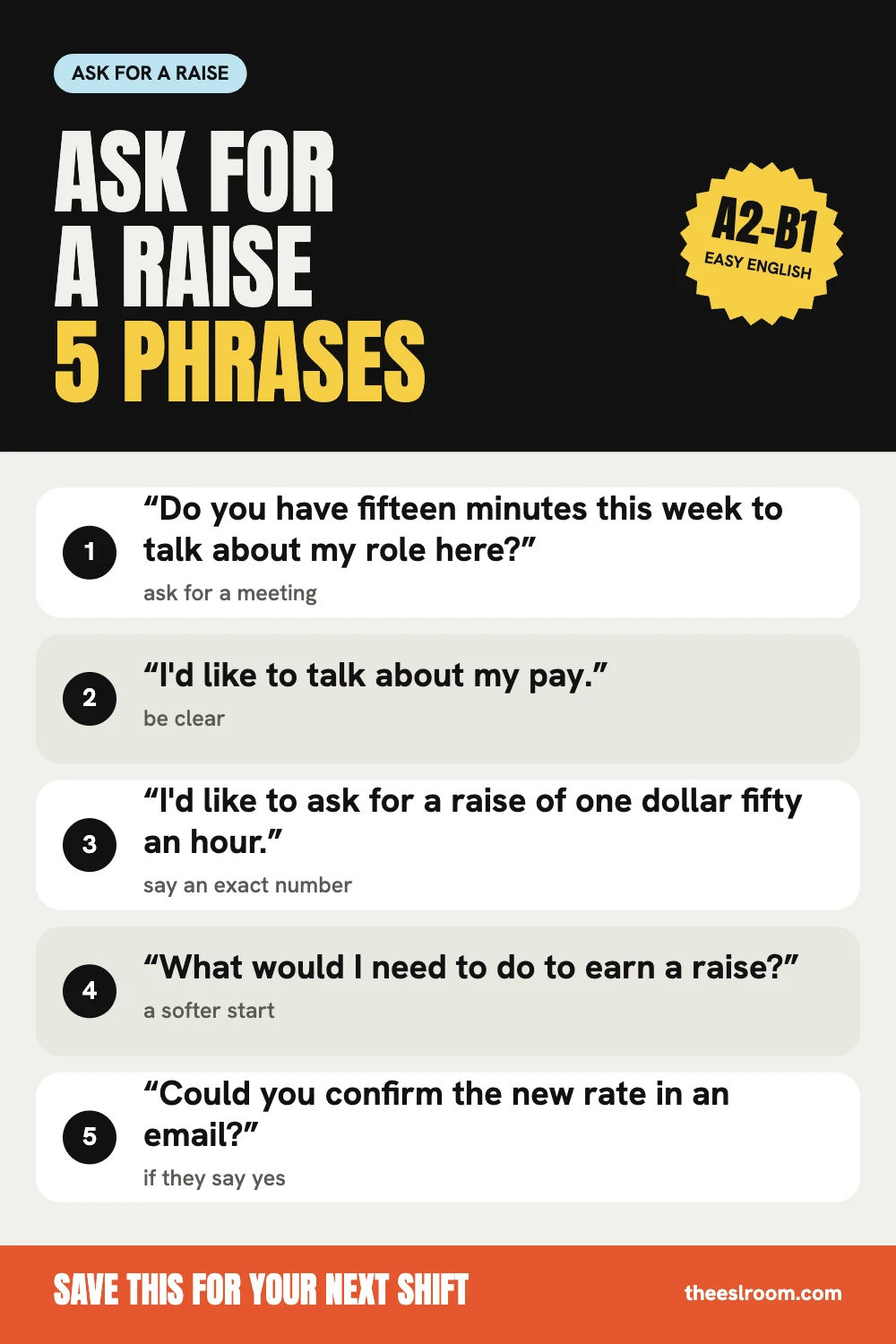
“Hi [Manager Name], I’d like to schedule a time to talk with you about my role here. Do you have 15 minutes sometime this week or next week?”

This shows respect for their time and gives them space to prepare.


How to Ask for a Raise or Promotion: A Server's Complete Guide to Getting What You Deserve

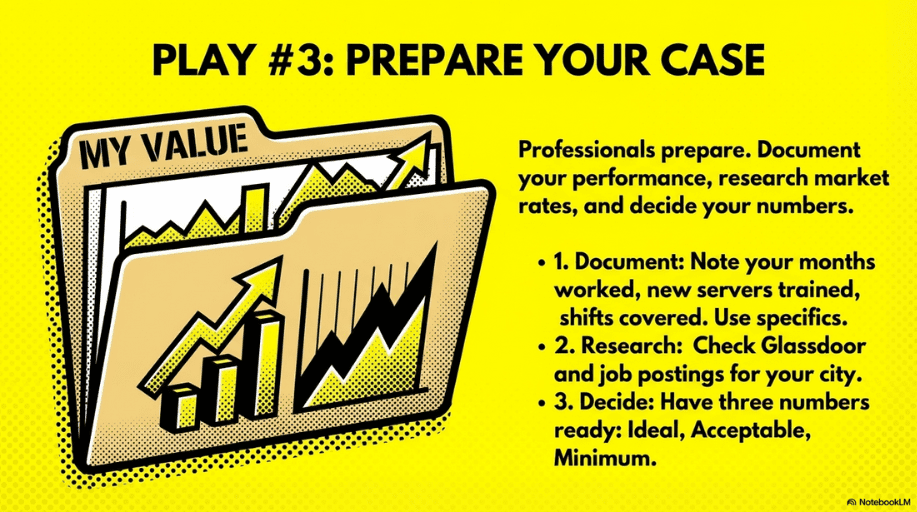
Part 4: How to Prepare Your Case (Do Your Homework)

Professional negotiators prepare before conversations. You should too.

Step 1: Document Your Performance

Create a simple list of your accomplishments. Write down:

Numbers (if you have them):

  • “I’ve worked here 14 months”
  • “I’ve trained 8 new servers”
  • “My customer satisfaction scores average 4.8/5”
  • “I’ve covered 12 shifts for other people in the last 3 months”

Specific examples:

  • “I handled the party of 25 last month without issues”
  • “I’ve never been late in 6 months”
  • “I resolved the customer complaint about the wine without manager help”

Extra contributions:

  • “I created the new opening checklist”
  • “I help new servers learn the POS system”
  • “I always volunteer for Sunday brunch shifts”

Step 2: Research Market Rates

Know what servers at similar restaurants in your area earn. Check:

  • Job postings for server positions
  • Glassdoor salary data for your city
  • Indeed salary estimates
  • Ask friends who work at other restaurants (if appropriate)

You need to know if you’re asking for something reasonable or unrealistic.

Step 3: Decide Your Number

Be specific. Don’t say “I want more money.” Say “I’m asking for $2.00 more per hour.”

Have three numbers ready:

  1. Your ideal raise: What you really want
  2. Your acceptable raise: What you’d be happy with
  3. Your minimum: The lowest you’ll accept before you consider looking elsewhere

Example:

  • Ideal: $2.50/hour increase
  • Acceptable: $1.50/hour increase
  • Minimum: $1.00/hour increase

Step 4: Plan for Alternatives

What if they say no to a raise? Have backup requests ready:

  • Better shifts (more Friday/Saturday nights)
  • Flexible scheduling
  • Guaranteed minimum hours per week
  • Training opportunities
  • Promotion to shift lead or trainer role
  • Earlier access to schedule to pick shifts first

According to the U.S. Bureau of Labor Statistics, the median hourly wage for servers was $16.23 in May 2024, with wages varying significantly based on experience, location, and restaurant type. When negotiating a raise, having documented performance data—your reliability metrics, customer satisfaction scores, and additional responsibilities—gives you concrete evidence to justify your requested increase and helps managers make informed compensation decisions.


How to Ask for a Raise or Promotion: A Server's Complete Guide to Getting What You Deserve

Part 5: The Exact Conversation (Word-for-Word Scripts)

Here’s how the actual conversation should go. These scripts work.

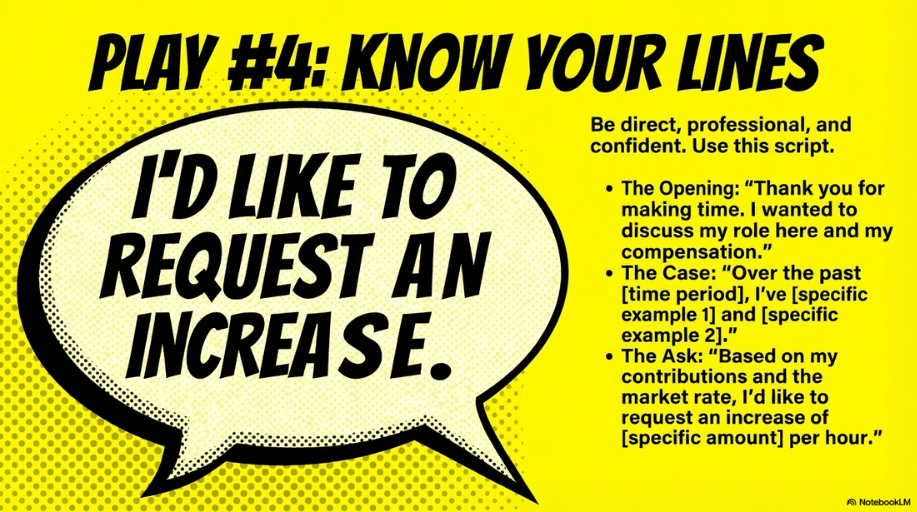
Opening the Conversation

Your manager: “Hi Elena, you wanted to talk?”

You: “Yes, thank you for making time. I wanted to discuss my role here and my compensation. I’ve been with the restaurant for [time period], and I’d like to talk about a raise.”

Why this works: You’re direct, professional, and clear about your purpose. Don’t apologize or say “sorry to bother you.” This is a legitimate business conversation.

Presenting Your Case

You: “I’ve really enjoyed working here, and I’m committed to this team. Over the past [time period], I’ve taken on several additional responsibilities beyond my original role. I’ve [specific example 1], [specific example 2], and [specific example 3]. I’ve also maintained strong performance with [specific metric – customer scores, reliability, training, etc.].”

Pause here. Let them respond.

Why this works: You’re giving specific evidence, not vague claims. “I work hard” means nothing. “I trained 8 new servers and covered 12 shifts” means something.

Making the Ask

You: “Based on my contributions and the market rate for servers with my experience in this area, I’d like to request an increase of [specific amount] per hour. I believe this reflects the value I bring to the restaurant.”

Why this works: You’re specific about the number. You’ve tied it to market research and your value. You’re confident but not demanding.

Alternative Script (If You’re Nervous About Being Too Direct)

You: “I’d like to discuss the possibility of a raise. I’ve taken on [specific responsibilities] and consistently [specific performance metric]. What would I need to do to earn an increase in my hourly rate?”

Why this works: This invites conversation rather than making a demand. It’s softer but still clear about what you want.


How to Ask for a Raise or Promotion: A Server's Complete Guide to Getting What You Deserve

Part 6: Handling Their Response

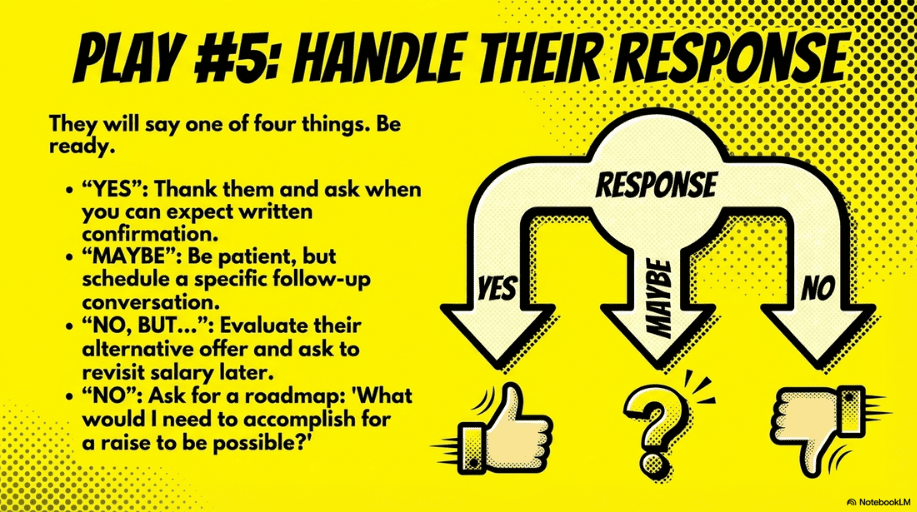
Your manager will respond in one of four ways. Here’s how to handle each.

Response 1: “Yes” (Immediate Agreement)

Manager: “You’re right, you’ve been doing great work. Let me talk to the owner and we’ll work out the details.”

Your response: “Thank you so much. I really appreciate it. When can I expect to hear back from you?”

Then: Get it in writing. Ask for an email confirming the new rate and when it starts.

Response 2: “Maybe” (They Need Time)

Manager: “I need to check with the owner about budget. Give me a week to discuss this.”

Your response: “I understand. I appreciate you considering it. Should we schedule a follow-up conversation for next [specific day]?”

Why this works: You’re being patient but also making sure they don’t forget about it.

Follow up in one week if you don’t hear back.

Response 3: “No, But…” (Rejection with Alternatives)

Manager: “I can’t approve a raise right now, but I can offer you [better shifts / more hours / different benefit].”

Your response: “I appreciate that. Let me think about it. Can we revisit the salary conversation in [3 months / 6 months]?”

Why this works: You’re not accepting “no” permanently. You’re setting up a future conversation while staying professional.

Evaluate their alternative: Is it actually valuable? Better Friday and Saturday night shifts can be worth more than a small hourly raise if tips are good.

Response 4: “No” (Direct Rejection)

Manager: “I appreciate your work, but we can’t do raises right now. The budget doesn’t allow it.”

Your response: “I understand. Can you help me understand what would need to change for a raise to be possible? What would I need to accomplish?”

Why this works: You’re asking for a roadmap. If they can’t give you one, that’s valuable information about whether you should stay.

Then ask: “When would be appropriate to revisit this conversation?”


How to Ask for a Raise or Promotion: A Server's Complete Guide to Getting What You Deserve

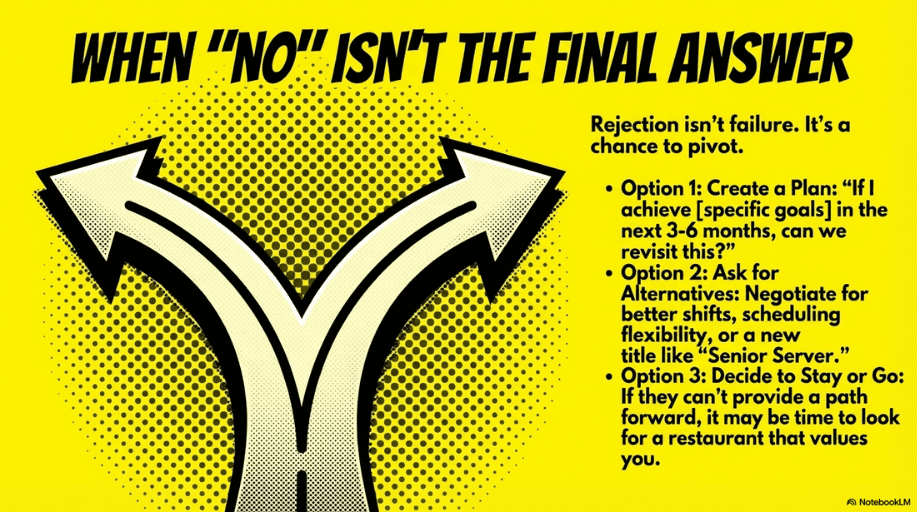
Part 7: What to Do If They Say No

Getting rejected hurts. But it doesn’t have to be the end.

Option 1: Create a Performance Plan

You: “If a raise isn’t possible right now, can we create a plan? If I achieve [specific goals] over the next [3-6 months], could we revisit this conversation?”

Why this works: It shows you’re serious about improving and gives you clear targets to hit.

Example goals:

  • “Increase my customer satisfaction scores by 10%”
  • “Train 5 more new servers”
  • “Work 4 weekend shifts per month consistently”
  • “Reduce my table turn time by 5 minutes”

Option 2: Ask for Alternative Benefits

If they won’t budge on money, negotiate for:

Better shifts:

  • More Friday/Saturday nights (higher tip potential)
  • Preferred sections in the restaurant
  • Consistent schedule (same shifts each week)

Scheduling flexibility:

  • Ability to request specific days off
  • Priority when requesting time off
  • Access to the schedule earlier than others

Professional development:

  • Cross-training in different positions (bar, host, food runner)
  • Opportunity to lead training sessions
  • Attendance at industry workshops

Title promotion without money:

  • “Senior Server” on your resume
  • “Training Specialist” title
  • “Shift Lead” designation

These might not pay more immediately, but they make you more valuable for future opportunities.

Option 3: Decide If You Should Stay

Sometimes “no” means “we don’t value you enough.”

Ask yourself:

  • Has the restaurant given raises to anyone recently?
  • Are they hiring new people at higher rates than you’re making?
  • Is management respectful in the conversation, or dismissive?
  • Do you see a future here, or have you hit the ceiling?

If the answer is “they don’t value me,” start looking for new opportunities. Life’s too short to work for people who don’t appreciate good employees.

But: Give them a fair chance first. If they ask you to prove yourself over 3-6 months, do it. See if they keep their word.


How to Ask for a Raise or Promotion: A Server's Complete Guide to Getting What You Deserve

Part 8: After the Conversation

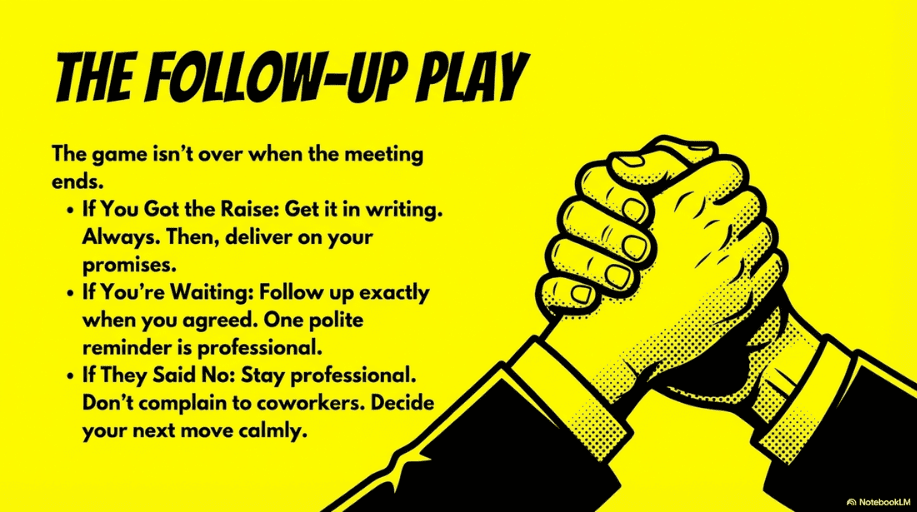
If You Got the Raise

Get it in writing. Always. Ask for:

  • An email confirming the new rate
  • The date it takes effect
  • Any conditions attached

Then deliver on your promises. If you said you’d maintain high performance, do it. Don’t get complacent.

Thank your manager a few days later. A simple “Thank you again for approving the raise. I appreciate the recognition” goes a long way.

If You’re Waiting for an Answer

Follow up exactly when you agreed. If they said “give me a week,” follow up in one week. Not before, not much after.

Script: “Hi [Manager], just following up on our conversation from last week about my compensation. Have you had a chance to discuss it with [owner/upper management]?”

If they keep delaying: After two delays, that’s probably a soft “no.” Start considering your options.

If They Said No

Stay professional. Don’t get angry, don’t complain to coworkers, don’t let it affect your work quality.

Decide: Will you wait and try again in 6 months, or is it time to look elsewhere?

If you’re staying: Keep documenting your performance. Build an even stronger case for next time.

If you’re leaving: Don’t burn bridges. Give proper notice and leave professionally. You might need a reference.


Part 9: Special Situations

Asking for a Promotion (Not Just a Raise)

If you want to move from server to shift lead, trainer, or supervisor:

Your approach: “I’m interested in growing within the restaurant. I’d like to discuss the possibility of a promotion to [specific role]. I’ve been preparing by [specific actions – training others, learning management tasks, etc.]. What would I need to do to be considered for this role?”

Why this works: You’re showing initiative and asking for a path forward.

Be ready to answer:

  • “Why do you want this role?”
  • “What makes you qualified?”
  • “How would you handle [specific management challenge]?”

Asking at a New Job (During Hiring)

If you’re being hired at a new restaurant and want to negotiate:

Wait until they make an offer. Never discuss money in the first interview.

When they offer: “Thank you for the offer. Based on my experience and the market rate in this area, I was hoping for [amount]. Is there flexibility in the starting rate?”

If they say no: “I understand. Are there opportunities for raises based on performance? What’s the timeline for performance reviews?”

Asking When You Have Another Offer

If another restaurant offered you more money:

Use it carefully: “I’ve received another job offer at [amount]. I’d prefer to stay here because [genuine reasons], but I need to make the right financial decision for myself. Is there any way we can match or get closer to that rate?”

Warning: Only do this if you’re truly willing to leave. Don’t bluff.


Part 10: ESL Considerations (Building Confidence for the Conversation)

If English is your second language, asking for a raise can feel even more stressful. Here’s how to prepare:

Practice the Conversation Out Loud

Rehearse your script multiple times. Practice with:

  • A mirror (to watch your body language)
  • A friend or family member
  • Record yourself on your phone and listen back

Focus on:

  • Speaking clearly and at a moderate pace
  • Making eye contact
  • Keeping your voice confident (not apologetic)

Write Everything Down First

Before the meeting, write out:

  • Your key points
  • Your specific number
  • Your accomplishments

You can even bring notes to the meeting. Say: “I wrote down some points I wanted to make sure I covered” and reference your paper. This is professional, not weak.

Use Simple, Clear Language

You don’t need fancy business vocabulary. Simple and clear beats complex and confusing.

Instead of: “I would like to inquire about the possibility of a compensation adjustment commensurate with my contributions.”

Say: “I’d like to ask for a raise based on my work here.”

Don’t Apologize for Your Accent

Your accent doesn’t make you less valuable. Never say:

  • “Sorry, my English isn’t perfect”
  • “I hope you understand me”
  • “Sorry if this doesn’t make sense”

Just speak confidently. Your manager understands you just fine.

If You Don’t Understand Something

If your manager says something you don’t understand, it’s okay to ask:

  • “Could you repeat that, please?”
  • “I want to make sure I understand – are you saying [paraphrase what you think they meant]?”
  • “Can you explain what that means?”

This is professional communication, not a weakness.


How to Ask for a Raise or Promotion: A Server's Complete Guide to Getting What You Deserve

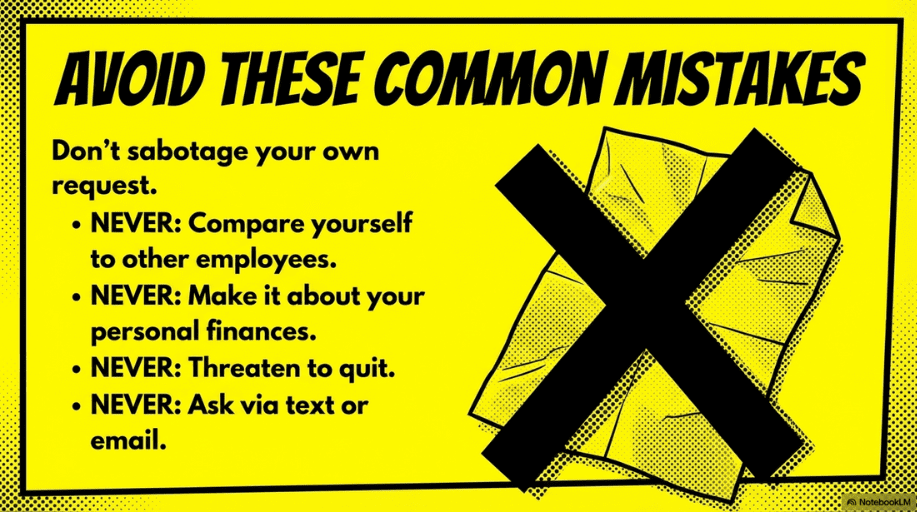
Part 11: Common Mistakes to Avoid

Mistake 1: Comparing Yourself to Other Employees

Don’t say: “Sarah makes more than me and she’s been here less time.”

Why it fails: You don’t know Sarah’s full situation. Maybe she negotiated better when hired. Maybe she has skills you don’t know about. Comparing creates conflict.

Say instead: Focus on YOUR value, not others’ pay.

Mistake 2: Making Personal Reasons Your Main Argument

Don’t say: “I need more money because my rent went up.”

Why it fails: Your personal expenses aren’t your employer’s problem. That’s not how business works.

Say instead: Focus on the value you provide to the restaurant.

Mistake 3: Threatening to Quit

Don’t say: “If you don’t give me a raise, I’m leaving.”

Why it fails: This feels like manipulation. Even if they give you a raise, they’ll resent it and might replace you later.

Exception: If you genuinely have another job offer, you can mention it professionally (see Part 9).

Mistake 4: Being Vague

Don’t say: “I think I deserve more money.”

Why it fails: “More” means nothing. How much more? Based on what?

Say instead: “I’m asking for a $1.50 per hour increase based on [specific reasons].”

Mistake 5: Asking Via Text or Email

Don’t do it: Don’t text your manager “can I get a raise?”

Why it fails: This is too important for text. It shows you’re not serious enough to have a face-to-face conversation.

Do instead: Ask for an in-person meeting.

Mistake 6: Getting Emotional

Don’t: Cry, get angry, raise your voice, or storm out if they say no.

Why it fails: It makes you look unprofessional and immature. Even if you’re frustrated, control your emotions.

Do instead: Stay calm. If you need to process feelings, do it after the meeting in private.


Part 12: Your Raise Action Plan (Step-by-Step Checklist)

Ready to ask for a raise? Follow this timeline:

Week 1: Preparation

☐ Document your accomplishments (numbers, examples, contributions)
☐ Research market rates for servers in your area
☐ Decide your ideal raise amount and your minimum
☐ Identify alternative benefits you’d accept
☐ Write out your talking points

Week 2: Practice

☐ Practice your conversation out loud multiple times
☐ Prepare for different responses (yes, no, maybe)
☐ Choose your timing (after busy season, during review, etc.)
☐ Request a meeting with your manager

Week 3: The Conversation

☐ Arrive on time (or early) to the meeting
☐ Bring your notes if needed
☐ Present your case clearly and confidently
☐ Listen to their response
☐ Thank them for their time

Week 4: Follow-Up

☐ If yes: Get it in writing
☐ If maybe: Schedule follow-up meeting
☐ If no: Ask about performance plan or timeline
☐ Continue performing well regardless of outcome


Moving into a management role requires the same interview skills and preparation you used to get hired as a server in the first place.

How to Ask for a Raise or Promotion: A Server's Complete Guide to Getting What You Deserve

Real Example: How Elena Asked for Her Raise

Remember Elena from the beginning? Here’s what actually happened.

Her preparation:

  • Documented 18 months of work, training 6 new servers, zero late arrivals
  • Researched market rates: servers in her city made $13-16/hour
  • She was making $12/hour
  • Decided to ask for $14/hour ($2 increase)

Her timing:

  • Asked after the busy holiday season
  • Restaurant had just had record December sales
  • Requested a meeting one week in advance

Her conversation: “Hi Marcus, thank you for meeting with me. I wanted to discuss my role here. I’ve been with the restaurant for 18 months now, and I’ve taken on additional responsibilities like training new servers. I’ve trained 6 people this year, and I also cover weekend shifts consistently. I’ve never been late, and my customer satisfaction scores are consistently high.

Based on my contributions and the market rate for experienced servers in this area, I’d like to request an increase to $14 per hour. I believe this reflects the value I bring to the team.”

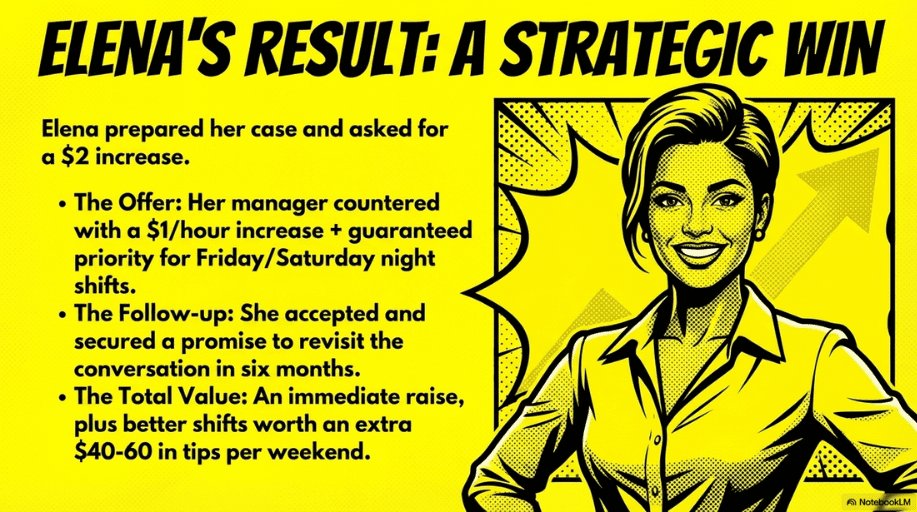
The manager’s response: “Elena, you’re absolutely right that you’ve been a valuable team member. I can’t approve $14 right now, but I can offer $13 per hour, plus guaranteed priority for Friday and Saturday night shifts going forward. Those are our highest tip nights.”

Elena’s response: “I appreciate that. Can we revisit the conversation about getting to $14 in six months if I maintain my performance?”

The manager: “Yes, let’s do a performance check-in in June and discuss it then.”

The result:

  • Elena got a $1/hour increase immediately
  • Better shifts mean roughly $40-60 more in tips per weekend
  • A clear path to another raise in 6 months

Total value: Roughly $150-200 more per week.

She didn’t get everything she wanted immediately, but she got a meaningful increase and set herself up for more growth. That’s a win.


How to Ask for a Raise or Promotion: A Server's Complete Guide to Getting What You Deserve

Final Thoughts: You Deserve to Be Paid Fairly

Asking for a raise is uncomfortable. It goes against many people’s natural instincts to avoid conflict.

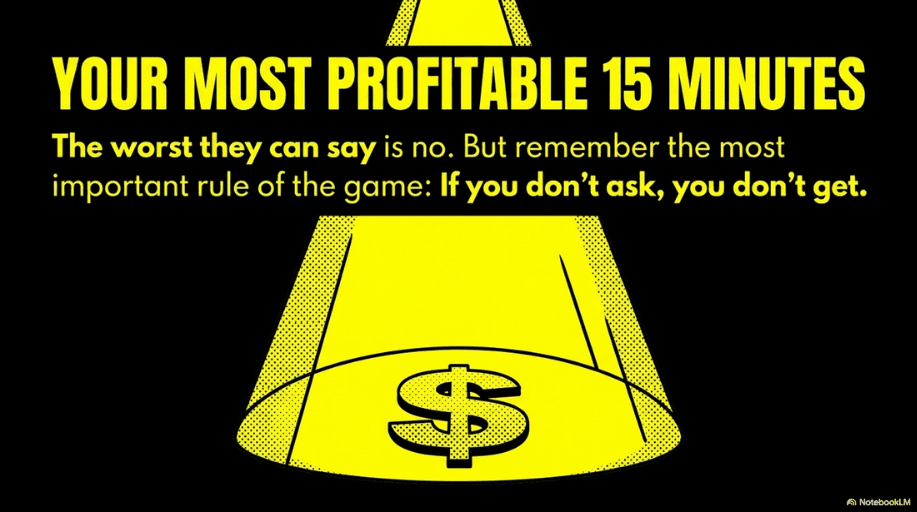
But here’s the truth: If you don’t ask, you don’t get.

Restaurant managers are busy. They won’t think about giving you a raise unless you bring it up. That’s not because they don’t care – it’s because they have a hundred other things demanding their attention.

Your manager can’t read your mind. They don’t know you’re struggling with bills or that you’re frustrated about your pay. They probably assume if you were unhappy, you’d say something.

So say something.

Prepare your case. Pick your timing. Practice your conversation. Ask professionally.

The worst they can say is no. And even “no” gives you valuable information about whether this job has a future for you.

The best they can say is yes – and that yes could mean thousands of extra dollars per year.

You’ve earned it. Now go get it.


Remember Elena’s story: She was nervous, but she prepared, she asked professionally, and she got results. You can too.

Start preparing your case today. Your raise conversation might be the most profitable 15 minutes you spend this year.


Ready to Master Restaurant English?

These free articles and scenarios are a great start, but if you want a complete, structured system for learning restaurant English, consider our full course.

learn english for waiters

English for Waiters includes:

✅ 22+ video lessons covering every restaurant situation
✅ Real restaurant scenarios with native pronunciation
✅ Interactive pronunciation practice
✅ Downloadable phrase guides
✅ Lifetime access with free updates