You see the menu. Your customer asks: “What do you recommend to start?”
Your heart beats fast. You know the food is good. But how do you describe it in English? What words should you use?
This is a common problem for ESL servers. You understand the menu. But explaining it to customers feels difficult.
Today, you will learn the essential English vocabulary for appetizers and starters. You will learn what to say, how to recommend dishes, and how to answer customer questions with confidence.
By the end of this guide, you will feel ready to present the first course like a professional server.
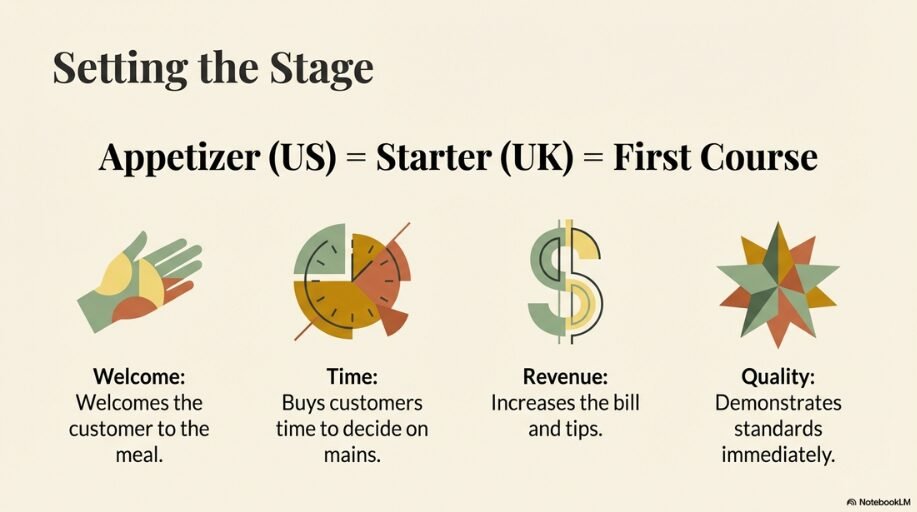
What Are Appetizers and Starters?
Appetizers (also called starters) are small dishes served at the beginning of a meal.
In American English, we usually say “appetizer.” In British English, we usually say “starter.”
Both words mean the same thing: the first food you serve before the main course.
Why are appetizers important?
- They welcome the customer to the meal
- They give customers time to decide on their main course
- They increase your bill and your tips
- They show your restaurant’s quality
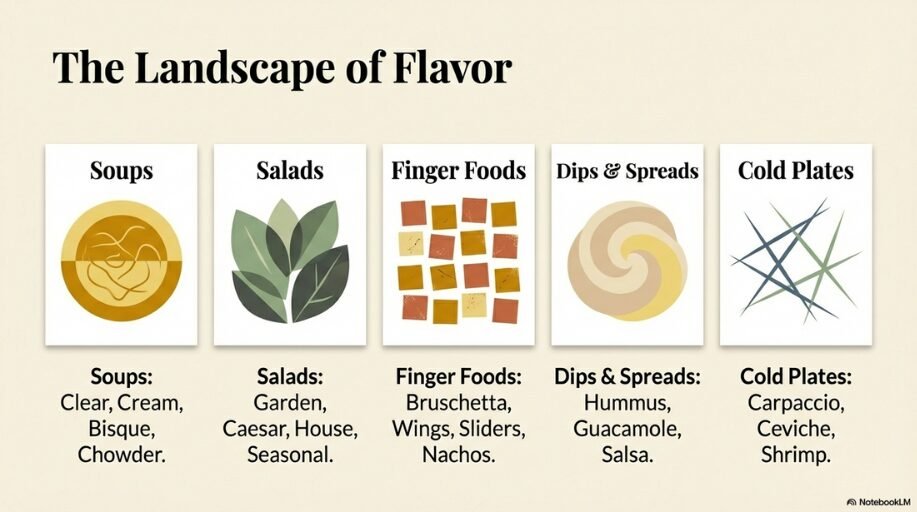
Common Types of Appetizers
Let’s learn the main categories of appetizers you will see on restaurant menus:
1. Soups
Types of soup:
- Clear soup – You can see through it (example: chicken broth)
- Cream soup – Thick and smooth (example: cream of mushroom)
- Bisque – Thick, creamy seafood soup (example: lobster bisque)
- Chowder – Thick soup with vegetables or seafood (example: clam chowder)
How to describe soup:
- “Our soup of the day is…”
- “The soup is served hot/warm”
- “It comes with bread/crackers”
Example sentences:
- “Today’s soup is a cream of tomato. It’s smooth and rich.”
- “We have a seafood chowder. It’s thick and full of fresh clams.”
2. Salads
Types of salad:
- Garden salad – Mixed lettuce and vegetables
- Caesar salad – Romaine lettuce with Caesar dressing and parmesan
- House salad – The restaurant’s special salad
- Seasonal salad – Made with vegetables in season now
How to describe salad:
- “Fresh and light”
- “Crisp vegetables”
- “Served with your choice of dressing”
Example sentences:
- “Our house salad is fresh and crisp with seasonal vegetables.”
- “The Caesar salad comes with grilled chicken if you’d like.”
3. Finger Foods
These are small foods you can eat with your hands.
Common finger food appetizers:
- Bruschetta – Toasted bread with tomatoes and herbs
- Spring rolls – Vegetables or meat wrapped and fried
- Sliders – Small burgers
- Wings – Chicken wings with sauce
- Nachos – Tortilla chips with cheese and toppings
How to describe finger foods:
- “Crispy and flavorful”
- “Perfect for sharing”
- “Served hot”
Example sentences:
- “The bruschetta is toasted bread with fresh tomatoes and basil.”
- “Our wings are crispy and come with your choice of sauce.”
4. Dips and Spreads
Common dips:
- Hummus – Chickpea dip
- Guacamole – Avocado dip
- Salsa – Tomato and pepper sauce
- Tzatziki – Yogurt and cucumber dip
How to describe dips:
- “Served with warm bread/chips/vegetables”
- “Fresh and creamy”
- “Made in-house” or “house-made”
Example sentences:
- “The hummus is smooth and creamy. It comes with warm pita bread.”
- “Our guacamole is made fresh daily.”
5. Seafood and Meat Plates
Common cold appetizers:
- Carpaccio – Thin sliced raw beef or fish
- Ceviche – Raw fish marinated in citrus
- Shrimp cocktail – Cold cooked shrimp with sauce
- Charcuterie – Selection of cold meats and cheese
How to describe these:
- “Served chilled”
- “Fresh and delicate”
- “Perfect as a light starter”
Example sentences:
- “The carpaccio is thin-sliced beef served with arugula and parmesan.”
- “Our shrimp cocktail comes with six large shrimp and cocktail sauce.”
Professional culinary programs like the Institute of Culinary Education train students on menu terminology and service language.
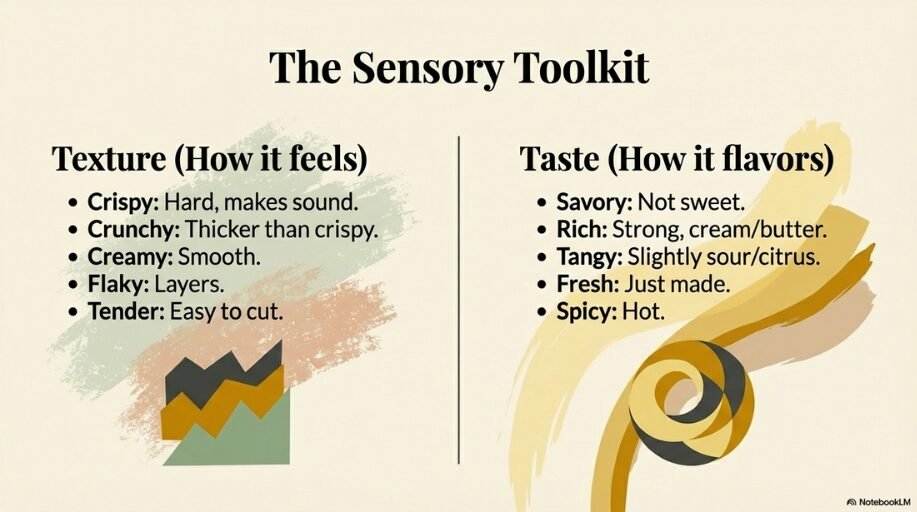
Essential Vocabulary for Appetizers
Adjectives to Describe Food
Texture words:
- Crispy – Hard and makes a sound when you bite (example: fried food)
- Crunchy – Similar to crispy but thicker
- Tender – Soft and easy to cut
- Creamy – Smooth like cream
- Flaky – Falls apart in thin layers
- Light – Not heavy, easy to eat
- Delicate – Gentle flavor, not strong
Taste words:
- Savory – Not sweet (opposite of sweet)
- Rich – Strong flavor, often with cream or butter
- Fresh – Just made, not old
- Mild – Not strong flavor
- Tangy – Slightly sour (like lemon)
- Spicy – Hot, with peppers
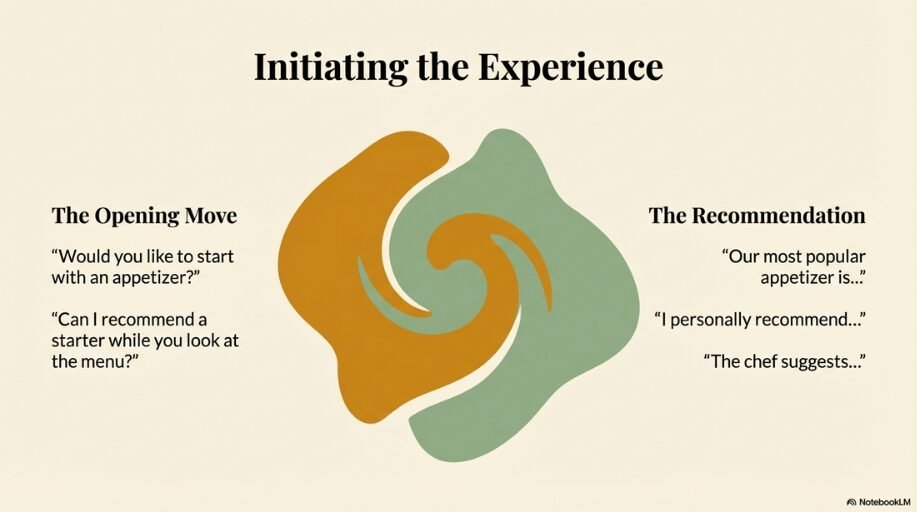
Key Phrases for Serving Appetizers
Starting the Conversation
When customers first sit down:
- “Would you like to start with an appetizer?”
- “Can I bring you something to start?”
- “Would you like to see our appetizer menu?”
- “Can I recommend a starter while you look at the menu?”
Making Recommendations
When customers ask what you recommend:
- “Our most popular appetizer is…”
- “I recommend the [dish name]”
- “The chef suggests…”
- “Many guests enjoy…”
- “This is a customer favorite”
Describing What Comes With the Dish
Use these phrases to explain the complete dish:
- “It comes with…”
- “Served with…”
- “Accompanied by…”
- “This includes…”
Examples:
- “The soup comes with fresh bread.”
- “It’s served with a side salad.”
- “The nachos are accompanied by sour cream and guacamole.”
Explaining Portion Sizes
Customers often ask: “Is this enough for two people?”
For individual portions:
- “This is an individual portion.”
- “This is designed for one person.”
- “Each person should order their own.”
For sharing portions:
- “This is perfect for sharing.”
- “This is a sharing plate.”
- “This serves 2-3 people.”
- “You can share this between two people.”
How to Answer Common Customer Questions
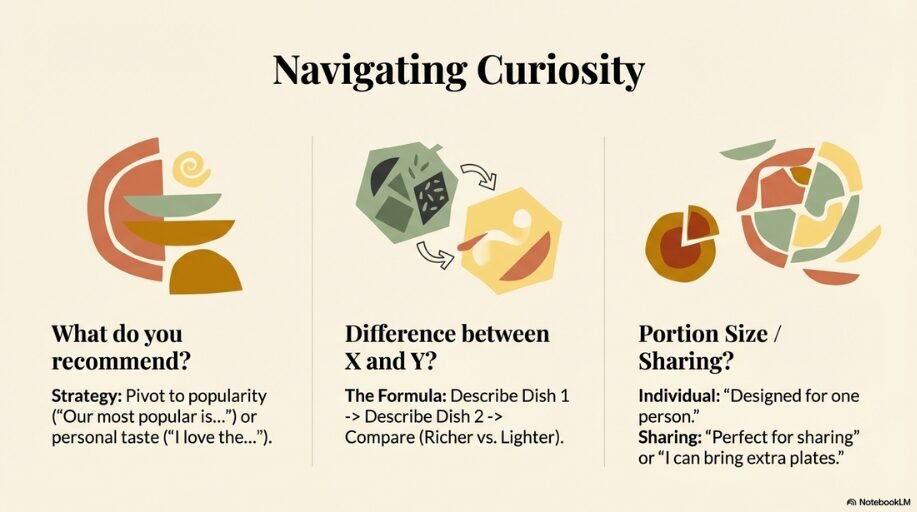
“What do you recommend?”
Good answers:
- “Our most popular starter is the [dish name]. It’s [description].”
- “I personally love the [dish name]. It’s [description].”
- “If you like [flavor/type], I recommend the [dish name].”
Example: “I recommend the bruschetta. It’s fresh and light, perfect to start your meal.”
“What’s the difference between X and Y?”
Structure your answer:
- Describe the first dish
- Describe the second dish
- Say which is better for different preferences
Example: “The Caesar salad has romaine lettuce with a creamy dressing. The garden salad has mixed greens with a lighter vinaigrette. The Caesar is richer, and the garden salad is lighter and fresher.”
“Can we share this?”
If yes:
- “Yes, this is perfect for sharing.”
- “Yes, many guests share this dish.”
- “Yes, I can bring extra plates.”
If it’s small:
- “This is an individual portion, but you’re welcome to share.”
- “It’s a smaller portion, but I can bring extra plates.”
“Is this cold or hot?”
Simple answers:
- “This is served hot.”
- “This is served chilled.”
- “This comes warm.”
- “This is a cold dish.”
“How big is it?”
Describing size:
- “It’s a small portion, perfect to start.”
- “It’s a generous portion.”
- “It’s about [size comparison – like ‘the size of your hand’].”
- “It’s designed as a small plate to share.”
The Complete Appetizer Conversation
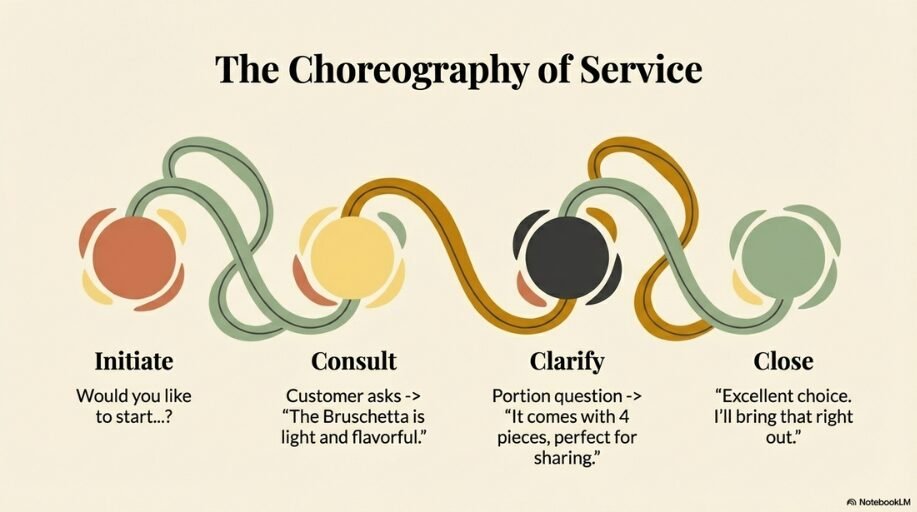
Here is a full example of taking an appetizer order:
Server: “Good evening! Would you like to start with an appetizer tonight?”
Customer: “Yes, what do you recommend?”
Server: “Our most popular starter is the bruschetta. It’s toasted bread with fresh tomatoes, basil, and olive oil. It’s light and flavorful.”
Customer: “That sounds good. Is it enough for two people?”
Server: “It comes with four pieces, so yes, it’s perfect for sharing. Would you like to order that?”
Customer: “Yes, please.”
Server: “Excellent choice. I’ll bring that right out for you.”
Practice: Sample Appetizer Menu
Here is a sample menu. Practice reading and understanding these descriptions:
APPETIZERS
Soup of the Day – $6 Ask your server about today’s fresh soup Served with crusty bread
Classic Caesar Salad – $8 Romaine lettuce, parmesan cheese, croutons House-made Caesar dressing
Crispy Calamari – $12 Lightly fried squid served with marinara sauce Perfect for sharing
Spinach & Artichoke Dip – $10 Creamy dip served with warm tortilla chips Serves 2-3 people
Bruschetta – $9 Four pieces of toasted bread topped with tomatoes, basil, and garlic Fresh and light
Reading Practice Questions:
- Which dish is good for sharing? (Answer: Calamari or Spinach Dip)
- What comes with the soup? (Answer: Crusty bread)
- How many pieces of bruschetta do you get? (Answer: Four)
- Which salad is on the menu? (Answer: Caesar salad)
- What sauce comes with the calamari? (Answer: Marinara sauce)
Important Grammar Notes
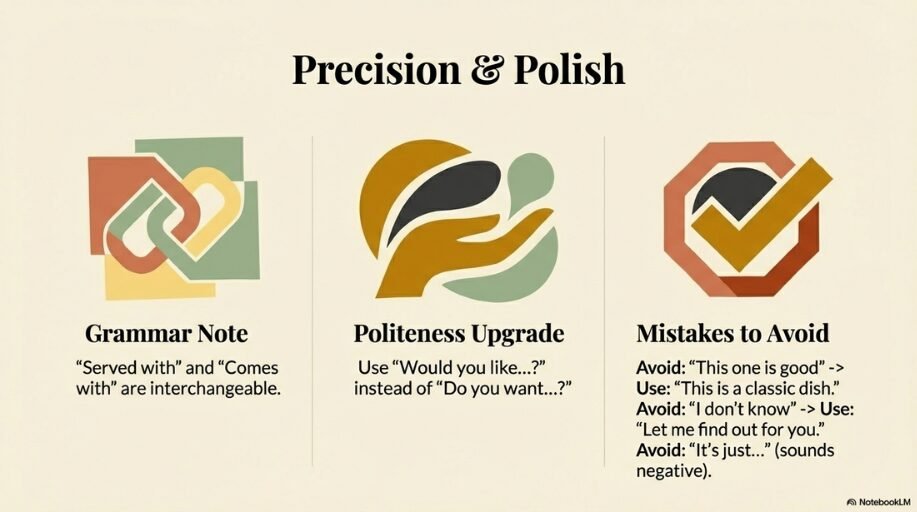
Using “Served with” vs “Comes with”
Both phrases mean the same thing:
- “The soup is served with bread.” ✓
- “The soup comes with bread.” ✓
Both are correct and professional.
Asking Questions: “Would you like…?” vs “Do you want…?”
More polite:
- “Would you like to start with an appetizer?” ✓
Less formal (but still okay):
- “Do you want an appetizer?”
In restaurants, “Would you like” is more professional.
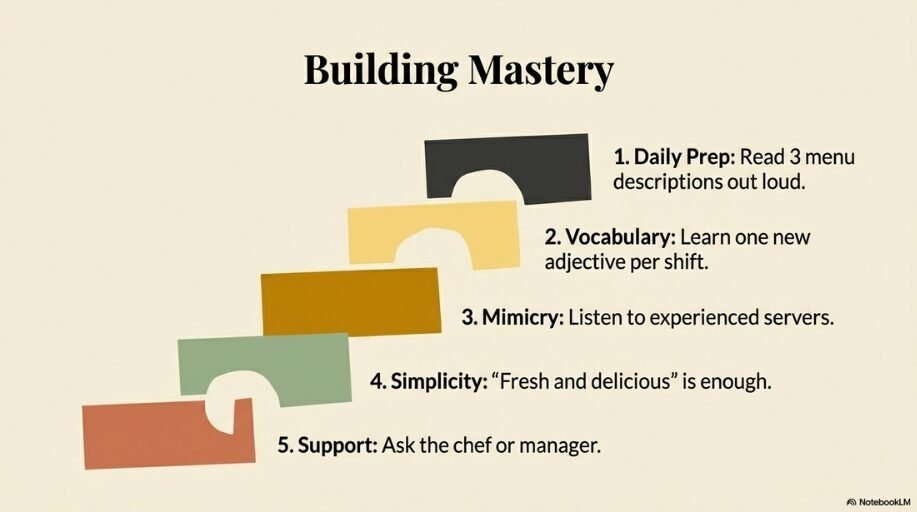
Tips for Building Confidence
1. Practice with the menu every day Before your shift starts, read three appetizer descriptions. Say them out loud.
2. Learn one new adjective per shift Today: “crispy” Tomorrow: “creamy” Next day: “fresh”
3. Listen to other servers When experienced servers describe food, write down what they say. Use the same phrases.
4. Start simple You don’t need to use complicated words. “Fresh and delicious” is enough.
5. Ask for help If you don’t know how to describe something, ask: “Let me check with the chef” or “Let me ask my manager.”
Professional servers also complete food safety certification like ServSafe to ensure they handle food properly.
Common Mistakes to Avoid
❌ DON’T SAY:
- “This one is good” (too simple)
- “I don’t know” (sounds unprofessional)
- “It’s just…” (sounds negative)
✅ INSTEAD SAY:
- “This is our most popular appetizer”
- “Let me find out for you”
- “It’s a classic dish”
Summary: What You Learned Today
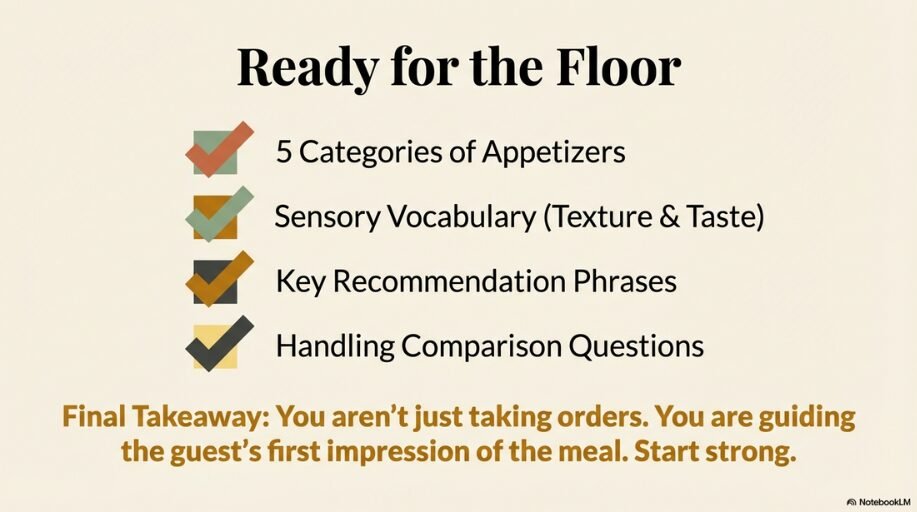
Today you learned:
✓ The difference between appetizers and starters ✓ Five main types of appetizers (soups, salads, finger foods, dips, cold plates) ✓ Essential vocabulary words to describe appetizers ✓ Key phrases for recommending starters ✓ How to answer common customer questions ✓ A complete appetizer conversation example
You now have the vocabulary and phrases to present appetizers with confidence.
📝 Test Your Appetizer Knowledge
Ready to see how much you learned? Take this quick quiz! (5 questions, 2 minutes)
Ready to Master Restaurant English?
These free articles and scenarios are a great start, but if you want a complete, structured system for learning restaurant English, consider our full course.
English for Waiters includes:
✅ 22+ video lessons covering every restaurant situation
✅ Real restaurant scenarios with native pronunciation
✅ Interactive pronunciation practice
✅ Downloadable phrase guides
✅ Lifetime access with free updates