The meal is almost over. You clear the main course plates. The table looks satisfied.
Now comes the moment that many servers fear: “Would you like to see our dessert menu?”
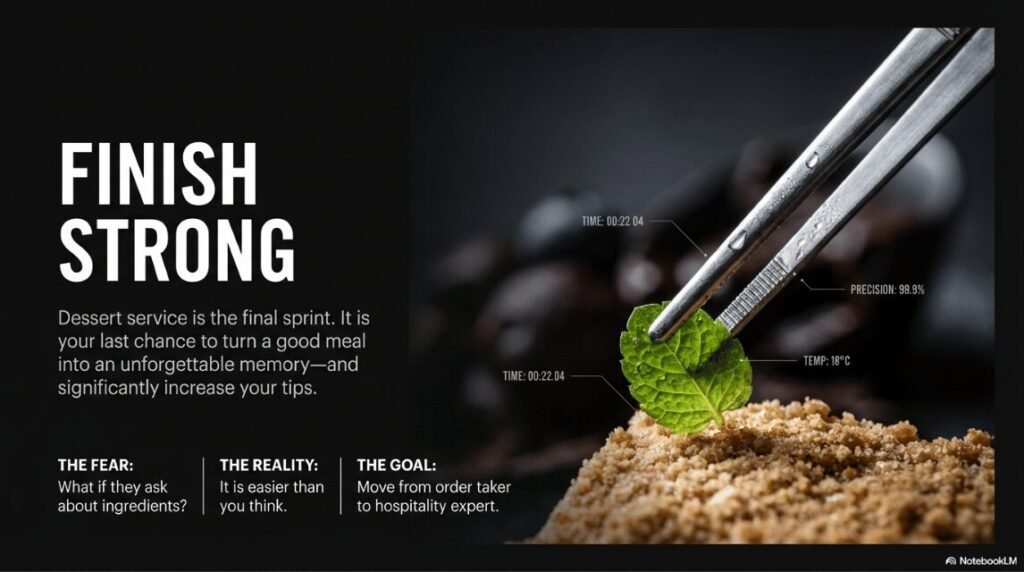
Your heart races. What if they ask about ingredients? What if someone has allergies? What if you cannot describe the desserts well?
Here is the truth: dessert service is your last chance to make a great impression. It can increase your tips. It can turn a good meal into a memorable one.
And it is easier than you think.
By the end of this guide, you will confidently describe desserts, handle customer questions, and close meals professionally.
Let’s finish strong.
What You Will Learn Today
This guide teaches you:
- The main dessert categories every server must know
- How to describe desserts professionally and appetisingly
- Upselling techniques that feel natural, not pushy
- How to handle common customer questions
- Presenting the check and closing the meal
- Professional phrases for the final impression
This is the final part of the Menu Mastery Series. You now have vocabulary for appetisers, main courses, wine and beer, and non-alcoholic drinks.
Now let’s complete your knowledge with desserts.
Part 1: Dessert Categories You Must Know
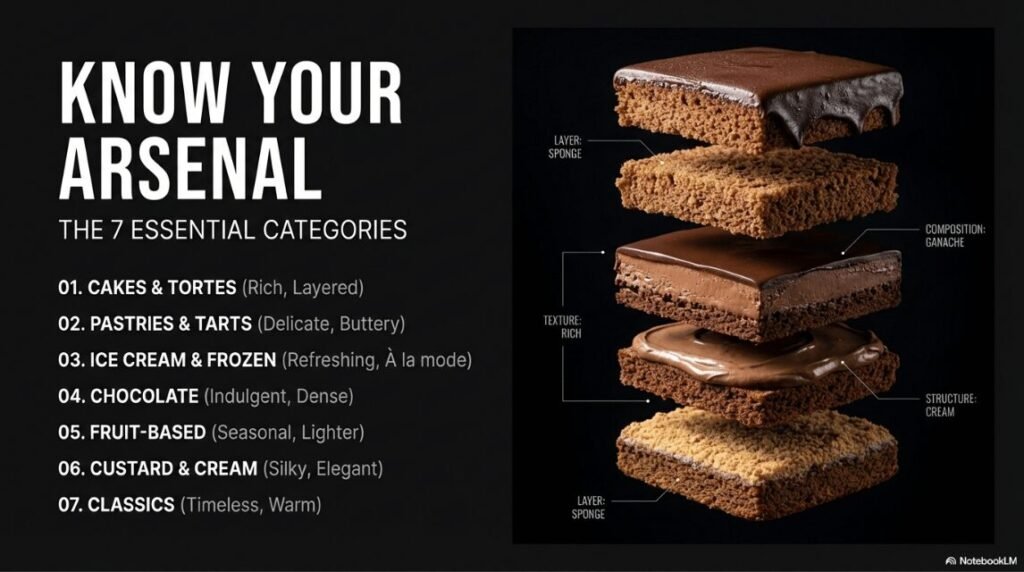
All desserts fit into seven main categories. Learn these, and you can describe almost any dessert menu.
Professional dessert presentation matters. Escoffier School of Culinary Arts teaches that plating should include a main component, a sauce, a crunch, and a garnish.
Category 1: Cakes and Tortes
Layered desserts with cake bases, fillings, and toppings.
| Dessert | Description | Key Words |
|---|---|---|
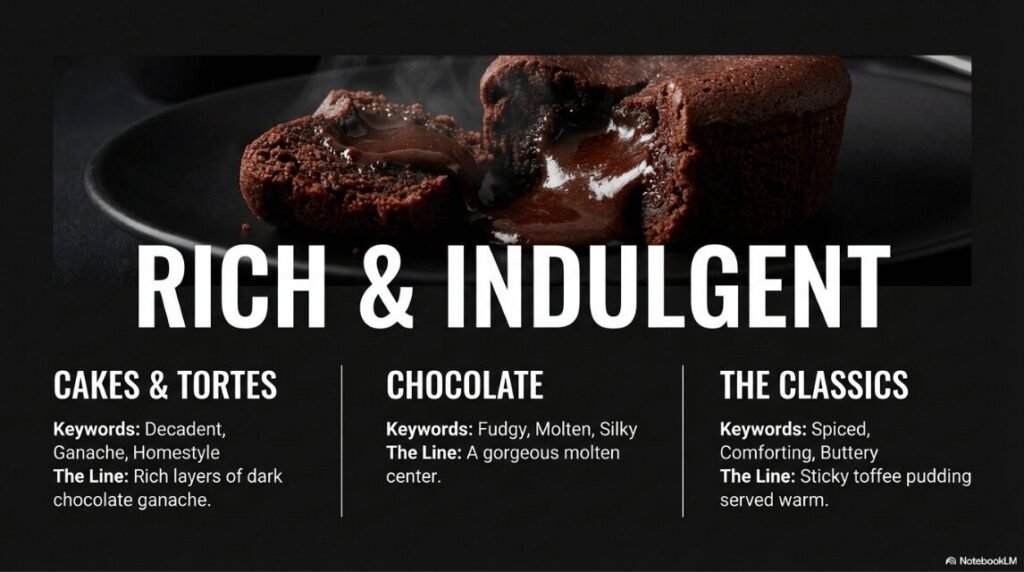
| Chocolate cake | Rich, dark chocolate layers with ganache | Rich, decadent, indulgent |
| Cheesecake | Creamy filling on a biscuit base | Smooth, creamy, rich |
| Tiramisu | Espresso-soaked sponge with mascarpone | Light, coffee-flavoured, creamy |
| Carrot cake | Spiced cake with cream cheese frosting | Moist, spiced, homestyle |
| Red velvet | Mild chocolate with cream cheese frosting | Velvety, elegant, mild |
How to describe cakes:
- “Our chocolate cake is rich and decadent with layers of dark chocolate ganache.”
- “The cheesecake is smooth and creamy on a buttery biscuit base.”
- “Tiramisu is light and coffee-flavoured. The name means ‘pick me up’ in Italian.”
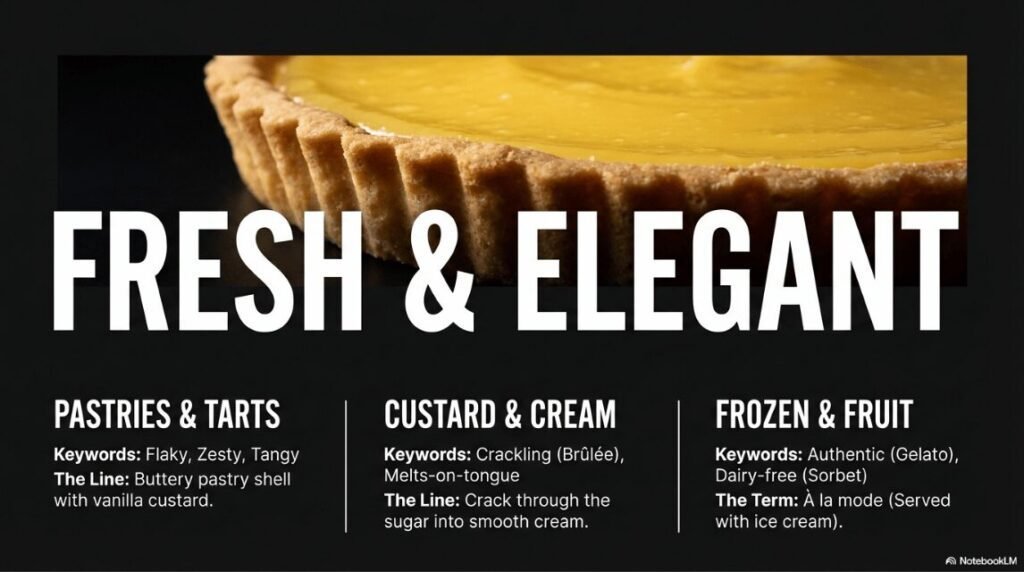
Category 2: Pastries and Tarts
Delicate pastry-based desserts with various fillings.
| Dessert | Description | Key Words |
|---|---|---|
| Fruit tart | Buttery pastry shell with custard and fresh fruit | Fresh, delicate, beautiful |
| Apple tart | Spiced apples on pastry with caramel | Warm, spiced, comforting |
| Lemon tart | Tangy lemon curd in sweet pastry | Zesty, tangy, refreshing |
| Éclair | Pastry tube filled with cream, topped with chocolate | Light, creamy, elegant |
| Croissant | Flaky, buttery pastry | Flaky, buttery, light |
How to describe pastries:
- “Our fruit tart has a buttery pastry shell filled with vanilla custard and topped with fresh seasonal berries.”
- “The lemon tart is zesty and refreshing. Perfect after a rich meal.”
- “Our éclairs are filled with smooth vanilla cream and topped with dark chocolate.”
Category 3: Ice Cream and Frozen Desserts
Cold, refreshing options for any meal.
| Dessert | Description | Key Words |
|---|---|---|
| Ice cream | Classic frozen dessert, many flavours | Creamy, smooth, refreshing |
| Gelato | Italian-style, denser than ice cream | Rich, dense, authentic |
| Sorbet | Fruit-based, dairy-free, lighter | Light, refreshing, fruity |
| Parfait | Layered ice cream with sauce and toppings | Layered, indulgent, beautiful |
| Affogato | Espresso poured over vanilla ice cream | Bold, warm and cold, Italian |
Key term: “À la mode”
This means “served with ice cream.” Very common in American restaurants.
- “Would you like that à la mode?” = “Would you like ice cream with that?”
- “The brownie comes à la mode with vanilla ice cream.”
How to describe frozen desserts:
- “Our gelato is authentic Italian-style. It is denser and richer than regular ice cream.”
- “The sorbet is dairy-free and refreshing. We have raspberry and mango today.”
- “An affogato is espresso poured over vanilla gelato. It is the perfect end to a meal.”
Category 4: Chocolate Desserts
Rich, indulgent options for chocolate lovers.
| Dessert | Description | Key Words |
|---|---|---|
| Chocolate mousse | Light, airy chocolate cream | Silky, light, airy |
| Chocolate lava cake | Warm cake with molten centre | Warm, gooey, indulgent |
| Brownie | Dense, fudgy chocolate square | Fudgy, rich, dense |
| Chocolate ganache | Smooth chocolate-cream mixture | Smooth, luxurious, glossy |
| Chocolate fondant | Similar to lava cake, French style | Warm, flowing, elegant |
How to describe chocolate desserts:
- “Our chocolate mousse is incredibly silky. It is light and airy, not too heavy.”
- “The chocolate lava cake has a warm, molten centre. Served with vanilla ice cream.”
- “Our brownie is fudgy and dense. Made with imported Belgian chocolate.”
Category 5: Fruit-Based Desserts
Fresh, lighter options highlighting seasonal fruit.
| Dessert | Description | Key Words |
|---|---|---|
| Cobbler | Fruit filling with biscuit topping | Warm, homestyle, comforting |
| Crumble | Fruit with buttery crumb topping | Crunchy, warm, rustic |
| Crisp | Similar to crumble but with oats | Crunchy, hearty, homemade |
| Berries with cream | Fresh berries, whipped cream | Light, fresh, simple |
| Fruit compote | Stewed fruit in syrup | Warm, sweet, aromatic |
The difference:
- Cobbler = fruit with biscuit or cake topping baked together
- Crumble = fruit with buttery flour-sugar topping (no oats)
- Crisp = fruit with oat-based crunchy topping
How to describe fruit desserts:
- “Our berry cobbler is warm and comforting with a soft cake topping.”
- “The apple crumble has a buttery, crunchy topping. Served warm with cream.”
- “Fresh berries with cream is light and refreshing. Perfect if you want something simple.”
Category 6: Custard and Cream Desserts
Smooth, silky, elegant options.
| Dessert | Description | Key Words |
|---|---|---|
| Crème brûlée | Vanilla custard with caramelised sugar top | Creamy, elegant, crackling |
| Panna cotta | Italian cream dessert set with gelatin | Silky, light, delicate |
| Flan | Caramel-topped custard | Smooth, caramel, classic |
| Bread pudding | Bread, custard, and sauce combined | Warm, comforting, homestyle |
| Rice pudding | Creamy rice with cinnamon | Creamy, comforting, simple |
How to describe custard desserts:
- “Crème brûlée is creamy vanilla custard with a crispy caramelised sugar top. You crack through the sugar into the smooth cream beneath.”
- “Panna cotta is silky Italian cream dessert. It almost melts on your tongue.”
- “Our bread pudding is warm and comforting. Served with vanilla sauce.”
Category 7: Traditional and Classic Desserts
Timeless favourites that customers love.
| Dessert | Description | Key Words |
|---|---|---|
| Apple pie | Classic pastry with spiced apples | Classic, homestyle, warm |
| Sticky toffee pudding | Warm sponge with toffee sauce | Warm, sweet, indulgent |
| Pavlova | Meringue with cream and berries | Light, crispy, elegant |
| Profiteroles | Cream puffs with chocolate sauce | Light, elegant, French |
| Banoffee pie | Banana, toffee, and cream | Sweet, creamy, indulgent |
How to describe classic desserts:
- “Our apple pie is a classic. Warm, spiced apples in buttery pastry. Served à la mode.”
- “Sticky toffee pudding is warm sponge cake covered in rich toffee sauce. Very indulgent.”
- “Pavlova is crispy meringue topped with fresh cream and seasonal berries. Light and elegant.”
Part 2: Dessert Vocabulary
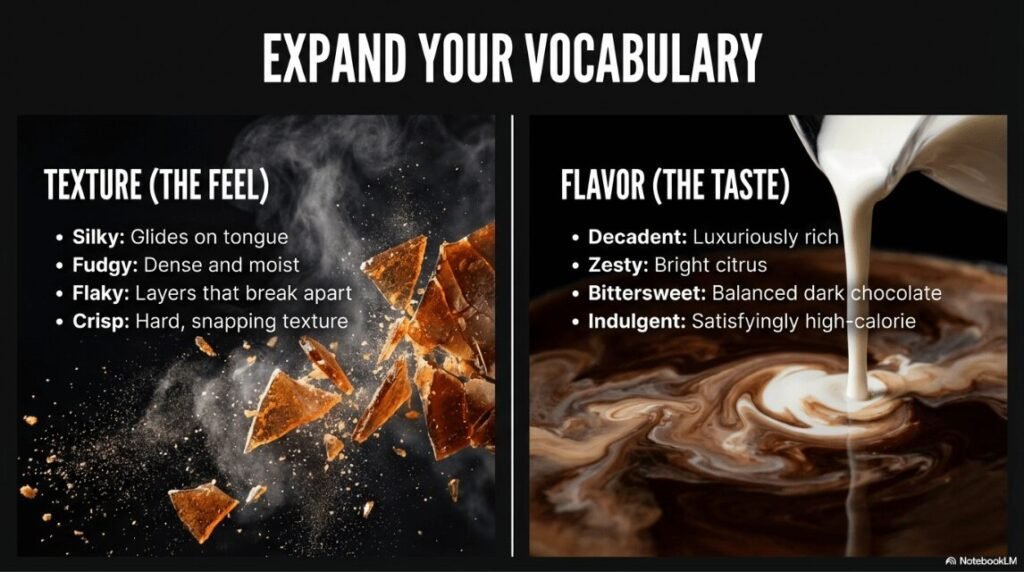
Texture Words
| Word | Meaning | Example |
|---|---|---|
| Rich | Full-bodied, intense flavour | “Rich chocolate ganache” |
| Creamy | Smooth, soft texture | “Creamy cheesecake” |
| Silky | Very smooth, glides on tongue | “Silky chocolate mousse” |
| Fluffy | Light and airy | “Fluffy sponge cake” |
| Fudgy | Dense, moist, chocolatey | “Fudgy brownie” |
| Flaky | Thin layers that break apart | “Flaky pastry” |
| Crunchy | Hard, crispy texture | “Crunchy sugar topping” |
| Moist | Soft, not dry | “Moist carrot cake” |
Flavour Words
| Word | Meaning | Example |
|---|---|---|
| Decadent | Luxuriously rich | “Decadent chocolate cake” |
| Indulgent | Satisfyingly rich | “Indulgent dessert” |
| Refreshing | Light, cleansing | “Refreshing sorbet” |
| Zesty | Bright citrus flavour | “Zesty lemon tart” |
| Spiced | Warm spices like cinnamon | “Spiced apple pie” |
| Tangy | Sharp, acidic taste | “Tangy passion fruit” |
| Sweet | High sugar content | “Sweet caramel sauce” |
| Bittersweet | Mix of bitter and sweet | “Bittersweet dark chocolate” |
Service Terms
| Term | Meaning |
|---|---|
| À la mode | Served with ice cream |
| House-made / Homemade | Made in the restaurant (higher value) |
| Chef’s special | Signature item, chef’s creation |
| Served warm | Heated before serving |
| Served chilled | Cold from refrigerator |
| Perfect for sharing | Large enough for two or more |
Part 3: How to Describe Desserts Professionally
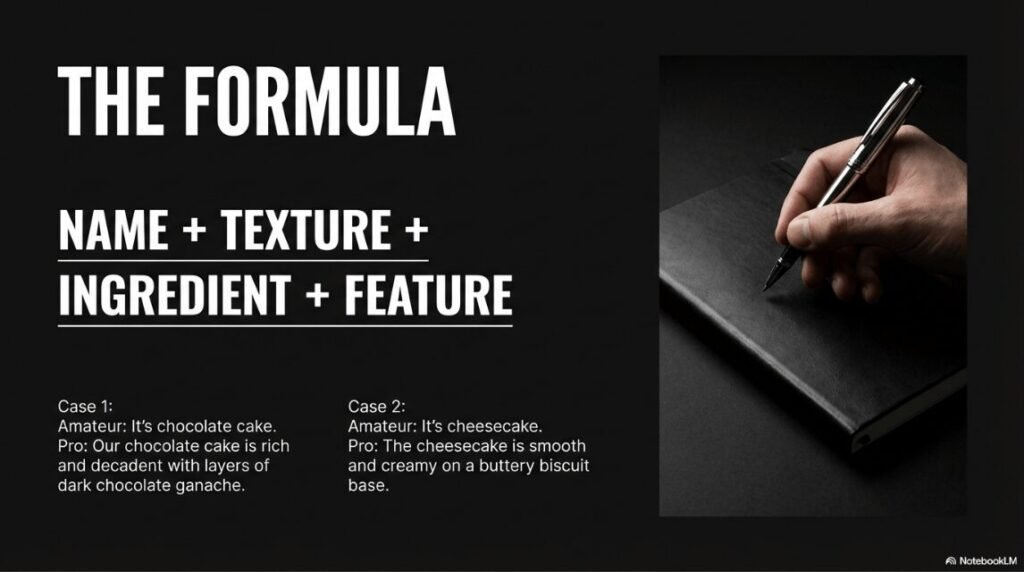
The Professional Formula
Dessert Name + Texture/Flavour + Key Ingredient + Special Feature
Examples:
| Basic | Professional |
|---|---|
| “It’s chocolate cake” | “Our chocolate cake is rich and decadent with layers of dark chocolate ganache” |
| “It’s cheesecake” | “The cheesecake is smooth and creamy on a buttery biscuit base” |
| “It’s ice cream” | “Our vanilla gelato is authentic Italian-style, dense and creamy” |
Opening Phrases for Dessert Service
Instead of: “Do you want dessert?”
Say:
- “Would you like to see our dessert menu?”
- “Can I tempt you with dessert?”
- “May I tell you about our desserts tonight?”
- “We have some wonderful desserts this evening.”
- “Our chef has prepared a special dessert today.”
Describing Specific Desserts
For chocolate desserts:
- “Our chocolate mousse is incredibly smooth and silky. Layers of dark and milk chocolate with whipped cream.”
- “The chocolate lava cake has a gorgeous molten centre. Served warm with vanilla ice cream.”
- “Rich, decadent brownie made with imported chocolate. Served warm à la mode.”
For fruit desserts:
- “Our fruit tart features a buttery pastry shell filled with vanilla custard and topped with fresh seasonal berries.”
- “Warm berry cobbler with a soft cake topping. The perfect comfort dessert.”
- “Fresh strawberries with whipped cream. Light and refreshing.”
For cream and custard desserts:
- “Crème brûlée is creamy vanilla custard with a crispy caramelised sugar top. You crack through the sugar into the smooth cream beneath.”
- “Panna cotta is silky Italian cream dessert. Incredibly light and elegant.”
- “Our tiramisu has layers of espresso-soaked sponge with smooth mascarpone cream.”
Part 4: Upselling Desserts Naturally
When to Offer Dessert
The right time:
- After clearing main course plates
- When the table is relaxed and not rushing
- Early evening when guests have time
The wrong time:
- Immediately after delivering main courses
- When guests are clearly in a hurry
- Near closing time
- When guests are already asking for the bill
Reading the Table
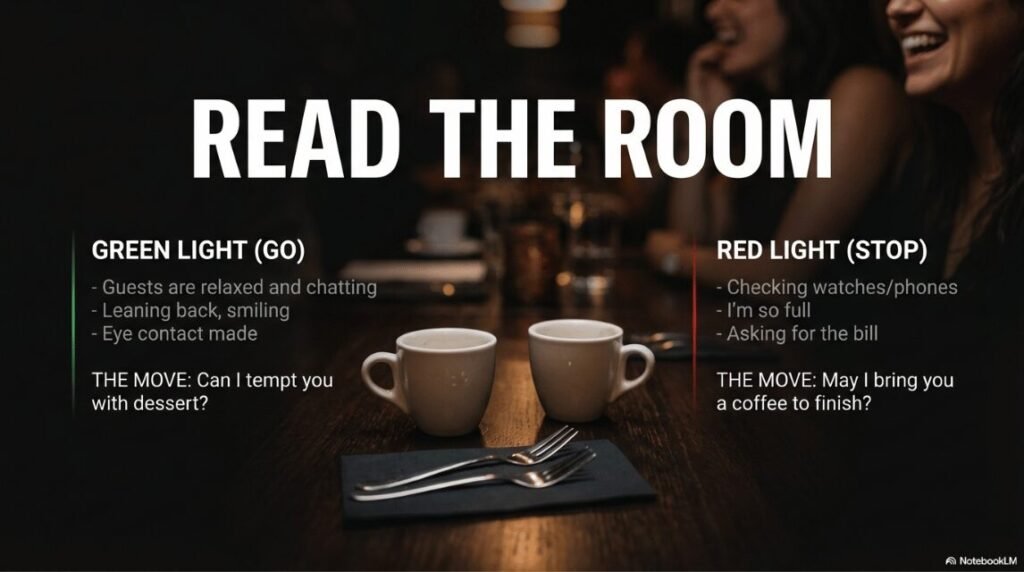
Good signs (offer dessert confidently):
- Guests are chatting and relaxed
- Leaning back, smiling
- Making eye contact with you
- It is a special occasion
- Weekend or early evening
Warning signs (be careful or skip):
- Eating slowly, struggling to finish
- Looking at watch or phone
- Asking for the bill already
- Saying “I’m so full”
- Near closing time
Professional Upselling Phrases
Highlight signature items:
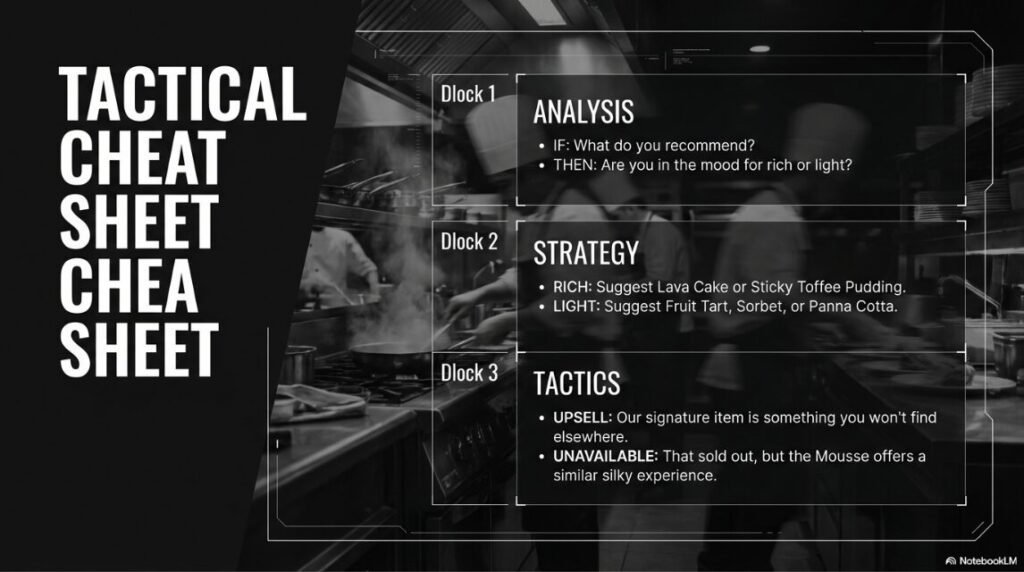
- “Our signature chocolate lava cake is something you won’t find elsewhere.”
- “May I recommend our chef’s special? It is our most popular dessert.”
- “Many guests love our tiramisu. It is house-made daily.”
Use specific recommendations:
Instead of: “Do you want dessert?”
Say: “Our chef has prepared a signature chocolate lava cake today. It is perfect with a cappuccino. May I bring one for you to share?”
Create appeal:
- “Our most popular item is…”
- “This pairs perfectly with coffee.”
- “It is not too heavy after a rich meal.”
- “Perfect for sharing between two.”
Handling Objections
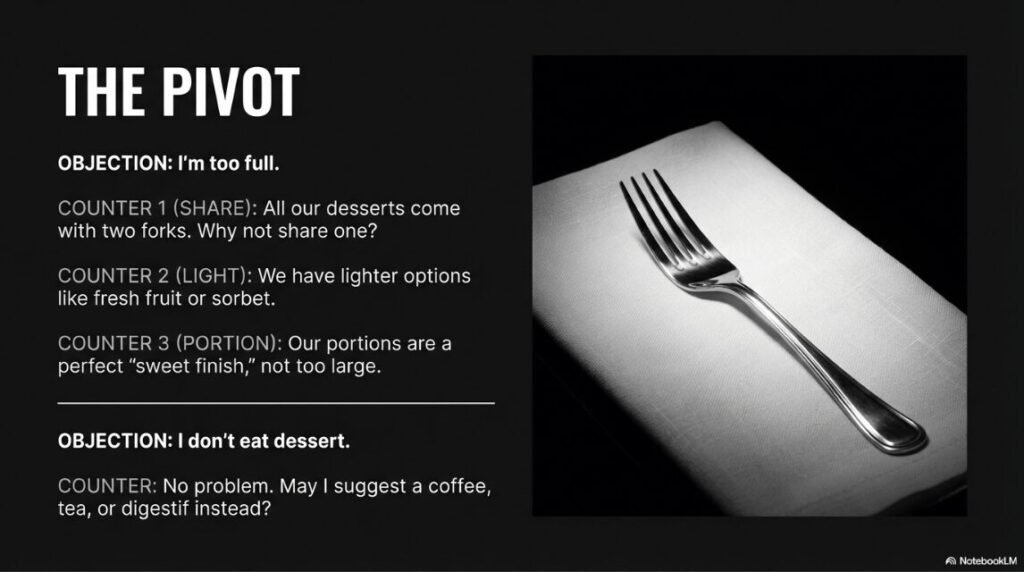
“I’m too full”
This is the most common objection. Three responses:
- Suggest sharing: “All our desserts come with two forks. Why not share one?”
- Offer lighter options: “We have lighter options like fresh fruit or sorbet. They are refreshing after a rich meal.”
- Mention size: “Our portions are not too large. Many guests find room for a small treat.”
“I don’t eat dessert”
- “No problem! May I suggest a coffee or tea instead?”
- “That is fine. Can I bring you anything else?”
“It’s too expensive”
- “Our desserts are perfect for sharing. You could split one between two?”
- “We have some smaller options if you would prefer.”
Part 5: Common Customer Questions
Questions About Sweetness
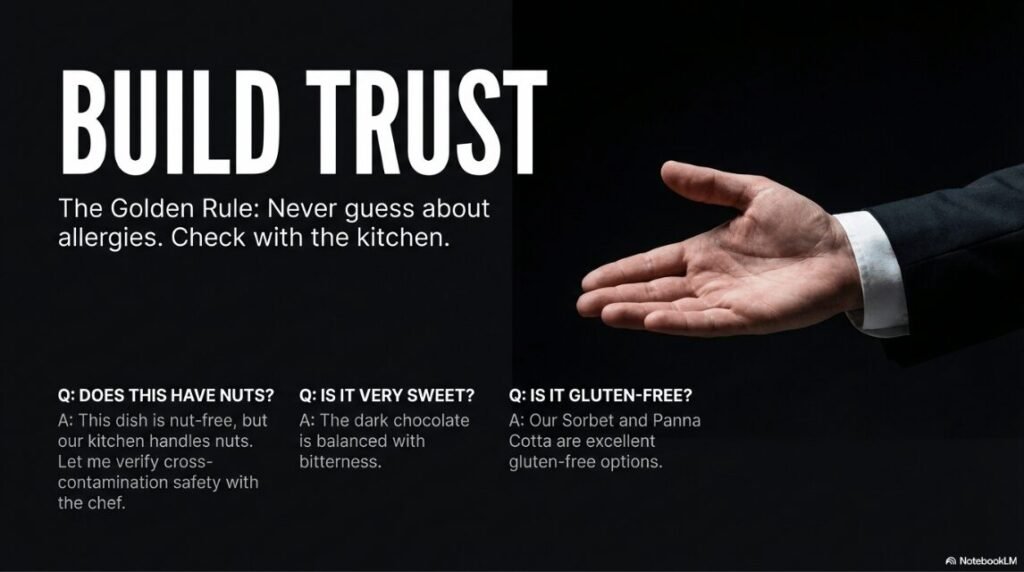
“Is it very sweet?”
For rich chocolate desserts:
- “The chocolate is rich and decadent, but it is balanced with a bit of bitterness. Not overly sweet.”
For fruit desserts:
- “This dessert uses natural fruit sweetness. It is quite light and refreshing.”
For cream desserts:
- “The panna cotta is delicately sweet. More focused on the silky texture than sugar.”
For less sweet options:
- “If you prefer something not too sweet, our sorbet or fresh fruit would be perfect.”
Questions About Portions and Sharing
“Can we share this?”
- “Absolutely! Many guests share our desserts. Would you like two forks?”
- “Yes, it is a generous portion. Perfect for sharing.”
- “Of course! I will bring extra cutlery.”
“How big is the portion?”
- “Our desserts are generously portioned. Most guests find one piece very satisfying.”
- “It is a full serving, but many people share because it is quite rich.”
“Do you have smaller portions?”
- “Some guests order a dessert and ask for extra plates to share.”
- “We have mini versions of some desserts available.”
Allergy and Dietary Questions
IMPORTANT: Never guess about allergies. Always check with the kitchen.
“Does this have nuts?”
- “Great question. Let me check with our kitchen to make sure I give you accurate information.”
- “I do not want to guess about allergens. Let me verify with the chef.”
“Is it gluten-free?”
- “Let me confirm which of our desserts are gluten-free.”
- “Our sorbet and panna cotta are gluten-free options.”
“Is it vegan?”
- “We have vegan options available. Let me show you which ones.”
- “Our dark chocolate sorbet is completely vegan.”
For serious allergies:
- “This dessert does not contain nuts, but it is prepared in a kitchen that handles nuts. Is cross-contamination a concern?”
- “Let me get our manager to discuss this with you to be completely safe.”
“What Do You Recommend?”
Best response: Ask a question first, then recommend.
“What kind of flavours do you usually enjoy?”
- If they like chocolate: “I would recommend our chocolate mousse cake. It is rich, luxurious, and not overly sweet.”
- If they like fruit: “The berry tart would be perfect. It is fresh and beautiful.”
- If they want something light: “Our panna cotta is elegant and light. Or the sorbet is very refreshing.”
“Are you in the mood for something rich or light?”
- Rich: “I would suggest our chocolate lava cake. Warm, decadent, perfect with espresso.”
- Light: “I would recommend the fruit tart or sorbet. Both feel fresh without being heavy.”
When Dessert is Unavailable
What NOT to say:
- “We’re out of that.”
- “It’s not available.”
What to say:
- “Unfortunately, that dessert sold out this evening, but I can recommend something very similar…”
- “That has been so popular tonight that it is gone, but may I suggest an alternative?”
- “That is not available tonight, but our chocolate mousse offers a similar experience.”
Always provide a solution. Do not just say it is unavailable.
Part 6: Presenting the Check and Closing the Meal
When to Bring the Check
The right time:
- After clearing dessert plates
- After offering coffee or tea
- When guests signal they are ready
- When guests ask for it
Customer signals they want the check:
- Plates pushed away, finished eating
- Looking around for the server
- Making eye contact
- Asking “Can we get the bill?”
- Gathering belongings
Customer signals they want to stay:
- Still drinking coffee slowly
- Deep in conversation
- Relaxed body language
- Not looking for you
Professional Phrases for the Bill
Opening:
- “Would you like anything else before I bring the check?”
- “May I bring you the bill?”
- “Shall I get the check for you?”
Presenting:
- “Here is your check. Take your time.”
- “Here is your bill. No rush at all.”
- “I will leave this here whenever you are ready.”
Handling Payment
Card payment:
- “Will that be card or cash today?”
- “I will process your card now.”
- “Just sign here, please.” or “Here is the terminal.”
Cash payment:
- Bring full change on a small tray
- Never ask “How much change back?” Let them decide the tip.
- “Here is your change. Thank you.”
Split checks:
- “How would you like to split this?”
- “I can split this by seat or by amount. Which do you prefer?”
- “I will bring separate receipts for each card.”
Final Impression Phrases
When picking up payment:
- “Thank you so much for coming. We really appreciated your visit.”
- “Thank you for joining us tonight. Safe travels.”
- “It was wonderful to see you. Please come back soon.”
- “Thank you. We hope to see you again!”
Inviting return visits:
- “We are open every day from 11am. We would love to see you again.”
- “We have a new dessert menu next month. Come see us soon!”
- “Thank you for dining with us. Have a wonderful evening.”
Common Mistakes to Avoid
| Mistake | Better Approach |
|---|---|
| Bringing check too quickly | Wait until guests signal |
| Hovering for tip | Give guests privacy |
| Forgetting to say goodbye | Always make eye contact and thank them |
| Rushing guests | Let them take their time |
| Appearing tired or unhappy | Smile until they leave |
Part 7: The Complete End-of-Meal Flow
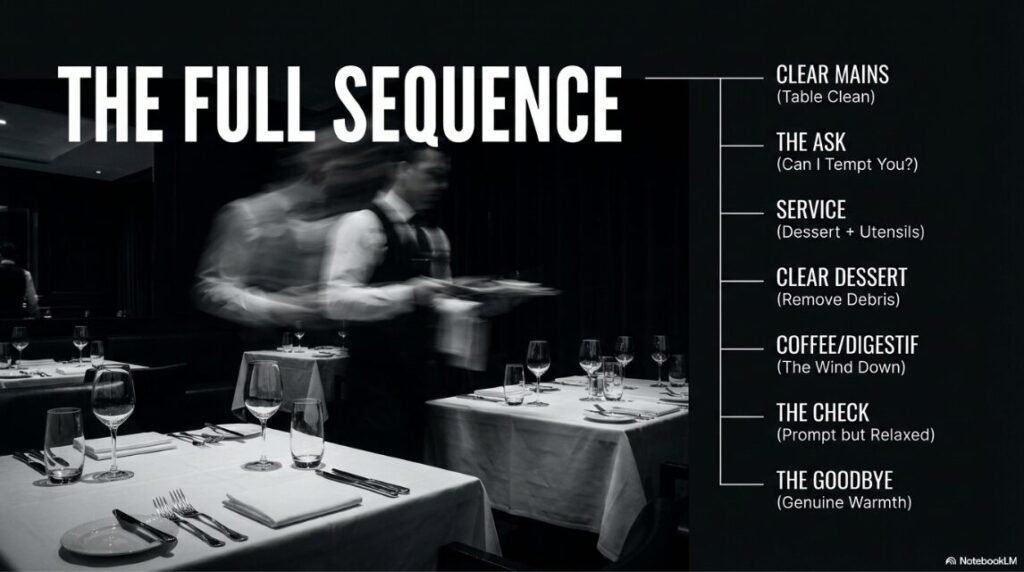
Follow this sequence for professional service:
According to CUNY City Tech’s Hospitality Management program, proper service flow is essential for customer satisfaction
- Clear main course plates when all guests are finished
- Offer water refills
- Ask about dessert using professional phrases
- Serve dessert if ordered
- Clear dessert plates when finished
- Offer coffee or tea
- Wait for decisions (do not rush)
- Ask “May I bring you the check?” when appropriate
- Present check professionally
- Process payment promptly
- Return with receipt and card/change
- Thank them genuinely
- Say goodbye with a smile
Part 8: Quick Reference Tables
Dessert Descriptions at a Glance
| Dessert | Quick Description |
|---|---|
| Chocolate lava cake | “Warm cake with molten chocolate centre, served with ice cream” |
| Crème brûlée | “Creamy vanilla custard with crispy caramelised sugar top” |
| Tiramisu | “Light, coffee-flavoured layers of sponge and mascarpone cream” |
| Cheesecake | “Smooth and creamy on a buttery biscuit base” |
| Fruit tart | “Buttery pastry with vanilla custard and fresh seasonal berries” |
| Panna cotta | “Silky Italian cream dessert, light and elegant” |
| Brownie | “Fudgy and dense, made with rich chocolate” |
| Apple pie | “Classic warm spiced apples in buttery pastry” |
| Sorbet | “Light, refreshing, dairy-free fruit ice” |
| Sticky toffee pudding | “Warm sponge cake with rich toffee sauce” |
Upselling Phrases Quick Reference
| Situation | What to Say |
|---|---|
| Opening dessert conversation | “Can I tempt you with dessert?” |
| Highlighting signature item | “Our most popular dessert is…” |
| Customer says “I’m full” | “Perfect for sharing. Would you like two forks?” |
| Recommending | “If you like chocolate, I would suggest…” |
| Creating appeal | “It is not too heavy after a rich meal” |
Handling Questions Quick Reference
| Question | Response |
|---|---|
| “Is it very sweet?” | “It is balanced, not overly sweet” |
| “Can we share?” | “Absolutely! I will bring two forks” |
| “Does it have nuts?” | “Let me check with the kitchen” |
| “What do you recommend?” | “What flavours do you enjoy?” |
| “Do you have gluten-free?” | “Yes, our sorbet and panna cotta are gluten-free” |
Quiz: Test Your Dessert Knowledge
Congratulations! You Have Completed Menu Mastery
You now have the vocabulary for:
✅ Appetisers and Starters ✅ Main Courses ✅ Wine and Beer ✅ Non-Alcoholic Drinks ✅ Desserts and After-Dinner Service
This is a huge achievement. You can now confidently describe any section of a restaurant menu.
But menu knowledge is just the beginning.
What Happens When…
❓ A customer complains about their food? ❓ You need to handle a difficult phone call? ❓ Your manager asks you to train someone? ❓ You want a raise or promotion?
Menu vocabulary helps you describe food. But professional English helps you build a career.
Ready to Master ALL Restaurant English?
English for Waiters covers everything you need to succeed:
All for only £37.99
→ ENROLL IN ENGLISH FOR WAITERS TODAY
Ready to Master Restaurant English?
These free articles and scenarios are a great start, but if you want a complete, structured system for learning restaurant English, consider our full course.
English for Waiters includes:
✅ 22+ video lessons covering every restaurant situation
✅ Real restaurant scenarios with native pronunciation
✅ Interactive pronunciation practice
✅ Downloadable phrase guides
✅ Lifetime access with free updates
Thank You for Completing Menu Mastery
You have invested time in your professional development. That matters.
Your customers will notice your confidence. Your managers will notice your knowledge. Your tips will reflect your professionalism.
Keep learning. Keep growing. Keep serving excellence.