Introduction
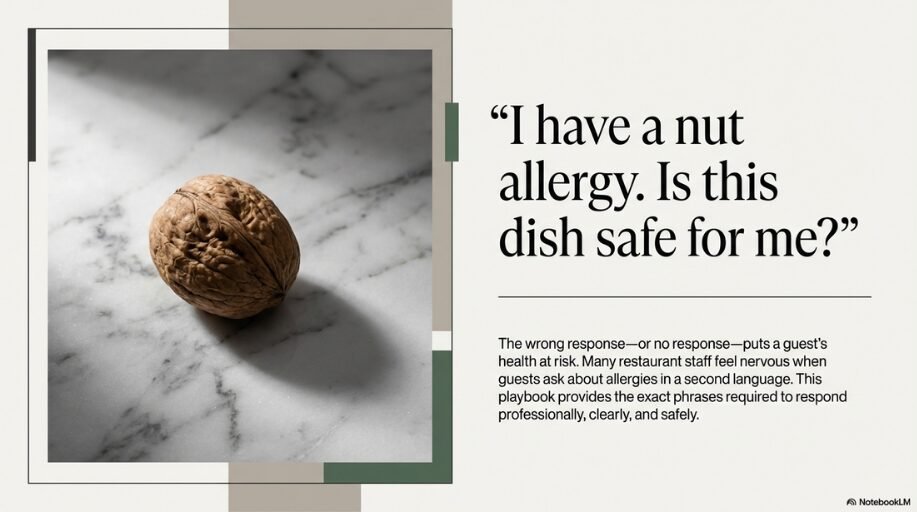
A guest sits down and says: “I have a nut allergy. Is this dish safe for me?”
Do you know exactly what to say?
Food allergies are serious. The wrong response — or no response — can put a guest’s health at risk. But many restaurant staff feel nervous when guests ask about allergies, especially in a second language.
This guide gives you the exact phrases and scripts you need to handle allergy and dietary requests professionally, clearly, and with confidence.
Why This Matters
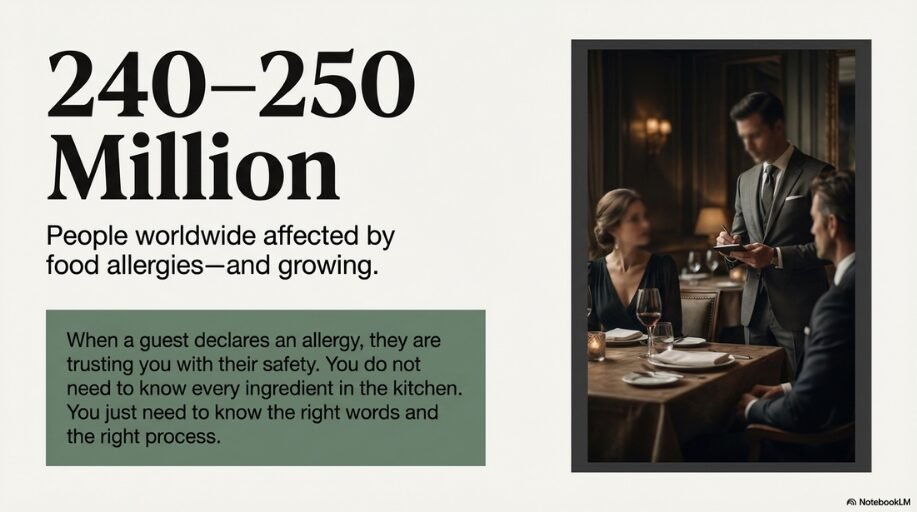
Food allergies are more common than many people realise. Research shows that around 240 to 250 million people worldwide are affected by food allergies, and the number is growing. When a guest tells you about an allergy, they are trusting you with their safety.
The good news is that clear, professional communication makes a huge difference. You do not need to know every ingredient in every dish. You just need to know the right words — and the right process.
The Most Common Allergies and Dietary Requests
Before the scripts, it helps to know the most common situations you will face:
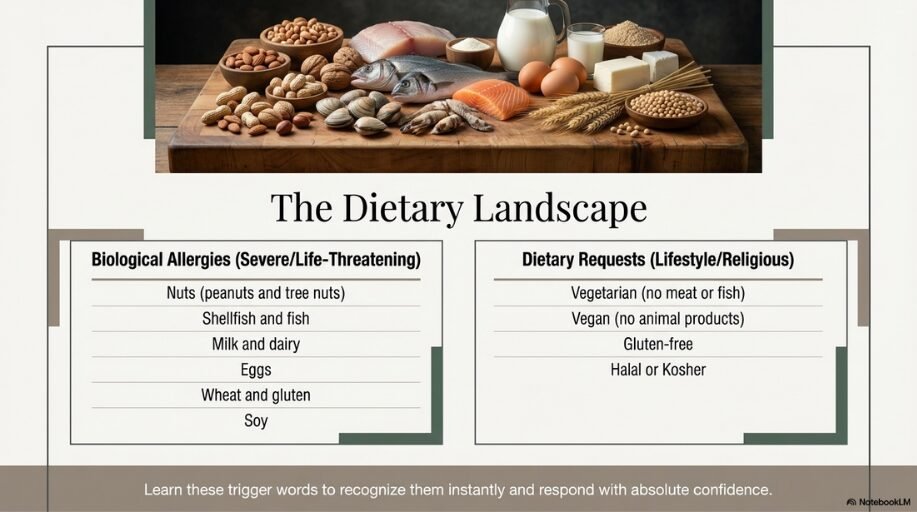
Common allergies:
- Nuts (peanuts and tree nuts)
- Shellfish and fish
- Milk and dairy
- Eggs
- Wheat and gluten
- Soy
Common dietary requests:
- Vegetarian (no meat or fish)
- Vegan (no animal products at all)
- Gluten-free
- Halal or Kosher
Learn these words. When a guest uses them, you will understand immediately and respond with confidence.
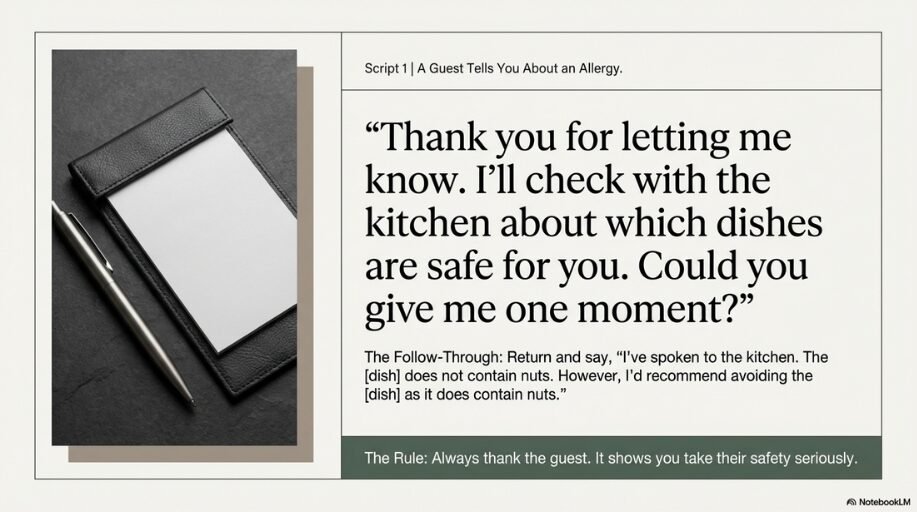
Script 1: A Guest Tells You About an Allergy
Guest says: “I have a nut allergy.”
You say:
“Thank you for letting me know. I’ll check with the kitchen about which dishes are safe for you. Could you give me one moment?”
Then go to the kitchen and ask. Come back with a clear answer.
When you return:
“I’ve spoken to the kitchen. The [dish name] does not contain nuts and is prepared separately. However, I’d recommend avoiding the [dish name] as it does contain nuts.”
Key point: Always thank the guest for telling you. It shows you take it seriously.
Script 2: You Are Not Sure If a Dish Is Safe
This is the most important script in this guide. Never guess. Never say “I think it’s okay.”
You say:
“I want to make sure I give you the right information. Let me check with the kitchen before you order. I’ll be right back.”
Then check. Always. Research on food allergy communication in restaurants shows that poor communication is responsible for the majority of allergic reactions that occur when dining out. Your honesty protects the guest.
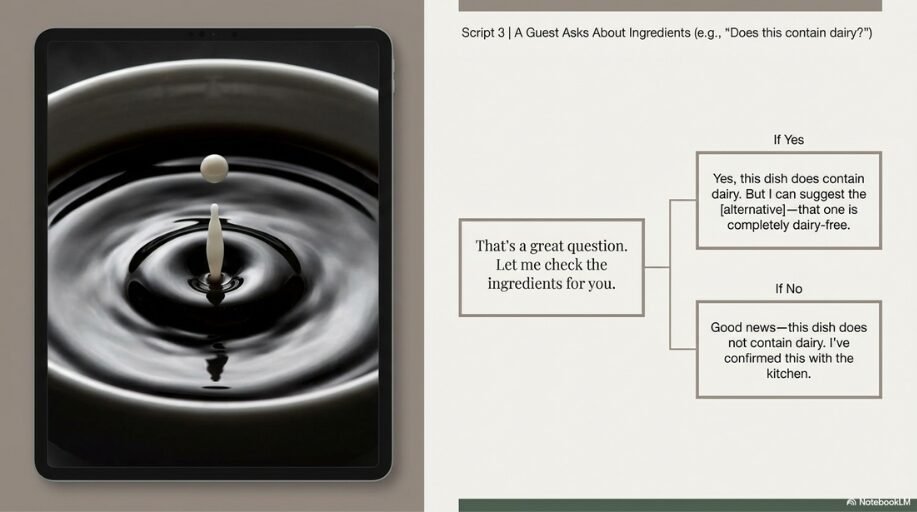
Script 3: A Guest Asks About Ingredients
Guest says: “Does this dish contain dairy?”
You say:
“That’s a great question. Let me check the ingredients for you.”
Check with the kitchen or menu information.
If it does contain dairy:
“Yes, this dish does contain dairy. But I can suggest the [alternative dish] — that one is completely dairy-free.”
If it does not contain dairy:
“Good news — this dish does not contain dairy. I’ve confirmed this with the kitchen.”
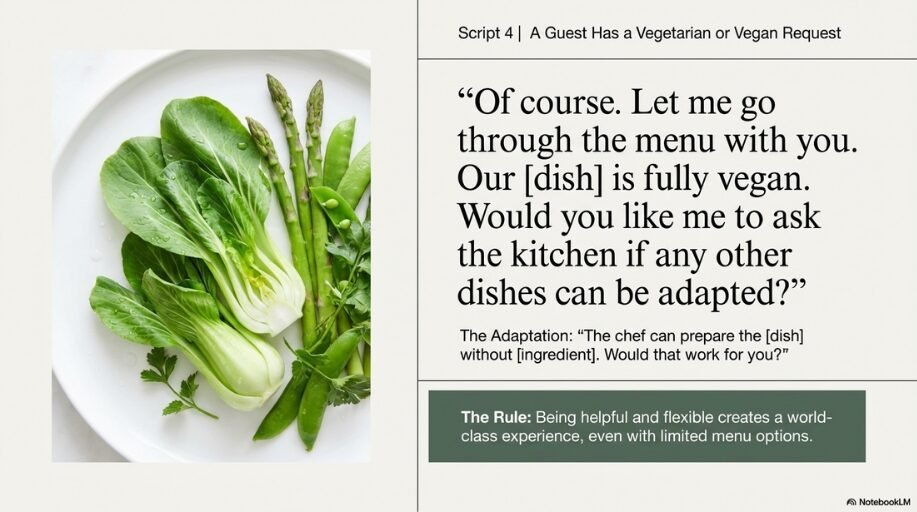
Script 4: A Guest Has a Vegetarian or Vegan Request
Guest says: “I’m vegan. What can I eat here?”
You say:
“Of course. Let me go through the menu with you. Our [dish name] and [dish name] are both fully vegan. Would you like me to ask the kitchen if any other dishes can be adapted for you?”
If a dish can be adapted:
“The chef can prepare the [dish] without [ingredient]. Would that work for you?”
Being helpful and flexible creates a great experience for the guest — even when the menu has limited options.
Script 5: When You Need to Involve a Manager or Chef
Some allergy situations are serious enough to involve a manager or chef directly. If a guest mentions a severe allergy — especially to nuts or shellfish — it is always better to bring in extra support.
You say:
“I want to make absolutely sure we get this right for you. Would it be okay if I ask our chef to speak with you directly? I want to make sure you’re completely safe.”
Most guests will appreciate this. It shows that you and your restaurant take their safety seriously.
Useful Phrases to Remember
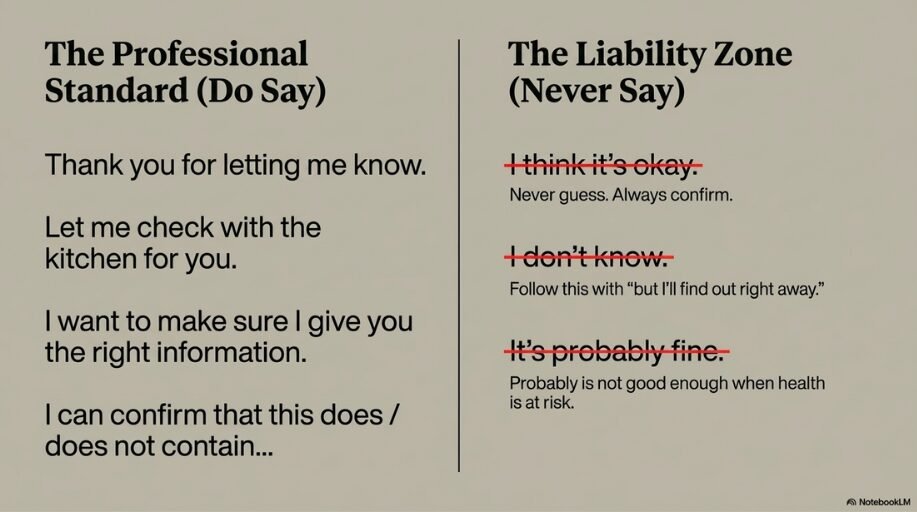
Keep these phrases in your memory for any allergy or dietary situation:
- “Thank you for letting me know.”
- “Let me check with the kitchen for you.”
- “I want to make sure I give you the right information.”
- “I can confirm that this dish does / does not contain [ingredient].”
- “I would recommend avoiding [dish] as it contains [allergen].”
- “The chef can adapt this dish for you.”
- “I’ll ask the manager to help us with this.”
Phrases to Avoid
“I think it’s okay.”— Never guess with allergies. Always confirm.“I don’t know.”— Follow this with “but I’ll find out right away.”“It’s probably fine.”— Probably is not good enough when someone’s health is at risk.
A Simple Process to Follow Every Time
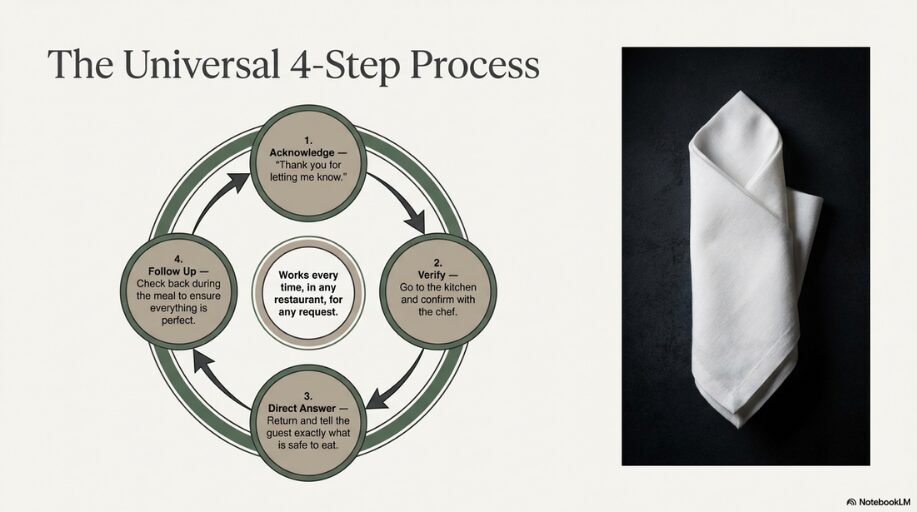
When a guest mentions an allergy or dietary need, follow these four steps:
- Thank them — “Thank you for letting me know.”
- Check — Go to the kitchen and confirm with the chef.
- Return with a clear answer — Tell the guest exactly what is safe and what to avoid.
- Follow up — Check back during the meal to make sure everything is okay.
This process works every time, in any restaurant, for any allergy or dietary request.
Want More Scripts Like These?
The Waiter’s English Phrase Guide covers 60 pages of professional restaurant English — including allergy phrases, dietary requests, taking orders, handling complaints, and more.
Get it on Etsy for just £2.99: https://www.etsy.com/listing/4452775338/the-waiters-english-phrase-guide-60
Instant download. Print it or save it to your phone and use it on your next shift.
Or if you want to go further, the full English for Waiters course gives you 22 video lessons with interactive practice — built specifically for restaurant staff at pre-intermediate level.
Start today at theeslroom.com

Conclusion
Food allergies are serious — but they do not have to be stressful. With the right words and a clear process, you can handle any allergy or dietary request professionally and confidently.
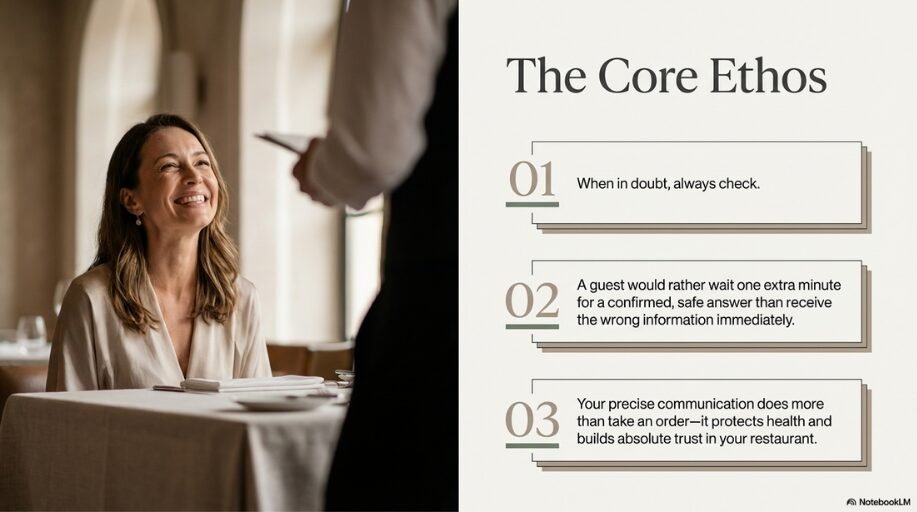
Remember: when in doubt, always check. A guest would rather wait one extra minute for a confirmed answer than receive the wrong information.
Your careful communication could make a real difference to someone’s health — and their trust in your restaurant.
Ready to Master Restaurant English?
These free articles and scenarios are a great start, but if you want a complete, structured system for learning restaurant English, consider our full course.

English for Waiters includes:
✅ 22+ video lessons covering every restaurant situation
✅ Real restaurant scenarios with native pronunciation
✅ Interactive pronunciation practice
✅ Downloadable phrase guides
✅ Lifetime access with free updates