
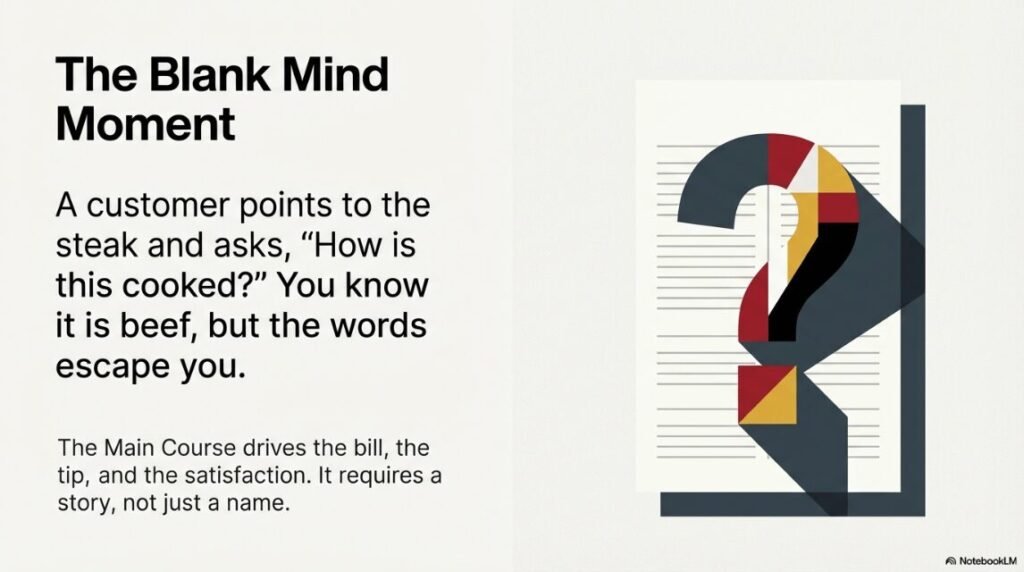
You look at the menu. Your customer points to a steak and asks: “How is this cooked?”
Your mind goes blank. You know it’s beef. But how do you explain the cooking method? What if they ask “How do you want it cooked?” What does that even mean?
This is a common challenge for ESL servers. The main course is the most important part of the meal. It’s usually the most expensive item. Customers have many questions about it.
Today, you will learn the essential English vocabulary for main courses. You will learn about proteins (meat, fish, chicken), cooking methods (grilled, roasted, fried), and how to describe them professionally.
By the end of this guide, you will feel confident explaining any main course on your menu.
What is a Main Course?
A main course (also called an entrée in American English) is the primary dish of a meal. It’s usually the largest and most expensive item customers order.
In American English: “Entrée” = Main course In British English: “Main course” or “Main” = Main course (Note: In French, “entrée” actually means appetizer, but Americans use it to mean main course!)
Why is the main course important?
- It’s the center of the meal
- It determines most of the bill total
- It requires the most explanation
- Customers have the most questions about it
- It affects your tips the most
The main course typically consists of:
- A protein (meat, fish, chicken, or plant-based)
- Cooking method (how it’s prepared)
- Sides (vegetables, starches, or salads)
Let’s learn about each part.
Part 1: Understanding Proteins
Protein is the main ingredient of most main courses. It’s usually meat, fish, chicken, or plant-based options.
Beef: The Premium Choice
Beef is one of the most popular main course proteins in UK and US restaurants. According to culinary research, 74% of consumers report that eating meat is an important part of their diet.
Common Beef Cuts:
Premium Steaks:
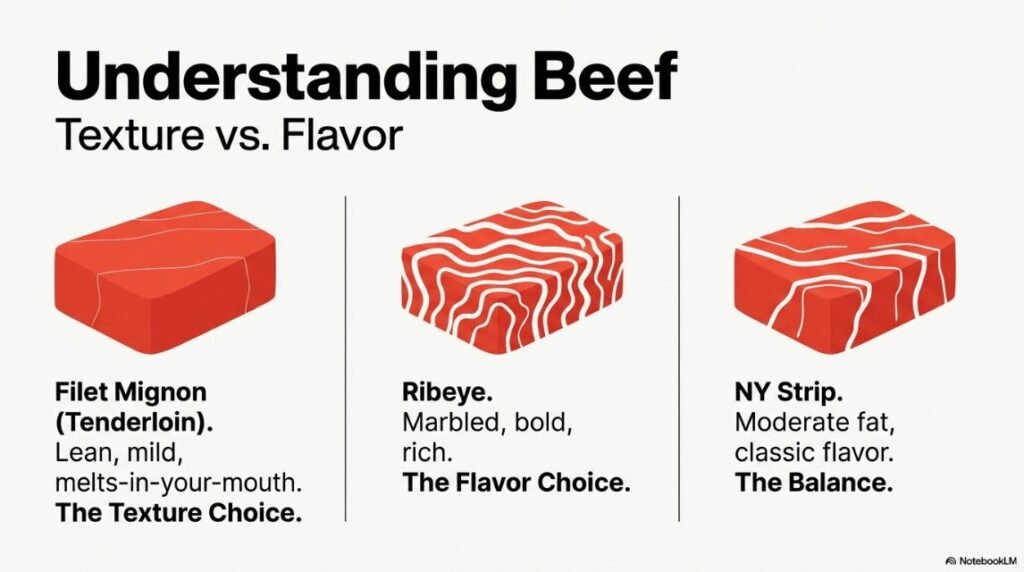
Filet Mignon (also called Tenderloin)
- The most tender cut of beef
- Lean (not much fat)
- Mild flavor
- “Melts in your mouth”
- Most expensive option
How to describe it: “The filet mignon is our most tender steak. It’s lean and buttery-soft with a mild flavor.”
Ribeye
- Very juicy and flavorful
- High fat content (marbled throughout)
- Bold, beefy taste
- Popular with customers who want maximum flavor
How to describe it: “The ribeye is very juicy and full of flavor. It has beautiful marbling throughout that makes it incredibly rich.”
New York Strip (also called Sirloin Steak)
- Balanced between filet and ribeye
- Moderate fat, good flavor
- Classic steakhouse choice
- Good for customers who can’t decide
How to describe it: “The New York strip is the perfect balance – tender with great beef flavor. It’s our most popular steak.”
Mid-Range Beef:
Sirloin
- Affordable option
- Less tender than premium cuts
- Good beef flavor
- Popular for value-conscious diners
Flank/Skirt Steak
- Used in tacos, stir-fries, fajitas
- Must be sliced against the grain
- Bold flavor
- Chewy if not prepared correctly
Chicken: The Everyday Favorite
Chicken ranks #1 for consumer taste preference among proteins according to restaurant industry studies. It’s versatile, affordable, and appears on almost every menu.
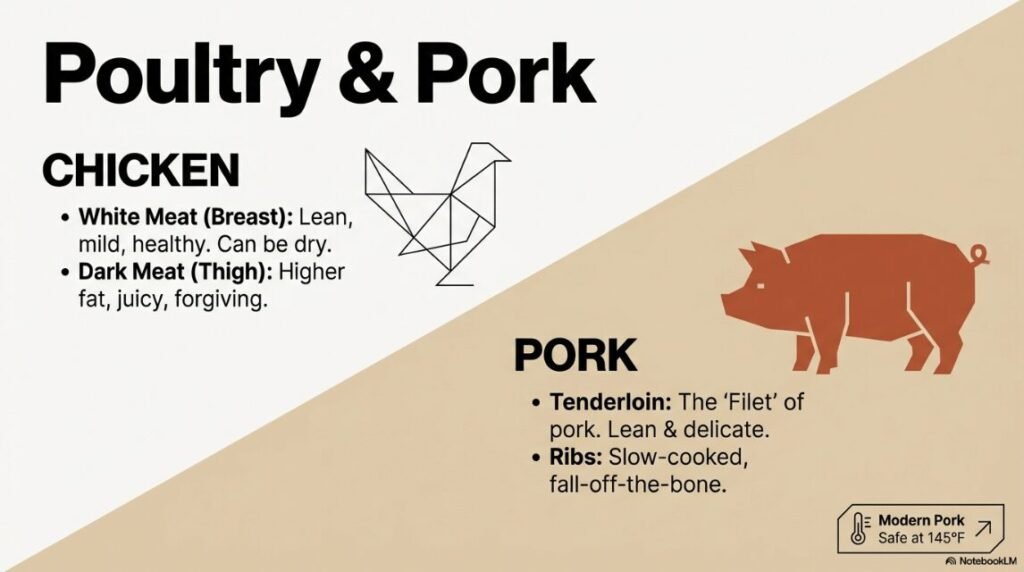
White Meat vs. Dark Meat
White Meat:
- Chicken breast, tenderloin, wings
- Lean (low fat)
- Mild flavor
- Texture: Can be dry if overcooked
- Health-conscious customers prefer this
Dark Meat:
- Chicken thighs, drumsticks, legs
- More fat (more flavorful)
- Juicy and tender
- Texture: Stays moist even if slightly overcooked
- Professional tip: Many restaurants use thighs instead of breasts because they’re more forgiving
Common Chicken Dishes:
Grilled Chicken Breast “Our chicken breast is grilled and served with lemon butter sauce. It’s lean and healthy.”
Chicken Thighs “We use chicken thighs because they stay juicy and tender. They have more flavor than breast meat.”
Whole Roasted Chicken “The chicken is roasted whole in the oven until the skin is crispy and golden brown.”
Pork: The Versatile Option
Pork is experiencing a resurgence on restaurant menus. Modern pork is much leaner than it was 20 years ago.
Important Safety Note: Modern pork is safe to eat at 145°F (63°C). It can be slightly pink inside. Many customers don’t know this!
Common Pork Cuts:
Pork Tenderloin
- The leanest, most tender cut
- Similar to filet mignon for beef
- Delicate flavor
- Often pan-seared then roasted
How to describe it: “The pork tenderloin is our most tender pork cut. It’s lean, juicy, and served with apple chutney.”
Pork Chops
- Cut from the loin
- Can be bone-in or boneless
- Quick-cooking
- Popular in casual dining
Pork Ribs
- Slow-cooked until tender
- Fall off the bone
- Usually served with barbecue sauce
- Casual, fun dining experience
How to describe it: “Our ribs are slow-cooked for hours until they fall off the bone. They’re glazed with our house barbecue sauce.”
Lamb: The Specialty Protein
Lamb is less common than beef or chicken but highly valued in upscale and Mediterranean restaurants.
Common Lamb Dishes:
Lamb Chops
- Small, elegant portions
- Rich, slightly gamey flavor
- Often grilled or pan-seared
- Premium pricing
How to describe it: “The lamb chops are grilled to order. They have a rich, distinctive flavor and are very tender.”
Lamb Shank
- Large cut, slow-braised
- Falls off the bone
- Deep, rich flavor
- Impressive presentation
How to describe it: “The lamb shank is braised slowly in red wine until it’s fall-apart tender. It’s a showstopper dish.”
Fish & Seafood: Growing Popularity
Fish-based proteins are rising in popularity for 2024-2026 according to restaurant trend reports. Fresh seafood is increasingly common even in casual dining.
Most Common Fish:
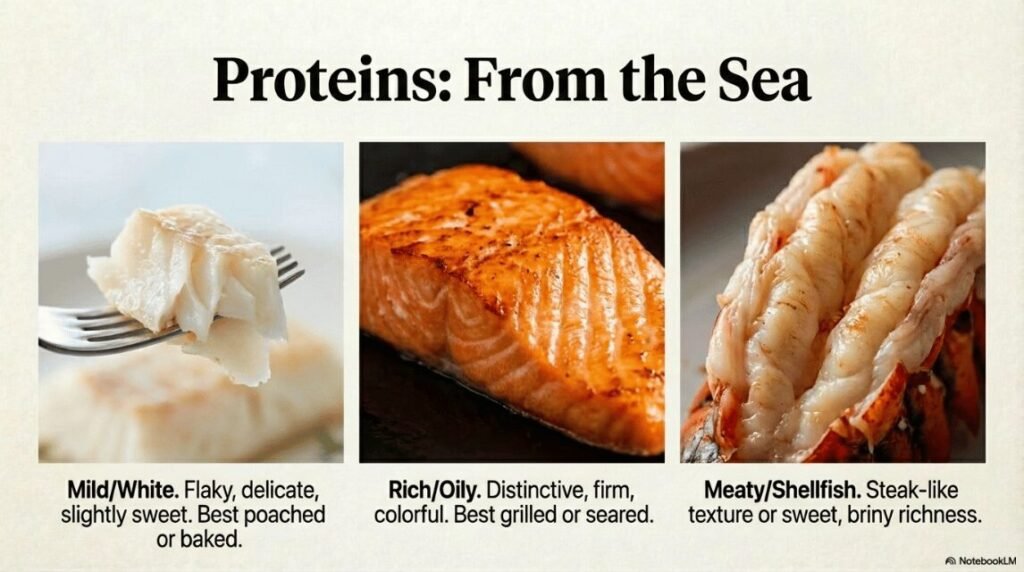
| Fish | Flavor | Texture | Best Preparation |
|---|---|---|---|
| Salmon | Rich, distinctive | Firm, oily | Grilled, pan-seared, roasted |
| Cod | Mild, slightly sweet | Flaky, delicate | Poached, baked, broiled |
| Halibut | Mild, sweet | Firm white meat | Pan-seared, roasted |
| Mahi-Mahi | Mild, slightly sweet | Firm, moist | Grilled, pan-seared |
| Tuna | Bold, rich | Firm, meaty | Seared rare, grilled |
| Swordfish | Meaty, bold | Firm, steak-like | Grilled, pan-seared |
How to Describe Fish:
For mild fish (cod, halibut, flounder): “This fish has a mild, delicate flavor. It’s perfect if you want something light and not too ‘fishy.'”
For rich fish (salmon, tuna): “This fish has a rich, distinctive flavor. It’s firmer and more substantial than white fish.”
For meaty fish (swordfish, tuna): “This fish has a meaty texture, almost like steak. It appeals to customers who don’t usually like fish.”
Shellfish: Premium Options
Shrimp – Sweet, mild, quick-cooking Scallops – Sweet, buttery, delicate Lobster – Sweet, rich, premium priced Crab – Sweet, delicate, special occasion
How to describe shellfish: “All our shellfish is fresh, not frozen. It has a sweet, briny flavor from the ocean.”
Plant-Based Proteins: The Growing Category
Plant-based proteins are expanding on restaurant menus, particularly in fast-casual and upscale segments according to 2024-2026 trend reports.
Common Plant-Based Proteins:
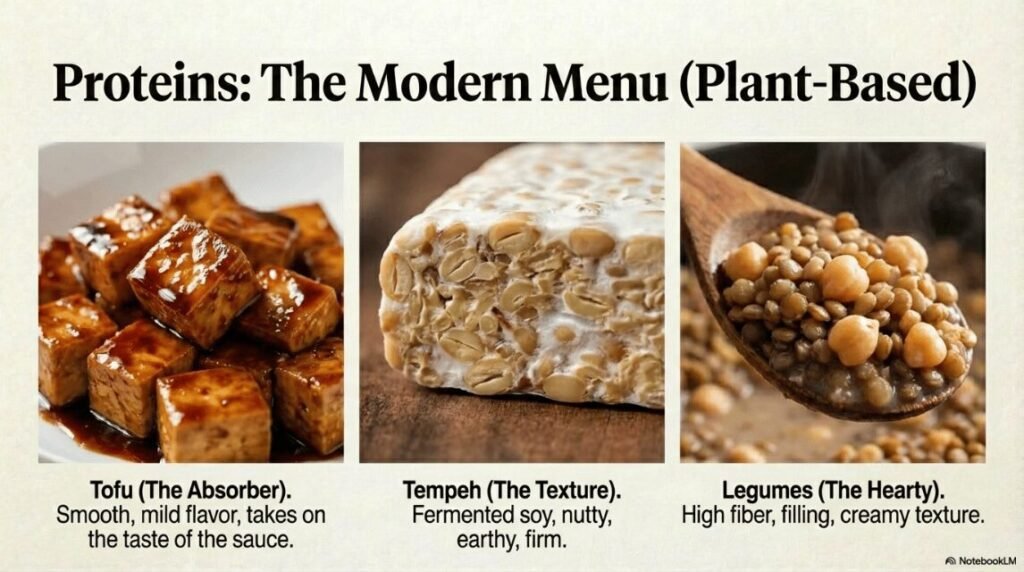
Tofu (Bean Curd)
- Made from soybeans
- Mild flavor (absorbs other flavors)
- Soft to firm texture
- Popular in Asian dishes
How to describe it: “Tofu is made from soybeans. It’s mild and absorbs the flavors of our sauce beautifully.”
Tempeh
- Fermented soybeans
- Nutty, earthy flavor
- Firm, meaty texture
- High protein (20g+ per serving)
How to describe it: “Tempeh has a nutty flavor and firm, meaty texture. It’s higher in protein than tofu.”
Lentils & Chickpeas
- Hearty and filling
- High in fiber and protein
- Creamy texture
- Used in soups, stews, bowls
How to describe it: “Our lentil bowl is hearty and filling. Lentils are high in protein and fiber – very nutritious.”
Seitan (Wheat Gluten)
- Chewy, meat-like texture
- Absorbs flavors well
- Popular in vegetarian “meat” dishes
Part 2: Cooking Methods – How Food is Prepared
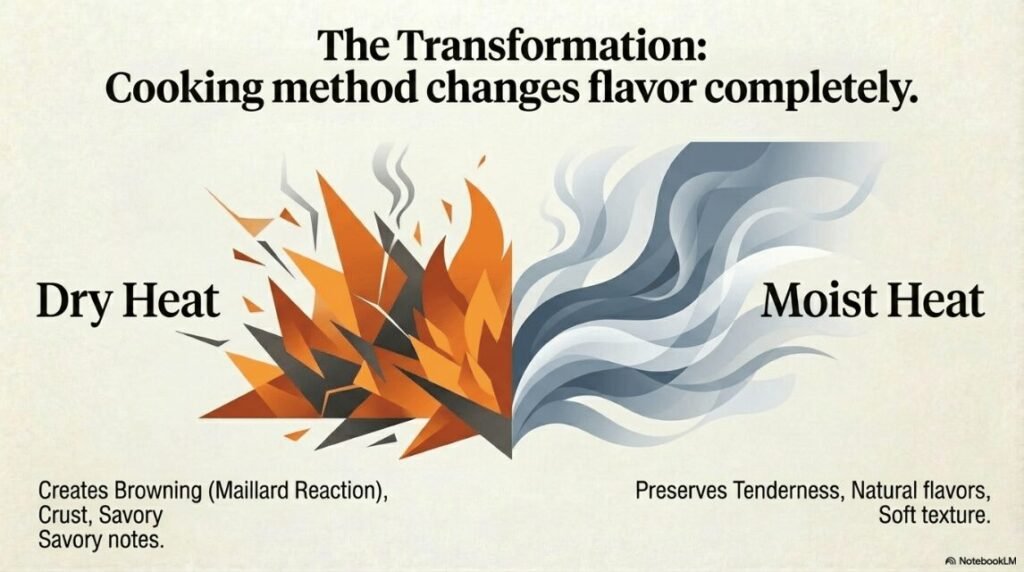
How food is cooked changes its flavor and texture completely. This is one of the most important things for servers to understand.
Dry-Heat Methods (Creates Browning and Crispy Texture)
Dry-heat methods use hot air or direct heat to cook food. They create browning through a process called the Maillard reaction – this is what makes food taste rich and savory.
1. GRILLING
Definition: Cooking over direct flame or high heat on grates
What it does:
- Creates char marks (black lines)
- Adds smoky flavor
- Crispy exterior, juicy interior
- Strong, bold flavor
Best for: Steaks, lamb chops, chicken breasts, salmon, vegetables
How to describe it: “The steak is grilled over high heat. You’ll see char marks from the grill, and it has a smoky, flame-grilled flavor.”
Customer benefit: “Grilling locks in the juices while creating a flavorful crust on the outside.”
2. ROASTING
Definition: Cooking in a hot oven with circulating dry air (usually 250°F-425°F / 120°C-220°C)
What it does:
- Even cooking on all sides
- Golden brown exterior
- Moist interior
- Develops deep flavor slowly
Best for: Whole chicken, pork tenderloin, prime rib, vegetables
How to describe it: “The chicken is roasted in the oven until the skin is golden and crispy. The meat stays juicy and tender inside.”
Customer benefit: “Roasting brings out the natural flavors and keeps everything moist.”
3. PAN-SEARING
Definition: Cooking on an extremely hot pan or griddle (375°F-450°F / 190°C-230°C+) for 2-3 minutes per side
What it does:
- Quick browning
- Develops flavorful crust
- Interior stays tender
- Creates “fond” (brown bits) for sauce
Best for: Steaks, scallops, duck breast, fish fillets
How to describe it: “The steak is seared in a very hot pan to create a caramelized crust. The inside stays tender and juicy.”
Customer benefit: “Searing creates maximum flavor in minimum time – perfect for tender cuts.”
4. SAUTÉING
Definition: Quickly cooking in a pan with a small amount of fat (butter or oil) over medium-high heat
What it does:
- Fast cooking (3-5 minutes)
- Light browning
- Keeps food tender
- Good for delicate proteins
Best for: Chicken breast, shrimp, thin fish fillets, vegetables
How to describe it: “The shrimp is sautéed quickly in garlic butter. It stays tender and picks up the flavor of the butter.”
Note: The word “sauté” comes from French meaning “to jump” – the food moves around in the pan.
5. FRYING
Pan-Frying – Shallow oil, partially submerged Deep-Frying – Completely submerged in hot oil (350°F-375°F / 175°C-190°C)
What it does:
- Creates crispy, crunchy exterior
- Seals in moisture
- Rich, indulgent texture
- Golden brown color
Best for: Chicken (fried chicken), fish (fish and chips), vegetables (onion rings, fries)
How to describe it: “The chicken is fried until golden and crispy on the outside. The coating is crunchy, and the meat inside is juicy.”
Customer benefit: “Frying creates that perfect crispy texture everyone loves.”
Moist-Heat Methods (Soft, Tender, Gentle)
Moist-heat methods use water, steam, or liquid to cook food. They keep food moist and tender but don’t create browning.
6. STEAMING
Definition: Cooking with steam (water vapor) without direct contact with water
What it does:
- Very gentle cooking
- Retains moisture completely
- No added fat
- Preserves nutrients
Best for: Fish, vegetables, dumplings
How to describe it: “The fish is steamed gently over boiling water. It’s light, healthy, and very moist.”
Customer benefit: “Steaming is the healthiest cooking method – no added oils or fats.”
7. POACHING
Definition: Cooking gently in hot liquid (not boiling) at 160°F-180°F (70°C-80°C)
What it does:
- Very tender texture
- Delicate, refined result
- Absorbs flavor from poaching liquid
- No crust or browning
Best for: Fish (especially salmon, halibut), chicken breast, eggs
How to describe it: “The salmon is poached gently in white wine and herbs. It’s incredibly tender and absorbs the subtle flavors.”
Customer benefit: “Poaching keeps fish moist and delicate – perfect for a light meal.”
8. BRAISING
Definition: Slow-cooking in liquid (partially covered) at low temperature for 2-4 hours
What it does:
- Breaks down tough connective tissue
- Creates fall-apart tenderness
- Develops deep, complex flavors
- Meat becomes incredibly soft
Best for: Tough cuts (lamb shank, short ribs, pork shoulder, chicken thighs)
How to describe it: “The short ribs are braised slowly in red wine for four hours. They’re so tender they fall off the bone.”
Customer benefit: “Braising turns tough cuts into the most tender, flavorful dishes on our menu.”
9. STEWING
Definition: Similar to braising but food is completely covered in liquid and cut into smaller pieces
What it does:
- Everything becomes very tender
- Flavors blend together
- Creates rich sauce/gravy
- Comfort food appeal
Best for: Beef stew, chicken stew, seafood stew
How to describe it: “Our beef stew has tender chunks of beef slow-cooked with vegetables in a rich gravy.”
Special Preparation Terms
MARINATED
- Soaked in spices, herbs, and liquid before cooking
- Adds flavor throughout the meat
- Makes meat more tender
How to describe it: “The chicken is marinated overnight in lemon and herbs before grilling.”
BLACKENED
- Coated in spices (usually Cajun spices)
- Cooked in a very hot cast-iron pan
- Creates dark, spicy crust
- Popular in Southern/Cajun restaurants
How to describe it: “The fish is blackened – coated in Cajun spices and seared in a hot pan until dark and crispy.”
GLAZED
- Coated with a shiny sauce (often sweet)
- Applied during or after cooking
- Examples: Teriyaki glaze, honey glaze, balsamic glaze
How to describe it: “The salmon is glazed with teriyaki sauce and broiled until caramelized.”
Part 3: Steak Doneness – The Most Important Question
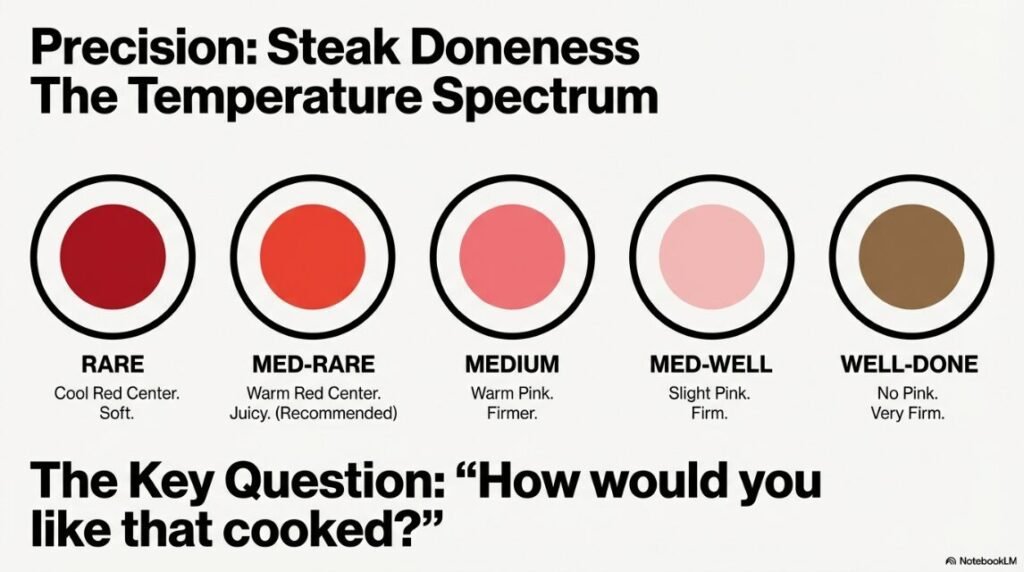
When customers order steak, you MUST ask: “How would you like that cooked?”
This is called the degree of doneness or temperature preference.
Important: Only beef steaks have doneness options. Chicken and pork must always be cooked fully (well-done) for food safety.
Steak Temperature Guide
| Doneness | Internal Temp | Center Color | Texture | Description |
|---|---|---|---|---|
| Rare | 120-125°F (50-52°C) | Cool, bright red | Very soft | “A cool red center, very soft and tender” |
| Medium-Rare | 130-135°F (54-57°C) | Warm, red-pink | Soft, juicy | “A warm red center with pink throughout – our most popular!” |
| Medium | 140-145°F (60-63°C) | Warm pink | Slightly firm | “A warm pink center, firmer texture” |
| Medium-Well | 150-155°F (65-68°C) | Slight pink | Firm | “Just a hint of pink, mostly brown throughout” |
| Well-Done | 160°F+ (71°C+) | No pink, brown | Very firm | “Cooked all the way through, no pink” |
How to Ask About Doneness
Professional phrases:
- “How would you like your steak cooked?”
- “What temperature would you prefer?”
- “How would you like that prepared?”
NEVER say:
- “How do you want it done?” (too casual)
- “Raw or cooked?” (confusing and unprofessional)
How to Recommend
Most popular choice: “Most of our guests prefer medium-rare. It’s the perfect balance of juicy and cooked.”
For customers who don’t know: “If you’re unsure, I recommend medium-rare. It’s warm throughout with a pink center – not too rare, not too done.”
Important caveat for well-done: “Just so you know, well-done steak will be firmer and less juicy than medium. We can serve it with extra sauce if you’d like.”
Why this matters: Managing expectations prevents disappointment. Well-done steak is naturally drier and tougher.
Confirming the Order
Always repeat back the temperature:
Customer: “I’ll have the ribeye, medium-rare.” You: “Perfect – one ribeye, cooked medium-rare with a warm red center. Excellent choice!”
Why this works: Confirms understanding and shows professionalism.
Part 4: Side Dishes – What Comes With It
Side dishes accompany the main protein. They’re served “on the side” of the plate.
Most main courses include 1-2 sides, or customers can add sides separately.
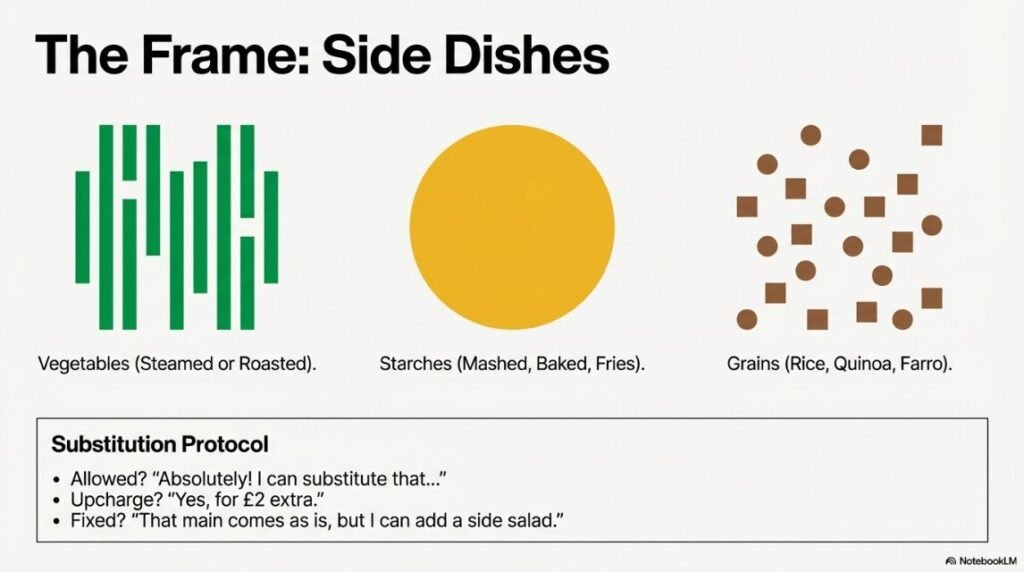
Common Side Dish Categories
VEGETABLES
Steamed Vegetables
- Broccoli, carrots, green beans
- Cooked with steam (healthy)
- “Our vegetables are steamed to keep them crisp and nutritious”
Roasted Vegetables
- Brussels sprouts, asparagus, root vegetables
- Cooked in oven until slightly caramelized
- “The vegetables are roasted with olive oil until tender and golden”
Sautéed Greens
- Spinach, kale, collard greens
- Quickly cooked in garlic and oil
- “The spinach is sautéed with garlic and olive oil”
STARCHES (CARBOHYDRATES)
Potatoes – Most Popular Starch
| Type | Preparation | Description |
|---|---|---|
| Mashed Potatoes | Boiled then mashed with butter/cream | “Creamy and smooth” |
| Baked Potato | Roasted whole in oven | “Fluffy inside, crispy skin outside” |
| French Fries | Deep-fried strips | “Crispy and golden” |
| Roasted Potatoes | Cut into chunks, roasted | “Crispy outside, tender inside” |
| Hash Browns | Shredded, pan-fried | “Crispy and golden brown” |
| Au Gratin | Sliced, baked with cheese/cream | “Creamy with melted cheese on top” |
Rice
- Steamed Rice – Plain, fluffy white or brown rice
- Pilaf – Rice cooked in broth with aromatics
- Fried Rice – Stir-fried with vegetables and soy sauce
How to describe: “The rice is fluffy and light” (steamed) “The pilaf is aromatic with herbs and spices” (pilaf)
Pasta/Noodles
- Usually served as a main course, but sometimes as a side
- Common types: Spaghetti, penne, fettuccine, rice noodles
Grains (Health-Conscious Options)
- Quinoa – Protein-rich grain, slightly nutty
- Couscous – Tiny pasta, light and fluffy
- Farro – Chewy ancient grain
How to describe: “Quinoa is a high-protein grain with a slightly nutty flavor – it’s very nutritious.”
How to Handle Side Substitutions
Common customer request: “Can I substitute the fries for a salad?”
Professional responses:
If allowed (most restaurants): “Absolutely! I can substitute the fries for a house salad or any other side for you.”
If there’s an upcharge: “Yes, we can do that. The salad is £2 extra. Is that okay?”
If not allowed: “Unfortunately, that particular main comes with fries only. But I can add a side salad for £3 if you’d like?”
Part 5: Adjectives – Describing Taste and Texture
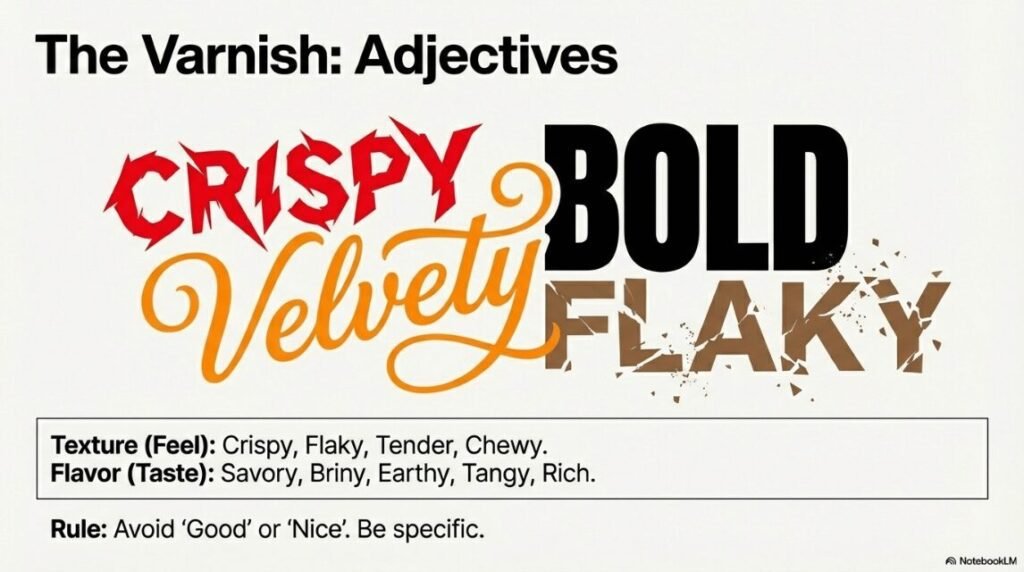
Professional servers use specific adjectives to help customers imagine the food.
Texture Words (How Food Feels)
| Adjective | Meaning | Examples |
|---|---|---|
| Crispy | Hard, crunchy, makes sound when you bite | Fried chicken, bacon, chips/fries |
| Crunchy | Similar to crispy but thicker | Raw vegetables, toasted nuts |
| Tender | Soft, easy to cut and chew | Braised meat, filet mignon |
| Juicy | Full of liquid, moist, not dry | Grilled chicken, ripe tomatoes |
| Flaky | Falls apart in layers | Baked fish, pie crust |
| Creamy | Smooth, rich like cream | Mashed potatoes, Alfredo sauce |
| Chewy | Requires chewing, not soft | Steak (if overcooked), bread crust |
| Melt-in-your-mouth | So tender it seems to dissolve | Filet mignon, braised short ribs |
Flavor Words (How Food Tastes)
| Adjective | Meaning | Examples |
|---|---|---|
| Savory | Salty, meaty, not sweet | Steak, roasted chicken, mushrooms |
| Rich | Full of fat, butter, or cream (heavy) | Ribeye, cream sauce, cheese |
| Mild | Gentle flavor, not strong | Chicken breast, cod, tofu |
| Bold | Strong, intense flavor | Blue cheese, ribeye, blackened fish |
| Spicy | Hot, burns the tongue | Chili peppers, hot sauce, curry |
| Tangy | Slightly sour or acidic | Lemon, vinaigrette, BBQ sauce |
| Smoky | Taste of smoke or fire | Grilled meat, smoked salmon |
| Sweet | Sugar taste | Glazed carrots, teriyaki sauce |
| Earthy | Natural, like soil/mushrooms | Mushrooms, lentils, beets |
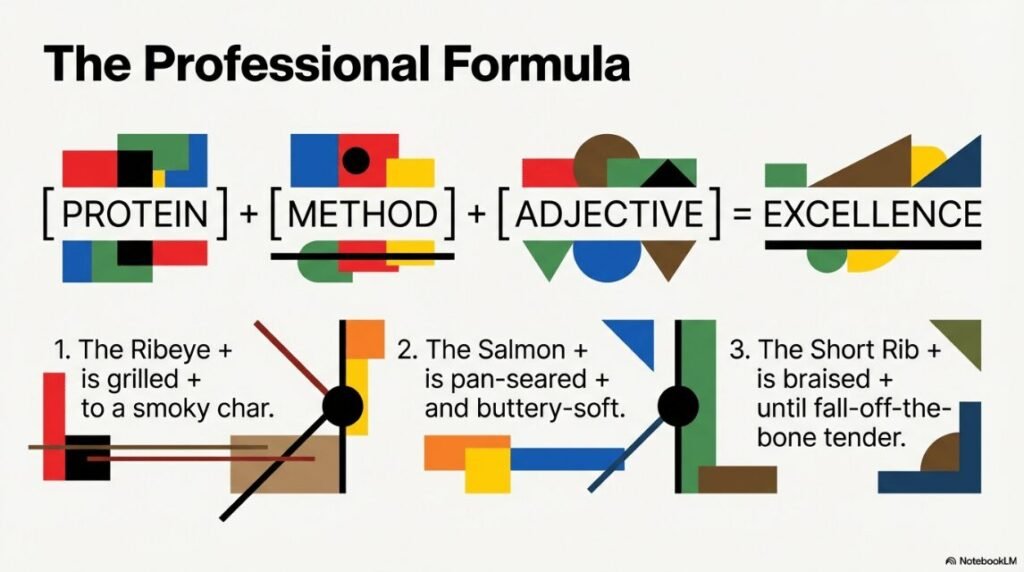
Combining Adjectives – The Professional Formula
Formula: [Protein] + [Cooking Method] + [Texture/Flavor Adjective]
Examples:
❌ Basic: “The steak is good.” ✅ Professional: “The ribeye is grilled to perfection – juicy and rich with a smoky, charred crust.”
❌ Basic: “The chicken is cooked.” ✅ Professional: “The chicken breast is pan-seared until golden and crispy on the outside, tender and juicy inside.”
❌ Basic: “We have fish.” ✅ Professional: “The salmon is roasted with lemon butter – flaky, moist, and delicate.”
Part 6: Sample Dialogue – Ordering a Main Course
Here’s a complete conversation between a server and customer:
Server: Good evening! Have you had a chance to look at our main courses?
Customer: Yes, I’m interested in the steak, but I have some questions.
Server: Of course! Our steaks are very popular. What would you like to know?
Customer: What’s the difference between the ribeye and the filet mignon?
Server: Great question! The ribeye is our most flavorful steak – it’s very juicy and rich because of the marbling throughout. The filet mignon is the most tender cut – it’s leaner and has a mild, buttery flavor. The ribeye has bold flavor, while the filet is more delicate.
Customer: I think I’ll try the ribeye. How is it cooked?
Server: Excellent choice! The ribeye is grilled over high heat to create a beautiful char on the outside. How would you like it cooked? Most guests prefer medium-rare – that’s a warm red center, very juicy.
Customer: Medium-rare sounds good.
Server: Perfect! And that comes with two sides. You can choose from mashed potatoes, roasted vegetables, French fries, or a house salad.
Customer: Can I get the roasted vegetables and mashed potatoes?
Server: Absolutely! So that’s one ribeye, grilled medium-rare, with roasted vegetables and mashed potatoes. Excellent choice – that ribeye is incredible!
Customer: Thank you!
Part 7: Common Customer Questions and How to Answer
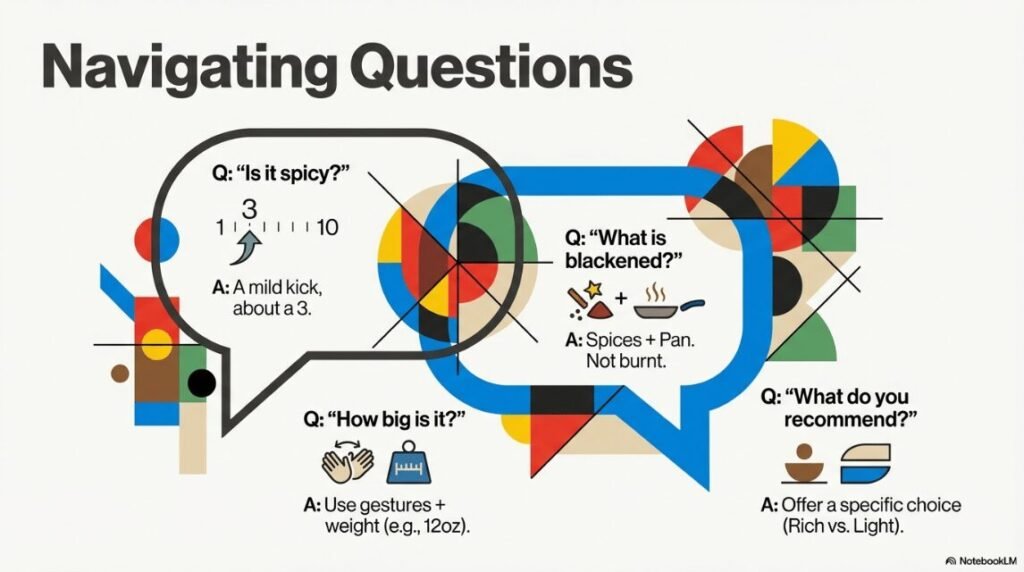
“What do you recommend?”
Bad answer: “Everything is good.” Good answer: “Our ribeye is our most popular steak – it’s incredibly juicy and flavorful. If you prefer something lighter, the grilled salmon is excellent – it’s fresh and served with lemon butter.”
Why this works: Specific recommendations with descriptions help customers decide.
“How big is the portion?”
Bad answer: “It’s pretty big.” Good answer: “The steak is 12 ounces – that’s about this size [gesture with hands]. Most people find it very filling. It comes with two sides as well.”
Why this works: Specific measurements and context help customers visualize.
“Is this dish spicy?”
Bad answer: “A little bit.” Good answer: “It has a mild kick from the peppers, but it’s not very spicy. On a scale of 1 to 10, it’s about a 3. If you’re sensitive to spice, I can ask the kitchen to make it mild.”
Why this works: Scale reference and offering a solution shows care.
“Can this be made vegetarian/vegan?”
Bad answer: “I don’t think so.” Good answer: “Let me check with the kitchen. We can definitely make substitutions. We also have several plant-based main courses like our lentil bowl or tofu stir-fry if you’d prefer something designed to be vegetarian.”
Why this works: Shows willingness to help and offers alternatives.
“What does ‘blackened’ mean?”
Bad answer: “It’s burnt.” Good answer: “Great question! Blackened means the fish is coated in Cajun spices and seared in a very hot pan. The spices create a dark, flavorful crust – it’s not actually burnt, just well-seasoned and crispy.”
Why this works: Clear explanation prevents misunderstanding.
“How is this cooked?” (for non-steak items)
Bad answer: “In the oven.” Good answer: “The chicken is pan-seared first to get a crispy golden crust, then finished in the oven to cook through. It stays juicy and tender this way.”
Why this works: Explains the method and the benefit.
Part 8: Common Mistakes to Avoid
❌ Mistake 1: Not Asking About Steak Temperature
Wrong: Taking the order without asking how they want it cooked Right: “How would you like your steak cooked? Most guests prefer medium-rare.”
Why it matters: Steak cooked wrong is the #1 complaint in restaurants.
❌ Mistake 2: Using Vague Words
Wrong: “The fish is nice.” Right: “The salmon is grilled – flaky, moist, and served with lemon butter.”
Why it matters: Specific adjectives help customers make confident decisions.
❌ Mistake 3: Not Knowing Sides
Wrong: “I don’t know what comes with it.” Right: “That comes with roasted vegetables and your choice of mashed potatoes or rice.”
Why it matters: Customers expect servers to know what’s included.
❌ Mistake 4: Confusing Cooking Methods
Wrong: “It’s grilled… or maybe roasted? I’m not sure.” Right: “It’s roasted in the oven until golden brown and tender.”
Why it matters: Credibility. Customers trust servers who know the menu.
❌ Mistake 5: Not Explaining Unfamiliar Terms
Wrong: Assuming customers know what “braised” means Right: “Braised means it’s slow-cooked in liquid for hours until it’s fall-apart tender.”
Why it matters: Many customers don’t know culinary terms – helping them shows expertise.
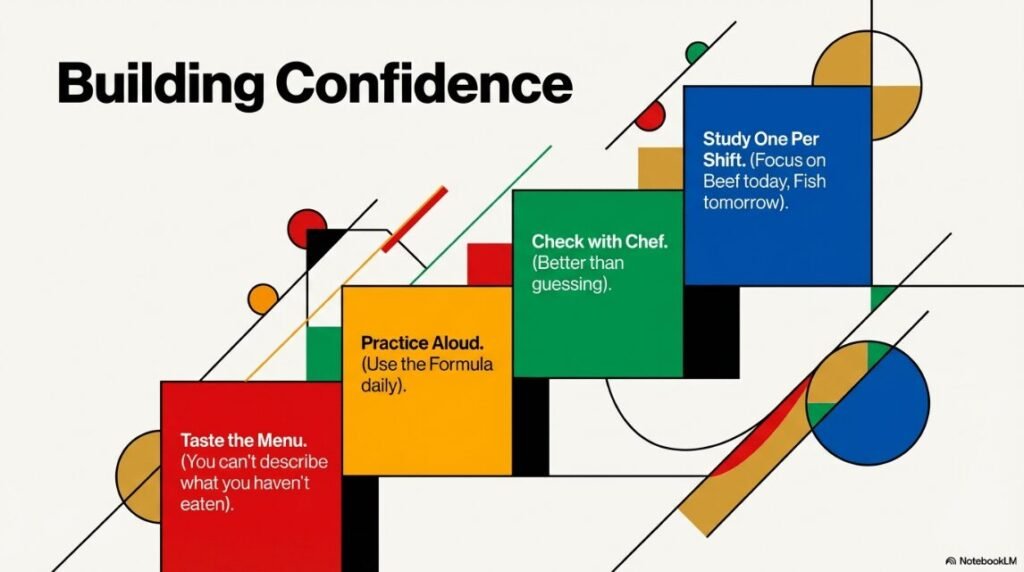
Part 9: Tips for Building Confidence
1. Taste the menu Ask your manager if you can try small portions of each main course. You can’t describe food well if you haven’t tasted it.
2. Practice cooking method vocabulary Every day, pick 3 dishes and practice saying how they’re cooked out loud.
Example:
- “The salmon is pan-seared…”
- “The chicken is roasted…”
- “The beef is grilled…”
3. Learn one protein deeply per shift Day 1: Master all beef descriptions Day 2: Master all chicken descriptions Day 3: Master all fish descriptions
4. Ask experienced servers When you don’t know something, ask: “How do you describe the ribeye to customers?” Write down what they say.
5. Study the menu before busy service Read the menu 10 minutes before your shift starts. Say the cooking methods out loud.
6. Use the formula [Protein] + [Cooking Method] + [Adjective] = Professional Description
“The salmon is grilled – crispy outside, tender inside.”
7. Don’t be afraid to say “Let me find out” If you don’t know the answer, say: “That’s a great question. Let me check with the chef to give you the most accurate information.”
This is better than guessing!
Summary: What You Learned Today
Today you learned:
✓ The main types of proteins: beef, chicken, pork, lamb, fish, and plant-based ✓ Different beef cuts and how to describe them (filet mignon, ribeye, New York strip) ✓ The difference between white meat and dark meat chicken ✓ Essential cooking methods: grilling, roasting, pan-searing, frying, steaming, poaching, braising ✓ How to ask about and explain steak doneness (rare, medium-rare, medium, medium-well, well-done) ✓ Common side dishes and how to describe them ✓ Texture and flavor adjectives: crispy, tender, juicy, savory, rich, mild ✓ How to answer common customer questions professionally ✓ The professional formula: Protein + Cooking Method + Adjective
You now have the vocabulary and phrases to describe main courses with confidence.
📝 Test Your Main Course Knowledge
Ready to see how much you learned? Take this quick quiz! (5 questions, 2 minutes)
Next Steps in Your Menu Mastery Journey
Continue the Series: 📖 Part 3: Wine & Beer Service – Coming soon! Learn beverage vocabulary and pairing recommendations.
Download Free Resource: 📥 Complete Menu Vocabulary Guide – Get all 5 parts in one downloadable PDF [Link to lead magnet]
Ready for Professional Training? 🎓 English for Waiters Course – Master the complete service experience
📚 Additional Learning Resources
Want to learn more about cooking methods and restaurant terminology?
Professional culinary programs like the Institute of Culinary Education train students on professional kitchen vocabulary and service standards.
For additional food service English resources, EnglishClub offers comprehensive restaurant vocabulary guides for ESL learners.
Many servers also complete ServSafe food safety certification to ensure they understand proper food handling and cooking temperatures.
Ready to Master ALL Restaurant English?
You’ve learned main course vocabulary. That’s excellent progress!
But what about: ❓ Describing wine and beer to customers? ❓ Handling complaints about overcooked food? ❓ Taking phone reservations? ❓ Speaking confidently to your manager? ❓ Asking for a promotion?
English for Waiters covers everything you need to succeed:
✓ 22 video lessons (greetings to payment) ✓ 60-page phrase guide with hundreds of professional expressions ✓ Complete course book with scripts and vocabulary ✓ Certificate of completion for your CV ✓ Lifetime access – study forever
All for only £37.99
→ ENROLL IN ENGLISH FOR WAITERS TODAY
You’ve Completed Part 2 of Menu Mastery!
Congratulations! You now have the vocabulary and confidence to describe proteins, cooking methods, and sides professionally.
Next: Part 3 will teach you about wine and beer service – essential beverage knowledge for every server.
Your customers are waiting. Your confidence is growing. Let’s continue.
Ready to Master Restaurant English?
These free articles and scenarios are a great start, but if you want a complete, structured system for learning restaurant English, consider our full course.

English for Waiters includes:
✅ 22+ video lessons covering every restaurant situation
✅ Real restaurant scenarios with native pronunciation
✅ Interactive pronunciation practice
✅ Downloadable phrase guides
✅ Lifetime access with free updates