A customer sits down for lunch. You approach with a smile and ask: “What can I get you to drink?”
They reply: “Just coffee, please.”
Simple, right? But then they ask: “What’s the difference between a latte and a cappuccino?”
Your mind goes blank. You know both have coffee and milk, but… which is which?
Or maybe a customer orders tea. “Do you have herbal options?” they ask. You’re not sure if chamomile is herbal. Is green tea caffeine-free?
These moments feel embarrassing. You want to help, but you don’t have the vocabulary or knowledge.
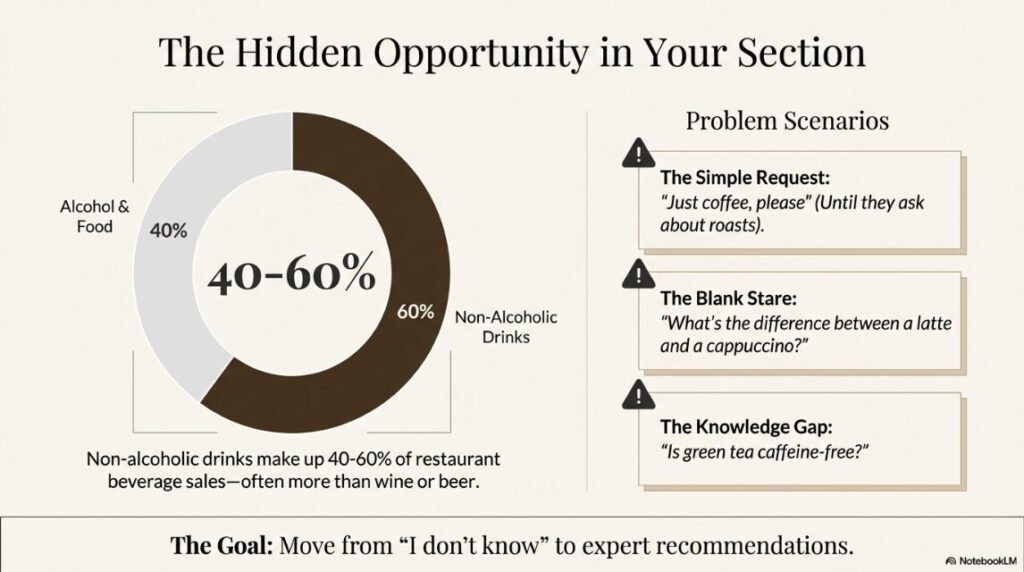
Here’s the truth: Non-alcoholic drinks are 40-60% of beverage sales in restaurants. Coffee, tea, soft drinks, and juice are ordered more often than wine and beer. Yet most servers receive almost no training on them.
Today, that changes.
What You’ll Learn Today
This guide teaches you:
- The main coffee drinks and how they differ (espresso, latte, cappuccino, americano)
- The 5 types of tea and when to recommend each
- How to describe coffee roasts (light, medium, dark)
- Soft drink service and professional language
- Juice options and fresh vs. bottled differences
- Water service standards
- Common customer questions and perfect responses
You don’t need barista certification. You just need practical knowledge you can use on your next shift.
Let’s begin.
Part 1: Coffee Service – The Foundation
The Two Main Coffee Categories
All coffee drinks fit into two categories:
1. ESPRESSO-BASED DRINKS (made with espresso shots + milk) 2. DRIP/BREWED COFFEE (regular coffee, made with coffee grounds + hot water)
Today we focus on espresso-based drinks because these confuse servers the most.
Part 2: The Espresso-Based Drinks You Must Know
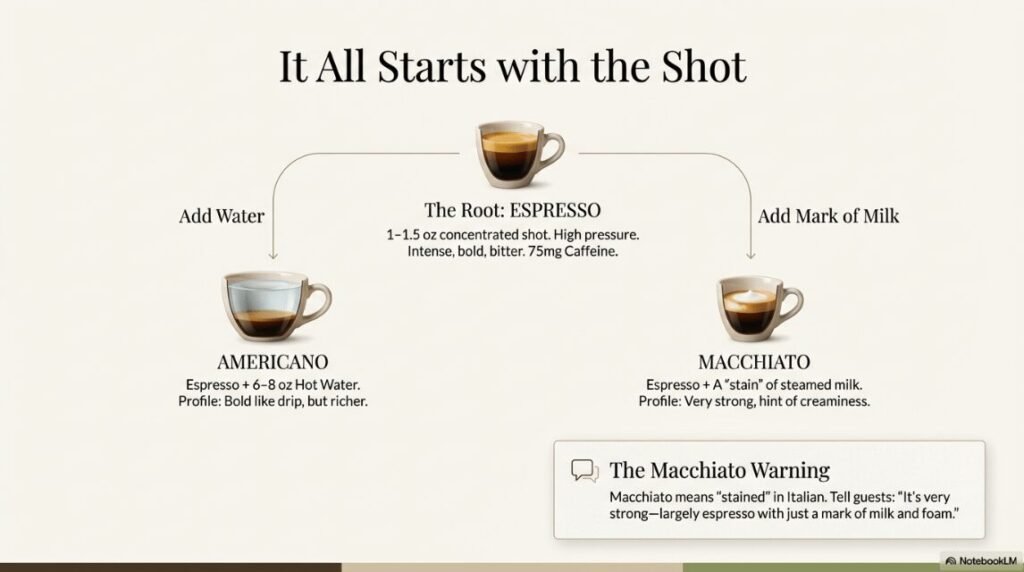
All espresso drinks have the same foundation: espresso + steamed milk. The difference is the ratio of milk to espresso.
Drink #1: Espresso
What it is: A small, concentrated shot of coffee (1-1.5 oz)
How it’s made: Hot water is forced through finely ground coffee beans under high pressure
Characteristics:
- Very strong and intense
- Bold, concentrated flavor
- Bitter taste
- High caffeine (75mg per shot)
When customers order: Usually after meals, quickly consumed
How to describe it: “A small, concentrated shot of coffee – very strong and intense.”
Drink #2: Americano
What it is: Espresso + hot water
Ratio:
- 1-2 shots espresso
- 6-8 oz hot water
Characteristics:
- Strong but less intense than espresso
- Similar to drip coffee but bolder
- No milk
How to describe it: “Espresso diluted with hot water – bold and strong, similar to regular coffee but richer.”
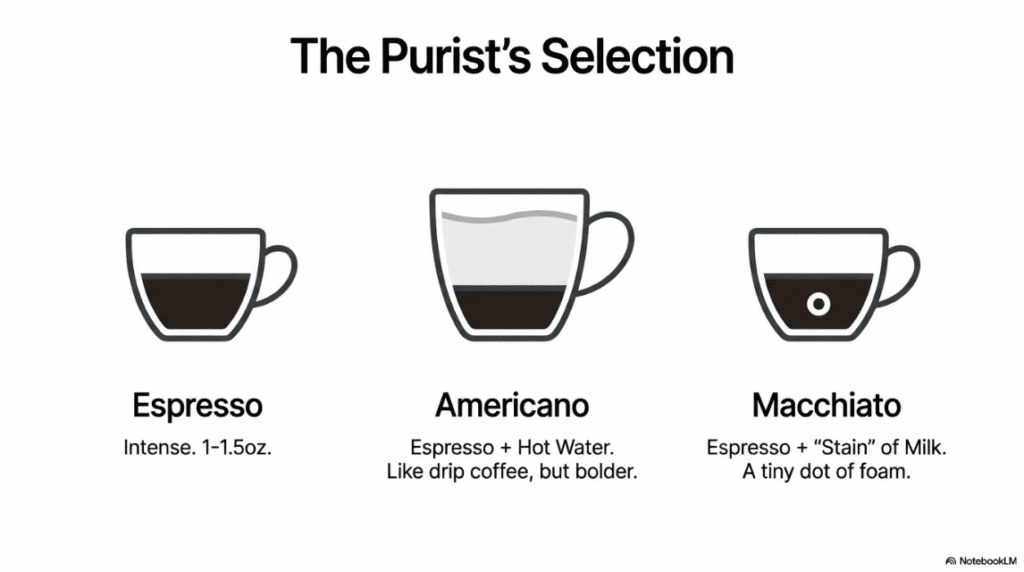
Drink #3: Macchiato
What it is: Espresso + tiny splash of steamed milk
Ratio:
- 1-2 shots espresso
- Tiny splash of milk (just a “stain”)
- Small dot of foam on top
Characteristics:
- Very strong (almost like straight espresso)
- Just a hint of milk to soften the bitterness
- Small drink (3-4 oz)
How to describe it: “Espresso ‘stained’ with a tiny bit of milk – very strong with just a hint of creaminess.”
Important note: The word “macchiato” means “stained” or “marked” in Italian.
Drink #4: Cappuccino
What it is: Espresso + steamed milk + thick foam
Ratio:
- 1-2 shots espresso (⅓)
- Steamed milk (⅓)
- Thick foam (⅓)
Characteristics:
- Medium-strong flavor
- Bold with creamy texture
- Lots of thick foam on top
- Smaller drink (6 oz)
How to describe it: “Espresso with steamed milk and thick foam – bold but creamy. About one-third foam.”
Drink #5: Latte
What it is: Espresso + lots of steamed milk + thin foam layer
Ratio:
- 1-2 shots espresso
- Much more steamed milk than cappuccino
- Small, thin layer of foam on top
Characteristics:
- Medium-light strength
- Mild, creamy, smooth
- Milk-forward (you taste milk more than coffee)
- Larger drink (8-12 oz)
How to describe it: “Espresso with lots of steamed milk – smooth and mild. Less foam than cappuccino.”
Drink #6: Flat White
What it is: Espresso + velvety steamed milk + thin microfoam
Ratio:
- 1-2 shots espresso
- Steamed milk (about ⅔)
- Very thin microfoam layer
Characteristics:
- Medium strength
- Smooth and velvety texture
- Less foam than cappuccino
- Stronger than latte (less milk)
How to describe it: “Espresso with velvety steamed milk – smooth and creamy with very little foam. Stronger than a latte.”
Drink #7: Mocha
What it is: Espresso + steamed milk + chocolate
Ratio:
- 1-2 shots espresso
- Steamed milk
- Chocolate syrup or powder
- Optional: whipped cream on top
Characteristics:
- Sweet and rich
- Chocolate + coffee flavor
- Medium strength
How to describe it: “Espresso with steamed milk and chocolate – sweet and rich. Like a hot chocolate with coffee.”
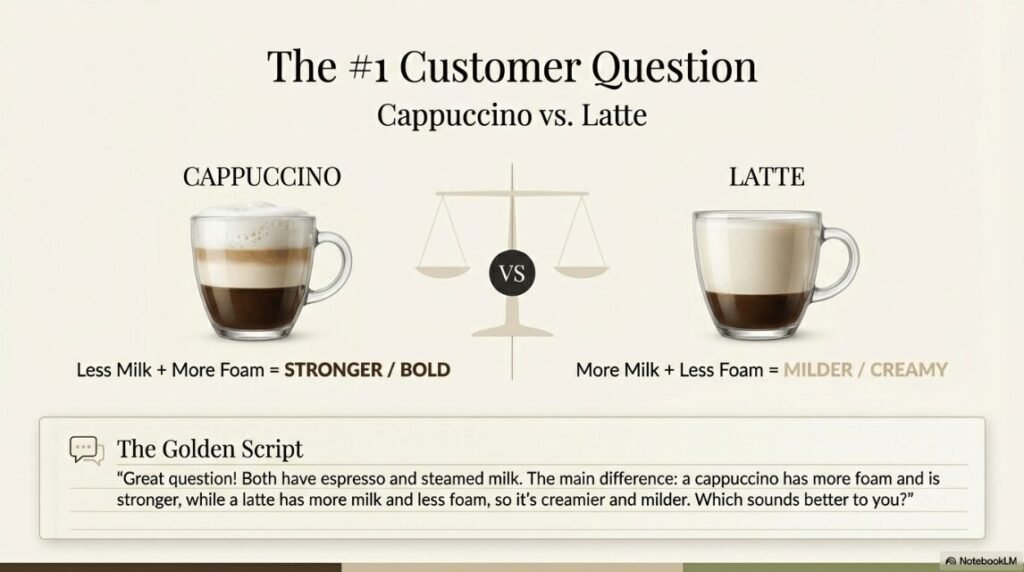
Part 3: The Critical Difference – Cappuccino vs. Latte
This is the #1 customer question about coffee.
Here’s the simple answer:
| Feature | Cappuccino | Latte |
|---|---|---|
| Milk Amount | Less milk (⅓) | More milk (⅔) |
| Foam Amount | Thick foam (⅓) | Thin foam layer |
| Strength | Stronger (more coffee taste) | Milder (more milk taste) |
| Size | Smaller (6 oz) | Larger (8-12 oz) |
| Taste | Bold + creamy | Smooth + mild |
| Texture | Foamy | Creamy |
The professional one-sentence answer:
“A cappuccino has more foam and is stronger. A latte has more milk and less foam, so it’s creamier and milder.”
What to say to customers:
“Great question! Both have espresso and steamed milk. The main difference: a cappuccino has more foam and is stronger, while a latte has more milk and less foam, so it’s creamier and milder. Which sounds better to you?”
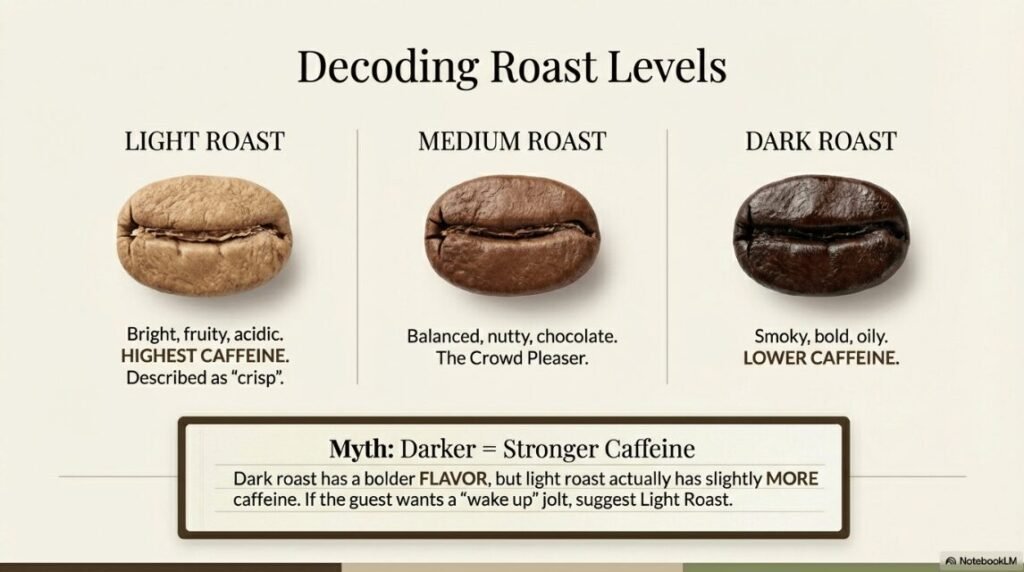
Part 4: Coffee Roast Levels – Light, Medium, Dark
Customers often ask about coffee roasts. Here’s what you need to know:
Light Roast (Blonde, Cinnamon)
Color: Light brown
Flavor:
- Bright and fruity
- Citrus notes
- Floral
- Slightly sweet
Body: Light, tea-like, delicate
Acidity: High (crisp, sharp)
Caffeine: Slightly higher than dark roast
How to describe it: “A light roast with bright, fruity flavors – crisp and refreshing.”
Medium Roast (American, Breakfast)
Color: Medium brown
Flavor:
- Balanced
- Chocolate and caramel
- Nutty (hazelnut, almond)
- Some fruit
Body: Medium, balanced
Acidity: Moderate (balanced)
Caffeine: Moderate
How to describe it: “A medium roast with chocolate and nutty notes – perfectly balanced.”
Most popular choice: This is the most common roast in casual restaurants.
Dark Roast (French, Italian, Espresso)
Color: Dark brown to nearly black, oily surface
Flavor:
- Smoky and bold
- Dark chocolate
- Molasses
- Caramel
- Roasted taste dominates
Body: Full, heavy, thick, creamy
Acidity: Low (smooth, less sharp)
Caffeine: Slightly lower
How to describe it: “A dark roast with bold, smoky flavors – rich and intense.”
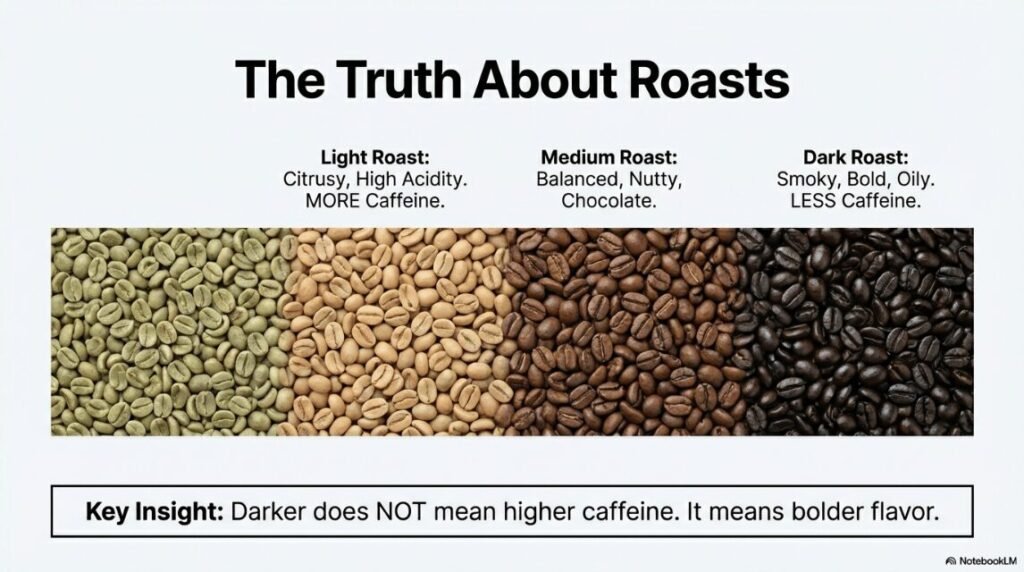
The Important Myth to Bust
Customer says: “I want dark roast because it’s stronger.”
The truth: Darker roasts are NOT higher in caffeine. They have slightly LESS caffeine because some burns off during roasting.
What “strength” means:
- Flavor strength: How bold the taste is (dark roast = bold flavor)
- Caffeine strength: How much caffeine (light roast = slightly more caffeine)
What to say: “Just so you know, dark roast has bold, intense flavor but slightly less caffeine than light roast. If you want the most caffeine, light roast actually has a bit more. But if you want bold flavor, dark roast is perfect!”
Part 5: Essential Coffee Vocabulary
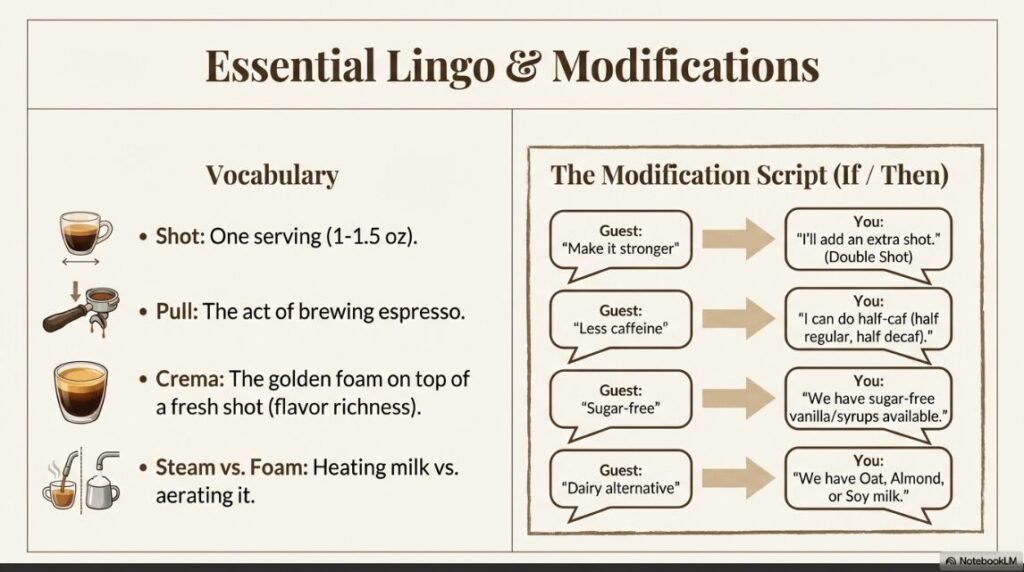
Words You Must Know
| Word | Meaning | Example |
|---|---|---|
| Shot | One serving of espresso (1-1.5 oz) | “Single shot” or “double shot” |
| Double shot | Two espresso shots | “Extra strong” |
| Pull | To brew/extract espresso | “I’ll pull that shot for you” |
| Crema | Golden foam on top of espresso | “That’s the crema – the richness” |
| Steam | Heat milk using steam wand | “Steamed milk” |
| Foam | Frothed milk with air bubbles | “Thick foam” or “microfoam” |
| Decaf | Caffeine-removed coffee | “No caffeine” |
| Half-caf | Half regular, half decaf | “Half the caffeine” |
Part 6: Common Coffee Modifications
Customers will ask for changes. Here’s how to handle them:
| Customer Says | You Say |
|---|---|
| “Make it stronger” | “I’ll add an extra espresso shot for you” |
| “I want less caffeine” | “I’ll make that half regular, half decaf” |
| “Caffeine-free, please” | “Absolutely – decaf espresso coming right up” |
| “Can I get oat milk?” | “Yes, we have oat milk available” |
| “Almond milk instead” | “Of course – almond milk” |
| “Soy milk, please” | “Absolutely – soy milk” |
| “Make it extra hot” | “I’ll have them make it extra hot” |
| “Less foam, please” | “Light foam, coming up” |
| “No foam at all” | “Just steamed milk, no foam” |
| “Sugar-free vanilla?” | “Yes, we have sugar-free syrups” |
Part 7: When to Offer Coffee
Morning/Brunch Service
Offer coffee immediately after greeting:
- “Good morning! Can I start you with coffee?”
- “Would you like coffee while you look at the menu?”
Lunch Service
Offer with or after taking food order:
- “What would you like to drink? Coffee, tea, soft drink?”
Dinner Service
Offer after the meal, with dessert:
- “Would you enjoy a coffee or espresso with dessert?”
- “Can I bring you coffee or tea?”
Part 8: Tea Service – The 5 Main Categories
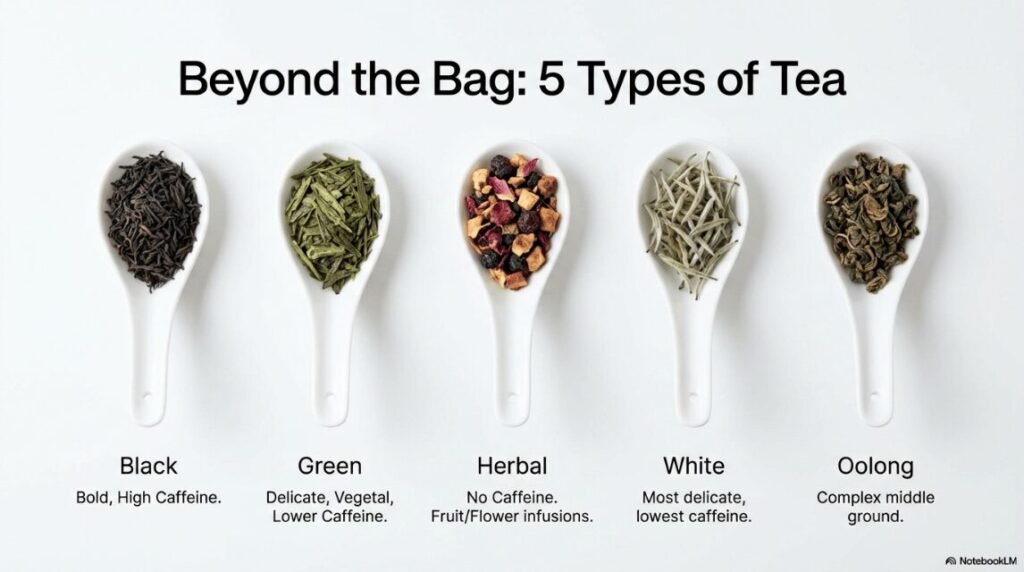
Tea confuses many servers. But it’s actually simple: there are 5 main types of tea.
Category 1: Black Tea (Full-Bodied, Bold, High Caffeine)
What it is: Fully oxidized tea leaves (dark color, robust flavor)
Caffeine: 40-90mg per cup (highest of all teas)
Flavor: Bold, rich, full-flavored
Water temperature: Boiling (200-212°F)
Steeping time: 3-5 minutes
Popular varieties:
- English Breakfast: Bold blend of black teas – classic, approachable
- Earl Grey: Black tea with bergamot orange – fragrant, sophisticated
- Assam: Indian black tea – malty, rich
- Darjeeling: Indian black tea – fruity, floral, delicate
- Ceylon: Sri Lankan black tea – bright, slightly citrus
How to describe it: “A bold, full-flavored tea – perfect if you want strong tea with higher caffeine.”
When to recommend:
- Morning service
- Customers who want caffeine
- People who like strong flavors
- With milk and sugar (traditional British style)
Category 2: Green Tea (Light, Delicate, Lower Caffeine)
What it is: Unoxidized or minimally oxidized tea leaves
Caffeine: 25-50mg per cup (lower than black tea)
Flavor: Light, delicate, fresh, grassy, vegetal
Water temperature: 160-180°F (IMPORTANT: NOT boiling – makes it bitter!)
Steeping time: 2-4 minutes
Popular varieties:
- Jasmine Green: Green tea with jasmine flowers – floral, light, aromatic
- Sencha: Japanese green tea – fresh, grassy, bright
- Matcha: Powdered Japanese green tea – earthy, slightly sweet (if ordered as latte)
How to describe it: “A lighter, more delicate tea – perfect if you want lower caffeine with fresh, subtle flavors.”
When to recommend:
- Afternoon service
- Customers who want less caffeine
- People who prefer subtle flavors
- Health-conscious customers
CRITICAL SERVER NOTE: Never use boiling water for green tea! It makes it taste bitter. Use water that’s cooled slightly after boiling.
Category 3: Herbal Tea (Caffeine-Free, Soothing)
What it is: NOT actually tea (no tea plant leaves) – it’s an infusion of herbs, flowers, fruits, spices
Caffeine: 0mg (completely caffeine-free)
Flavor: Varies widely depending on herbs used
Water temperature: Boiling (200-212°F)
Steeping time: 5-7 minutes
Popular varieties:
- Peppermint: Refreshing, cooling, helps digestion
- Chamomile: Calming, sweet, floral – great for relaxation
- Rooibos: South African, naturally sweet, caffeine-free, warming
- Hibiscus: Tart, fruity, bright red color
- Ginger: Warming, spicy, helps digestion
- Lemon Balm: Fresh, lemony, calming
How to describe it: “A caffeine-free herbal tea – perfect for evening or if you want to avoid caffeine.”
When to recommend:
- Evening service
- After dinner
- Customers who want no caffeine
- Customers with sensitive stomachs (peppermint, ginger, chamomile help digestion)
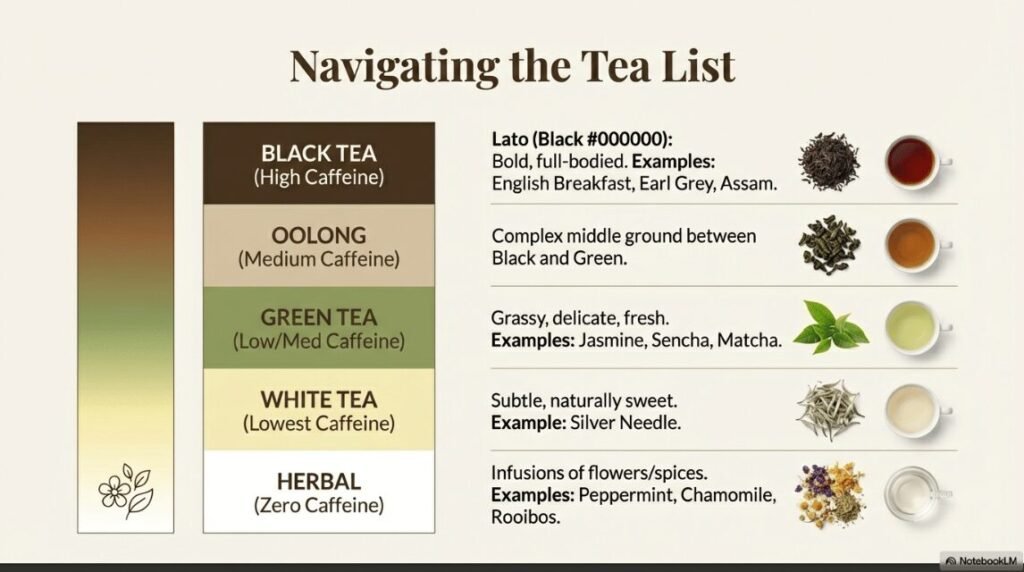
Category 4: White Tea (Most Delicate, Lowest Caffeine)
What it is: Minimally processed tea (young leaves and buds only)
Caffeine: 15-30mg per cup (lowest caffeine of all teas)
Flavor: Very subtle, delicate, naturally sweet, floral
Water temperature: 140-160°F (very low – delicate leaves)
Steeping time: 3-5 minutes
Popular varieties:
- Silver Needle: Most delicate, sweet, pale color
- White Peony: Slightly more robust, floral notes
How to describe it: “The most delicate tea we offer – very subtle, naturally sweet flavors, lowest caffeine.”
When to recommend:
- Customers who want very subtle tea
- People sensitive to caffeine
- Customers who like naturally sweet flavors
Category 5: Oolong Tea (Between Green and Black, Medium Caffeine)
What it is: Partially oxidized tea (between green and black)
Caffeine: 30-50mg per cup
Flavor: Can range from floral/fruity to dark/roasted
Water temperature: 160-212°F (depends on oxidation level)
Steeping time: 3-5 minutes
Popular varieties:
- Light Oolong: Floral, fruity, delicate (similar to green tea)
- Dark Oolong: Roasted, complex, rich (similar to black tea)
How to describe it: “A middle-ground tea – between green and black. Floral and complex with moderate caffeine.”
When to recommend:
- Customers who can’t decide between green and black
- Tea enthusiasts who want something different
Part 9: The Simple Tea Guide for Servers
When customers ask “What tea do you have?” – use this framework:
“We have black teas (bold with high caffeine), green teas (lighter with less caffeine), and herbal teas (caffeine-free). Which sounds good to you?”
Then offer specific options based on their choice.
Part 10: Tea Service Procedure
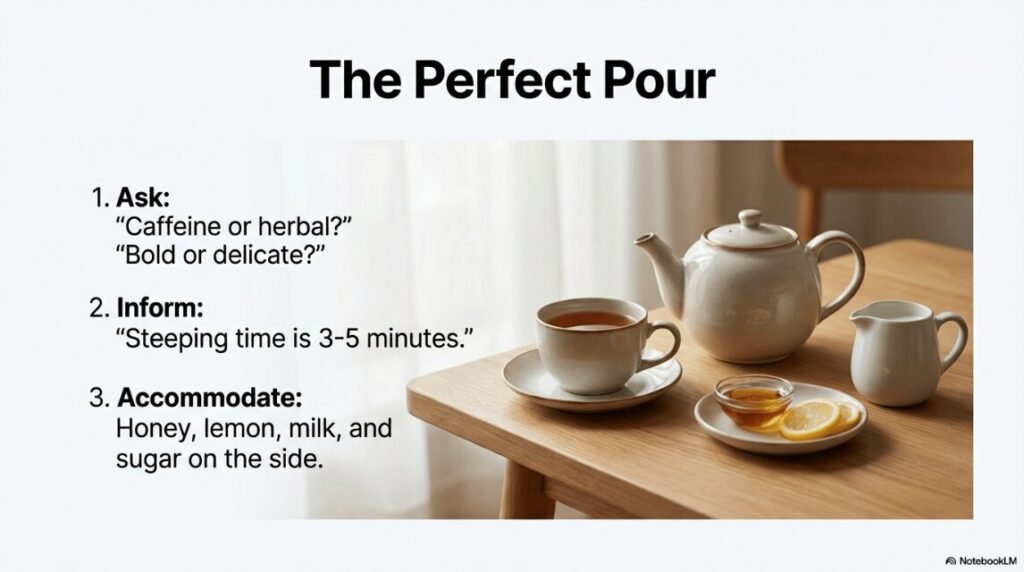
Step 1: Offer Tea
“Would you like tea? We have black, green, and herbal options.”
Step 2: Understand Their Preference
“Do you prefer something bold and strong, or light and delicate? And do you want caffeine?”
Step 3: Present the Tea
- Deliver tea in a teapot or with tea bag
- Tell them steeping time: “This needs 3-4 minutes to steep”
- Place honey, lemon, milk, and sugar within reach
Step 4: Let It Steep
- Tea must steep for the correct time (usually 3-5 minutes)
- Some customers prefer to steep their own
- Remove tea bag after steeping (prevents over-steeping and bitterness)
Step 5: Serve
- Pour tea into cup (or let customer pour)
- Offer milk, honey, lemon, sugar on the side
Part 11: Critical Tea Service Knowledge
Water Temperature Matters!
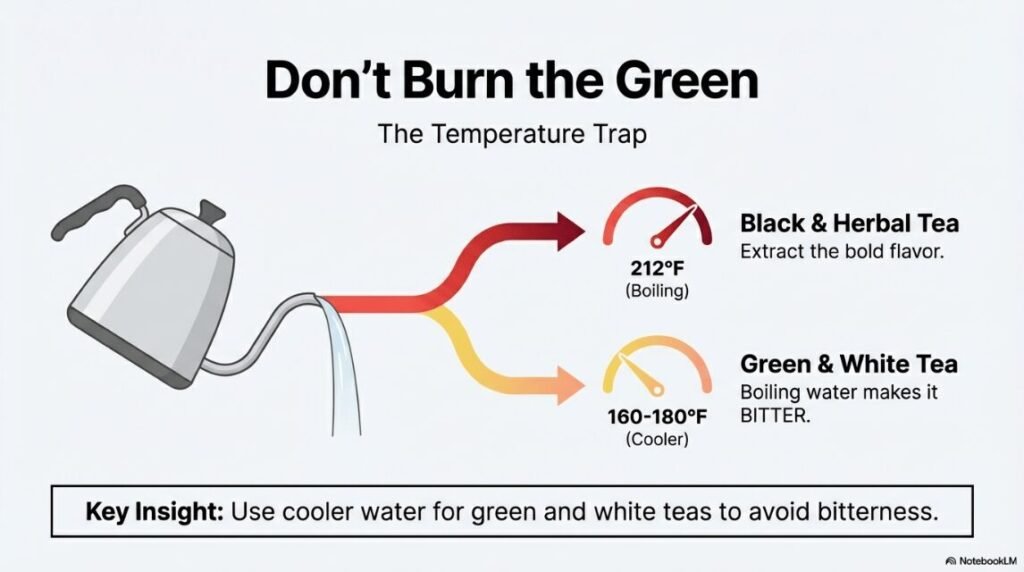
This is the #1 mistake servers make with tea.
| Tea Type | Water Temperature | Why It Matters |
|---|---|---|
| Black Tea | Boiling (200-212°F) | Needs hot water to extract bold flavors |
| Green Tea | Below boiling (160-180°F) | Boiling water makes it bitter |
| White Tea | Warm (140-160°F) | Very delicate – low heat extracts best flavors |
| Herbal Tea | Boiling (200-212°F) | Robust herbs need hot water |
What this means for you:
If a customer orders green tea and you use boiling water, it will taste bitter and bad. Always use slightly cooled water for green tea.
Part 12: Common Tea Modifications
| Customer Says | You Say |
|---|---|
| “Honey instead of sugar” | “Absolutely, I’ll bring honey on the side” |
| “Can I get lemon?” | “Of course, fresh lemon wedge coming right up” |
| “Milk instead of sugar” | “Milk on the side, perfect” |
| “Extra hot” | “I’ll make sure it’s very hot” |
| “Let it steep longer” | “I’ll time it for a stronger brew” |
Part 13: Soft Drinks – Simple but Professional
Soft drinks are the easiest beverages, but professional service still matters.
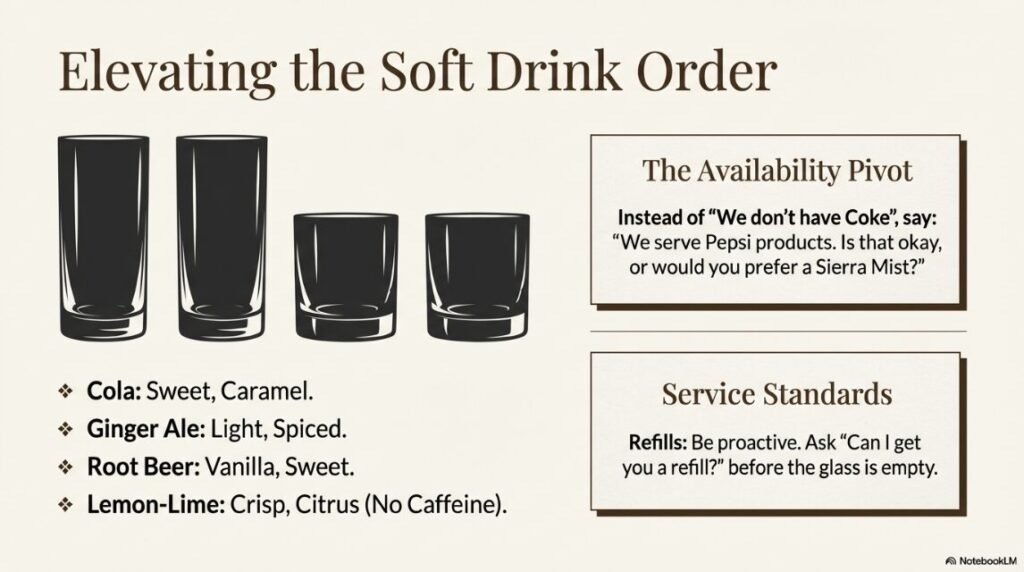
Main Categories
| Category | Examples | Flavor | Caffeine |
|---|---|---|---|
| Cola | Coke, Pepsi | Sweet, caramel | Yes |
| Lemon-Lime | Sprite, 7UP | Crisp, citrus | No/Low |
| Root Beer | A&W, Mug | Sweet, vanilla | Low/None |
| Ginger Ale | Canada Dry | Light, ginger-spiced | No |
| Orange Soda | Fanta, Crush | Bright, orange | No |
| Diet/Zero | Diet Coke, Zero Sugar | Same taste, no sugar | Yes |
Professional Service Language
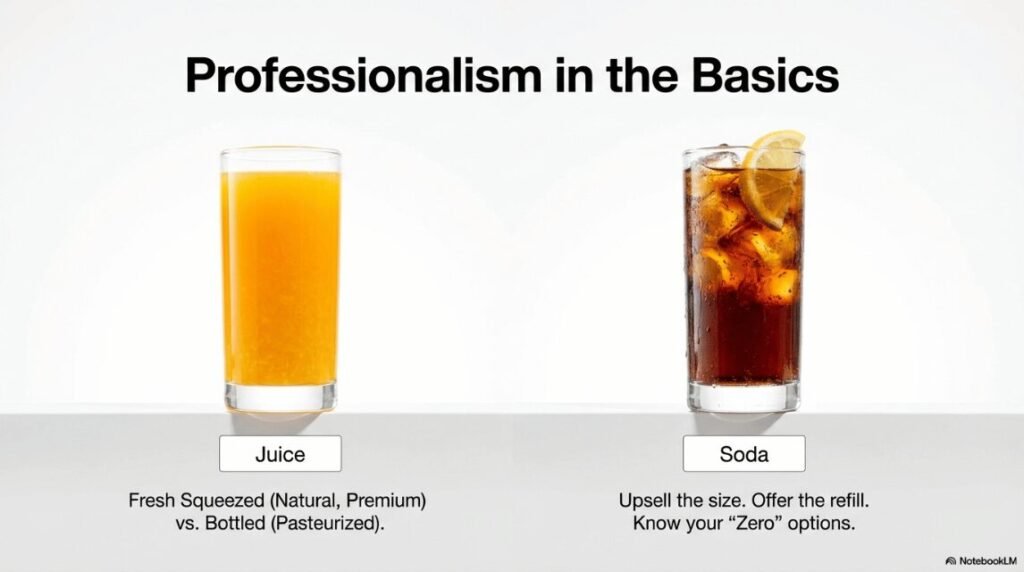
Opening offer: “What can I get you to drink? We have sodas, juice, coffee, tea, and water.”
Upselling size: “Would you like that in a regular or large?”
Offering refills: “Can I get you a refill on that Coke?”
Special requests: “No problem! I’ll bring that with light ice.”
Part 14: Juice Service
Common Juice Options
| Juice | Characteristics |
|---|---|
| Orange Juice | Classic breakfast choice, vitamin C |
| Apple Juice | Sweet, mild, kid-friendly |
| Cranberry Juice | Tart, often mixed with other juices |
| Grapefruit Juice | Tart, bitter, morning choice |
| Pineapple Juice | Sweet, tropical |
| Tomato Juice | Savory, often with brunch |
Fresh-Squeezed vs. Bottled – THE KEY DIFFERENCE
Fresh-Squeezed:
- Juiced right when you order
- No preservatives
- More expensive
- Higher quality perception
Bottled/Concentrate:
- Pre-made, pasteurized
- Has preservatives for shelf life
- Lower cost
- Consistent taste
How to describe the difference:
“Fresh-squeezed means we juice it right here when you order – no preservatives, completely natural. Bottled juice is pre-made and has preservatives for shelf life.”
Part 15: Water Service
Water is the foundation of beverage service. Every customer gets water.
Water Types
| Type | Description | Price |
|---|---|---|
| Tap Water | Municipal water, free | Free |
| Filtered Tap | Tap through filtration | Free |
| Bottled Still | Non-carbonated bottled | Premium ($2-5) |
| Sparkling | Carbonated bottled | Premium ($3-6) |
How to Offer Water Without Confusion
Don’t ask: “Still, sparkling, or tap?” (confusing!)
Do say: “What can I get you to drink? Would you like water? We have cold tap water, or if you prefer, we have bottled sparkling water.”
This clearly shows:
- Free option (tap)
- Paid option (bottled)
Professional Water Service Standards
✓ Offer water immediately upon seating ✓ Provide clean, cold water ✓ Fill glasses appropriately (don’t overflow) ✓ Monitor levels throughout service ✓ Refill proactively when glass is ¼ full ✓ Serve from the right side of guest
Part 16: Common Customer Questions – Perfect Responses
Coffee Questions
“What’s the difference between a latte and cappuccino?”
“Great question! Both have espresso and steamed milk. The main difference: a cappuccino has more foam and is stronger, while a latte has more milk and less foam, so it’s creamier and milder.”
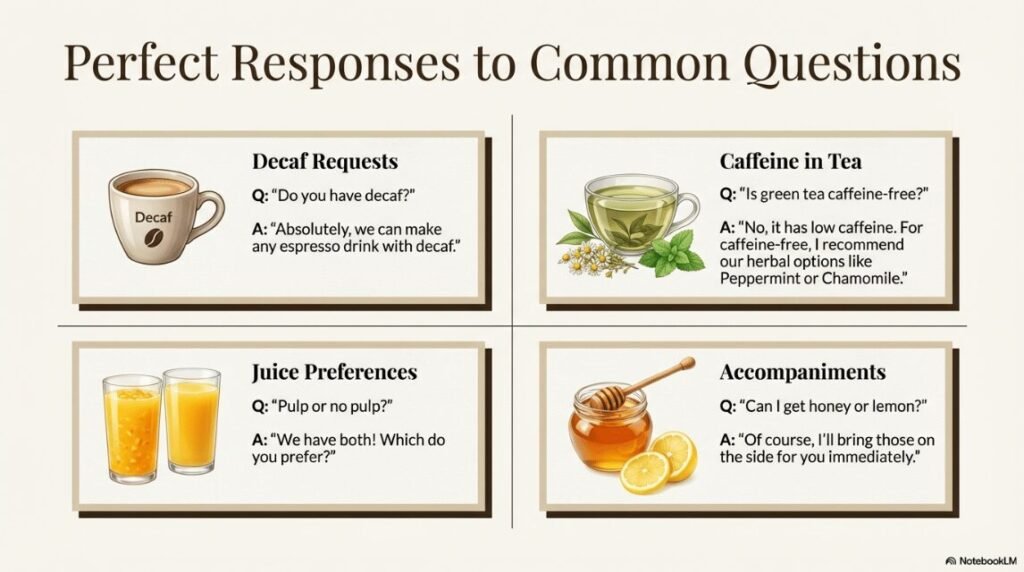
“Do you have decaf?”
“Absolutely! We can make any of our coffee drinks with decaf espresso. Would that work for you?”
“Can I get oat milk?”
“Yes, we have oat milk available. I’ll make that with oat milk instead.”
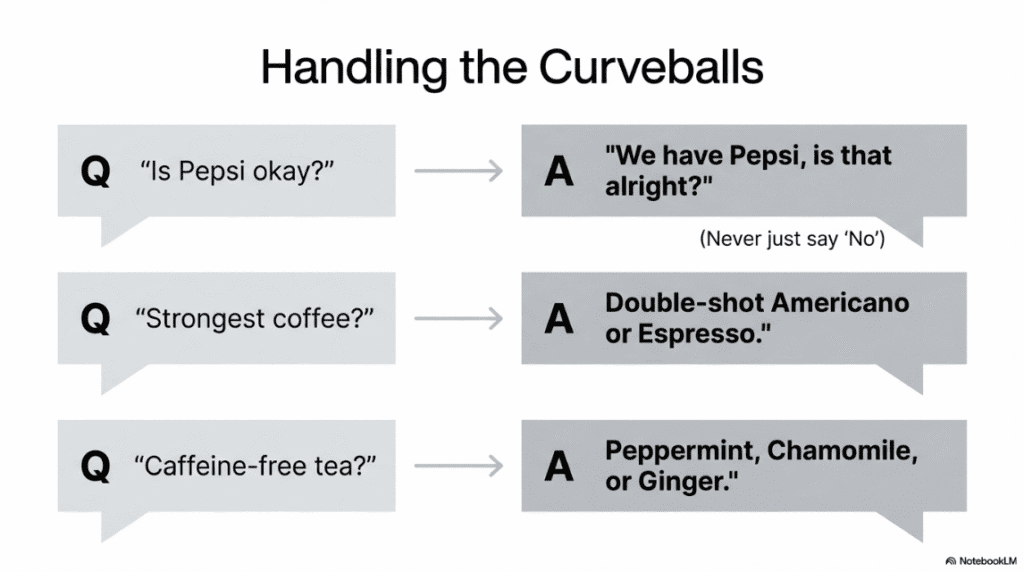
“What’s the strongest coffee you have?”
“That would be our espresso – very concentrated and bold. Or if you want a larger drink, a double-shot americano gives you extra strength.”
“How much caffeine is in this?”
“A regular espresso drink has about 75-150mg of caffeine depending on the drink. A double shot has more. If you want to avoid caffeine, we have decaf available.”
Tea Questions
“Which tea has no caffeine?”
“All our herbal teas are caffeine-free – peppermint, chamomile, and ginger are popular options. Which sounds good to you?”
“What’s the strongest tea you have?”
“Our black teas – English Breakfast and Earl Grey – are the strongest with higher caffeine.”
“Can I get honey instead of sugar?”
“Absolutely! I’ll bring honey on the side along with your tea.”
“What’s the difference between black and green tea?”
“Black tea is fully processed, so it’s bolder and stronger with more caffeine. Green tea is lighter and more delicate with less caffeine. Which sounds better?”
Soft Drink Questions
“Is Pepsi ok?” (when they ask for Coke)
“We actually have [your brand]. Is that ok, or would you prefer something else?”
“Do you have diet options?”
“Yes, we have Diet Coke and Coke Zero. Which would you prefer?”
“Can I get that with no ice?”
“Absolutely, no ice. I’ll bring ice on the side if you change your mind.”
“Can I get a refill?”
“Of course! Same drink, or would you like to try something different?”
Juice Questions
“Is the orange juice fresh-squeezed?”
“Yes, we fresh-squeeze all our orange juice daily – no preservatives.”
OR (if bottled):
“Our orange juice is bottled but very high quality with no added sugar.”
“Pulp or no pulp?”
“We have both! Which do you prefer?”
Water Questions
“Can I just get water?”
“Absolutely! Cold tap water coming right up.”
(Never make customers feel bad for ordering water!)
“Still or sparkling?”
“Still means no bubbles, sparkling has bubbles. Which would you like?”
“Ice on the side?”
“No problem! I’ll bring ice on the side so you can add it yourself.”
Part 17: Common Mistakes to Avoid
❌ Mistake 1: Not Knowing Your Menu
Wrong: “I don’t know what teas we have.”
Right: “We have English Breakfast, Earl Grey, green tea, chamomile, and peppermint. Which sounds good?”
You must know what’s on your menu!
❌ Mistake 2: Using Boiling Water for Green Tea
Wrong: Using the same temperature water for all teas
Right: Use cooler water (160-180°F) for green tea to prevent bitterness
❌ Mistake 3: Confusing Cappuccino and Latte
Wrong: Describing them the same way
Right: “Cappuccino has more foam and is stronger. Latte has more milk and is creamier.”
❌ Mistake 4: Making Customers Feel Bad for Ordering Water
Wrong: Sighing or showing disappointment when someone orders “just water”
Right: “Absolutely! Cold water coming right up.” (Cheerful and professional)
❌ Mistake 5: Not Offering Modifications
Wrong: “We don’t do that.”
Right: “Let me check with the barista if we can do that for you.”
Always try to accommodate reasonable requests!
Part 18: Tips for Building Confidence
1. Taste the drinks on your menu
Ask your manager if you can try small samples. You can’t describe something you’ve never tasted.
2. Learn ONE key fact about each drink
You don’t need to know everything. Just one characteristic:
- “Cappuccino has more foam”
- “Green tea is lighter than black tea”
- “Fresh-squeezed juice has no preservatives”
3. Practice the professional phrases out loud
Before your shift, say:
- “A cappuccino has more foam and is stronger.”
- “Green tea is lighter with less caffeine.”
- “We fresh-squeeze our orange juice daily.”
Say them until they sound natural.
4. Ask questions before recommending
Never guess. Ask:
- “Do you want caffeine or caffeine-free?”
- “Do you prefer bold or light flavors?”
- “Hot or iced?”
5. When in doubt, say “Let me find out”
“That’s a great question. Let me check with our barista and come right back with the answer.”
This is professional. Guessing is not.
Summary: What You Learned Today
Today you learned:
✓ The 7 main espresso drinks (espresso, americano, macchiato, cappuccino, latte, flat white, mocha) ✓ The critical difference between cappuccino and latte (foam vs. milk) ✓ Coffee roast levels (light, medium, dark) and what they mean ✓ Essential coffee vocabulary (shot, pull, crema, steam, foam) ✓ The 5 tea categories (black, green, white, oolong, herbal) ✓ Why water temperature matters for tea ✓ Soft drink service and professional language ✓ Fresh-squeezed vs. bottled juice differences ✓ Water service standards ✓ Perfect responses to common customer questions
You now have the vocabulary and confidence to recommend coffee, tea, and non-alcoholic drinks professionally.
📝 Test Your Non-Alcoholic Drink Knowledge
Ready to see how much you learned? Take this quick quiz! (5 questions, 2 minutes)
QUIZ FOR QUIZMAKER PLUGIN
QUIZ TITLE: Non-Alcoholic Drink Knowledge Check
QUIZ INSTRUCTIONS: Test your understanding of coffee, tea, and beverage service. Choose the best answer for each question.
Next Steps in Your Menu Mastery Journey
Continue the Series: 📖 Part 5: Desserts & After-Dinner Service – Coming soon! Learn dessert vocabulary and service.
Review Previous Parts: 📖 Part 1: Appetizers & Starters – Essential starter vocabulary 📖 Part 2: Main Courses – Proteins, cooking methods, sides 📖 Part 3: Wine & Beer – Beverage alcohol confidence
Download Free Resource: 📥 Complete Menu Vocabulary Guide – Get all 5 parts in one downloadable PDF [Link to lead magnet]
Ready for Professional Training? 🎓 English for Waiters Course – Master the complete service experience
📚 Additional Learning Resources
Ready to Master Restaurant English?
These free articles and scenarios are a great start, but if you want a complete, structured system for learning restaurant English, consider our full course.
English for Waiters includes:
✅ 22+ video lessons covering every restaurant situation
✅ Real restaurant scenarios with native pronunciation
✅ Interactive pronunciation practice
✅ Downloadable phrase guides
✅ Lifetime access with free updates
Want to learn more about coffee and tea service?
Professional hospitality programs like Short Courses Australia train students on espresso coffee service standards, customer recommendations, and beverage preparation for restaurant staff.
The Hospitality Institute provides professional hospitality training.
Many servers also complete professional barista training to understand coffee terminology and preparation methods.
Ready to Master ALL Restaurant English?
You’ve learned non-alcoholic drink vocabulary. That’s excellent progress!
But what about: ❓ Taking orders professionally? ❓ Handling difficult customers? ❓ Describing desserts? ❓ Phone reservations in English? ❓ Asking for a promotion?
English for Waiters covers everything you need to succeed:
✓ 22 video lessons (greetings to payment) ✓ 60-page phrase guide with hundreds of professional expressions ✓ Complete course book with scripts and vocabulary ✓ Certificate of completion for your CV ✓ Lifetime access – study forever
All for only £37.99
→ ENROLL IN ENGLISH FOR WAITERS TODAY
You’ve Completed Part 4 of Menu Mastery!
Congratulations! You now have the vocabulary and confidence to recommend coffee, tea, and non-alcoholic drinks professionally.
Next: Part 5 will teach you about desserts and after-dinner service.
Your customers are waiting. Your confidence is growing. Let’s continue.