

James had been applying for server positions at upscale restaurants for two months. His resume looked good. His interview skills were solid. But every application asked the same question: “Please provide three professional references.”
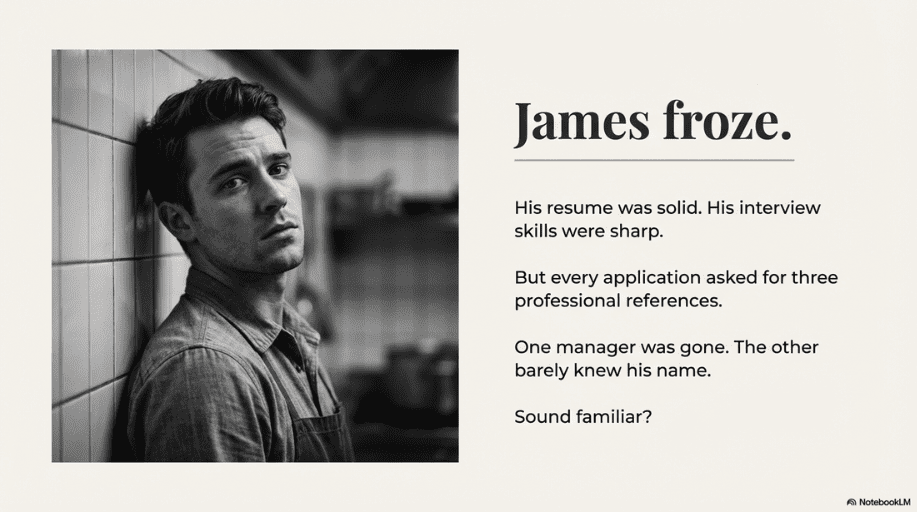
James froze. He’d worked at two restaurants. One manager had quit months ago and he didn’t have her contact information. The other manager barely remembered his name because the restaurant had such high turnover. He’d never asked anyone for a reference before and didn’t know where to start.
Sound familiar?
References and recommendation letters are the final piece of the job search puzzle. You can have perfect experience and ace the interview, but if you can’t provide strong references, you might not get hired.
According to Indeed’s career resources, employers use references to verify resume information and determine if candidates are a good fit for their organization. In the hospitality industry—where trust, reliability, and customer service are everything—good references can be the difference between getting the job and getting passed over.
This guide shows you exactly how to build, ask for, and use professional references and recommendation letters as a restaurant worker. You’ll get word-for-word scripts, sample templates, and strategies that work even if you’re early in your career or left a job on bad terms.
Indeed are one of the worlds leading hospitality recruiters. They have some great tips on professional references.
Perfer to listen? Here’s the podcast.
Part 1: Understanding References vs. Recommendation Letters
Before we get into the how, let’s clarify what these actually are. People use these terms interchangeably, but they’re different.
What is a Professional Reference?
A professional reference is a person who can speak about your work performance and character. When you list someone as a reference, you’re giving the new employer permission to contact that person directly.
How it works:
- You apply for a job and provide 3-5 references (names, titles, phone numbers, emails)
- The employer calls or emails your references
- Your reference answers questions about your work history, skills, and character
- The employer uses this information to decide whether to hire you
Common questions employers ask references:
- “How long did [name] work for you?”
- “What were their main responsibilities?”
- “How was their reliability and punctuality?”
- “How did they handle stressful situations?”
- “Would you rehire this person?”
- “What are their strengths and weaknesses?”
What is a Recommendation Letter?
A recommendation letter (also called a letter of reference) is a written document from someone who knows your work. Unlike a reference check where the employer asks questions, a letter is pre-written and you provide it directly to potential employers.
How it works:
- You ask someone to write a letter for you
- They write it, usually on company letterhead
- You include it with your application or bring it to interviews
- The employer reads it
What a good letter includes:
- Who the writer is and how they know you
- How long you worked together
- Your specific skills and accomplishments
- Examples of your work performance
- A strong endorsement (“I highly recommend…”)
- The writer’s contact information
Which Do You Need?
You almost always need references. Most job applications require you to list 3-5 references. This is standard.
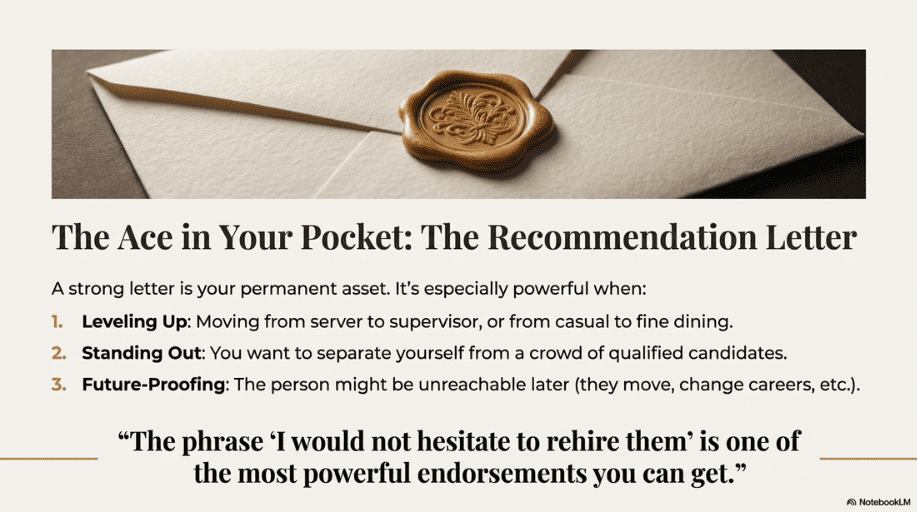
Recommendation letters are optional but helpful. They’re particularly valuable when:
- Applying for higher-level positions (supervisor, manager)
- Moving to a more upscale restaurant
- Your last job ended a while ago and references might not remember details
- You want to stand out from other candidates
- You left on excellent terms and have a manager willing to write something strong
Think of references as required and recommendation letters as bonus points.
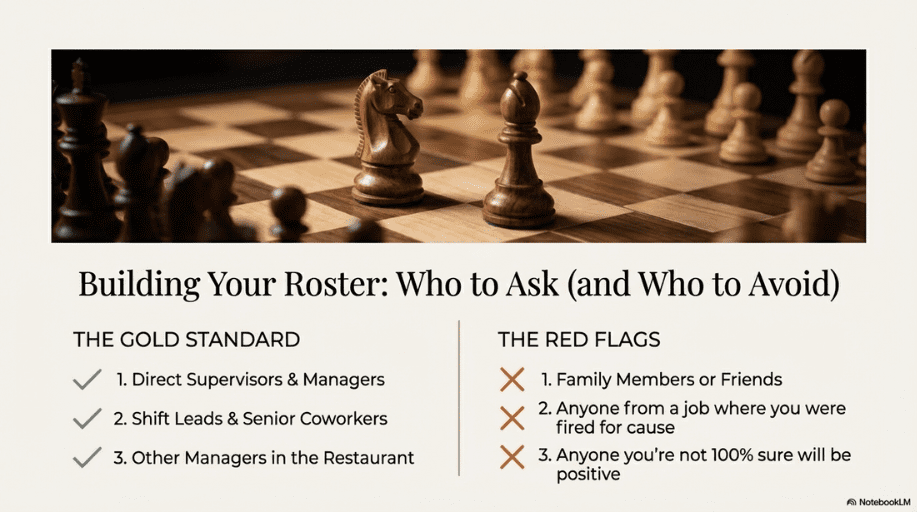
Part 2: Who to Ask for References
Not everyone makes a good reference. Here’s who to ask—and who to avoid.
Best Reference Options (In Order of Preference)
1. Direct supervisors and managers
This is the gold standard. The person who supervised your work directly can speak most credibly about your performance.
Good choices:
- Your restaurant manager
- Assistant manager who scheduled you or worked your shifts
- General manager who oversaw operations
- Head chef if you worked closely in kitchen
Why they work: They observed your work daily, evaluated your performance, and made decisions about your employment.
2. Shift leads or senior coworkers
If you can’t get your direct manager (they left, you lost contact, you didn’t part on good terms), a senior coworker is your next option.
Good choices:
- Shift supervisor who worked alongside you
- Senior server who trained you
- Head bartender if you worked bar shifts
- Anyone with “lead” or “senior” in their title
Why they work: They worked with you closely and can speak to your skills, reliability, and teamwork.
3. Other managers in the restaurant
Even if they weren’t your direct supervisor, other managers who observed your work can serve as references.
Good choices:
- Front-of-house manager (if you’re a server)
- Kitchen manager (if they saw you interact with kitchen staff)
- Owner (if you worked at a small restaurant)
Why they work: They have credibility as decision-makers and can vouch for your professionalism.
4. Long-term regular customers (use sparingly)
For restaurant workers, regular customers who know you well can sometimes serve as character references, though they’re not ideal for work references.
When to use: Only if you can’t get workplace references, and only for character reference (not professional reference). Use 1 at most, never as your primary references.
5. Professors or volunteer supervisors (if you’re new to the industry)
If you’re early in your restaurant career with limited work history, academic or volunteer references can fill gaps.
Good choices:
- Hospitality management professors
- Culinary school instructors
- Volunteer coordinators where you worked events
- Any leadership position in school organizations
Why they work: They can speak to your work ethic, reliability, and transferable skills even if it’s not restaurant-specific.
Who NOT to Use as References
Never use:
- Family members (even if they supervised you in a family business, it looks unprofessional)
- Friends (no credibility)
- Coworkers at your level with no supervisory responsibility (weak credibility)
- Anyone you haven’t spoken to in over 3 years (they won’t remember details)
- Anyone from a job where you were fired for cause
- Anyone you’re not 100% sure will say positive things
Red flag: If you hesitate to ask someone because you’re not sure they’ll say good things, don’t use them. A lukewarm or negative reference is worse than no reference.
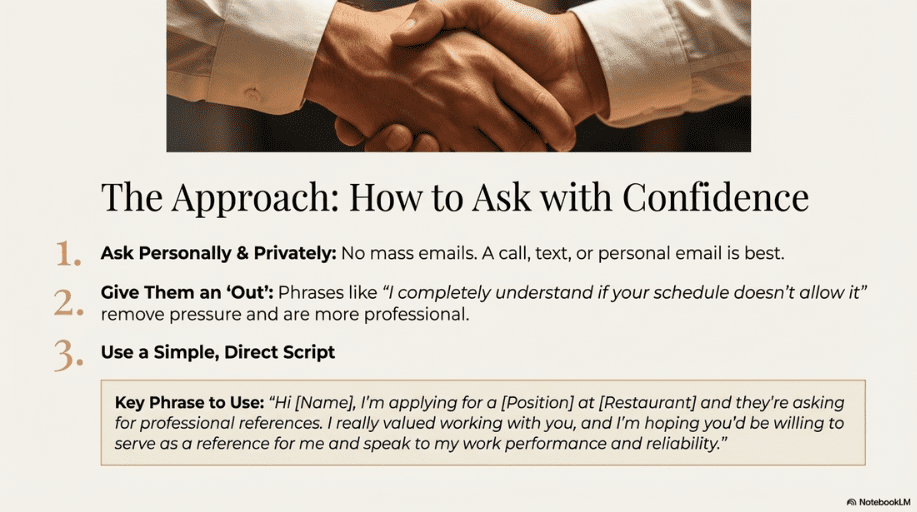
Part 3: How to Ask Someone to Be a Reference
Most people don’t mind being a reference—but you need to ask properly.
The Right Way to Ask (Step-by-Step)
Step 1: Make a list of potential references
Write down 5-7 people who could potentially serve as references. You need backups in case someone says no or becomes unavailable.
For each person, note:
- Their full name and current title
- Where you worked together and when
- Their current contact information (if you have it)
- Why they’re a good reference for you
Step 2: Reach out individually
Contact each person separately. Don’t mass email “Will you be my reference?” to five people at once. Make it personal.
Best method: If you’re still in contact, text or call. If you haven’t spoken in a while, email is fine.
Timing: Ask at least 2 weeks before you need to use them. Don’t wait until an employer requests references.
The Exact Script to Use
If you still work together or recently left:
“Hi [Manager Name], I’m applying for a server position at [Restaurant] and they’re asking for professional references. You’ve been a great manager to work with, and I was wondering if you’d be willing to serve as a reference for me? They’d likely call to ask about my work performance and reliability.”
If it’s been a while since you worked together:
“Hi [Manager Name], this is James from [Restaurant Name] – I worked as a server there from 2022 to 2023. I’m applying for a server position at [New Restaurant] and they’re asking for professional references. Would you be willing to serve as a reference and speak to the work I did when we worked together?”
Via email (if you’ve lost touch):
Subject: Reference Request – James [Your Last Name]
Hi [Manager Name],
I hope this email finds you well. This is James [Last Name] – I worked as a server at [Restaurant Name] from [dates] when you were [their position].
I’m currently applying for a server position at [New Restaurant] and they require professional references. I really valued working with you at [Restaurant], and I’m hoping you’d be willing to serve as a reference for me.
If you’re comfortable being a reference, they would likely call to ask about my work performance, reliability, and skills during the time we worked together.
Please let me know if you’re able to do this – I completely understand if your schedule doesn’t allow it.
Thank you for considering this request.
Best regards, James [Last Name] [Your Phone Number] [Your Email]
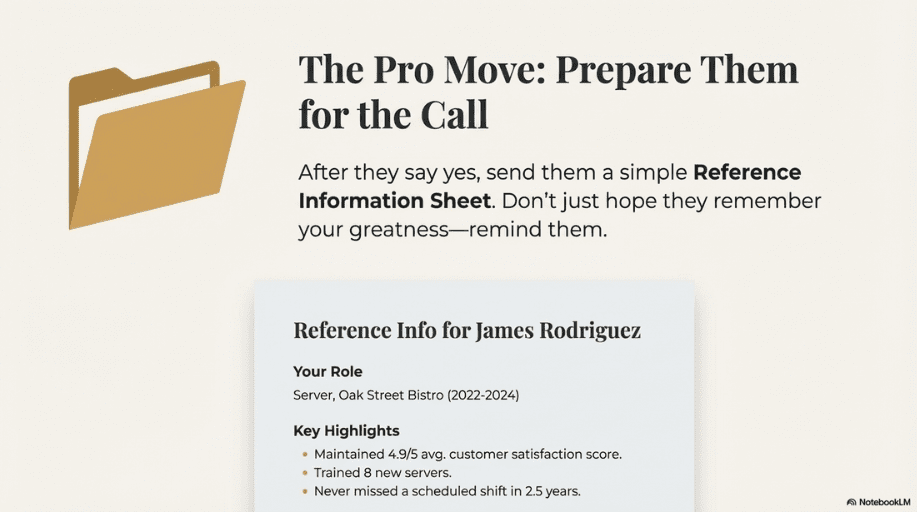
What to Do After They Say Yes
Send them a reference sheet with the information they’ll need. This makes it easy for them and ensures they have accurate details.
Create a simple document with:
- Your full name
- The position you’re applying for (or type of positions)
- A brief reminder of when you worked together and your role
- 3-5 bullet points highlighting your key accomplishments while you worked together
- Your current contact information
Example:
Reference Information Sheet

Name: James Rodriguez
Position Applying For: Server at Upscale Dining Establishments

Background: I worked as a server at Oak Street Bistro from March 2022 - August 2024, reporting directly to you as Restaurant Manager.

Key Highlights from My Time There:
- Maintained 4.9/5 average customer satisfaction score
- Trained 8 new servers during my tenure
- Consistently worked weekend and holiday shifts
- Never missed a scheduled shift in 2.5 years
- Handled VIP events including parties of 20+ guests

Thank you for serving as a reference. Employers may contact you via:
Phone: [Your Manager's Phone]
Email: [Your Manager's Email]

If you have any questions, feel free to contact me:
James Rodriguez
Phone: (555) 123-4567
Email: james.rodriguez@email.com
Why this works: It refreshes their memory, gives them specific talking points, and makes it easy for them to give you a strong reference.
Part 4: How to Ask for a Recommendation Letter
Asking for a letter requires more effort from the person, so approach it carefully.
When to Ask for a Letter
Best times to request:
- When you’re leaving a job on excellent terms
- Right after receiving strong praise or a positive performance review
- When applying for a significant step up (server to supervisor, casual dining to fine dining)
- When you need documentation because the person might not be reachable later
Don’t ask for letters:
- From every job (one or two strong letters is enough)
- From people who don’t know your work well
- When you’re leaving on bad terms
The Script for Requesting a Letter
In person (best option):
“[Manager Name], I wanted to thank you for being such a great manager to work with. I’ve learned a lot here. As I move on to [new opportunity], I’m wondering if you’d be willing to write me a letter of recommendation? It would really help with my job search, and I’d be happy to provide any information that would make it easier for you to write.”
Via email:
Subject: Letter of Recommendation Request
Hi [Manager Name],
I wanted to reach out to ask if you’d be willing to write a letter of recommendation for me as I transition to [new opportunity/job search].
Working at [Restaurant] under your management has been a valuable experience. I’ve really appreciated [specific thing they taught you or specific positive experience].
I know writing a letter takes time, so I’d be happy to provide:
- A draft outline with key points you might include
- My current resume
- Specific accomplishments or projects you might want to mention
The letter would help me as I apply for [type of positions]. There’s no immediate deadline, but having it within the next [timeframe] would be ideal.
I completely understand if your schedule doesn’t allow for this. Either way, thank you for the experience and mentorship.
Best regards, James
Follow-up: If they say yes, send them everything that makes writing easier: your resume, a list of accomplishments, even a rough draft they can edit.
Part 5: Sample Recommendation Letter Template
If your manager asks you to write a draft they can edit (this is common and acceptable), here’s a template.
Letter Template for Restaurant Workers
[Manager's Name]
[Their Title]
[Restaurant Name]
[Restaurant Address]
[City, State ZIP]
[Email]
[Phone]

[Date]

To Whom It May Concern,

I am writing to recommend [Your Name] for a server position with your establishment. [He/She/They] worked as a server at [Restaurant Name] from [Start Date] to [End Date], reporting directly to me as [Manager's Title].

During [his/her/their] time with us, [Your Name] consistently demonstrated exceptional customer service skills and professionalism. [He/She/They] quickly became one of our most reliable team members, maintaining a [specific metric, e.g., 4.8/5 customer satisfaction rating] throughout [his/her/their] tenure.

[Your Name]'s strengths include:

- Reliability: [He/She/They] maintained perfect attendance and was never late for a scheduled shift in [time period]. [He/She/They] frequently volunteered to cover shifts for colleagues when needed.

- Customer Service: [He/She/They] handled difficult customers with patience and professionalism. I particularly remember [specific example - e.g., "when he successfully managed a party of 30 guests during our busiest holiday season without a single complaint"].

- Teamwork: [Your Name] worked well with both front-of-house and kitchen staff. [He/She/They] trained [number] new servers during [his/her/their] time here and was always willing to help coworkers.

- Skills Development: [He/She/They] took initiative to [specific skill - e.g., "learn our wine list thoroughly, becoming our go-to server for wine recommendations"].

[Your Name] left our restaurant in good standing to pursue [reason for leaving - career advancement/relocation/education]. We were sorry to see [him/her/them] go, and I would not hesitate to rehire [him/her/them] if the opportunity arose.

I strongly recommend [Your Name] for any server position. [He/She/They] will be an asset to your team.

Please feel free to contact me at [phone] or [email] if you need any additional information.

Sincerely,

[Signature]
[Manager's Printed Name]
[Title]
What Makes This Template Work
✅ Professional format – Standard business letter layout
✅ Specific details – Numbers, examples, concrete accomplishments
✅ Clear structure – Introduction, strengths, conclusion
✅ Contact information – Employer can verify if needed
✅ Strong endorsement – “I would rehire” is powerful language
✅ Focuses on relevant skills – Reliability, service, teamwork
Part 6: How to Provide References During the Job Search
Now that you have references lined up, here’s how to actually use them.
Creating Your Reference Sheet
Format it professionally:
Professional References for James Rodriguez

Reference 1:
Maria Sanchez
Restaurant Manager
Oak Street Bistro
Phone: (555) 234-5678
Email: m.sanchez@oakstreetbistro.com
Relationship: Direct supervisor (March 2022 - August 2024)

Reference 2:
David Kim
Assistant Manager
Oak Street Bistro
Phone: (555) 234-5679
Email: d.kim@oakstreetbistro.com
Relationship: Shift supervisor (March 2022 - August 2024)

Reference 3:
Jennifer Lopez
General Manager
Riverside Cafe
Phone: (555) 345-6789
Email: jlopez@riversidecafe.com
Relationship: Direct supervisor (June 2020 - February 2022)
Key elements:
- Each reference on separate lines with clear formatting
- Full contact information (don’t make the employer hunt for it)
- Your relationship to each person (how they know you)
- Current and accurate phone numbers and emails
When to Provide References
Don’t provide them until asked. Here’s the timeline:
During application: Most applications have a section asking “May we contact your references?” Check “yes” but don’t provide details yet unless specifically requested.
After first interview: If the interview goes well and they ask for references, provide them then.
Never before first interview: It’s too early. They don’t know if they’re interested yet.
References typically come into play after acing your restaurant job interview, usually before the final job offer.
The Right Way to Hand Over References
If they ask during interview:
“Yes, I have three professional references prepared. Would you like me to email you the list, or would you prefer I leave a printed copy?”
Via email after interview:
Subject: References for Server Position – James Rodriguez
Hi [Hiring Manager Name],
Thank you again for meeting with me yesterday about the server position. As requested, I’ve attached my professional references.
All three references are available and expecting potential contact from you. Please let me know if you need any additional information.
Best regards, James Rodriguez
[Attach: James_Rodriguez_References.pdf]
Important: Always notify your references before you give their information to an employer. Text or email them: “Hi! I just provided your contact info as a reference for a server position at [Restaurant]. They may reach out within the next week. Thanks again for being willing to do this!”
Part 7: What to Do If You Don’t Have Good References
This is James’s actual situation. What do you do if you can’t get traditional references?
Strategy 1: Rebuild Connections with Former Managers
Even if you haven’t spoken in years, reach out. People often remember good employees.
Script for reconnecting:
“Hi [Manager Name], this is James Rodriguez – I worked as a server at [Restaurant] from [dates]. I know it’s been a while, but I’m currently job searching and I was hoping you might remember me well enough to serve as a reference? I really valued the experience working there. No pressure if too much time has passed – I completely understand.”
Why this works: People are generally willing to help if you’re polite and acknowledge the time gap.
Strategy 2: Use Non-Traditional References
If you truly can’t get manager references, use what you have:
Option A: Shift leads or senior servers
They’re not ideal, but they’re better than nothing. Be honest with potential employers:
“My direct manager from [Restaurant] has left the company and I’ve lost contact. However, I can provide references from the shift supervisor and senior server I worked with closely.”
Option B: Customers (character references only)
If you have long-term regular customers who know your work ethic, they can serve as character references.
How to position them: “In addition to my workplace references, I can also provide a character reference from a regular customer I served for over two years who can speak to my customer service skills.”
Option C: Combine references from multiple sources
Mix whatever you have: one manager, one senior coworker, one professor, one volunteer supervisor.
Strategy 3: Get a Recommendation Letter Before You Leave
Even if you can’t use the person as an active reference later (they leave the company, change careers, move away), a written letter has permanent value.
Do this proactively: When you’re leaving any job on good terms, ask for a letter. You might not need it immediately, but you’ll have it forever.
Strategy 4: Start Fresh
If your work history genuinely has no good references:
Short-term solution: Start at an entry-level position where references matter less. Work there 6-12 months, build a strong record, then use that manager as a reference for better positions.
Long-term solution: Going forward, always maintain good relationships with managers and ask for letters when you leave. Build your reference network intentionally.
Part 8: Red Flags and How to Handle Them
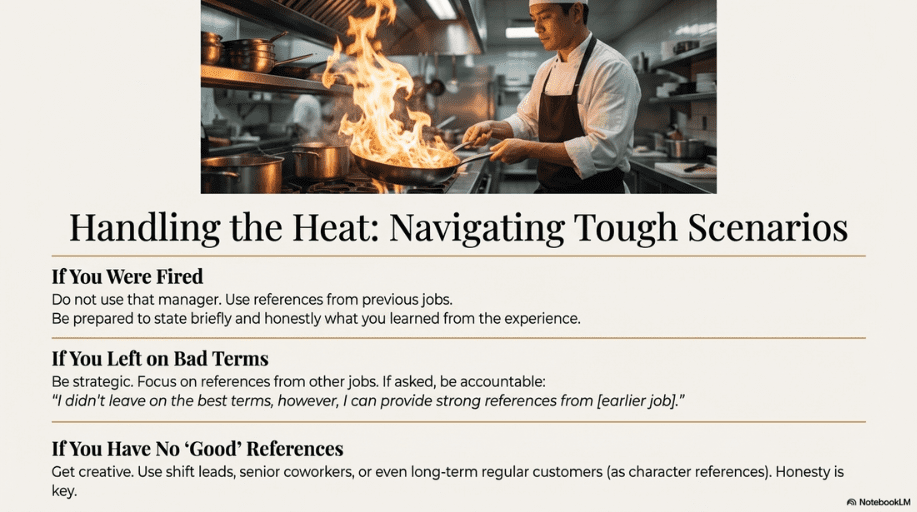
What If You Were Fired?
Don’t use that manager as a reference. It’s that simple.
What to do instead:
- Use references from earlier jobs
- Use references from the same job but different managers (if you worked there long enough)
- Be honest if asked directly why you left: “I was let go due to [brief, honest reason]. I learned from the experience and have since [what you’ve improved].”
What If You Left on Bad Terms?
Maybe you quit without notice or had a falling out with management.
Don’t lie: If an employer asks “Can we contact your previous employer?” and you say yes knowing they’ll give a bad reference, you’ll look worse when they get the bad report.
Be strategic: Focus on references from other jobs or other managers at the same company.
If asked directly: “I didn’t leave [Restaurant] on the best terms. However, I can provide strong references from [earlier job] where I worked for [time period].”
Honesty with accountability is better than a surprise bad reference.
What If Your Reference Doesn’t Respond?
Sometimes references don’t answer when employers call.
Prevention: When you give someone’s info, tell them: “They’ll likely call within the next 1-2 weeks. Please try to answer calls from unknown numbers during this time.”
If it happens: Have backup references ready. Tell the employer: “I apologize that [Name] hasn’t responded. I have an alternative reference I can provide: [Backup Person].”
What If You Think Someone Gave You a Bad Reference?
You might not know unless the employer tells you, but if you keep getting rejected after reference checks, something might be wrong.
What you can do:
- Ask a friend to call your reference pretending to be an employer and see what they say (legal in most states)
- Remove that person from your reference list
- Add different references
- Consider if you need to address something proactively in interviews
Part 9: ESL Considerations
If English is your second language, there are a few extra things to consider with references.
Make Sure Contact Information is Clear
When you list references, pronunciation matters.
If your reference has a difficult name:
- Include pronunciation guide: “Maria Gonzalez (Mar-EE-ah Gon-ZAH-lez)”
- Or write it phonetically: “David Nyugen (Win)”
For your own contact info:
- Use a professional, easy-to-spell email: james.rodriguez@gmail.com (not jrodriguez1234@yahoo.com)
- If your name is hard to pronounce, include pronunciation on your reference sheet
Brief Your References About Your Language Skills
If you’re worried about how your reference will describe your English:
What to say to your reference:
“I wanted to mention – I’m working on improving my English fluency. If they ask about my communication skills, I’d appreciate if you could mention that I communicate clearly with customers and that any language barrier hasn’t affected my work performance. I’ve never had customer complaints about not understanding me.”
Why this works: You’re giving them language to use that’s honest but positive.
Have References Ready in Multiple Formats
Some applications want you to type in reference info. Some want uploaded documents. Some want it emailed.
Prepare:
- Digital PDF you can email or upload
- Printed copies to bring to interviews
- The information saved in a note on your phone so you can quickly type it into applications
This saves time and reduces stress during the application process.
Part 10: Special Situations
Asking for References When You’re Still Employed
What if you’re currently working but job searching confidentially?
Don’t use your current manager if you haven’t told them you’re leaving. Use references from:
- Previous jobs
- Other managers at your current restaurant (if you trust them not to tell your boss)
- Former colleagues who have left
What to say to current employer on applications: “Please do not contact my current employer” – this is completely normal and understood.
Getting References for Your First Restaurant Job
If you’re completely new to the industry:
Use academic and volunteer references:
- Professors from hospitality programs
- Volunteer coordinators where you’ve worked
- Coaches or mentors from leadership positions
- Part-time job supervisors from non-restaurant work
Frame them appropriately: “While I’m new to restaurant work specifically, I can provide references who can speak to my work ethic, reliability, and customer service skills from my experience in [retail/volunteering/school projects].”
Updating Your References Over Time
Your reference list should evolve as your career grows.
Every time you leave a job on good terms:
- Ask for a recommendation letter
- Add that manager to your reference list
- Remove your oldest reference (keep your list to your 3-5 most recent and relevant references)
Check in with references annually: Send a brief email: “Hi [Name], I wanted to let you know I’m still using you as a reference for job applications. I really appreciate your willingness to speak to my work. Hope you’re doing well!”
Why this matters: It keeps the relationship active and reminds them who you are if they get called.
Part 11: What Employers Are Actually Looking For
Understanding what employers verify helps you choose better references.
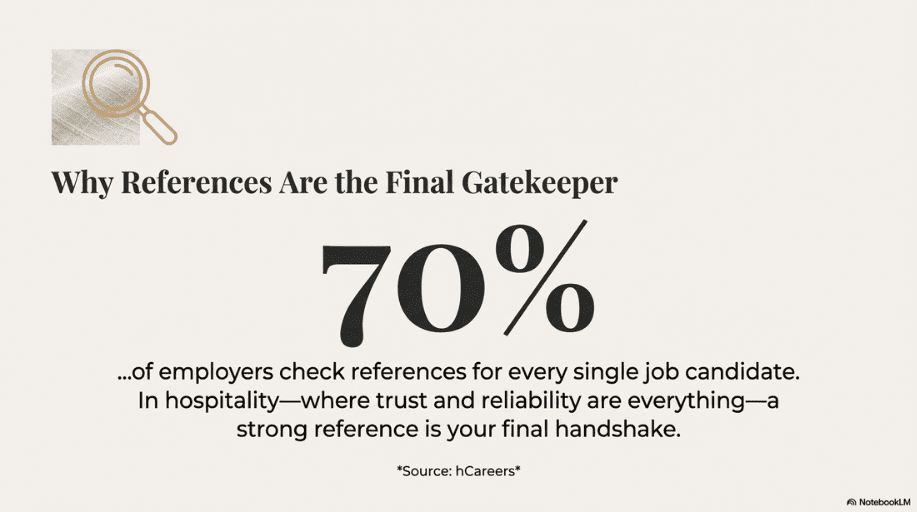
According to hCareers, a leading hospitality employment platform, 70 percent of employers check references for every job candidate, and 63 percent do so because getting third-party opinions helps them hire better employees. In restaurants specifically, employers typically verify:
1. Employment dates and position
They want to confirm you actually worked where you said you did, for as long as you said.
Red flag: If your resume says you worked somewhere for 2 years but your reference says it was 6 months, that’s a problem.
2. Job responsibilities
They want to confirm you actually did what you claim on your resume.
Red flag: If you say you trained new employees but your reference says you were entry-level with no training responsibilities.
3. Reliability and attendance
In restaurants, showing up consistently is critical.
What they ask: “How was their attendance?” “Were they typically on time?”
4. Reason for leaving
They want to know if you left on good terms or were terminated.
What they ask: “Why did [name] leave?” “Would you rehire them?”
5. Performance and skills
They want specific examples of how you performed.
What they ask: “How would you rate their customer service?” “Can you give an example of how they handled a difficult situation?”
The takeaway: Choose references who can speak positively and specifically about these areas. A reference who only knows you casually can’t answer these questions well.
HCareers has some great data on what employers are looking for in a reference.
Part 12: Common Mistakes to Avoid
Mistake 1: Not Asking Permission
Never list someone as a reference without asking them first.
Why it’s bad: They might be caught off guard when an employer calls, give a poor reference, or even say “I never agreed to this.”
Do this instead: Always ask first and get confirmation they’re willing.
Mistake 2: Using Outdated Contact Information
If your reference’s phone number or email has changed, the employer can’t reach them.
Why it’s bad: Makes you look disorganized and creates delays in the hiring process.
Do this instead: Verify contact info is current before giving it to employers. Send a quick text: “Is this still the best number to reach you?”
Mistake 3: Providing References Too Early
Don’t attach your reference sheet to your initial application unless specifically requested.
Why it’s bad: Your references might get called before you’ve even had a first interview, wasting their time and yours.
Do this instead: Wait until after you’ve interviewed and the employer specifically asks for references.
Mistake 4: Only Having Exactly Three References
What if one doesn’t answer? What if one moved and changed numbers?
Why it’s bad: You’ll scramble to find a replacement at the last minute.
Do this instead: Have 5-7 people willing to be references. Provide the best 3-5 for each specific job.
Mistake 5: Not Preparing Your References
If your reference gets a call and doesn’t remember who you are or what to say, the call goes poorly.
Why it’s bad: Weak, vague references don’t help you get hired.
Do this instead: Send that reference information sheet with specific talking points.
Mistake 6: Using the Same References for Every Job
A reference who can speak to your fine dining skills might not be relevant for a casual brunch spot.
Why it’s bad: Mismatched references don’t make your case effectively.
Do this instead: Tailor your references to the job. Applying to upscale restaurants? Use your fine dining manager. Applying to family restaurants? Use your casual dining supervisor.
Part 13: After You Get the Job
Once you’re hired, there’s one more important step.
Thank Your References
They helped you get the job. Acknowledge it.
What to say:
Via text: “Hi [Name], just wanted to let you know I got the server position at [Restaurant]! Thank you so much for being a reference – I really appreciate you taking the time to speak with them.”
Via email: “Hi [Name], I wanted to let you know that I was offered the server position at [Restaurant]. Thank you for serving as a reference and for the positive recommendation. I really appreciate your support.”
Why this matters:
- It’s professionally courteous
- It keeps the relationship positive
- They’ll be more willing to be a reference again in the future
Once you’ve built strong references at your current job, you’ll also have the credibility to ask for a raise or promotion when you’re ready to advance.
Keep Building Your Network
Every job is an opportunity to earn future references.
At your new job:
- Build strong relationships with managers
- Document your accomplishments
- Maintain professionalism
- Leave on good terms when you eventually move on
The long game: Your reputation follows you in the restaurant industry. Managers talk to each other, especially within the same city or restaurant group. Building a strong reference network now pays off for years.
Part 14: Quick Reference Checklist
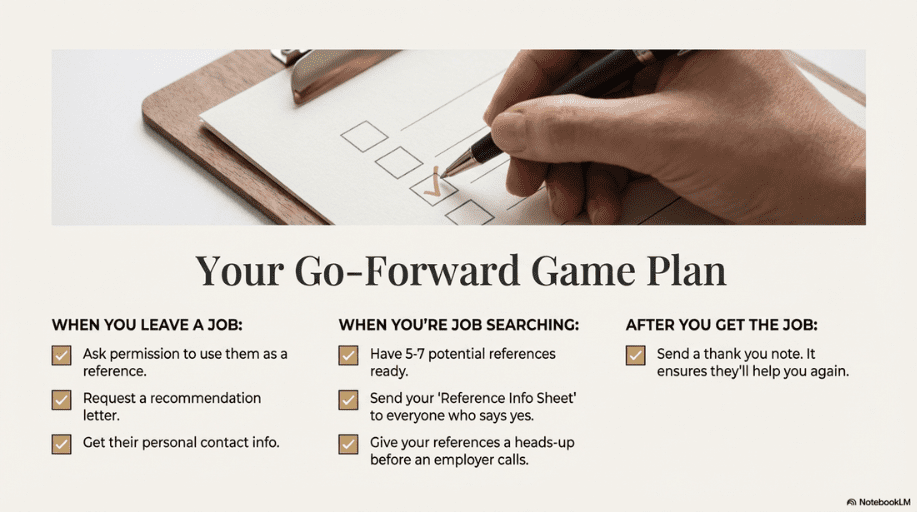
Before You Leave Any Job
☐ Ask your manager if they’d be willing to be a reference
☐ Request a recommendation letter if you left on excellent terms
☐ Get current contact information (personal email/phone, not just work email)
☐ Connect on LinkedIn to maintain the relationship
☐ Document your accomplishments to include in future reference materials
When Job Searching
☐ Create a list of 5-7 potential references
☐ Ask each person for permission to use them as a reference
☐ Verify their current contact information
☐ Create a professional reference sheet document
☐ Prepare a reference information sheet for each person
☐ Notify references when you give their info to an employer
After Getting Hired
☐ Thank all references who were contacted
☐ Let references know you got the job
☐ Update your reference list with new contacts from this job
☐ Send annual check-ins to maintain relationships
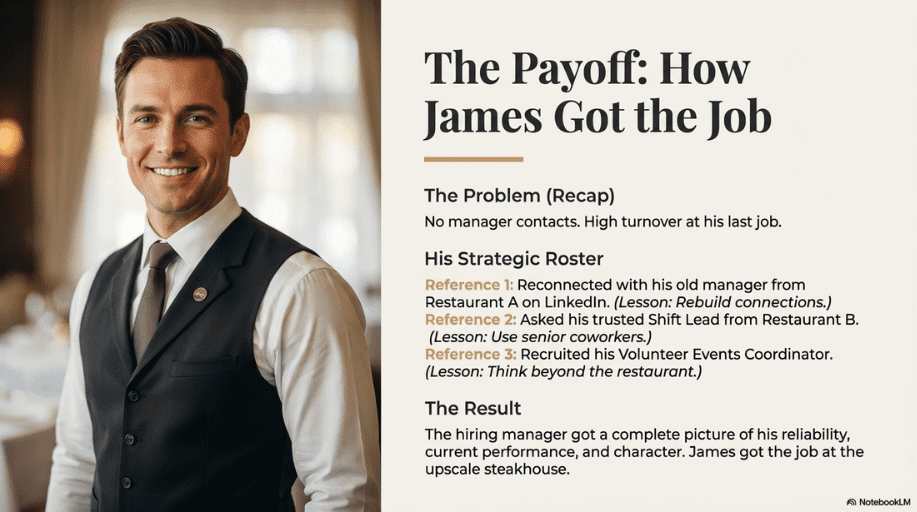
Real Example: How James Built His Reference Network
Remember James from the beginning? Here’s how he solved his reference problem.
His situation:
- Worked at Restaurant A for 1 year (manager quit, lost contact)
- Worked at Restaurant B for 6 months (high turnover, manager barely knew him)
- No recommendation letters
- Applying for server jobs at better restaurants
What he did:
Step 1: Reconnected with old manager
James found his old manager from Restaurant A on LinkedIn. He sent a message:
“Hi Sarah, this is James Rodriguez – I worked as a server at Restaurant A from 2022-2023 when you were the manager. I know it’s been about 18 months since we worked together, but I’m currently job searching and I was hoping you might remember me well enough to serve as a reference? I really valued working under your management. No pressure if too much time has passed.”
Sarah responded: “Of course I remember you! You were one of our most reliable servers. Happy to be a reference.”
Step 2: Asked current shift lead
At Restaurant B, James had a good relationship with Miguel, the shift lead, even though the manager didn’t know him well.
James asked: “Miguel, I’m planning to apply for positions at some upscale restaurants. Would you be willing to serve as a reference? You’ve seen my work more closely than [manager] has since we work the same shifts.”
Miguel agreed.
Step 3: Added non-traditional reference
James had volunteered as a server at community fundraising dinners through his church for 3 years. He asked the event coordinator:
“Hi Ms. Chen, I’ve been volunteering at the community dinners for three years now. I’m applying for professional server positions and I’m wondering if you’d be willing to serve as a character reference? You’ve seen my service skills and reliability in the volunteer setting.”
She agreed enthusiastically.
His final reference list:
- Sarah Johnson (Former Restaurant Manager, Restaurant A) – direct supervisor
- Miguel Santos (Shift Lead, Restaurant B) – current supervisor
- Linda Chen (Community Events Coordinator) – character reference demonstrating service skills
The result:
When James applied for a server position at an upscale steakhouse, he provided these three references. The hiring manager called all three.
- Sarah spoke about his reliability and customer service skills from a year ago
- Miguel spoke about his current work performance and teamwork
- Linda spoke about his professionalism and commitment (3 years of consistent volunteering showed character)
James got the job.
The lesson: You don’t need perfect references. You need credible people who can speak positively and specifically about your skills and character. Be creative, be honest, and use what you have.

Final Thoughts: Your References Tell Your Professional Story
References and recommendation letters aren’t just a formality in the hiring process. They’re the final piece of evidence that you’re the right person for the job.
Everything else in your application is what YOU say about yourself. References are what OTHER PEOPLE say about you. And employers trust other people’s opinions more than they trust yours.
That’s why building and maintaining a strong reference network is one of the most important career investments you can make.
Start today:
- If you’re currently employed, build relationships with your managers and supervisors
- Document your accomplishments so you can provide specific talking points
- When you leave jobs on good terms, ask for recommendation letters
- Maintain contact with former managers and colleagues
- Say thank you when people help you
Your references are proof that you’re not just a good employee on paper—you’re someone real people trust, respect, and would work with again.
And in the restaurant industry, where teamwork, reliability, and customer service are everything, that matters more than any resume can show.
Remember James: He felt stuck with weak references, but he solved it by reconnecting with old contacts, using non-traditional references, and being strategic about who he asked. You can do the same.
Your next job is out there. Your references will help you get it. Now you know exactly how to build, ask for, and use them.
Ready to Master Restaurant English?
These free articles and scenarios are a great start, but if you want a complete, structured system for learning restaurant English, consider our full course.

English for Waiters includes:
✅ 22+ video lessons covering every restaurant situation
✅ Real restaurant scenarios with native pronunciation
✅ Interactive pronunciation practice
✅ Downloadable phrase guides
✅ Lifetime access with free updates