
The Problem Marcus Didn’t Know How to Handle
Marcus had been working at Riverside Bistro for eight months. Good server. Reliable. The managers liked him. His coworkers respected him.
But something was wrong.
Every week, his manager asked him to come in 30 minutes early to set up the dining room – before he clocked in. “Just help us get ready for service,” the manager said. “It’s part of being a team player.”
Marcus did it. He wanted to be helpful.
Then he noticed his paychecks seemed low. He was working 45 hours most weeks, but his pay stub only showed 40. When he asked about overtime, his manager said, “We don’t pay overtime. You’re salaried.”
But Marcus wasn’t salaried. He was paid hourly at $12 per hour plus tips.
He also noticed that the restaurant was keeping 15% of the tip pool for “house expenses.” And sometimes, when credit card tips came in, the full amount didn’t appear on his paycheck.
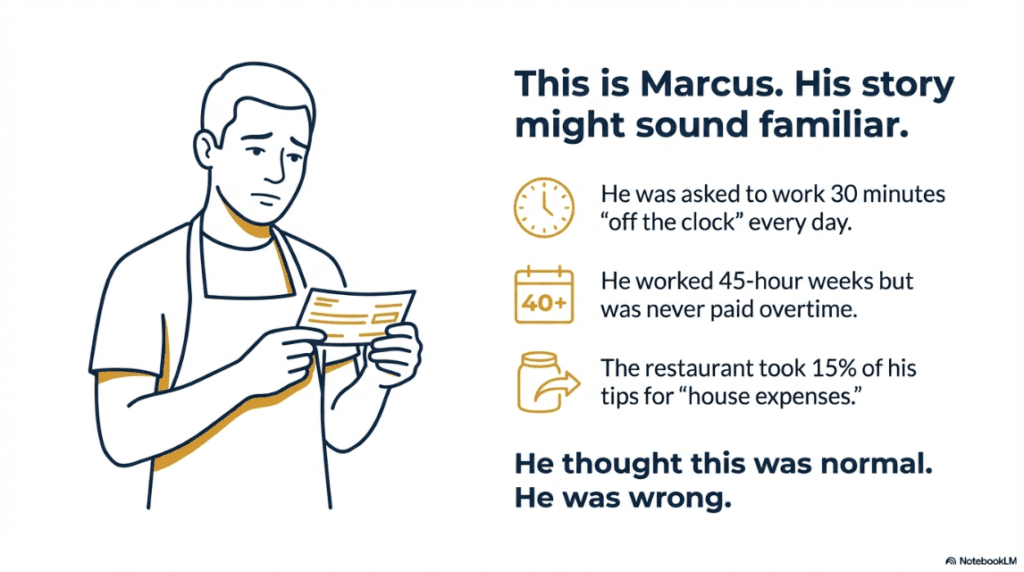
Marcus had three problems:
- Working off the clock (wage theft)
- Not being paid overtime (illegal)
- Restaurant keeping portions of tips (also illegal)
But Marcus didn’t know these were illegal. He thought this was just how restaurants worked. He thought if he complained, he’d get fired. He thought because his English wasn’t perfect, he didn’t have the same rights as other workers.
Marcus was wrong on all counts.
This guide teaches you:
- Your legal rights as a restaurant worker (regardless of immigration status or English level)
- How to recognize wage theft, harassment, and discrimination
- When and how to document problems
- Who to report problems to and how the process works
- How to protect yourself from retaliation
- When to quit versus when to fight
By the end of this article, you’ll know exactly what is and isn’t legal in your workplace, how to protect yourself, and where to go for help when your rights are violated.
Important disclaimer: This guide provides general information about worker rights under U.S. federal law. It is not legal advice. State and local laws may provide additional protections. For specific legal advice about your situation, consult an employment attorney.
Prefer to listen? Here’s the podcast.
Part 1: Understanding Your Basic Rights
Federal Laws That Protect Restaurant Workers
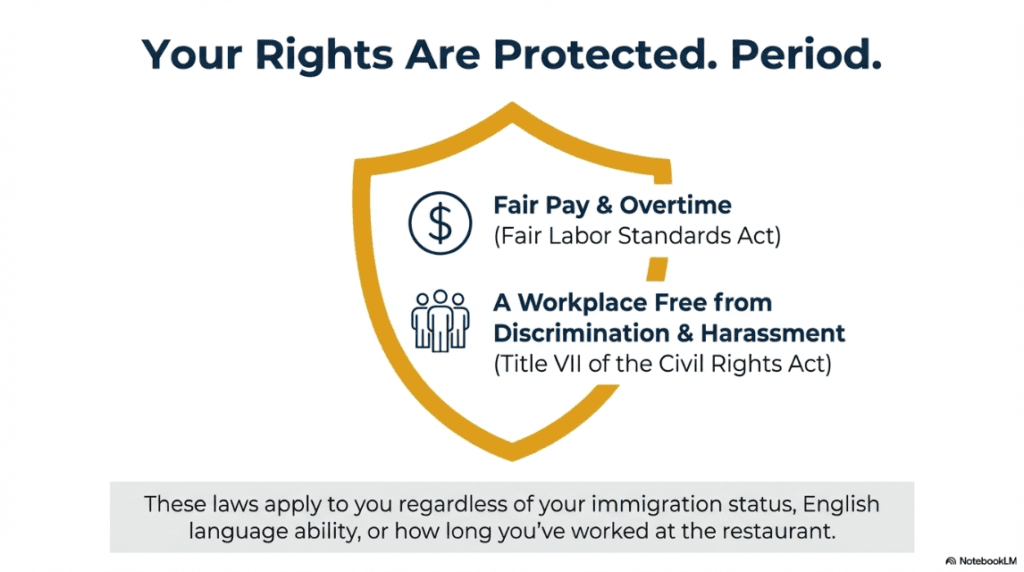
Fair Labor Standards Act (FLSA)
- Sets federal minimum wage ($7.25/hour, though many states have higher minimums)
- Requires overtime pay (1.5x regular rate for hours over 40 per week)
- Regulates tip credit and tip pooling
- Prohibits working off the clock
Title VII of the Civil Rights Act
- Prohibits discrimination based on race, color, religion, sex (including pregnancy, sexual orientation, gender identity), or national origin
- Prohibits sexual harassment and hostile work environments
- Protects against retaliation for reporting discrimination
Americans with Disabilities Act (ADA)
- Prohibits discrimination based on disability
- Requires reasonable accommodations for qualified workers with disabilities
Age Discrimination in Employment Act (ADEA)
- Prohibits discrimination against workers 40 and older
These laws apply to you regardless of:
- Your immigration status
- Your English language ability
- Whether you’re documented or undocumented
- How long you’ve worked at the restaurant
Who Enforces These Laws
| Agency | What They Handle | Contact |
|---|---|---|
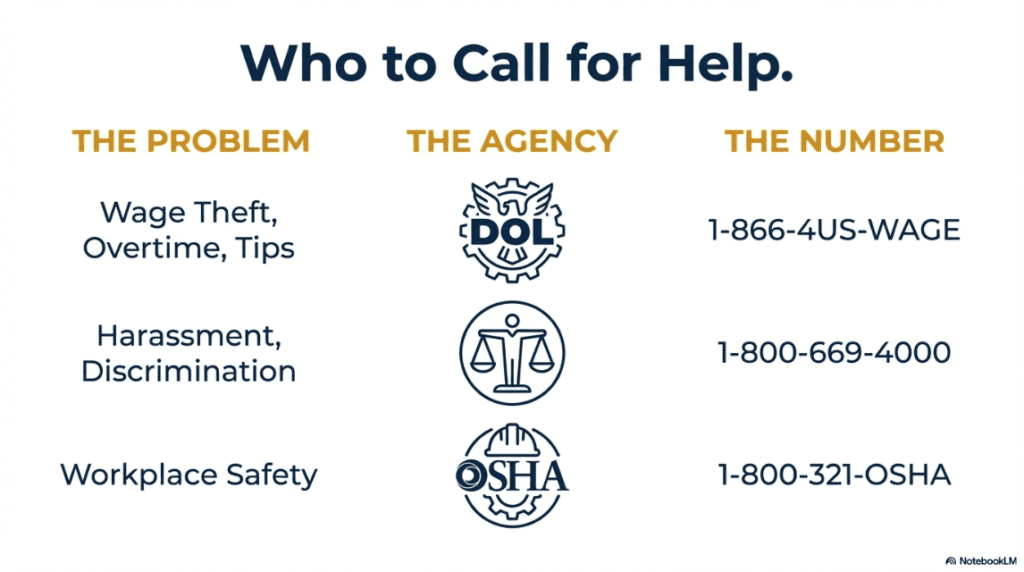
| U.S. Department of Labor (DOL) | Wage theft, overtime violations, tip violations | 1-866-4US-WAGE (487-9243) |
| Equal Employment Opportunity Commission (EEOC) | Discrimination, harassment, retaliation | 1-800-669-4000 |
| State Labor Department | State-specific wage and hour violations | Varies by state |
| Occupational Safety and Health Administration (OSHA) | Workplace safety violations | 1-800-321-6742 |
Part 2: Wage Theft – The Most Common Problem
What is Wage Theft?
Wage theft happens when an employer doesn’t pay you the full wages you’ve legally earned.
According to the U.S. Department of Labor, investigations of over 9,000 restaurants found that 84% were in violation of federal wage laws. This is the most common problem restaurant workers face.
The 8 Most Common Forms of Wage Theft
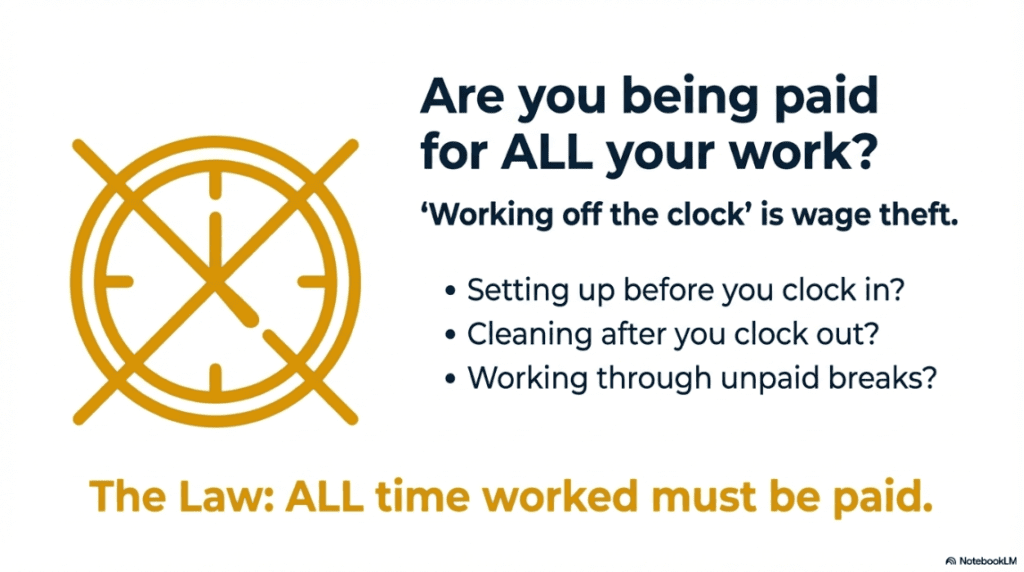
1. Working Off the Clock
What it looks like:
- Asked to arrive 15-30 minutes early to set up before clocking in
- Required to stay after clocking out to clean or close
- Pressured to work through breaks
- Doing opening/closing work while restaurant is closed (but paid tipped minimum wage)
What the law says: ALL time worked must be paid. If your employer asks you to do any work-related task, you must be clocked in and paid for that time.
Special rule: Opening and closing work when the restaurant is not open for business must be paid at full minimum wage (not tipped minimum wage), because you cannot receive tips when there are no customers.
2. Unpaid Overtime
What it looks like:
- Working 45-50 hours but only getting paid for 40
- Being told “we don’t pay overtime”
- Manager tells you you’re “salaried” when you’re actually hourly
- Pressure to clock out at 40 hours but keep working
What the law says: Non-exempt employees (which includes most servers, cooks, and hourly restaurant workers) MUST be paid 1.5 times their regular rate for ALL hours worked over 40 in a workweek.
For tipped workers: If you make tipped minimum wage ($2.13/hour federal, higher in many states), your overtime rate is calculated differently. The overtime rate is based on the full minimum wage, not the tipped minimum wage. Consult the Department of Labor’s overtime calculator for tipped workers.
Exception: Some managers and supervisors may be exempt from overtime if they meet specific criteria (primarily managerial duties, paid on salary basis, earn above certain threshold). Most servers do NOT meet these criteria.
3. Illegal Tip Violations
What it looks like:
- Restaurant keeps a percentage of the tip pool
- Manager or owner takes part of tips
- Required to share tips with non-tipped employees (kitchen managers, owners)
- Credit card processing fees deducted from tips (more than actual processing cost)
- Tips don’t bring you up to minimum wage, but employer doesn’t make up the difference
What the law says (as of 2021 federal rules):
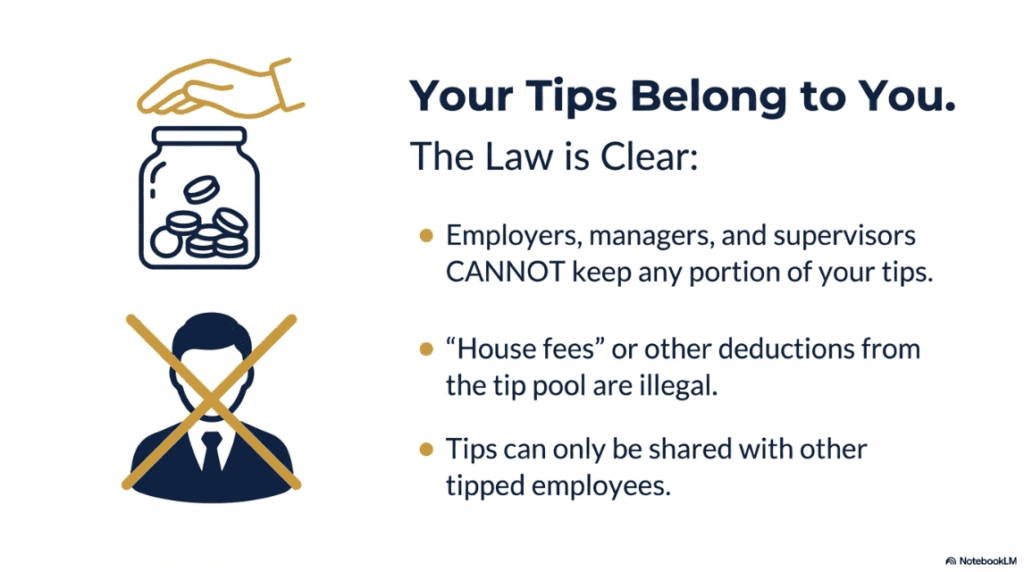
- Employers CANNOT keep any portion of employee tips under any circumstances
- Managers and supervisors CANNOT receive tips from tip pools
- Only tipped employees can participate in tip pools
- Employers can only deduct actual credit card processing fees from tips
- If your tips + tipped wage don’t equal full minimum wage, employer must pay the difference
Important: Some states have stricter rules. Some states don’t allow the tip credit at all and require full minimum wage plus tips.
4. Unpaid or Interrupted Breaks
What it looks like:
- Breaks automatically deducted from hours even if you didn’t actually take them
- Asked to do work tasks during your break
- Breaks shorter than 20 minutes but still deducted as full break
What the law says: Federal law does not require breaks, but if breaks are deducted from your pay:
- Breaks must be completely uninterrupted (you cannot be asked to do any work)
- Breaks under 20 minutes must be paid
- Meal breaks (30+ minutes) can be unpaid ONLY if you’re completely relieved of duties
Many states have additional break requirements. Check your state labor department website.
According to Modern Restaurant Management, wage and hour violations have plagued the restaurant industry for nearly two decades, with lawsuits over tips, overtime, and meal breaks continuing to be filed nationwide – demonstrating these problems are widespread and persistent.
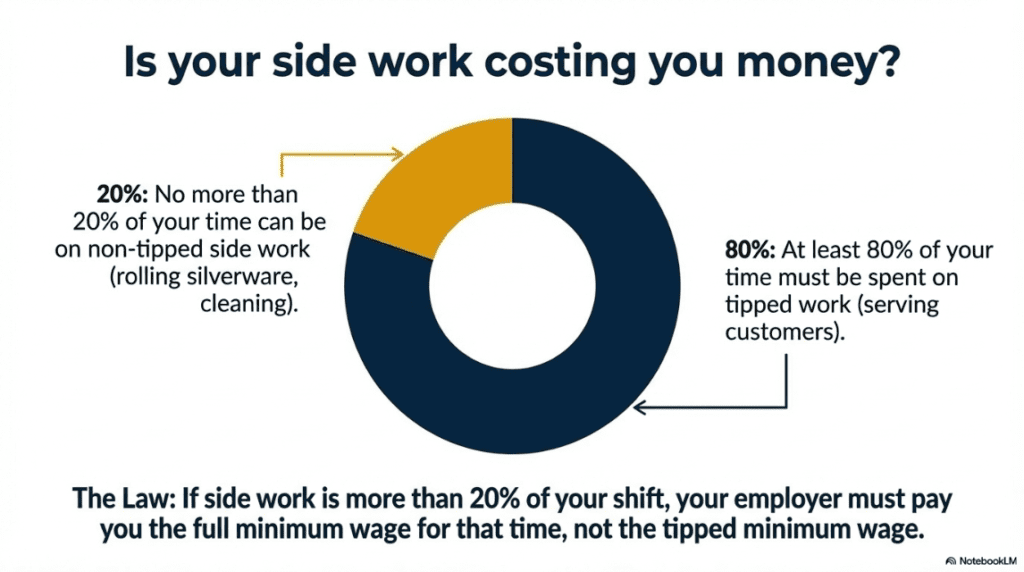
5. Illegal Side Work (The 80/20 Rule)
What it looks like:
- Spending 2-3 hours doing side work (rolling silverware, stocking, cleaning) while being paid tipped minimum wage
- More than 20% of your shift is non-tipped work
What the law says: Tipped workers can do some “tip-supporting” side work (bussing tables, folding napkins, making coffee) while being paid tipped minimum wage, BUT this work cannot exceed 20% of your shift.
The 80/20 rule: At least 80% of your shift must be spent on actual tipped work (serving customers). No more than 20% can be tip-supporting side work.
If you spend more than 20% on side work, you should be paid full minimum wage for that time.
6. Uniform and Supply Costs
What it looks like:
- Required to buy specific uniform or shoes
- Costs deducted from paycheck
- Required to pay for broken dishes or walkouts
- Deductions bring your pay below minimum wage
What the law says: Employers can require specific uniforms, but:
- The cost cannot bring your wages below minimum wage
- Many states require employers to pay for uniforms
- Employers CANNOT deduct for broken dishes, walkouts, or cash register shortages if it brings you below minimum wage
7. Misclassification as Independent Contractor
What it looks like:
- Classified as “independent contractor” but work set shifts like an employee
- Receive 1099 form instead of W-2
- No overtime, no minimum wage protections
What the law says: Most restaurant workers are EMPLOYEES, not independent contractors. If the restaurant controls when you work, how you work, and what you do, you’re an employee – regardless of what they call you.
Why this matters: Independent contractors don’t get minimum wage, overtime, or other employee protections.
8. Not Paying Final Paycheck
What it looks like:
- Quit or got fired, but didn’t receive final paycheck
- Final paycheck delayed for weeks
- Deductions taken from final paycheck
What the law says: Varies by state, but most states require final paychecks to be provided within a specific timeframe (often the next payday or within 72 hours). Check your state’s Department of Labor website.
According to 7shifts’ restaurant labor law guide, wage violations are costly – one Denver-area bistro recently paid almost $243,000 in back pay after withholding minimum wage, keeping tips, and denying overtime, demonstrating that these violations are serious and enforceable.
How to Protect Yourself from Wage Theft
1. Keep Your Own Records
Track every week:
- Exact hours worked (start time, end time, breaks)
- Tips earned each shift
- Any deductions on paystub
- Any time worked off the clock
Use: Notebook, phone app, or DOL’s free Timesheet App (available for iOS and Android in English and Spanish)
Why: Your records can prove wage theft if your employer’s records are inaccurate or altered.
2. Save All Paystubs
Some states don’t require employers to provide paystubs. If you get them (paper or digital), save them all.
If you’re paid through an app: Screenshot or download statements regularly. If you’re removed from the schedule, you may lose access to this data.
3. Understand Your Paystub
Check for:
- Total hours worked (match your records?)
- Regular pay vs. overtime pay
- Tip credit claimed
- Deductions (what are they for?)
- Net pay (does the math add up?)
Red flags:
- Hours worked don’t match your records
- No overtime pay when you worked over 40 hours
- Unexplained deductions
- Tip amounts significantly lower than what you recorded
Part 3: Sexual Harassment and Hostile Work Environment
What is Sexual Harassment?
According to the EEOC, sexual harassment includes:
- Unwelcome sexual advances
- Requests for sexual favors
- Other verbal or physical harassment of a sexual nature
- Offensive remarks about a person’s sex or gender
Important: The harasser can be any gender. The victim can be any gender. They don’t have to be different genders.
Two Types of Sexual Harassment
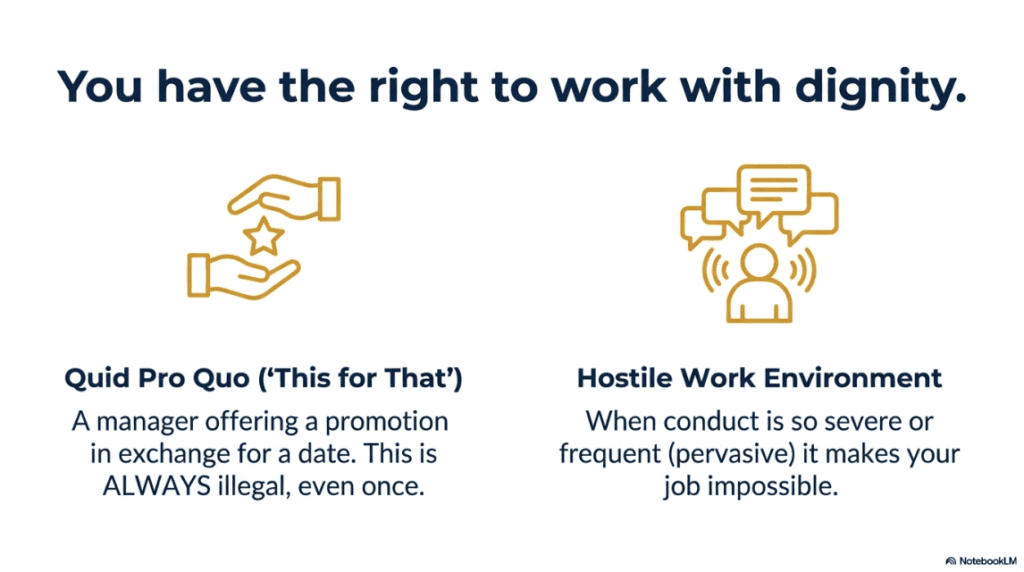
1. Quid Pro Quo (“This for That”)
Examples:
- Manager offers promotion if you go on a date
- Supervisor threatens to fire you if you don’t accept sexual advances
- Better shifts given to employees who comply with sexual requests
This is ALWAYS illegal, even if it only happens once.
2. Hostile Work Environment
Examples:
- Repeated sexual comments or jokes
- Unwanted touching or groping
- Sexual gestures
- Displaying pornographic images
- Commenting on someone’s body or appearance in a sexual way
- Making someone uncomfortable because of their sex or gender
For this to be illegal, the conduct must be:
- Severe OR pervasive (frequent)
- Based on a protected characteristic (sex, gender, gender identity)
- Creates an environment a reasonable person would find hostile or abusive
Note: Simple teasing, offhand comments, or isolated incidents that aren’t very serious don’t violate the law. But patterns of behavior, even if each incident seems minor, can add up to illegal harassment.
Common Scenarios in Restaurants
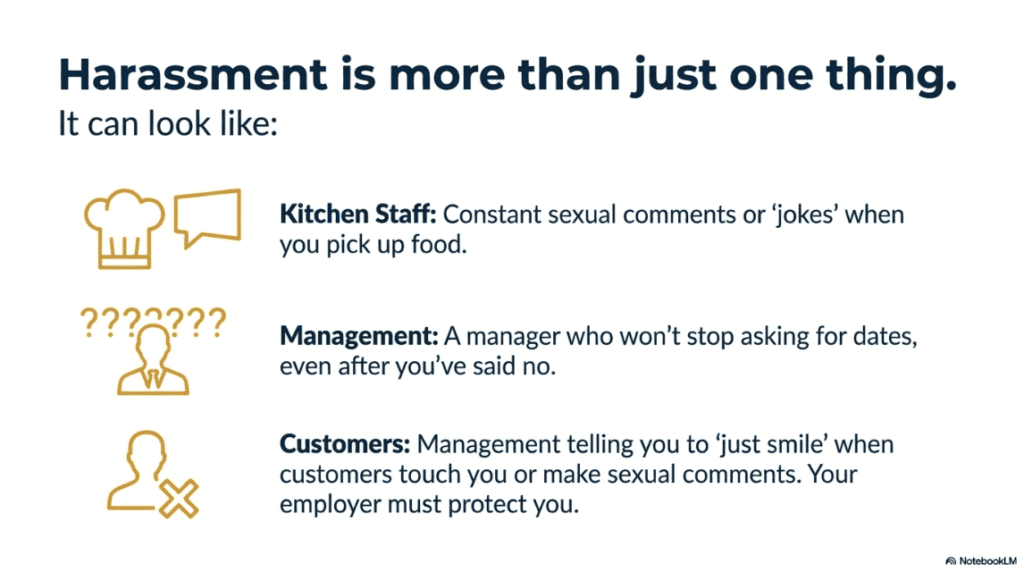
Scenario 1: Kitchen Staff Making Sexual Comments
Marcus’s coworker, Ana, is constantly subjected to sexual comments from kitchen staff when she picks up food at the window. They comment on her body, make sexual jokes, and ask intrusive questions about her personal life. When she asks them to stop, they say “we’re just joking” and continue.
Is this illegal? Likely yes. This is a hostile work environment based on sex. The pattern of behavior creates an uncomfortable, hostile environment.
Scenario 2: Manager Asking for Dates
A manager repeatedly asks a server out on dates despite being told “no” multiple times. The manager hasn’t threatened the server’s job, but the server feels uncomfortable and pressured.
Is this illegal? Potentially yes. Repeated unwanted advances from someone in a position of power can create a hostile work environment, even without explicit threats.
Scenario 3: Customer Harassment
Customers regularly make sexual comments to servers or touch them inappropriately. Management knows this happens but tells servers “just smile and be nice, they tip well.”
Is this illegal? Yes. Employers are responsible for protecting employees from harassment by customers and must take steps to stop it.
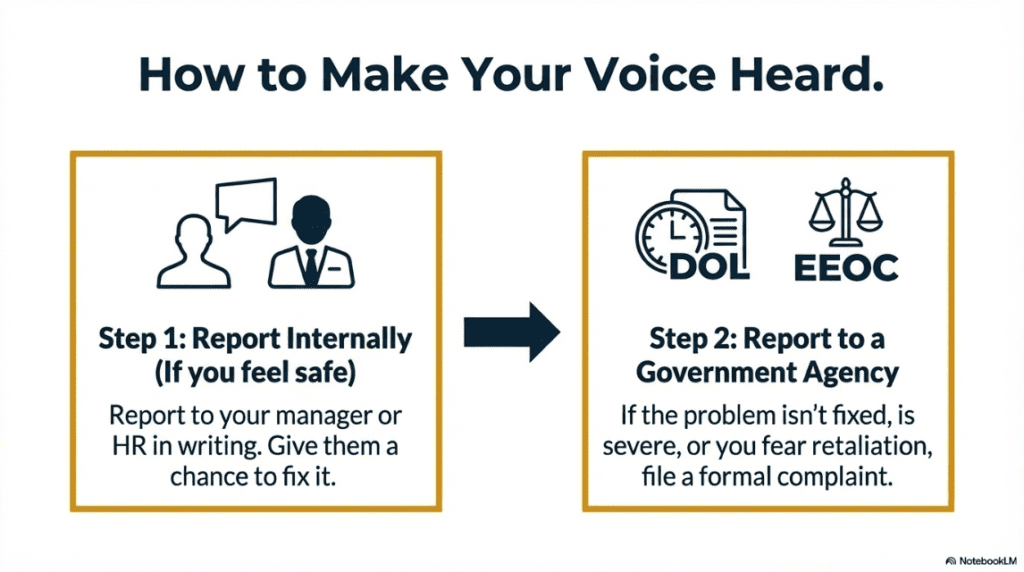
What to Do if You’re Being Harassed
Step 1: Tell the Harasser to Stop (if safe to do so)
Say clearly: “That comment makes me uncomfortable. Please don’t say things like that to me.”
Or: “I’m not interested in dating you. Please stop asking.”
Why: Creates a clear record that the behavior is unwelcome. However, you are NOT required to do this if you feel unsafe.
Step 2: Report to Your Employer
Who to tell:
- Your direct supervisor (if they’re not the harasser)
- HR department
- General manager or owner
- Any person designated in the employee handbook
How to report:
- In writing if possible (email or written note)
- State specific facts: who, what, when, where
- Keep a copy for yourself
Example email:
“Dear [Manager Name],
I’m writing to report sexual harassment I’ve been experiencing at work.
On [dates], [name of person] made the following comments to me: [specific comments]. This has happened approximately [number] times over the past [timeframe].
I told [person] to stop on [date], but the behavior has continued.
This behavior makes me uncomfortable and interferes with my ability to do my job.
I request that the company investigate this matter and take appropriate action to stop this harassment.
Sincerely, [Your Name] [Date]”
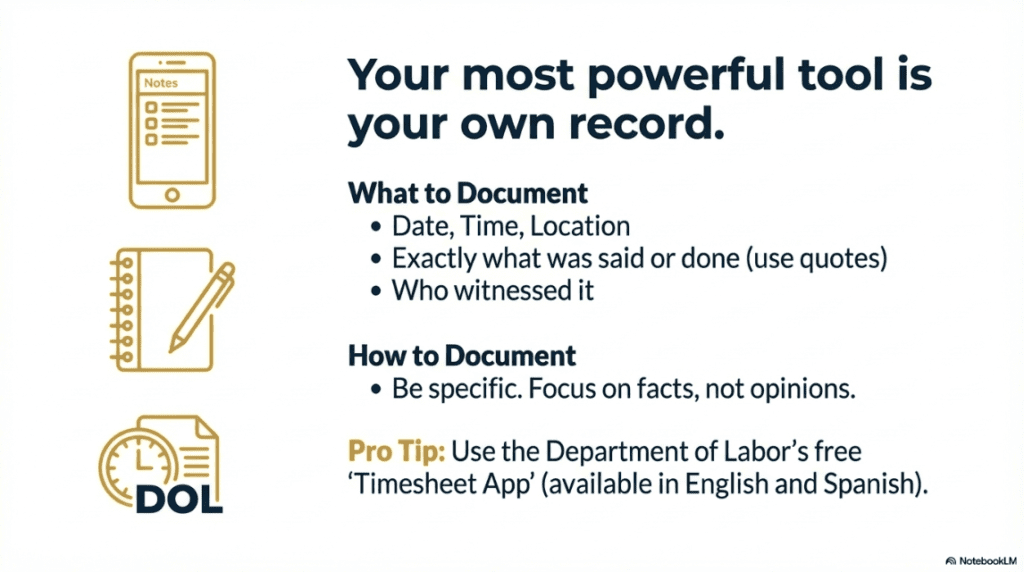
Step 3: Document Everything
Keep a written record:
- Date and time of each incident
- Exactly what was said or done
- Who witnessed it
- How it made you feel
- Any action you took (told them to stop, reported it)
Save:
- Emails, texts, or messages related to the harassment
- Your written complaints to management
- Any responses from management
Step 4: If Your Employer Doesn’t Fix It, File with EEOC
You can file a charge of discrimination with the EEOC if:
- Your employer doesn’t investigate your complaint
- Your employer doesn’t take action to stop the harassment
- The harassment continues after you reported it
- You’re retaliated against for reporting
Timeline: You must file with EEOC within 180 days of the harassment (300 days in some states).
How to file:
- Call: 1-800-669-4000
- Online: www.eeoc.gov/how-file-charge-employment-discrimination
- In person: Visit local EEOC office
What to provide:
- Your name and contact information
- Employer’s name and address
- Description of what happened (dates, specific incidents)
- Why you believe it was discrimination (based on sex, gender, etc.)
- Signature
Part 4: Discrimination and Retaliation
What is Illegal Discrimination?
Discrimination means treating someone differently because of a protected characteristic:
Protected characteristics under federal law:
- Race or color
- National origin or ethnicity
- Religion
- Sex (including pregnancy, sexual orientation, gender identity)
- Age (40 or older)
- Disability
- Genetic information
Examples of illegal discrimination:
- Refusing to hire someone because of their accent
- Paying women less than men for the same work
- Giving worse shifts to older workers
- Firing someone because they’re pregnant
- Refusing to accommodate a worker’s religious practices
- Not hiring someone because of their race
What is NOT discrimination:
- Being rude to everyone equally (not based on protected characteristic)
- Firing someone for legitimate poor performance
- Personality conflicts (without connection to protected characteristic)
- Unfair treatment that’s not based on protected characteristic
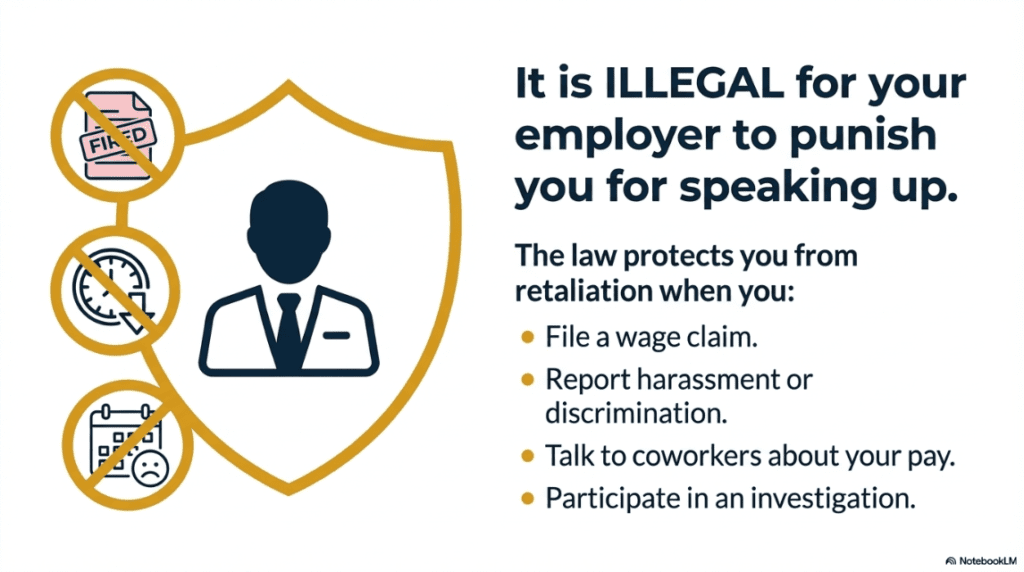
What is Retaliation?
Retaliation is when an employer punishes you for:
- Filing a discrimination or harassment complaint
- Participating in an investigation
- Opposing discrimination (speaking up about it)
- Filing a wage claim
- Talking to coworkers about pay or working conditions
Examples of retaliation:
- Firing you after you complain about harassment
- Reducing your hours after you file a wage claim
- Giving you worse shifts after you participate in an EEOC investigation
- Creating a hostile environment after you speak up about discrimination
Important: Retaliation is illegal even if the original complaint turns out to be unfounded. You’re protected for making a complaint in good faith.
How to Prove Discrimination or Retaliation
You’ll need to show:
- You’re in a protected class OR engaged in protected activity
- You were treated negatively (fired, demoted, harassed, etc.)
- The negative treatment was because of your protected characteristic OR your protected activity
Evidence that helps:
- Written records of discriminatory comments
- Comparisons showing others were treated differently
- Timeline showing negative treatment started after protected activity
- Witnesses who saw discriminatory behavior
- Emails, texts, or documents showing bias
Part 5: When and How to Document
What to Document
Keep records of:
For wage theft:
- Daily start/end times and breaks
- Tips earned each shift
- All paystubs
- Any requests to work off the clock
- Overtime hours worked
For harassment or discrimination:
- Date, time, location of each incident
- Exactly what was said or done (quote if possible)
- Who witnessed it
- How it made you feel
- Any reports you made to management
- Management’s response
For retaliation:
- Timeline showing when you made complaint
- Timeline showing when negative treatment started
- Specific examples of changed treatment
- Any comments management made connecting the two
How to Document
1. Write It Down Immediately
Don’t rely on memory. Write notes the same day incidents happen.
2. Be Specific
❌ “Manager was inappropriate” ✅ “On March 15, 2024 at 2:30 PM, Manager John said ‘You look sexy in that uniform’ in front of servers Ana and Mike in the break room.”
3. Focus on Facts, Not Opinions
❌ “Manager is a jerk and hates me” ✅ “On March 15, Manager gave me a written warning for being 2 minutes late. Other servers are regularly 10-15 minutes late with no consequences.”
4. Keep Documents Safe
- Don’t store on work computer or email
- Use personal email or phone
- Keep physical copies at home
- Back up electronic files
Part 6: How to Report Problems
Internal Reporting (To Your Employer)
When to report internally first:
- Minor issues that may be misunderstandings
- Situations where you think employer doesn’t know
- When you want to give employer chance to fix it
How to report:
- Check employee handbook for reporting procedures
- Report in writing (email, written note)
- Be specific and factual
- Keep a copy for yourself
- Note the date you reported
Who to report to:
- Direct supervisor (if not the problem)
- HR department
- General manager or owner
- Anyone designated in handbook
What to expect:
- Employer should investigate promptly
- You may be interviewed
- Witnesses may be interviewed
- You should receive update on outcome
- Problem should be corrected
External Reporting (To Government Agencies)
When to report externally:
- Employer doesn’t fix problem after internal report
- Problem is severe (safety issue, serious harassment)
- You’ve been retaliated against
- Employer is involved in the problem
- You don’t trust internal process
Where to Report
| Problem | Where to Report | Contact | Deadline |
|---|---|---|---|
| Wage theft, overtime violations | U.S. Department of Labor | 1-866-4US-WAGE (487-9243) | 2-3 years depending on violation |
| Tip violations | U.S. Department of Labor | 1-866-4US-WAGE (487-9243) | 2-3 years |
| Sexual harassment | EEOC | 1-800-669-4000 | 180-300 days |
| Discrimination | EEOC | 1-800-669-4000 | 180-300 days |
| Retaliation | EEOC | 1-800-669-4000 | 180-300 days |
| Safety violations | OSHA | 1-800-321-6742 | 30 days (for some violations) |
| State wage violations | State Department of Labor | Varies by state | Varies by state |
Important: Different violations have different deadlines. Don’t wait. Report as soon as possible.
What Happens When You File a Complaint
Department of Labor (Wage Claims):
- You file complaint (online, phone, or in person)
- DOL investigates (reviews records, interviews people)
- If violations found, DOL can require employer to pay back wages
- In serious cases, employer may face penalties
- You’re protected from retaliation
Timeline: Can take several months
EEOC (Discrimination/Harassment):
- You file charge of discrimination
- EEOC notifies employer
- EEOC investigates or offers mediation
- EEOC determines if there’s reasonable cause
- EEOC may sue on your behalf OR give you “right to sue” letter
- You can file lawsuit with right to sue letter
Timeline: Can take 6 months to 2+ years
Part 7: Protecting Yourself from Retaliation
Know Your Rights
It is ILLEGAL for your employer to retaliate against you for:
- Filing wage claim
- Filing EEOC charge
- Reporting harassment or discrimination
- Participating in investigation
- Discussing wages with coworkers
- Refusing to do something illegal
Retaliation can include:
- Firing or demotion
- Reducing hours or pay
- Giving worse shifts
- Harassment or hostility
- Negative performance reviews
- Making your job more difficult
How to Protect Yourself
1. Document Everything
Keep detailed timeline of:
- When you made complaint
- Any changes to treatment after complaint
- Specific examples of retaliation
2. Continue Performing Well
Don’t give employer legitimate reason to discipline you:
- Be on time
- Follow all policies
- Do your job well
- Document your good performance
3. Get Everything in Writing
If manager says something verbally: “Can you send me an email confirming that?”
Or send follow-up email: “This email confirms our conversation today where you told me [what they said]. Please let me know if I understood correctly.”
4. Know the Timeline
Retaliation often happens soon after protected activity. If you’re fired, demoted, or treated differently within days or weeks of making a complaint, that’s strong evidence of retaliation.
Part 8: When to Quit vs. When to Stay
Red Flags: Time to Leave
Quit immediately if:
- You’re in physical danger
- Employer asks you to do something illegal
- Harassment is severe and employer won’t act
- Your mental/physical health is seriously affected
- Employer is clearly retaliating and you can’t afford to fight
You can quit and still file claims for past violations.
Green Flags: Worth Staying and Fighting
Consider staying if:
- Problem is recent and you haven’t reported yet
- Employer has good track record of fixing issues
- You like the job otherwise
- You have evidence and want to pursue legal action
- Financial situation requires keeping job while pursuing claim
How to Quit Professionally
Even if employer treated you poorly, quit professionally:
1. Give notice (if safe to do so)
- Standard is 2 weeks
- Protects your references
- Shows professionalism
2. Write resignation letter
“Dear [Manager],
I’m writing to inform you that I’m resigning from my position as [job title], effective [date].
Thank you for the opportunity to work at [restaurant name].
Sincerely, [Your name]”
Don’t: Explain why you’re quitting in resignation letter (keep it neutral)
3. Return all property
- Uniforms
- Keys
- Any restaurant materials
4. Request final paycheck “Please provide my final paycheck on [date] per [state] labor law.”
5. Keep documentation Even after you quit, keep all records in case you need to file claims.
Some red flags appear early—if you’re starting a new restaurant job, pay attention to warning signs from day one.
Part 9: Finding Help
Free Legal Resources
Legal Aid Societies
- Provide free legal help to low-income workers
- Google: “[Your city] legal aid employment”
Worker Centers
- ROC United (Restaurant Opportunities Centers): www.rocunited.org
- Restaurant Workers United: www.restaurantworkersunited.org
- Provide support, education, organizing help
Law School Clinics
- Many law schools have employment law clinics
- Provide free representation
State Bar Associations
- Lawyer referral services
- Some offer free consultations
When to Hire a Lawyer
Consider hiring an employment lawyer if:
- You were fired and believe it was illegal
- Wage theft involves significant money
- Harassment was severe
- You want to file lawsuit
- Retaliation is ongoing
- Your situation is complex
Many employment lawyers work on contingency (they only get paid if you win).
First consultation is often free. Don’t be afraid to call and ask.
Part 10: Special Considerations for ESL Workers
Your Rights Don’t Depend on English Fluency
You have the same rights as native English speakers.
Employers cannot:
- Pay you less because of accent
- Refuse to hire you because of language
- Discriminate against you for being ESL
- Retaliate against you for limited English
Language Access
EEOC provides language assistance:
- Interpreters available for filing charges
- Documents available in multiple languages
- Call 1-800-669-4000 and ask for interpreter
DOL provides language assistance:
- Spanish language helpline: 1-866-4US-WAGE (487-9243)
- Translation services available
You can:
- Bring interpreter to meetings
- Request documents in your language
- Ask for language accommodations
Immigration Status Does NOT Affect Most Rights
Your wage and hour rights apply regardless of immigration status.
You can:
- File wage claims
- File discrimination charges
- Report violations
- Participate in investigations
Federal agencies (DOL, EEOC) generally:
- Don’t ask about immigration status
- Don’t share information with immigration enforcement
- Focus on labor violations, not immigration
However: Consult immigration attorney if you have concerns, as some situations are complex.
Conclusion: Marcus Takes Action
Remember Marcus from the introduction?
After eight months of working off the clock, not receiving overtime, and having tips withheld, Marcus finally learned about his rights.
He started documenting:
- Every day he came in early (before clocking in)
- Every week he worked over 40 hours
- Every paycheck where tips seemed low
After two months of documentation, he had clear records.
Marcus filed a complaint with the Department of Labor. He was nervous. Would he get fired? Would there be retaliation?
Here’s what happened:
The DOL investigated. They reviewed the restaurant’s records. They found:
- Marcus and other servers regularly worked 30-45 minutes off the clock
- No overtime was paid despite 45+ hour weeks
- The restaurant was illegally keeping 15% of tip pool
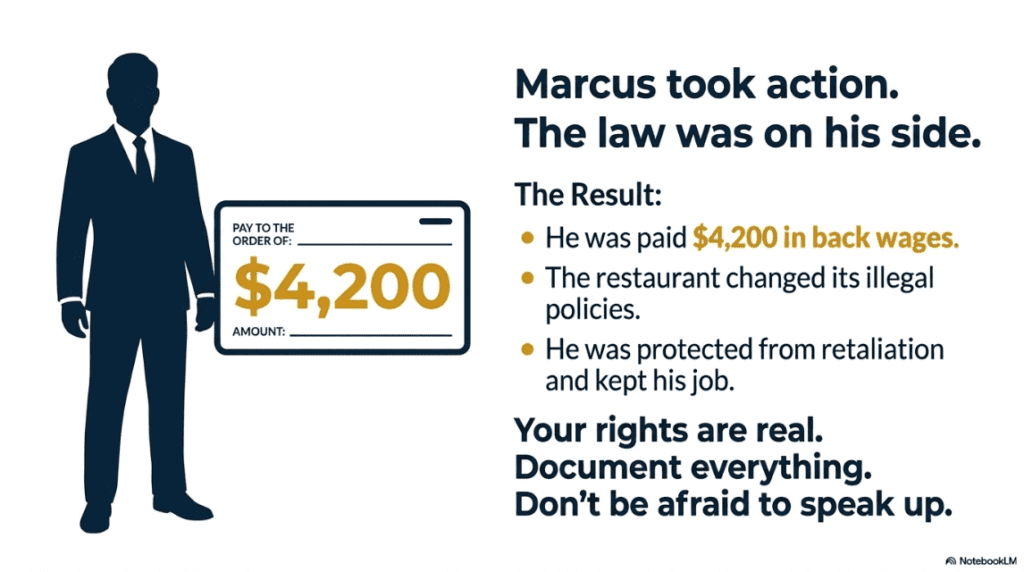
The result:
- The restaurant paid Marcus $4,200 in back wages
- Five other servers also received back pay
- The restaurant changed its policies
- Marcus was NOT fired (retaliation is illegal)
Six months later, Marcus still works there. The problems are fixed. He clocks in before any work. He gets overtime. Tips are properly distributed.
What changed? Not the restaurant’s willingness to treat workers fairly – they did that only when forced to by law. What changed was Marcus learning his rights and having the courage to stand up for them.
Your workplace problems are real. Wage theft is real. Harassment is real. Discrimination is real.
But your rights are also real. And there are systems in place to protect those rights.
You don’t have to accept illegal treatment. You don’t have to work for free. You don’t have to tolerate harassment. You don’t have to stay silent.
Your action items:
- Start documenting today (hours, tips, any problems)
- Save this guide for reference
- Know who to call if problems arise (DOL: 1-866-487-9243, EEOC: 1-800-669-4000)
- Talk to trusted coworkers (you’re probably not alone)
- Don’t be afraid to stand up for your rights
You deserve to be paid fairly. You deserve to work in a safe environment. You deserve to be treated with respect.
Know your rights. Document everything. Don’t be afraid to speak up.
Quick Reference: Your Rights Checklist
You Have the Right To:
Wages & Pay:
- Be paid for ALL time worked (including setup, closing, meetings)
- Receive overtime (1.5x) for hours over 40 per week
- Keep all your tips (employers cannot take any portion)
- Receive full minimum wage if tips don’t cover it
- Receive final paycheck when you leave
Workplace Safety:
- Work free from harassment (sexual, racial, etc.)
- Work free from discrimination
- Report safety violations without retaliation
- Reasonable accommodations for disabilities
Protection from Retaliation:
- File wage claims without being fired
- Report harassment without punishment
- Participate in investigations safely
- Discuss wages with coworkers
Your Options When Rights Are Violated:
- Report internally to employer first (if safe)
- File complaint with Department of Labor (wage issues)
- File charge with EEOC (harassment/discrimination)
- Contact worker advocacy organizations
- Consult employment lawyer
- Quit if necessary (and still pursue claims)
Emergency Contacts
Wage Theft & Overtime: U.S. Department of Labor: 1-866-4US-WAGE (487-9243)
Harassment & Discrimination: EEOC: 1-800-669-4000
Workplace Safety: OSHA: 1-800-321-6742
Legal Help: Legal Aid: Google “[your city] legal aid employment” ROC United: www.rocunited.org
Remember: Knowledge is power. You now know your rights. Use them.
Ready to Master Restaurant English?
These free articles and scenarios are a great start, but if you want a complete, structured system for learning restaurant English, consider our full course.

English for Waiters includes:
✅ 22+ video lessons covering every restaurant situation
✅ Real restaurant scenarios with native pronunciation
✅ Interactive pronunciation practice
✅ Downloadable phrase guides
✅ Lifetime access with free updates