A customer sits down. You bring menus. They look at the drink list and ask: “What wine goes with this?”
Your heart races. You know there are reds and whites. But which one? What if you recommend the wrong thing?
This is one of the most stressful moments for new servers. Wine and beer seem complicated. There are so many choices. So many rules.
But here’s the truth: you don’t need to be a wine expert. You just need to know the basics. And that’s exactly what you’ll learn today.
By the end of this guide, you will feel confident recommending wine and beer to any customer.
What You’ll Learn Today
This guide teaches you:
- The 5 main types of wine (red, white, rosé, sparkling, dessert)
- Simple wine and food pairing rules that always work
- The difference between ale and lager beer
- How to describe wine and beer professionally
- What to say when customers ask questions
- How to serve wine properly
You don’t need sommelier training. You just need practical knowledge you can use on your next shift.
Let’s begin.
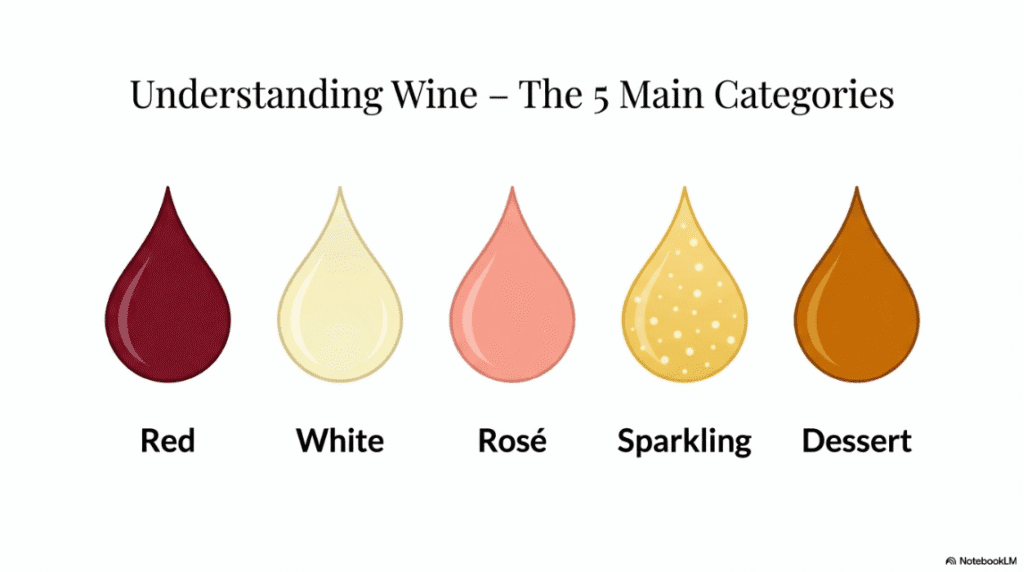
Part 1: Understanding Wine – The 5 Main Categories
All wines fit into 5 categories. Learn these five, and you understand 95% of wines in casual restaurants.
Category 1: Red Wine (Bold, Rich, Full-Bodied)
What is red wine? Red wine comes from dark grapes. The skins stay with the juice during fermentation. This creates the red color and the tannins.
What are tannins? Tannins create a dry, bitter feeling in your mouth. They come from grape skins. Red wine has high tannins. White wine has low tannins.
Basic characteristics:
- Color: Red, purple, or brown
- Body: Full and heavy (feels thick in your mouth)
- Taste: Bold, rich, sometimes bitter
- Temperature: Serve cool, not ice-cold (58-65°F / 14-18°C)
- Best with: Red meat, grilled foods, heavy dishes
The 5 Red Wines You Must Know:
1. Cabernet Sauvignon (cab-er-nay saw-vin-yawn)
- Taste: Dark fruits (plum, blackberry), bold, strong tannins
- Body: Full
- Best with: Steak, grilled meats, beef dishes
- How to describe it: “Bold and structured – perfect with a juicy steak”
2. Merlot (mer-lo)
- Taste: Red fruits (cherry, plum), smooth, silky, velvety
- Body: Medium to full
- Best with: Roasted meats, duck, pasta with meat sauce
- How to describe it: “Smooth and approachable – easier to drink than Cabernet”
3. Pinot Noir (pee-no nwahr)
- Taste: Red fruits (cherry, strawberry, raspberry), earthy, light
- Body: Light to medium
- Best with: Chicken, pork, mushroom dishes, even salmon
- How to describe it: “Light and elegant – works with delicate proteins”
4. Syrah/Shiraz (sir-ah / shee-raz)
- Taste: Dark fruits, peppery, smoky, spicy
- Body: Full
- Best with: Grilled meats, barbecue, spicy dishes
- How to describe it: “Peppery and bold – excellent with grilled foods”
5. Malbec (mal-bek)
- Taste: Dark fruits, earthy, smooth
- Body: Full
- Best with: Grilled meats, steak, hearty dishes
- How to describe it: “Rich and earthy – pairs beautifully with steak”
Professional Server Language:
“Our Cabernet Sauvignon is bold and structured – perfect if you’re ordering the ribeye. If you prefer something smoother and more approachable, our Merlot is excellent with any roasted meat dish.”
Category 2: White Wine (Light, Crisp, Refreshing)
What is white wine? White wine comes from green or light-colored grapes. The skins are removed before fermentation. This creates the light color.
Basic characteristics:
- Color: Yellow, golden, or pale
- Body: Light to medium (feels thin in your mouth)
- Tannins: Almost none (no dry, bitter feeling)
- Acidity: High (crisp, fresh, zesty)
- Temperature: Serve cold (47-55°F / 8-13°C)
- Best with: Fish, chicken, salads, light dishes
The 4 White Wines You Must Know:
1. Chardonnay (shar-don-ay)
- Taste: Citrus (lemon), tropical fruits, buttery, vanilla, oak
- Body: Medium to full
- Best with: Cream sauces, butter-based dishes, rich fish, roasted chicken
- How to describe it: “Rich and buttery – perfect with cream sauces”
Important note: Some Chardonnay is aged in oak barrels. This makes it taste buttery and creamy. This is called “oak-aged Chardonnay.”
2. Sauvignon Blanc (saw-vin-yawn blonk)
- Taste: Bright citrus (lime, grapefruit), herbaceous (grass), tropical
- Body: Light to medium
- Best with: Seafood, salads, light fish, fresh herb dishes
- How to describe it: “Crisp and fresh – ideal with fish and salads”
3. Pinot Grigio (pee-no gree-jo)
- Taste: Green apple, pear, citrus, mineral
- Body: Light
- Best with: Light seafood, white fish, appetizers, summer meals
- How to describe it: “Light and refreshing – perfect for white fish”
4. Riesling (reez-ling)
- Taste: Green apple, pear, stone fruits, mineral
- Sweetness: Can be dry OR sweet (ask which one you have!)
- Body: Light to medium
- Best with: Asian cuisine, spicy dishes, light desserts
- How to describe it: “Can range from dry to sweet – ask us which style”
Chardonnay vs. Sauvignon Blanc – THE KEY DIFFERENCE:
This is the most important thing to know about white wine:
| Feature | Chardonnay | Sauvignon Blanc |
|---|---|---|
| Body | Full, heavy | Light, thin |
| Taste | Rich, buttery, creamy | Crisp, fresh, zesty |
| Aging | Oak barrels (creates butter flavor) | Stainless steel (no oak) |
| Best with | Cream sauces, rich dishes | Light dishes, seafood, salads |
Professional language:
“Our Chardonnay is rich and creamy with buttery notes – perfect if you want something fuller-bodied. Our Sauvignon Blanc is crisp and fresh with herbaceous notes – ideal if you prefer something lighter with bright acidity.”
Category 3: Rosé Wine (Pink, Balanced, Summer Favorite)
What is rosé? (ro-zay) Rosé is made from red grapes. But the skins only touch the juice for a few hours (not weeks like red wine). This creates the pink color.
Basic characteristics:
- Color: Pink (pale to salmon)
- Body: Light to medium
- Tannins: Low (not dry like red wine)
- Acidity: High (crisp and refreshing like white wine)
- Temperature: Serve cold (50-55°F / 10-13°C)
- Taste: Fresh, fruity (berries, watermelon), crisp
- Best with: Salads, seafood, grilled vegetables, light dishes
Professional language:
“Rosé is perfect for today – it’s lighter and crisper than red wine but more flavorful than white. It pairs beautifully with our salads and grilled fish.”
When to recommend rosé:
- Hot weather / summer
- Light meals
- Customers who can’t decide between red and white
- Outdoor dining
Category 4: Sparkling Wine (Bubbly, Celebratory, Versatile)
What is sparkling wine? Sparkling wine has bubbles (carbonation). The bubbles are created during fermentation.
The 3 main types you need to know:
| Wine | Origin | Price | Taste | When to Serve |
|---|---|---|---|---|
| Champagne | France ONLY | High ($40-100+) | Complex, brioche, yeasty, nutty, dry | Celebrations, special occasions |
| Cava | Spain | Mid ($15-30) | Fruity, citrus, pear, toasty | Celebrations, aperitifs |
| Prosecco | Italy | Low ($10-20) | Light, floral, fruity, frothy | Casual occasions, aperitifs |
Key difference servers should know:
Champagne and Cava use the same production method (bottle fermentation – slow and expensive). Prosecco uses tank fermentation (faster and cheaper). That’s why Prosecco costs less – not because it’s lower quality!
Professional language:
“If you’d like something celebratory and sophisticated, our Champagne is wonderful. For that same festive feeling at a better price point, our Cava is excellent – it uses the same production method as Champagne. And if you want something light and approachable to start your meal, our Prosecco is perfect for an aperitif.”
When to recommend sparkling:
- Celebrations (birthdays, anniversaries)
- Before the meal (as an aperitif)
- With appetizers
- When customers can’t decide (sparkling goes with almost everything!)
Category 5: Dessert Wine (Sweet, After-Dinner, Rich)
What is dessert wine? Dessert wine is very sweet wine. It’s served with or after dessert.
Common types:
- Port: Fortified red wine (higher alcohol); pairs with chocolate
- Late Harvest Riesling: Sweet white wine; pairs with fruit desserts
- Moscato: Sweet sparkling wine; light and fruity
- Sherry: Fortified wine; ranges from dry to very sweet
Professional language:
“Would you like a dessert wine? Our Moscato is light and fruity, perfect with chocolate. Or our ruby Port pairs beautifully with our chocolate cake if you prefer something richer.”
Important: Dessert wine is NOT part of main-course wine service. Only offer it at the end of the meal.
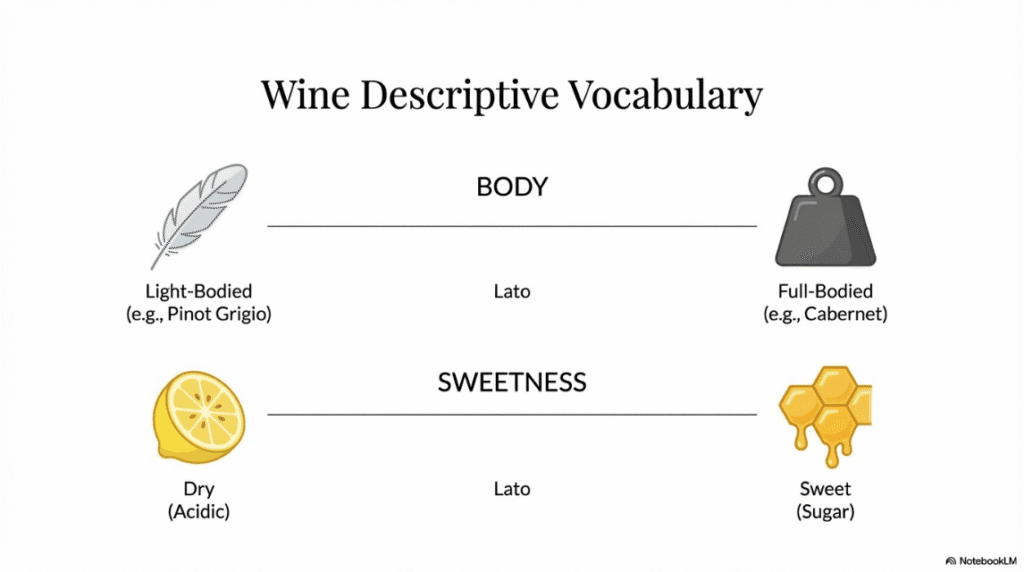
Part 2: Wine Descriptive Vocabulary – Speaking Like a Professional
Customers use certain words to describe what they like. You need to match their words to the right wine.
Understanding “Body”
Body means how heavy or light wine feels in your mouth.
| Body Type | Feels Like | Examples |
|---|---|---|
| Light-bodied | Thin, delicate, refreshing | Pinot Grigio, Sauvignon Blanc, Pinot Noir |
| Medium-bodied | Balanced weight | Rosé, some Chardonnay, Merlot |
| Full-bodied | Rich, heavy, thick | Cabernet, oak-aged Chardonnay |
How to use it:
“Our Pinot Noir is light-bodied and elegant, while our Cabernet is full-bodied and bold. Which appeals to you more tonight?”
Understanding “Dry vs. Sweet”
These terms describe sugar content:
| Term | Sugar Level | Taste |
|---|---|---|
| Dry | Little to no sugar | Not sweet at all |
| Off-dry | Slightly sweet | Subtle sweetness |
| Semi-sweet | Noticeably sweet | Sweet but balanced |
| Sweet | Very sweet | Dessert wines |
How to use it:
“Our Sauvignon Blanc is bone-dry with bright citrus notes. If you prefer something slightly sweeter, we have a Riesling that’s off-dry.”
Common Flavor Words Customers Use
When customers describe preferences, match them to these wines:
| Customer Says | They Mean | Recommend |
|---|---|---|
| “I like fruity wines” | Strong fruit flavors | Sauvignon Blanc, Merlot |
| “I love a buttery Chardonnay” | Rich, creamy | Oak-aged Chardonnay |
| “I prefer crisp wines” | High acidity, fresh | Sauvignon Blanc, Pinot Grigio |
| “I like earthy undertones” | Mineral, soil-like | Pinot Noir |
| “I enjoy spicy wines” | Pepper, spice notes | Syrah, Malbec |
| “I prefer smooth wines” | Soft, easy-drinking | Merlot, Pinot Noir |
| “I want bold flavors” | Strong, full-bodied | Cabernet, Syrah |
Professional approach:
When customers use these words, ask clarifying questions:
- “When you say ‘buttery,’ are you thinking of rich and creamy?” → Recommend oak-aged Chardonnay
- “So you prefer ‘crisp and fresh’?” → Recommend Sauvignon Blanc or Pinot Grigio
- “You want ‘bold flavors’?” → Recommend Cabernet or Syrah
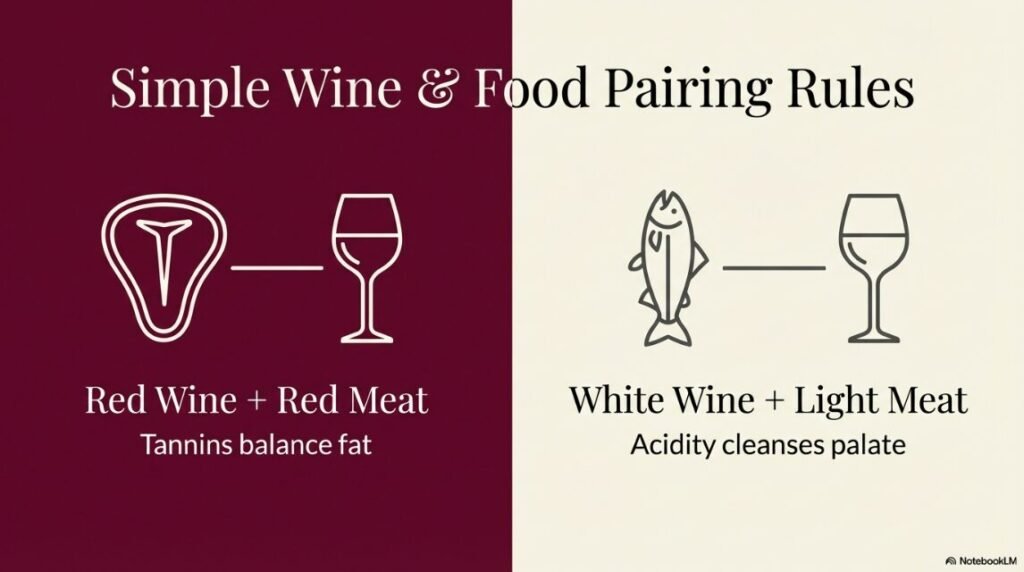
Part 3: Simple Wine & Food Pairing Rules
You don’t need to memorize 100 pairings. You need 5 simple rules that work 90% of the time.
Rule 1: Red Wine + Red Meat ✓
Why it works: Tannins in red wine balance the fat and protein in red meat.
Example: Cabernet Sauvignon with ribeye steak
What to say: “Our Cabernet pairs beautifully with the ribeye – the tannins balance the richness of the meat.”
Rule 2: White Wine + Fish/Chicken ✓
Why it works: Light body and high acidity of white wine don’t overpower delicate proteins. The acidity cleanses the palate.
Example: Sauvignon Blanc with grilled white fish
What to say: “Our Sauvignon Blanc is perfect with the sea bass – crisp acidity complements the delicate fish.”
Rule 3: Rosé + Salads & Light Dishes ✓
Why it works: Rosé is balanced – light enough for vegetables but flavorful enough to be interesting.
Example: Rosé with Caprese salad or grilled vegetables
What to say: “Rosé works wonderfully with our salad – it’s crisp enough to handle the vinaigrette without overpowering.”
Rule 4: Sparkling Wine + Almost Everything ✓
Why it works: Bubbles and acidity work with nearly any food. Carbonation adds vibrancy.
Example: Prosecco with appetizers, Champagne with oysters, sparkling with dessert
What to say: “Sparkling wine is incredibly versatile – it pairs with almost anything on our menu.”
Rule 5: Match Wine Intensity to Food Intensity ✓
The rule:
- Light dishes = Light wine
- Heavy dishes = Full-bodied wine
Examples:
- Light pasta → Pinot Grigio
- Beef stew → Cabernet Sauvignon
- Thai curry → Riesling (off-dry) or Sauvignon Blanc
What to say: “Our beef bourguignon is rich and hearty, so I’d recommend our full-bodied Cabernet rather than a lighter wine.”
The Important Exceptions
Exception 1: Sauce Matters More Than Protein
Rule: Match wine to the SAUCE, not just the protein.
Example:
- Chicken with red wine mushroom sauce → Pair with red wine (Pinot Noir)
- Fish with cream sauce → Pair with white wine or light red
What to say: “This salmon has a red wine reduction, so a medium-bodied red like Pinot Noir works beautifully – the sauce guides the pairing, not just the protein.”
Exception 2: Fatty Fish Can Pair with Red Wine
Rule: Fatty fish (salmon, tuna, swordfish) can pair with light-to-medium red wine.
Why: The richness of fatty fish matches the body of light red wine.
Example: Grilled salmon with Pinot Noir
What to say: “Salmon is rich and fatty, so our Pinot Noir – which is lighter than a Cabernet but fuller than white wine – pairs wonderfully.”
Exception 3: Spicy Dishes Need Special Treatment
Rule: Off-dry wines (slightly sweet) OR high-acidity wines work with spicy food.
Why: Sweetness soothes heat. Acidity refreshes and cools the palate.
Example: Thai curry with Riesling (off-dry) or Sauvignon Blanc (high acidity)
What to say: “Our Thai curry is spicy. I’d recommend either our Sauvignon Blanc for crisp acidity to cool the heat, or our Riesling, which has slight sweetness to balance the spice.”
Part 4: By-the-Glass vs. By-the-Bottle – When to Recommend Each
Understanding this helps you increase sales and provide better value to customers.
By-the-Glass Pricing
Restaurant pricing:
- One glass = $8-10
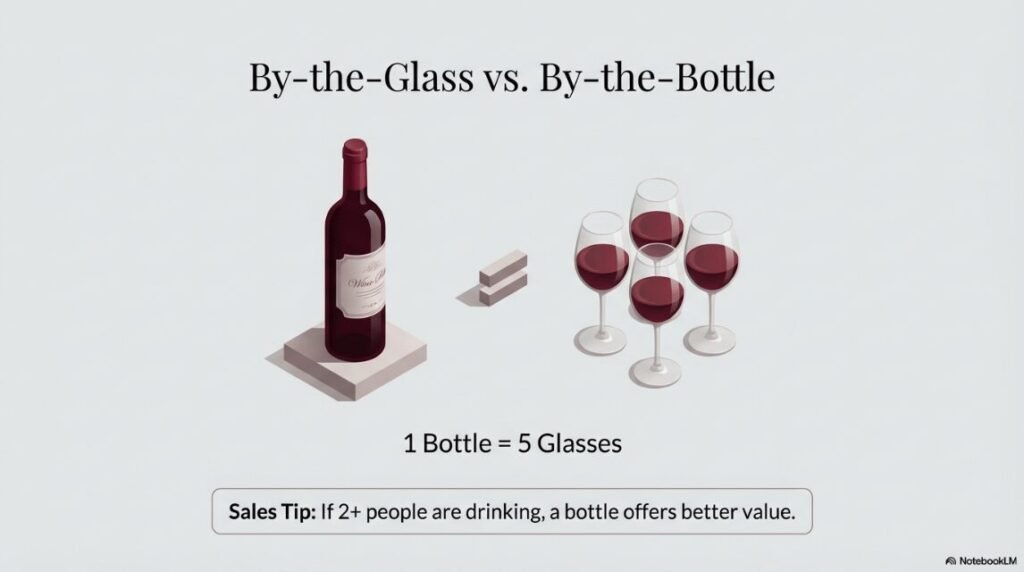
- A full bottle has 5 glasses
- If you buy 2 glasses = $16-20
- If you buy 1 bottle = $30-40 (more wine, less cost per glass!)
When to recommend by-the-glass:
- Only 1 customer is drinking
- Customers want different wines
- Customers are price-sensitive for small quantities
- Early in the meal (they might change their mind)
By-the-Bottle Pricing
The value: A bottle costs more total but less per glass. If 2+ people are drinking, a bottle is better value.
When to recommend by-the-bottle:
- 2+ customers are ordering wine
- They’re ordering the SAME wine
- They’re celebrating or staying for a full meal
- They want to explore wines
Professional language (KEY PHRASE):
“We offer wines by the glass and by the bottle. Since you’re both having wine, ordering a bottle is often a better value – you get more wine for less money per ounce. Would you like to consider a bottle?”
For larger groups:
“For your party of four, many guests find that ordering two bottles gives everyone a good pour at a great price point. Would you like to consider two bottles – maybe one red and one white?”
Part 5: How to Serve Wine Properly – Step by Step
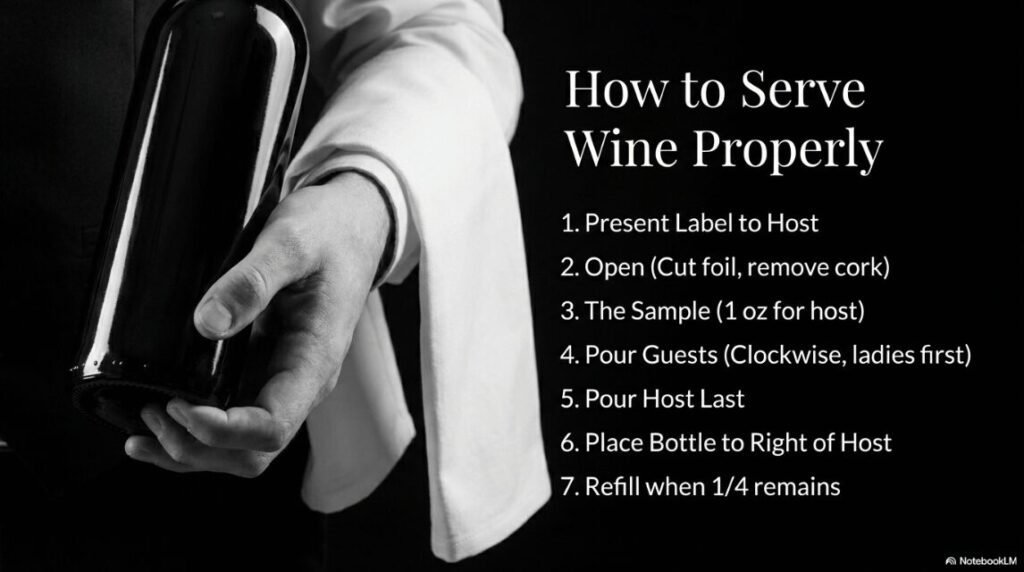
You don’t need sommelier training. Just follow these 7 steps.
Step 1: Present the Bottle
- Hold the bottle with the label facing the guest
- Stand at the host’s RIGHT side (the person who ordered)
- Say: “This is the 2022 Cabernet Sauvignon you ordered. Shall I open it?”
Step 2: Open the Bottle
- Use a foil cutter to cut the foil below the lip
- Use a wine key (waiter’s corkscrew) to remove the cork
- Wipe the bottle after opening
Step 3: Pour a Tasting Sample (CRITICAL!)
- Pour 1 ounce into the host’s glass first
- Step back and let them swirl, smell, and taste
- The host should nod approval OR say the wine is flawed (bad)
- If flawed: Replace immediately, no questions
- If approved: Pour for all guests
Why this matters: This step checks if the wine is bad (corked, oxidized). It’s not about whether they “like” it – it’s about wine quality.
Step 4: Pour for Guests
- Pour 4-5 ounces per glass (don’t fill to the top!)
- Move clockwise around the table
- Pour from the guest’s RIGHT side
- White wines: Fill half-full
- Red wines: Fill slightly below half-full
- End with the host
- Twist the bottle as you finish each pour (prevents dripping)
- Wipe the bottle lip after each pour
Step 5: Place the Bottle
- Place bottle on the table to the right of the host (label facing them)
- For white wine/sparkling: Place in an ice bucket to keep cold
- For red wine: Leave on table at room temperature
Step 6: Monitor and Refill
- Check glasses throughout the meal
- Refill when about ¼ glass remains
- Always ask before refilling (not all customers want more)
Step 7: When Bottle Empties
Ask: “Would you like another bottle of the same Cabernet, or would you like to see the wine list again?”
Part 6: Understanding Beer – The Foundation
Beer is simpler than wine. You just need to understand one key difference.
The Most Important Beer Knowledge: Ale vs. Lager
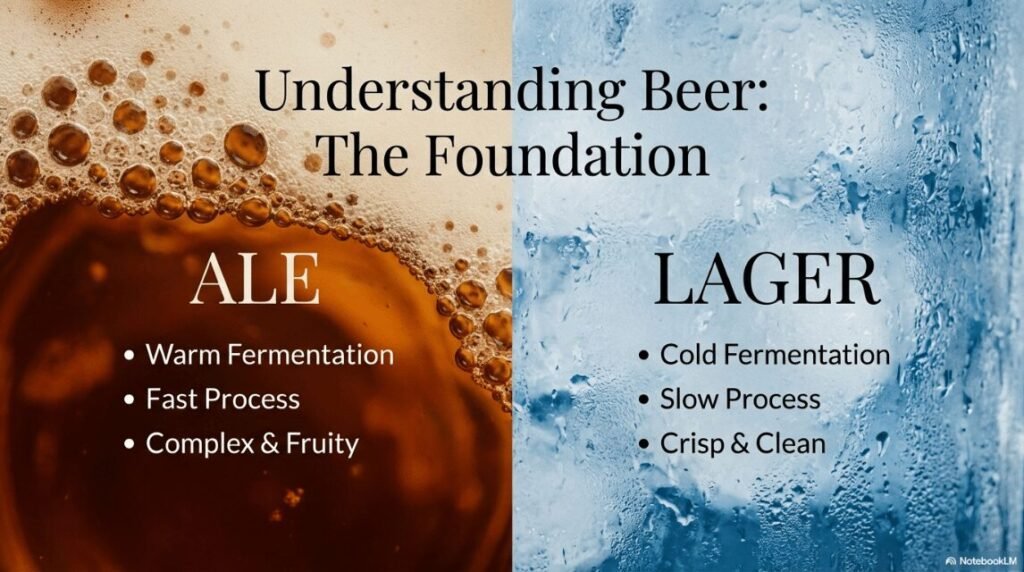
ALL beer is either ale or lager. This is based on fermentation method.
| Feature | Ale | Lager |
|---|---|---|
| Yeast Type | Top-fermenting | Bottom-fermenting |
| Fermentation Temp | Warm (60-72°F) | Cold (45-55°F) |
| Fermentation Speed | Fast | Slow (takes months) |
| Flavor | Fuller, complex, fruity, bold | Clean, crisp, smooth, easy-drinking |
| Body | Fuller-bodied | Light to medium-bodied |
| Bitterness | Often more bitter/hoppy | Less bitter, subtle |
| Common Types | IPA, Stout, Porter, Pale Ale, Brown Ale | Pilsner, American Lager, Dark Lager |
| Serve At | Cool (50-55°F) | Very cold (40-45°F) |
The professional one-sentence explanation:
“Ales are fuller-flavored beers with more complexity. Lagers are crisp and refreshing – great if you want something clean and easy-drinking.”
Part 7: Beer Styles You Must Know
You don’t need to know 50 beer styles. Learn these 8, and you can describe most beers in restaurants.
LAGERS (Light, Crisp, Easy-Drinking)
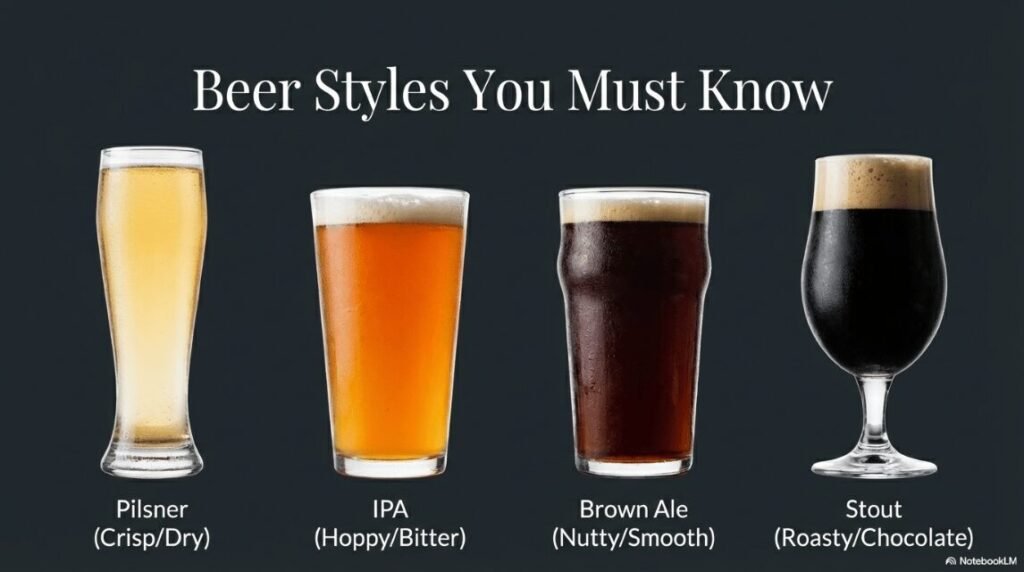
1. Pilsner / American Lager
- Color: Golden to pale yellow
- Body: Light
- Taste: Crisp, dry, clean, refreshing
- Alcohol: 4-5% ABV
- Famous brands: Budweiser, Coors, Miller, Corona
- Best for: Hot days, casual drinking, new beer drinkers
- Serve: Ice-cold (40-45°F)
What to say: “A crisp, refreshing lager – perfect if you want something light and easy-drinking.”
2. Dark Lager
- Color: Deep amber to nearly black
- Body: Medium to full
- Taste: Smooth, malty, caramel/chocolate/toasted bread – NOT bitter
- Alcohol: 4-5% ABV (same as light lager!)
- Best for: Winter, comfort food, dark flavors without bitterness
- Serve: Cold (45-50°F)
What to say: “A smooth, dark lager with malty caramel notes – great if you want darker flavors without bitterness.”
IMPORTANT: Dark lager is NOT stronger than light lager. Darkness comes from roasting time, not alcohol content!
ALES (Complex, Flavorful, Varied)
3. Pale Ale
- Color: Golden to amber
- Body: Light to medium
- Taste: Balanced hoppy bitterness, citrus/pine, moderate bitter
- Alcohol: 5-6% ABV
- Best for: Intermediate beer drinkers, flavor without extreme bitterness
- Serve: Cold (45-50°F)
What to say: “A balanced pale ale with hoppy citrus notes – great if you want flavor without being too bitter.”
4. IPA (India Pale Ale)
- Color: Golden to amber
- Body: Medium to full
- Taste: Very hoppy, strong bitterness, citrus/pine/tropical fruit, bold
- Alcohol: 6-14% ABV (varies widely!)
- Famous brands: Dogfish Head, Stone IPA, Sierra Nevada
- Best for: Adventurous drinkers, bold flavor lovers, spicy food
- Serve: Cold (45-50°F)
CAUTION: IPAs can intimidate casual drinkers due to bitter taste.
What to say: “An IPA is a hoppy, bold ale with citrus and bitter notes. If you like strong, adventurous flavors, you’ll love it. If you’re new to beer, it might be intense.”
5. Brown Ale
- Color: Brown
- Body: Medium
- Taste: Nutty, toasty, chocolate, caramel – smooth and LOW bitterness (NOT bitter like IPA)
- Alcohol: 4-6% ABV
- Best for: Dark beer option for those avoiding bitterness
- Serve: Cool (50-55°F)
What to say: “A smooth brown ale with nutty and toasty flavors – great if you want a darker beer without bitterness.”
Why this matters: Brown Ale is the bridge between light and dark. Customers who want dark beer but fear bitterness should start here.
6. Stout
- Color: Black, opaque
- Body: Full
- Taste: Coffee, chocolate, roasted grain, creamy, slightly sweet (NOT dry)
- Alcohol: 4-8% ABV
- Most famous brand: Guinness (56% popularity in UK and US)
- Best for: Dessert pairing, chocolate lovers, after-dinner drinks
- Serve: Cool (45-55°F)
What to say: “A rich, creamy stout with coffee and chocolate notes. Many people are surprised how smooth and sweet it is.”
7. Porter
- Color: Dark brown to black
- Body: Medium to full
- Taste: Chocolate, coffee, caramel, roasted – smoother and less dry than stout
- Alcohol: 4.5-12% ABV
- Best for: Hearty meals, grilled meats, barbecue
- Serve: Cool (50-55°F)
What to say: “A smooth porter with chocolate and caramel notes – excellent with our grilled meats.”
Stout vs. Porter (for customers): “Both are dark and roasted. Stout is creamier and richer; porter is a bit smoother and less intense. Try whichever appeals to you.”
Part 8: Draft vs. Bottled Beer – Why It Matters
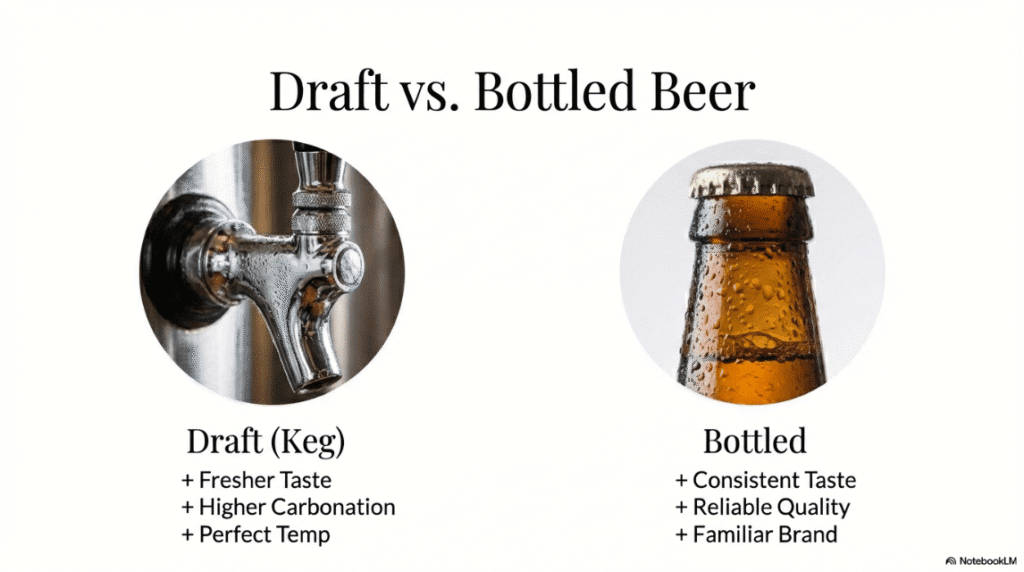
Draft Beer (From Keg)
Advantages:
- Higher carbonation (~5% more CO2) = fresher, livelier taste
- Fresher supply (shorter supply chain)
- Perfect temperature (professional systems maintain consistency)
- Better foam (superior head formation)
What to say: “Draft beer comes straight from the keg with more carbonation, so it has a fresher, crisper taste. Plus, we keep it perfectly cold and pour it fresh for you.”
Bottled Beer (In Bottle)
Advantages:
- Consistent taste every time
- Easy to serve, visible, familiar
- Longer shelf life
- No equipment maintenance needed
Disadvantages:
- Less carbonation (5% less CO2 = less fizz)
- Can be affected by light exposure during transport
- Quality depends on storage conditions
When customer asks why draft tastes different: “Draft has more carbonation and comes fresher from the keg. Bottled beer is consistent and reliable. Both are great – depends on your preference.”
Part 9: Craft vs. Domestic vs. Imported Beer
Domestic Beer
Definition: Brewed in the United States (or UK, depending on region)
Characteristics:
- Light lagers (easy-drinking, affordable)
- Lower alcohol (usually 4-5% ABV)
- Clean, crisp, accessible flavor
- Widely available
- Lower price
Popular brands (USA): Budweiser, Bud Light, Coors, Miller
Customer profile: Budget-conscious, traditional, “safe” choice
What to say: “A classic, easy-drinking lager at a great value.”
Craft Beer
Definition: Beer made by smaller, independent breweries using traditional methods
Characteristics:
- Wide variety of styles (IPA, stout, porter, wheat beer, etc.)
- Higher alcohol (5-7% ABV average; some 9%+)
- More complex flavors
- Small production batches
- More expensive ($1-2 premium per pint)
- Often fresher (local/regional distribution)
Examples: Samuel Adams, Blue Moon, Dogfish Head, local breweries
Customer profile: Quality-conscious, adventurous, willing to pay premium
Restaurant benefit: Higher profit margin (40-50%)
What to say: “Our craft beer selection features [local brewery name]. Their [beer] is a [style] with [flavor notes] – it’s really well-made and definitely worth trying if you enjoy [flavor preference].”
Imported Beer
Definition: Brewed outside the United States/UK and imported
Characteristics:
- Reflects brewing traditions of origin country
- Premium positioning
- More expensive ($1-2 premium per pint)
Popular imports:
- Guinness (Ireland) – Stout
- Corona (Mexico) – Light lager
- Heineken (Netherlands) – Light lager
- Stella Artois (Belgium) – Premium lager
- Peroni (Italy) – Light lager
What to say: “[Beer name] is a traditional [style] from [country]. It’s known for [characteristic] and pairs beautifully with [food pairing].”
Part 10: Beer Descriptive Vocabulary
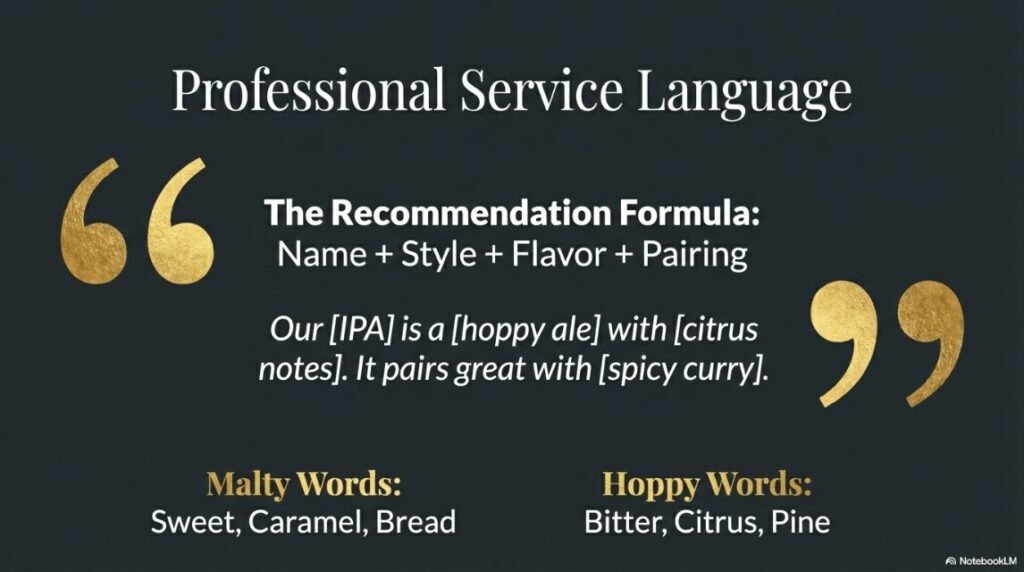
Words for Malty Beers (Grain & Sweet Flavors)
| Word | Meaning | Use For |
|---|---|---|
| Malty | Grain-based sweetness | Brown ales, dark lagers |
| Sweet | Sugar/honey flavors | Stouts, dark ales |
| Biscuity | Bread/biscuit flavors | Wheat beers, pale ales |
| Caramel/Toffee | Sweet candy notes | Dark lagers, brown ales |
| Roasty | Roasted/toasted | Stouts, porters |
| Chocolate | Chocolate notes | Stouts, porters |
| Coffee | Coffee/espresso | Dark stouts |
Example: “This brown ale has malty, caramel notes with a smooth finish.”
Words for Hoppy Beers (Bitter & Aromatic)
| Word | Meaning | Use For |
|---|---|---|
| Hoppy | Strong hop flavor | IPAs, pale ales |
| Bitter | Dry, sharp bitterness | IPAs, hoppy ales |
| Citrusy | Lemon, lime, grapefruit | Hoppy ales, IPAs |
| Piney | Pine needle/herbal | Hoppy ales |
| Earthy | Soil/mineral/herbal | Some ales, lagers |
| Herbal | Green, fresh herb | Hop-forward beers |
| Bright | Fresh, crisp, lively | Pilsners, hoppy ales |
Example: “This IPA is very hoppy with bright citrus and grapefruit notes.”
Words for Overall Impression
| Word | Meaning | Use For |
|---|---|---|
| Refreshing | Clean, thirst-quenching | Light lagers, Pilsners |
| Smooth | No harsh edges, creamy | Porters, stouts, lagers |
| Bold | Strong flavors | IPAs, dark ales |
| Light-bodied | Thin, delicate | Lagers, light ales |
| Full-bodied | Heavy, substantial | Stouts, dark ales |
| Clean | Clear taste | Quality domestics, imports |
| Crisp | Sharp, dry finish | Hoppy beers, Pilsners |
| Balanced | Flavors work together | Well-made beers |
Example: “This Pilsner is crisp and refreshing – perfect for warm weather.”
Part 11: Simple Beer & Food Pairing
The core rule: Light beers with light foods. Dark beers with heavy foods. Hoppy beers with spicy foods.
Light Beer Pairings
| Food | Best Beer | Why |
|---|---|---|
| White fish, seafood | Pilsner, light lager, pale ale | Crisp flavor doesn’t overpower delicate proteins |
| Salads, vegetables | Light lager, Pilsner | Clean, refreshing |
| Pizza, fried food | Pilsner, American lager | Carbonation cuts through rich, fried flavors |
| Asian cuisine (not spicy) | Light lager, Pilsner | Clean flavors complement light preparations |
| Chicken (light) | Pale ale, light lager | Balanced, not overwhelming |
What to say: “Our Pilsner pairs beautifully with the white fish – the crisp acidity cuts through the richness without overwhelming the delicate flavor.”
Dark Beer Pairings
| Food | Best Beer | Why |
|---|---|---|
| Steak, beef | Porter, stout, brown ale | Rich meat flavors complement rich beer |
| Grilled/smoked meats | Porter, dark ale | Roasted beer flavors match cooking method |
| Chocolate dessert | Stout, porter | Coffee/chocolate flavors match dessert |
| Oysters | Stout, porter | Traditional pairing |
| Stew, braised dishes | Dark lager, porter, brown ale | Full-bodied beer matches heavy food |
What to say: “This stout would be perfect with our chocolate dessert. The coffee and chocolate flavors in the beer complement the richness of the cake beautifully.”
Hoppy Beer (IPA) Pairings
| Food | Best Beer | Why |
|---|---|---|
| Spicy food (curry, Thai) | IPA, pale ale | Bitterness and acidity cool heat |
| Bold cheese | IPA, pale ale | Strong beer matches strong cheese |
| Barbecue | Hoppy ale, pale ale | Bitterness balances BBQ sauce sweetness |
| Grilled vegetables | Pale ale, IPA | Citrus/herbal notes complement roasted vegetables |
What to say: “This IPA is perfect with our Thai curry. The hops’ bitterness and citrus notes cut through the heat and spice beautifully.”
Part 12: Professional Service Language – What to Say
Opening the Beverage Conversation
Weak (passive): ❌ “Do you want wine?” (implies optional) ❌ “Any drinks?” (vague)
Strong (professional): ✅ “Would you like to start with a glass of wine or beer this evening?” (assumes yes) ✅ “Can I interest you in one of our craft beers or perhaps a glass of wine?” (leads with product) ✅ “What would you prefer – wine, beer, or another beverage?” (direct choice)
Making Wine Recommendations
When customer is uncertain: “Let me ask a couple questions. Do you prefer red or white? And what flavors appeal to you – bold and spicy, or light and fresh?”
When upselling bottle over glasses: “We offer these wines by the glass, but since you’re both having wine, a bottle is typically a better value. Would you like to consider a bottle?”
When customer asks for a recommendation: “I’d love to help! What are you ordering? And tell me – do you prefer bolder wines, or something lighter and crisper?”
Making Beer Recommendations
Template that works: “[Beer name] is a [style] with [one flavor note]. It pairs great with [food]. Would you like to try it?”
Examples:
Light/easy drinking: “Our Corona is a crisp, refreshing lager – perfect if you want something light and cold. It’s great with lighter meals.”
Dark without intimidating: “If you like darker flavors, I’d recommend our brown ale. It’s smooth with nutty and caramel notes – definitely not bitter like an IPA.”
Craft (upselling): “We have an excellent craft selection from [Local Brewery]. Their IPA is hoppy with citrus notes. Or if you prefer something smoother, their porter has chocolate and coffee flavors. Would you like to try one?”
When You Don’t Know the Answer
CORRECT: “That’s a great question. I’m not 100% sure about [detail]. Let me check with our bartender/manager, and I’ll be right back with that information. That way you get the correct answer instead of me guessing.”
Why this works:
- Shows professionalism and honesty
- Customer respects the effort
- You get accurate information
- Customers appreciate servers who don’t fake expertise
WRONG: ❌ “Uh, I think it’s… probably… from California? Maybe?”
This damages credibility.
Part 13: Common Customer Questions and Answers
Question 1: “What wine goes with this dish?”
Basic answer: “Great question! That [dish name] pairs beautifully with our [wine name]. It’s a [red/white/full-bodied/light]. The [flavor note] complements the [main ingredient] perfectly.”
Real example: “Great question! That ribeye pairs beautifully with our Cabernet Sauvignon. It’s a full-bodied red wine. The bold, structured tannins complement the richness of the steak perfectly.”
Question 2: “Do you have sweet wines?”
Answer: “Yes, absolutely! We have several options. Are you looking for a sweet wine to drink with dinner, or something sweet to finish the meal with dessert?”
If with dinner: “Our Riesling is lightly sweet with stone fruit flavors – it pairs wonderfully with spicy dishes or seafood.”
If with dessert: “For dessert, our Moscato is perfect. It’s sparkling and fruity – light and refreshing, great with lighter desserts.”
IMPORTANT: Never assume customers want only dry wines. Many casual diners prefer slightly sweet wines.
Question 3: “What’s an IPA?”
Answer: “IPA stands for India Pale Ale. It’s a beer style with strong hop flavor – which means it’s bitter and hoppy. If you like bold, bitter tastes, you’ll love it! If you prefer something lighter and less bitter, I’d recommend our [lighter beer option].”
Question 4: “What beer is light and refreshing?”
Answer: “Perfect! For light and refreshing, I’d recommend our [beer name]. It’s a [pilsner/lager] with a crisp, clean taste. It’s very easy to drink and perfect if you want something refreshing without heavy flavors.”
Real examples:
- “Our Corona is a light lager – crisp, clean, and refreshing. Perfect with your meal.”
- “Our Pilsner is a crisp, easy-drinking lager with a dry finish. Very refreshing.”
Question 5: “What’s the difference between draft and bottled beer?”
Answer: “Great question! Draft beer comes directly from the keg, so it’s fresher and has more carbonation – it tastes crisper and fresher. Bottled beer is consistent every time and cold from the bottle. Both are excellent; it depends on your preference!”
Question 6: “Is dark beer stronger?”
Answer: “Good question! Dark beer isn’t automatically stronger. The darkness comes from how long we roast the grains during brewing. Guinness, for example, has the same alcohol as a light lager – about 4%. Some dark beers have more alcohol, but many don’t. The color tells you flavor, not strength.”
Part 14: Common Mistakes to Avoid
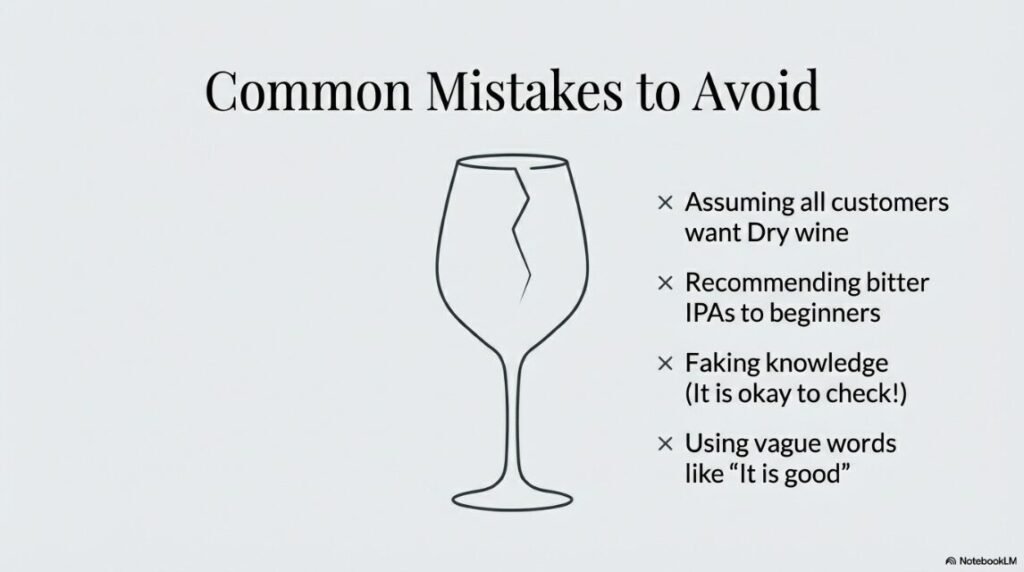
❌ Mistake 1: Assuming Customers Want Dry Wine
Wrong: Only offering dry wines Right: Ask: “Do you prefer dry wines or something with a little sweetness?”
Many customers prefer slightly sweet wines. Always ask!
❌ Mistake 2: Not Knowing Your Menu
Wrong: “I don’t know what wines we have by the glass.” Right: “We have [3 reds and 3 whites] by the glass. Let me describe them for you.”
You must know what’s on your menu!
❌ Mistake 3: Using Vague Language
Wrong: “The wine is good.” Right: “The Cabernet is bold and structured with dark fruit notes – perfect with your steak.”
Specific adjectives help customers make confident decisions.
❌ Mistake 4: Recommending IPA to New Beer Drinkers
Wrong: “Try our IPA!” (to someone who doesn’t drink beer) Right: “Since you’re new to beer, I’d suggest our light lager – it’s crisp and easy-drinking. IPAs can be quite bitter.”
IPAs intimidate beginners. Start them with something gentle!
❌ Mistake 5: Not Upselling Bottles
Wrong: Taking glass orders without mentioning bottles Right: “Since you’re both having wine, a bottle is often better value. Would you like to consider a bottle?”
Bottles benefit the customer (more wine, less cost per glass) AND the restaurant (higher total sale).
Part 15: Tips for Building Confidence
1. Taste the wines and beers on your menu Ask your manager if you can try small portions. You can’t describe something you’ve never tasted.
2. Learn ONE key fact about each wine/beer You don’t need to know everything. Just one characteristic:
- “Our Cabernet is bold and pairs with steak”
- “Our Sauvignon Blanc is crisp and pairs with fish”
- “Our IPA is hoppy and bitter”
3. Practice the professional phrases out loud Before your shift, practice saying:
- “Our Cabernet pairs beautifully with the ribeye – the tannins balance the richness.”
- “Our Pilsner is crisp and refreshing – perfect for warm weather.”
Say them until they sound natural.
4. Ask questions before recommending Never guess what customers want. Ask:
- “Do you prefer red or white?”
- “Do you like bold flavors or something lighter?”
- “Have you tried hoppy beers before?”
5. Use the formula: Name + Style + One Flavor Note + Food Pairing
Example: “Our Chardonnay [name] is a full-bodied white wine [style] with buttery, creamy notes [flavor]. It pairs beautifully with our pasta in cream sauce [food pairing].”
6. When in doubt, say “Let me find out” If you don’t know the answer, never guess. Say: “That’s a great question. Let me check with our bartender and come right back with the correct information.”
This is professional. Guessing is not.
7. Learn from experienced servers Ask: “How do you describe the Pinot Noir to customers?” Write down what they say.
Summary: What You Learned Today
Today you learned:
✓ The 5 main wine categories (red, white, rosé, sparkling, dessert) ✓ Key red wines: Cabernet, Merlot, Pinot Noir, Syrah, Malbec ✓ Key white wines: Chardonnay, Sauvignon Blanc, Pinot Grigio, Riesling ✓ The difference between Chardonnay (buttery, full) and Sauvignon Blanc (crisp, light) ✓ 5 simple wine pairing rules that work 90% of the time ✓ When to recommend bottles vs. glasses ✓ How to serve wine properly in 7 steps ✓ The difference between ale and lager beer ✓ 8 essential beer styles (Pilsner, Dark Lager, Pale Ale, IPA, Brown Ale, Stout, Porter) ✓ Draft vs. bottled beer differences ✓ Craft vs. domestic vs. imported beer ✓ Simple beer pairing rules ✓ Professional phrases for recommending wine and beer ✓ How to answer common customer questions
You now have the vocabulary and confidence to recommend wine and beer professionally.
📝 Test Your Wine & Beer Knowledge
Ready to see how much you learned? Take this quick quiz! (5 questions, 2 minutes)
QUIZ FOR QUIZMAKER PLUGIN
Score: 5/5 (100%)
🌟 EXCELLENT! You're Ready for Wine & Beer Service!

You have excellent understanding of wine and beer fundamentals, pairing rules, and professional service. You're ready to confidently recommend beverages to customers!

Next Steps:
→ Continue to Blog 4: Non-Alcoholic Drinks (Coffee, Tea, Soft Drinks)
→ Or master ALL restaurant English in English for Waiters (£37.99)

[Enroll in English for Waiters]
Score: 3-4/5 (60-80%)
👍 GOOD JOB! You're Making Progress

You understand the main concepts about wine and beer. Review the sections on wine pairing rules and the difference between Chardonnay vs. Sauvignon Blanc to strengthen your confidence.

Want structured video lessons with demonstrations?
→ Check out English for Waiters Course (£37.99)

[Enroll in English for Waiters]
Score: 0-2/5 (0-40%)
📚 KEEP LEARNING! Practice Makes Perfect

Don't worry - wine and beer vocabulary is challenging! Re-read the blog and focus on:
- The 5 wine categories (red, white, rosé, sparkling, dessert)
- The 5 pairing rules (red with red meat, white with fish, etc.)
- Ale vs. lager difference
- When to recommend bottles vs. glasses

Need structured help with video demonstrations?
→ English for Waiters provides 22 video lessons with practice (£37.99)

[Enroll in English for Waiters]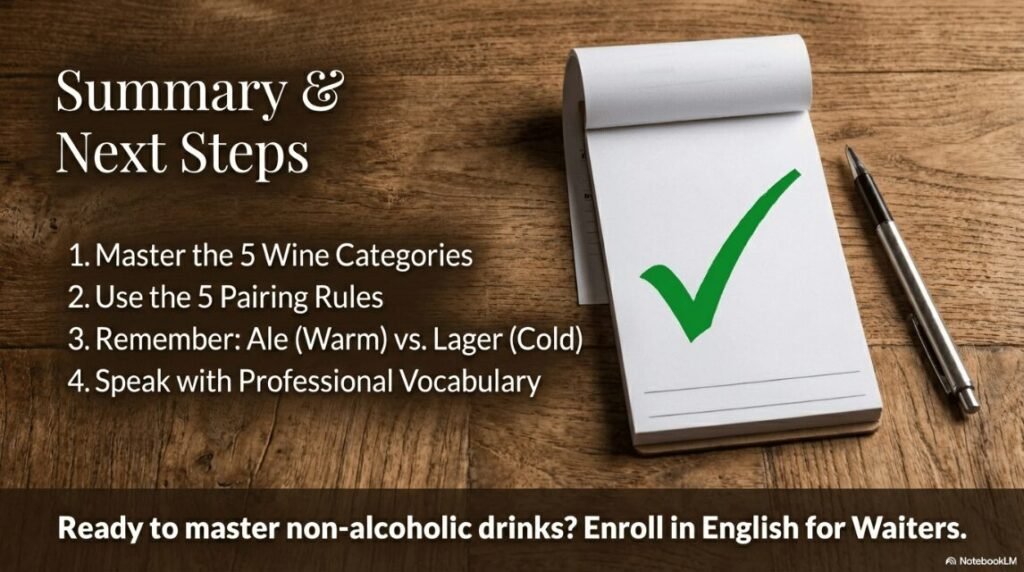
Next Steps in Your Menu Mastery Journey
Continue the Series: 📖 Part 4: Non-Alcoholic Drinks – Coming soon! Learn coffee, tea, and soft drink vocabulary.
Review Previous Parts: 📖 Part 1: Appetizers & Starters – Essential starter vocabulary 📖 Part 2: Main Courses – Proteins, cooking methods, sides
Download Free Resource: 📥 Complete Menu Vocabulary Guide – Get all 5 parts in one downloadable PDF [Link to lead magnet]
Ready for Professional Training? 🎓 English for Waiters Course – Master the complete service experience
📚 Additional Learning Resources
Want to learn more about wine and beer service?
Professional hospitality programs like Cesar Ritz Colleges train students on wine pairing fundamentals and professional service standards for restaurant staff.
The Wine Guild Education offers professional hospitality wine service pathway courses for servers building beverage expertise.
Many servers also complete ServSafe Alcohol certification from the National Restaurant Association to ensure responsible alcohol service.
Ready to Master ALL Restaurant English?
You’ve learned wine and beer vocabulary. That’s excellent progress!
But what about: ❓ Handling difficult customers? ❓ Speaking confidently to managers
English for Waiters covers everything you need to succeed:
✓ 22 video lessons (greetings to payment) ✓ 60-page phrase guide with hundreds of professional expressions ✓ Complete course book with scripts and vocabulary ✓ Certificate of completion for your CV ✓ Lifetime access – study forever
All for only £37.99
→ ENROLL IN ENGLISH FOR WAITERS TODAY
You’ve Completed Part 3 of Menu Mastery!
Congratulations! You now have the vocabulary and confidence to recommend wine and beer professionally.
Next: Part 4 will teach you about non-alcoholic drinks – coffee, tea, and soft drink service.
Your customers are waiting. Your confidence is growing. Let’s continue.
Ready to Master Restaurant English?
These free articles and scenarios are a great start, but if you want a complete, structured system for learning restaurant English, consider our full course.

English for Waiters includes:
✅ 22+ video lessons covering every restaurant situation
✅ Real restaurant scenarios with native pronunciation
✅ Interactive pronunciation practice
✅ Downloadable phrase guides
✅ Lifetime access with free updates