The First Month Makes or Breaks Your Restaurant Career
Sofia got the job at Harbor Grill. She was excited. Nervous. Ready to prove herself.
Day one started well. The manager showed her the POS system, gave her a menu to study, introduced her to the team. She smiled, nodded, took notes.
Day three, she was shadowing experienced servers during lunch service. She watched them take orders, run food, handle payments. It looked manageable.
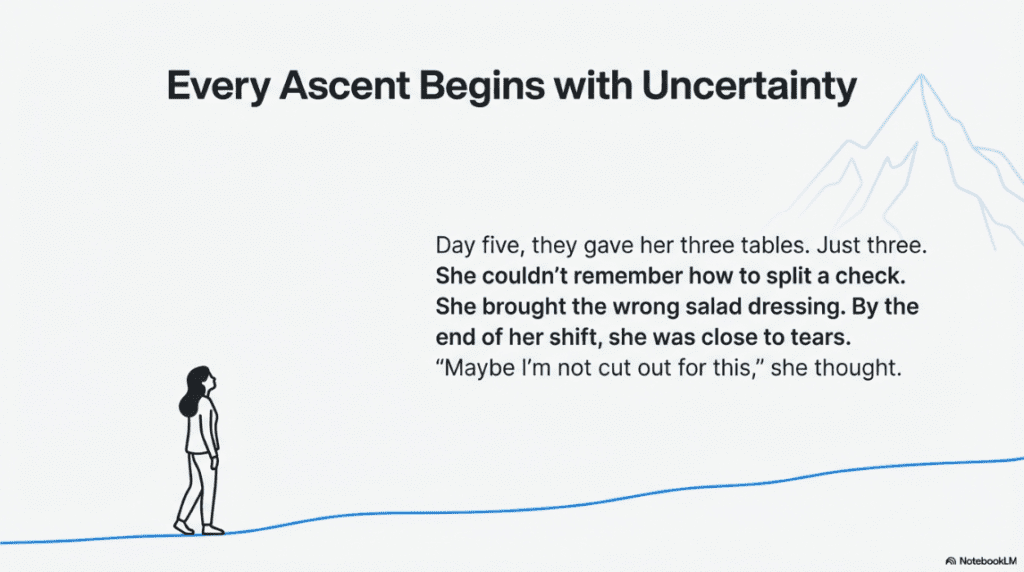
Day five, they gave her three tables. Just three. She could handle three tables.
Except she couldn’t remember how to split a check in the POS. She forgot to put in table 7’s drinks. She brought the wrong salad dressing to table 9. She didn’t know where the extra napkins were stored.
By the end of her shift, she was close to tears.
“Maybe I’m not cut out for this,” she thought.
But here’s what Sofia didn’t know: Every successful server has terrible first shifts. The difference between servers who quit in week one and servers who thrive in month two is knowing what to focus on, how to ask for help, and which mistakes are normal versus which ones need immediate correction.
The first 30 days determine everything:
- Whether you survive the training period
- Whether your coworkers respect you or avoid you
- Whether managers see potential or regret hiring you
- Whether you build good habits or struggle for months
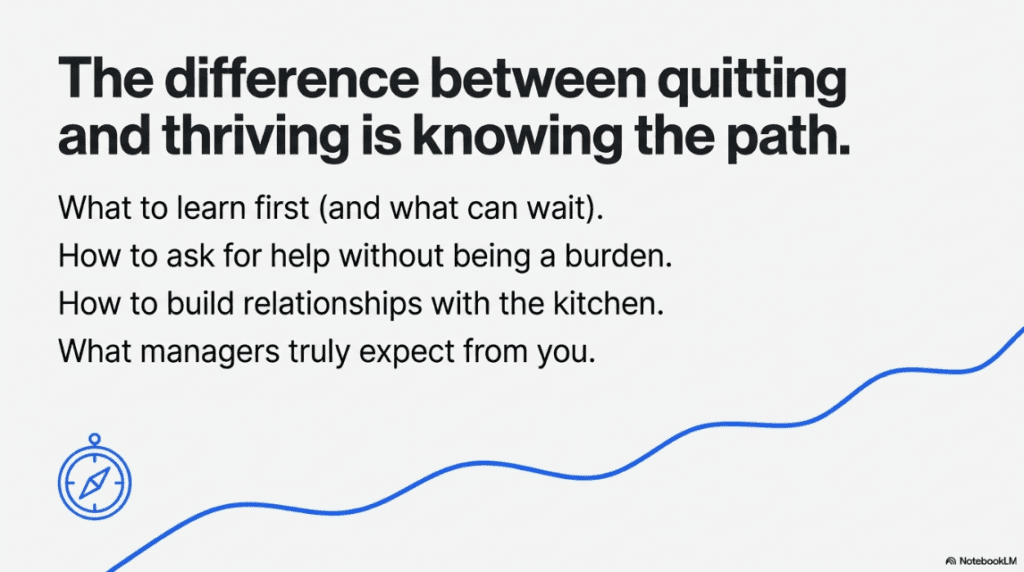
This guide teaches you:
- What to learn first (and what can wait)
- How to ask for help without annoying experienced servers
- How to build relationships with kitchen staff (they control your success)
- The 10 most common new server mistakes and how to avoid them
- What managers expect during your training period
- When to speak up versus when to observe quietly
By the end of this article, you’ll have a clear 30-day roadmap for succeeding as a new server – even if English is your second language and you’ve never worked in a restaurant before.
Prefer to listen? Here’s the podcast.
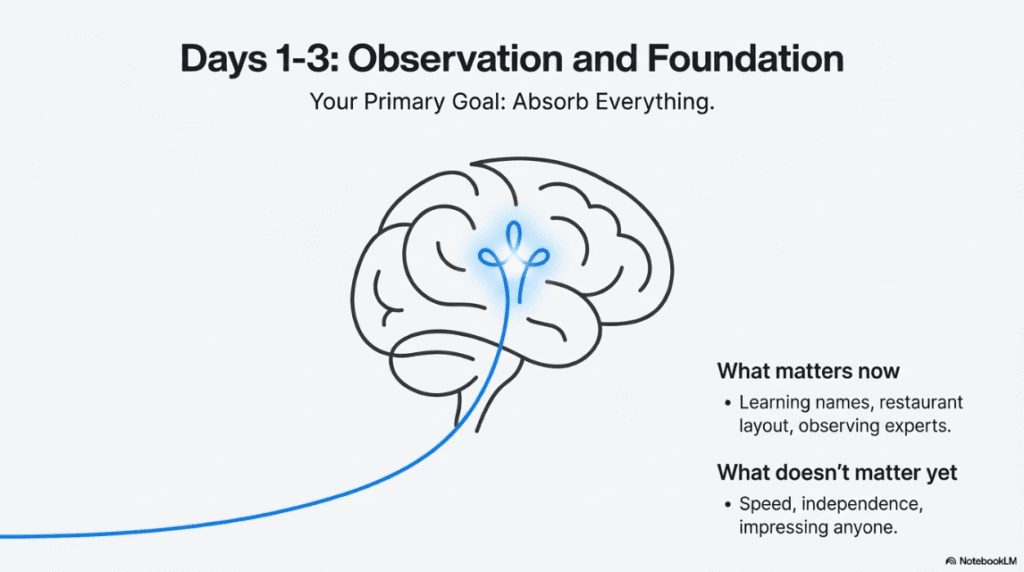
Part 1: Days 1-3 – Observation and Foundation
Your Primary Goal: Absorb Everything
What matters most in days 1-3:
- Learning names (staff and managers)
- Understanding the restaurant layout
- Observing how experienced servers work
- Taking detailed notes
What does NOT matter yet:
- Being fast
- Knowing the entire menu
- Working independently
- Impressing anyone
Day 1: The Critical First Impression
Morning of Day 1:
| DO This | Why It Matters |
|---|---|
| Arrive 15 minutes early | Shows reliability from day one |
| Bring a notebook and pen | Demonstrates you’re serious about learning |
| Wear clean, appropriate clothing | Even if you don’t have uniform yet |
| Greet everyone you meet | Builds immediate rapport |
| Remember names (write them down) | Shows respect and attention |
What to ask on Day 1:
- “Where should I store my belongings?”
- “What time should I arrive for future shifts?”
- “Who should I ask if I have questions during my shift?”
- “Is there anything I should study at home tonight?”
What NOT to ask on Day 1:
- ❌ “When do I get paid?”
- ❌ “Can I take a break?”
- ❌ “Is the manager always this strict?”
Learn the Physical Layout First
Before you can serve, you need to know WHERE everything is.
Priority 1 – Essential Locations:
- Where glasses are stored
- Where plates/silverware are kept
- Ice machine location
- Coffee station
- POS terminals (computer for orders)
- Expeditor window (where food comes out)
- Walk-in cooler (if servers access it)
- Trash/dish station
- Staff bathroom
- Manager’s office
Priority 2 – Service Essentials:
- Where napkins are stored
- Where condiments are kept
- Where to-go containers live
- Cleaning supplies location
- Extra menus
- High chairs for children
Pro tip: Take a photo tour on your phone (if allowed) or draw a simple map in your notebook. Knowing where things are saves you 50% of your stress during busy shifts.
The Three People You Must Befriend Immediately
1. The Experienced Server Who Seems Nice
Why: They’ll answer your questions without judgment.
How to approach: “Hi, I’m Sofia, I just started. Would you mind if I asked you questions when things aren’t too busy? I want to make sure I’m learning correctly.”
2. The Lead Server or Trainer
Why: This is your official resource person.
How to approach: “Thank you for training me. What’s the best way to reach you if I have questions during my shift – should I come find you or is there a system?”
3. One Kitchen Staff Member
Why: Kitchen staff can make your life easy or very difficult.
How to approach: “Hi, I’m Sofia, the new server. I know you’re busy, but I wanted to introduce myself. I’m still learning the system, so please let me know if I make mistakes on tickets.”
Why this works: Shows respect, acknowledges their workload, and establishes you as someone who cares about getting orders right.
What to Study After Day 1
At home that night:
30 minutes – Menu basics:
- Read through the entire menu once
- Identify the 5 most popular items (ask trainer which ones)
- Note any items with complicated names or ingredients
- Look up words you don’t know
15 minutes – Review your notes:
- Staff names and positions
- Layout map
- Any procedures you learned
- Questions you still have
Don’t stress about: Memorizing prices, knowing every ingredient, understanding complex modifications. That comes later.
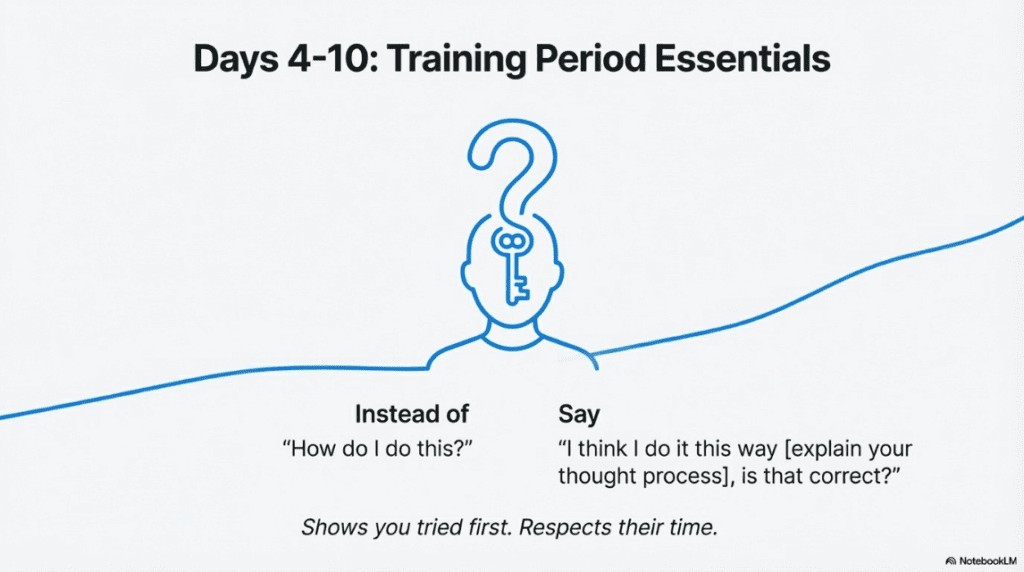
Part 2: Days 4-10 – Training Period Essentials
Understanding the Training Timeline
What most restaurants expect:
| Days 1-3 | Observation, shadowing, learning layout |
|---|---|
| Days 4-7 | Taking small sections (2-4 tables) with supervision |
| Days 8-14 | Increasing table count, less direct supervision |
| Days 15-21 | Working independently with occasional check-ins |
| Days 22-30 | Fully independent, evaluation period |
Your timeline may vary – fine dining trains longer, casual restaurants train faster.
According to 7shifts’ restaurant research, new hires typically need about three months to fully acclimate to their role – which is why the first 30 days focus on building foundational skills rather than achieving perfection.
How to Ask for Help (Without Annoying People)
The Problem: You need help constantly. But experienced servers are busy. Managers are managing. Kitchen staff are cooking.
The Solution: Ask questions strategically.
GOOD Times to Ask Questions:
- ✅ Before service starts
- ✅ During slow periods between rushes
- ✅ After you’ve tried to figure it out yourself first
- ✅ When the person isn’t actively serving a table
BAD Times to Ask Questions:
- ❌ During peak rush
- ❌ When the person is clearly stressed
- ❌ In the middle of them taking an order
- ❌ Asking the same question you asked yesterday
The Question Framework
Instead of: “How do I do this?”
Say: “I think I do it this way [explain what you think], is that correct?”
Why it works: Shows you tried to figure it out, makes it a yes/no answer (faster for them).
Example: ❌ “How do I ring in a side salad?” ✅ “I think side salads go under ‘sides’ in the POS, then I select the dressing. Is that right?”
Questions Worth Interrupting Someone For
Stop what you’re doing and ask immediately if:
- Guest has a food allergy (kitchen needs to know NOW)
- You’re not sure if food contains an allergen
- A guest is angry or has a serious complaint
- You dropped food or broke something expensive
- The POS crashed and you can’t take orders
- A child is hurt or a guest needs medical help
Everything else can wait 5-10 minutes for an appropriate time to ask.
Building Your Question List
Keep a running list in your notebook:
Page 1: “Ask when I see my trainer next”
- Non-urgent questions
- Menu clarifications
- System questions
- Procedure questions
Page 2: “Figured out myself”
- Write down what you learned
- Prevents asking the same question twice
- Shows initiative
This system shows you:
- Value their time
- Are actively learning
- Take initiative
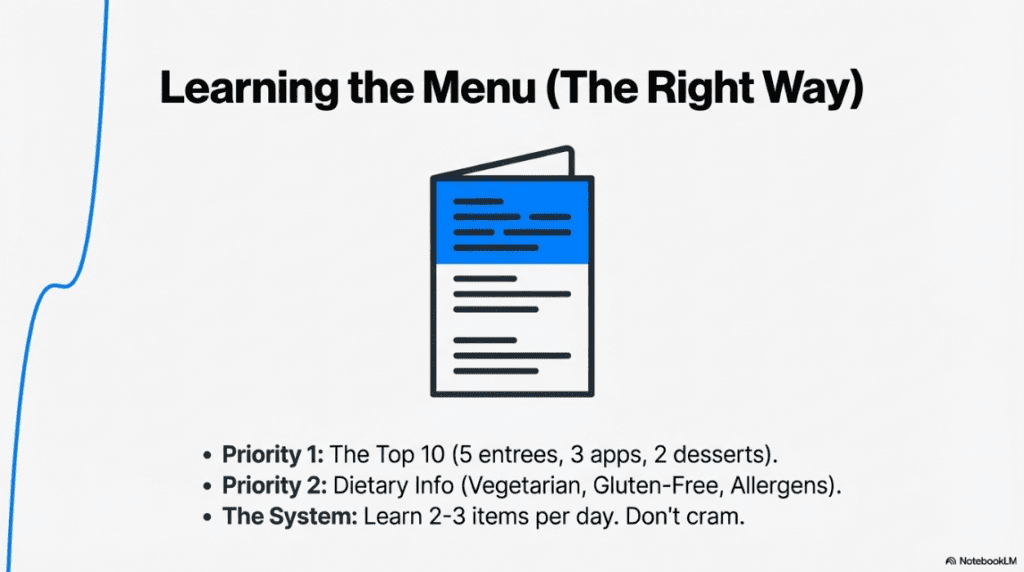
Part 3: Learning the Menu (The Right Way)
You Don’t Need to Memorize Everything
What you MUST know in Week 1:
Priority 1 – The Top 10:
- 5 most popular entrees
- 3 most popular appetizers
- 2 most popular desserts
Ask your trainer: “What are our most popular dishes? I want to learn those first.”
Priority 2 – Dietary Information:
- Which items are vegetarian
- Which items are gluten-free (or can be modified)
- Which items contain common allergens (nuts, dairy, shellfish)
Priority 3 – The Basics:
- What comes with each entree (sides, garnishes)
- What’s included in combos or set meals
- Price ranges (expensive vs affordable items)
The Menu Learning System
Week 1: Learn 2-3 items per day
Monday: Study breakfast items (if applicable) Tuesday: Study appetizers Wednesday: Study salads and soups Thursday: Study main courses (half) Friday: Study main courses (other half) Saturday: Study desserts and drinks Sunday: Review everything
How to study one item:
- Name of dish
- Main ingredients (3-5 key ones)
- How it’s prepared (grilled, fried, baked, etc.)
- What it comes with (sides, sauce, garnish)
- One-sentence description you’d tell a guest
Practice Describing Dishes Out Loud
Don’t just read the menu – speak it.
Menu description: “Grilled Salmon – Fresh Atlantic salmon, grilled and served with roasted vegetables and lemon butter sauce”
What you say to a guest: “Our grilled salmon is really popular. It’s fresh Atlantic salmon, grilled perfectly, and it comes with roasted seasonal vegetables and a light lemon butter sauce. If you like salmon, you’ll love this one.”
Practice in front of a mirror or record yourself on your phone.
Why this works: Reading ≠ speaking. You need to practice the actual words coming out of your mouth.
Menu Questions Guests Always Ask
Be ready for these 5 questions about ANY dish:
- “What’s in it?” – Know the main ingredients
- “How is it cooked?” – Grilled, fried, baked, etc.
- “Is it spicy?” – Know spice levels
- “What does it come with?” – Sides, garnishes, sauce
- “How big is the portion?” – Size relative to other dishes
If you don’t know: “That’s a great question. Let me check with the kitchen to make sure I give you the right information.”
Never guess about ingredients – especially with allergies.
Part 4: Mastering the POS System
Every Restaurant Uses Different Systems
Common POS systems:
- Toast
- Square
- Clover
- Micros
- Aloha
- TouchBistro
But the basic functions are the same:
- Ring in orders
- Modify items
- Split checks
- Process payments
- Void/comp items (with manager approval)
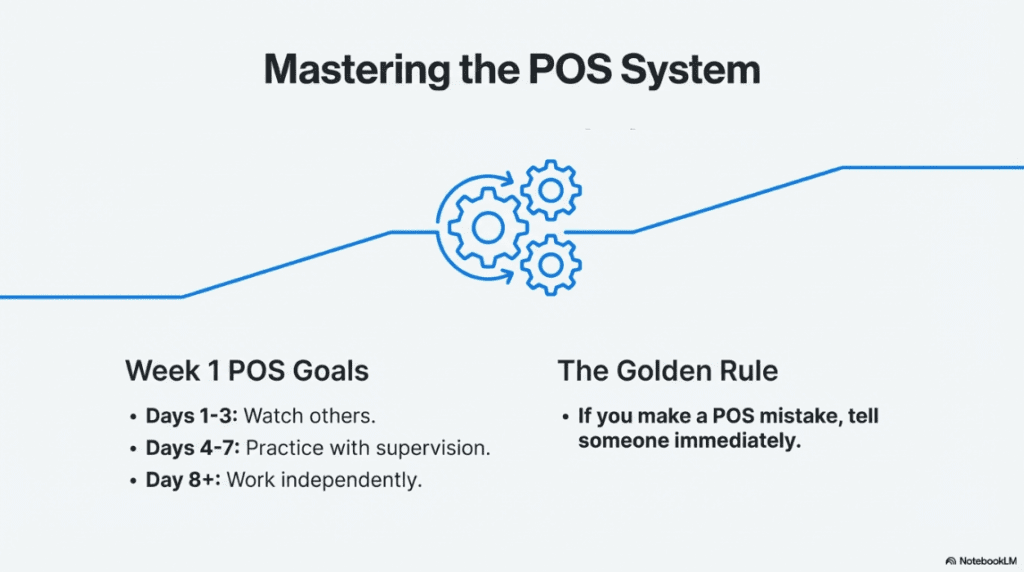
Week 1 POS Goals
Day 1-3: Watch others use it
- Stand behind experienced servers
- Watch the flow: tap item → add modifications → send to kitchen
- Ask: “Can you show me that one more time?”
Day 4-7: Practice with supervision
- Ring in your own orders with trainer watching
- Make mistakes (this is the learning phase)
- Ask: “Did I do that correctly?”
Day 8-14: Work independently
- Ring in orders solo
- Call trainer only if system does something unexpected
- Build speed and accuracy
The 5 Most Common POS Mistakes
| Mistake | How to Fix It | How to Prevent It |
|---|---|---|
| Sent to wrong printer | Ask manager to void, re-send correctly | Double-check screen before sending |
| Wrong modifications | Tell kitchen ASAP, may need to remake | Repeat modifications back to guest |
| Can’t find an item | Ask experienced server where it’s located | Study menu organization in system |
| Accidentally sent order twice | Tell kitchen immediately, void duplicate | Wait for confirmation before re-sending |
| Split check wrong | Void and re-do (easier than fixing) | Clarify with guests BEFORE ringing in |
The golden rule: If you make a POS mistake, tell someone immediately. Mistakes caught early are easy to fix. Mistakes discovered when the guest gets the bill are disasters.
Part 5: Working With Kitchen Staff
Why Kitchen Relationships Matter More Than You Think
The kitchen controls:
- How fast your food comes out
- Whether mistakes get fixed quickly
- Whether they help you when you’re struggling
- Your overall stress level during shifts
Servers who respect kitchen staff: Food on time, mistakes fixed immediately, help when needed.
Servers who disrespect kitchen staff: “Lost” tickets, slow food, “didn’t see” your urgent requests.
The 7 Rules for Kitchen Respect
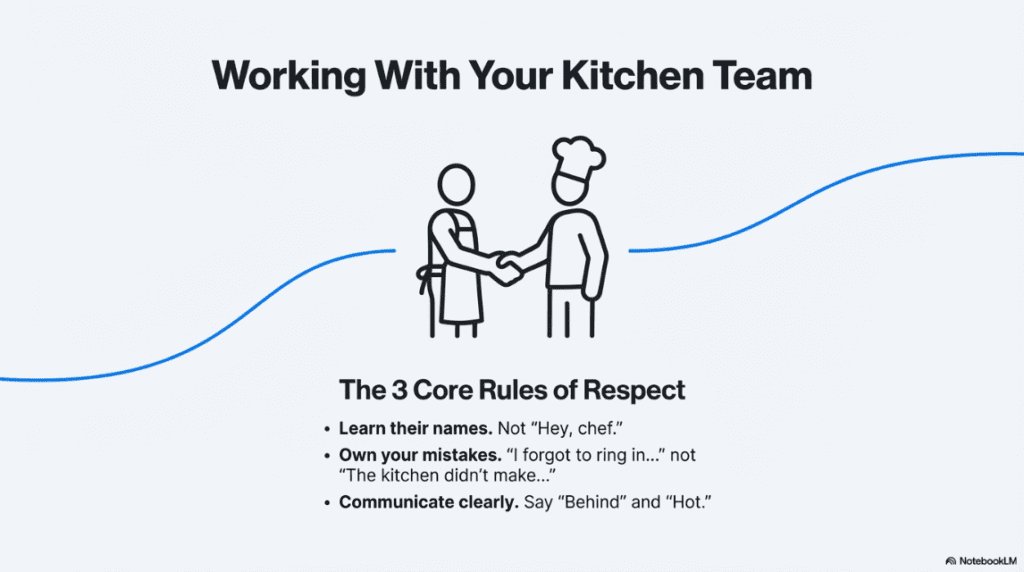
Rule 1: Learn Their Names Not “Hey chef” or “Excuse me” – use their actual names.
Rule 2: Say “Behind” and “Hot”
- “Behind” = you’re walking behind someone
- “Hot” = you’re carrying something hot
- These aren’t optional – they prevent injuries
Rule 3: Don’t Blame Them for Your Mistakes If you forgot to ring something in, own it: ❌ “The kitchen didn’t make table 5’s appetizer” ✅ “I forgot to ring in table 5’s appetizer – can you rush it please?”
Rule 4: Communicate Clearly
- Write legible tickets (if handwritten)
- Enter modifications correctly in POS
- Don’t change orders after they’ve started cooking
Rule 5: Don’t Hover at the Window Standing at the expo window staring won’t make food come faster. It just annoys everyone.
Rule 6: Thank Them for Rush Orders “Thank you for rushing that, I really appreciate it” goes a long way.
Rule 7: Treat Them Like Teammates, Not Servants You’re working together to serve guests. Act like it.
What to Do When Kitchen Makes a Mistake
The wrong way: Walk to the window and announce loudly: “This is wrong! Table 6 said no onions!”
The right way: Speak quietly to the chef: “Hey, table 6’s burger has onions, but they ordered it without. Can you remake it? Sorry about that.”
Why it works: Doesn’t embarrass them in front of the whole kitchen, acknowledges shared responsibility (even if it wasn’t your fault), gets the problem fixed faster.
Part 6: The 10 Most Common New Server Mistakes
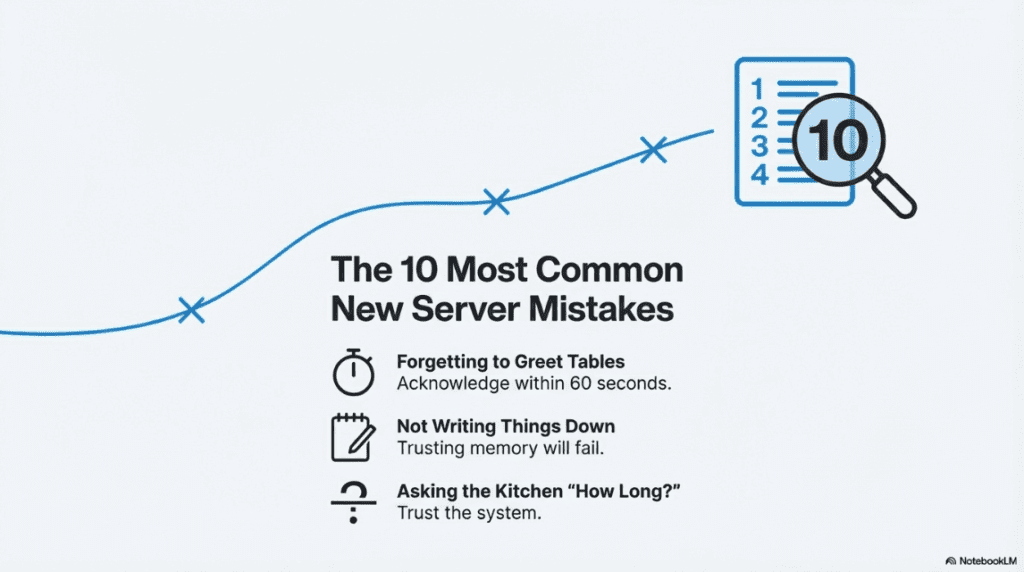
Mistake #1: Forgetting to Greet Tables Immediately
The mistake: Taking too long to acknowledge a new table because you’re busy with other tasks.
Why it’s bad: Guests who wait 10 minutes to be acknowledged are already annoyed before you take their order.
The fix: Acknowledge every new table within 60 seconds, even if you can’t take their order yet.
What to say: “Hi, welcome! I’ll be right with you in just one minute – can I get you started with some water?”
Mistake #2: Not Writing Things Down
The mistake: Trusting your memory during busy shifts.
Why it’s bad: You WILL forget something. Everyone does.
The fix: Write everything down.
- Table numbers
- Special requests
- Timing (apps first, then mains)
- Allergies (especially these!)
- Items that need to be rushed
Pro tip: Use abbreviations, but make sure YOU can read them later.
Mistake #3: Disappearing After Dropping Food
The mistake: Bringing food to the table and immediately walking away.
Why it’s bad: Guests realize they need ketchup, extra napkins, refills – and you’re gone.
The fix: “Two-minute check-back”
Drop food → Walk away → Return in 2 minutes
What to say: “How is everything tasting? Can I get you anything else?”
This catches: Wrong temperatures, missing items, additional requests.
Mistake #4: Not Confirming Orders
The mistake: Taking an order without repeating it back to the guest.
Why it’s bad: Misunderstandings about modifications, cooking temperatures, sides.
The fix: Always repeat the order back.
Example: “So that’s the chicken sandwich with no mayo, extra pickles, and sweet potato fries instead of regular fries. And you’d like the chicken grilled, not fried. Did I get that right?”
Bonus: Guest hears it and corrects you NOW instead of when food arrives.
Mistake #5: Asking the Kitchen “How Long?”
The mistake: Constantly asking “How long on table 4?” “Is table 7 ready?”
Why it’s bad: Slows down the kitchen, annoys cooks, doesn’t actually speed up food.
The fix: Trust the system. Food will come when it’s ready.
Exception: If it’s been unusually long (20+ minutes for appetizer, 40+ minutes for entree), THEN check politely once.
Mistake #6: Not Pre-Bussing Tables
The mistake: Letting dirty plates pile up until the end of the meal.
Why it’s bad: Tables look messy, makes dessert/check drop awkward, creates more work later.
The fix: Remove finished plates every time you pass the table.
What to say: “Are you finished with this?” [gesture to plate]
Pro tip: Never reach across guests. Ask them to hand you plates from the far side of the table.
Mistake #7: Poor Cash Handling
The mistake: Bringing incorrect change, miscounting tips, losing receipts.
Why it’s bad: Costs you money, damages trust with managers.
The fix:
- Count change twice before bringing it to the table
- Keep cash organized in your apron (ones, fives, tens, twenties separated)
- Never put cash in your pocket (easy to lose)
- Always bring receipts with change
Mistake #8: Being Too Chatty
The mistake: Having long conversations with tables when the restaurant is busy.
Why it’s bad: Your other tables suffer, coworkers have to cover for you.
The fix: Read the room.
- Slow shift with 2 tables? Chat a bit.
- Busy shift with 6 tables? Be friendly but efficient.
How to exit a conversation politely: “I’d love to talk more, but I need to check on my other tables. I’ll be back to see how everything is!”
Mistake #9: Not Asking for Help When You Need It
The mistake: Struggling alone during a busy shift instead of asking a coworker for help.
Why it’s bad: You fall behind, guests get angry, quality suffers everywhere.
The fix: “I’m in the weeds on table 12 – can someone run drinks to table 8 for me?”
Remember: Good servers help each other. Asking for help during a rush is normal and expected.
Mistake #10: Taking Criticism Personally
The mistake: Getting defensive when a manager or experienced server corrects you.
Why it’s bad: People stop giving you feedback, you don’t improve.
The fix: “Thank you for telling me. I’ll make sure I do it that way next time.”
Even if you disagree, even if you think they’re wrong, even if you’re embarrassed: Just say thank you and do it their way.
You’re learning. Corrections are part of the process.
Part 7: What Managers Are Actually Evaluating
The Training Period is a Test
Most restaurants have a 30-90 day probation period.
During this time, managers are deciding:
- Do we keep you?
- Do we give you more shifts?
- Do we invest in training you further?
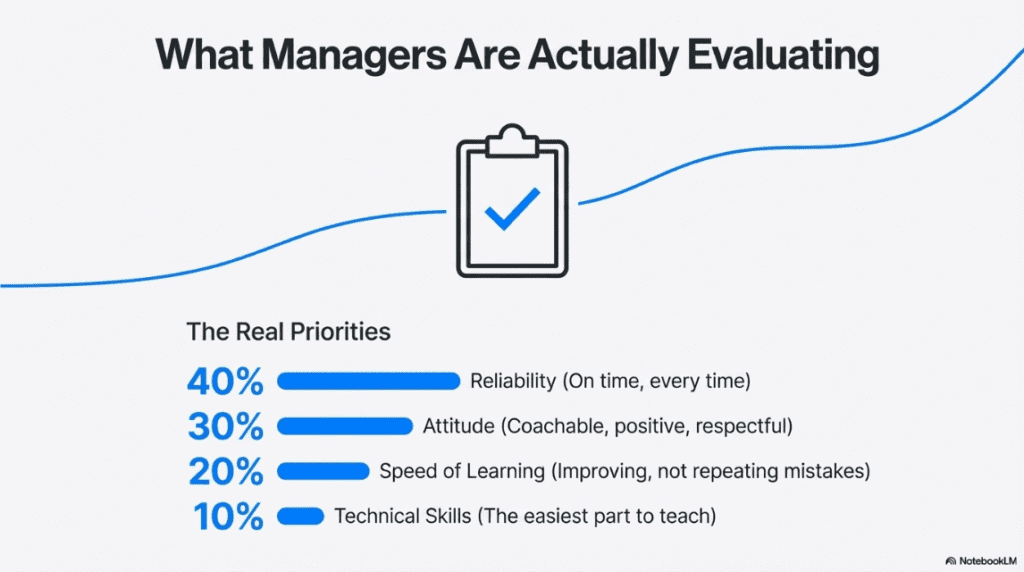
What Matters Most (In Order)
1. Reliability (40% of evaluation)
- Do you show up on time?
- Do you call if you’re sick?
- Do you complete your shifts without drama?
2. Attitude (30% of evaluation)
- Are you coachable?
- Do you have a positive demeanor?
- Do you treat coworkers respectfully?
3. Speed of Learning (20% of evaluation)
- Are you making the same mistakes repeatedly?
- Are you asking good questions?
- Are you improving each week?
4. Technical Skills (10% of evaluation)
- Can you operate the POS?
- Do you know the menu?
- Can you carry multiple plates?
Notice: Technical skills matter LEAST. Managers can train technical skills. They can’t train attitude and reliability.
How to Know If You’re Doing Well
Good signs:
- ✅ Manager gives you more tables each week
- ✅ Coworkers invite you to shift drinks or employee meals
- ✅ Trainer says “good job” or gives specific positive feedback
- ✅ You’re added to the schedule 2-3 weeks in advance
- ✅ Manager asks if you want to pick up extra shifts
Warning signs:
- ⚠️ Manager only gives you slow shifts
- ⚠️ Your hours are reduced after week 2
- ⚠️ Manager has “check-in meetings” frequently
- ⚠️ Coworkers don’t include you in conversations
- ⚠️ Trainer seems frustrated when correcting you
According to Toast research, when it comes to training new hires, the majority of restaurants (68%) share an employee handbook, but only 19% use online training modules and only 36% have a formal 30-day check-in
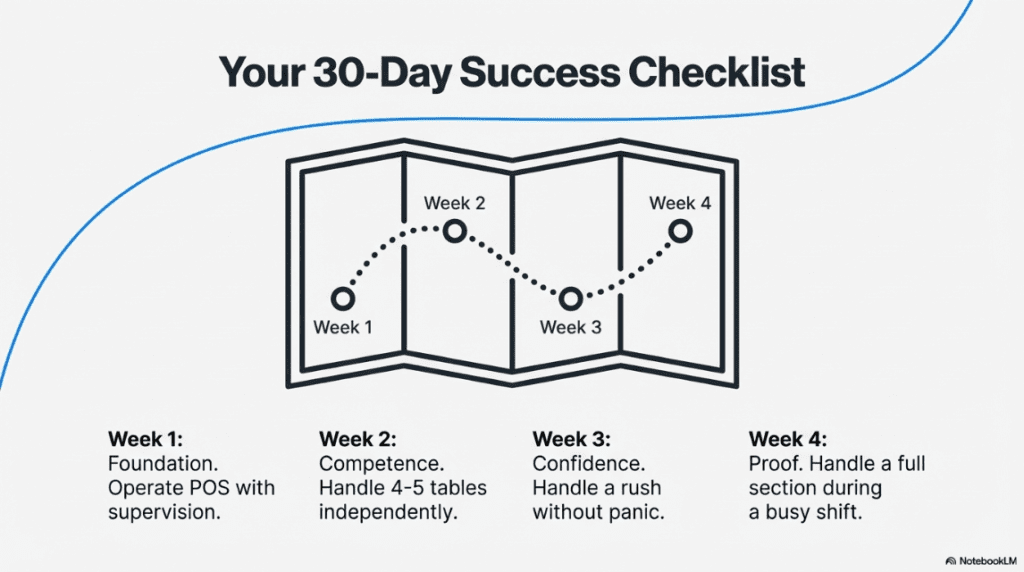
Part 8: Your 30-Day Success Checklist
Week 1 (Days 1-7): Foundation
Learning Goals:
- Know all staff names and positions
- Understand restaurant layout completely
- Learn top 10 menu items
- Successfully operate POS with supervision
- Complete first solo shift (even if just 2-3 tables)
Behavioral Goals:
- Arrive 10 minutes early every shift
- Ask at least one good question per shift
- Thank someone for helping you each day
- Write notes after every shift
Success metric: By end of week 1, you should be able to take orders and ring them in correctly, even if slowly.
Week 2 (Days 8-14): Building Competence
Learning Goals:
- Know 50% of full menu
- Handle 4-5 tables independently
- Process split checks correctly
- Handle a complaint professionally (with support)
- Complete side work without being reminded
Behavioral Goals:
- Help a coworker without being asked
- Introduce yourself to kitchen staff you haven’t met
- Ask for feedback from your trainer
- Practice menu descriptions at home
Success metric: By end of week 2, you should work with minimal supervision and handle basic situations independently.
Week 3 (Days 15-21): Developing Confidence
Learning Goals:
- Know 75% of menu (including modifications)
- Handle full section during moderate shifts
- Make menu recommendations confidently
- Handle rush period without panic
- Train alongside another new server (if applicable)
Behavioral Goals:
- Offer to help coworkers during slow times
- Anticipate what needs to be done (don’t wait to be told)
- Share something you learned with another new server
- Stay calm when you make a mistake
Success metric: By end of week 3, you should feel comfortable during normal shifts and capable during busy periods.
Week 4 (Days 22-30): Proving Yourself
Learning Goals:
- Know entire menu (or 90%+)
- Handle full section during busy shifts
- Work opening or closing shift solo
- Resolve guest complaints independently
- Help train the next new server
Behavioral Goals:
- Volunteer for difficult shifts
- Ask manager for feedback on your progress
- Build relationship with at least 3 regular guests
- Anticipate busy periods and prepare accordingly
Success metric: By day 30, managers should trust you to work independently and consider you a reliable team member.
Part 9: Special Situations for ESL Servers
When Language is Your Biggest Challenge
Common fears:
- “What if I don’t understand a guest?”
- “What if they don’t understand my accent?”
- “What if I can’t pronounce menu items?”
The reality: Language challenges are manageable if you have strategies.
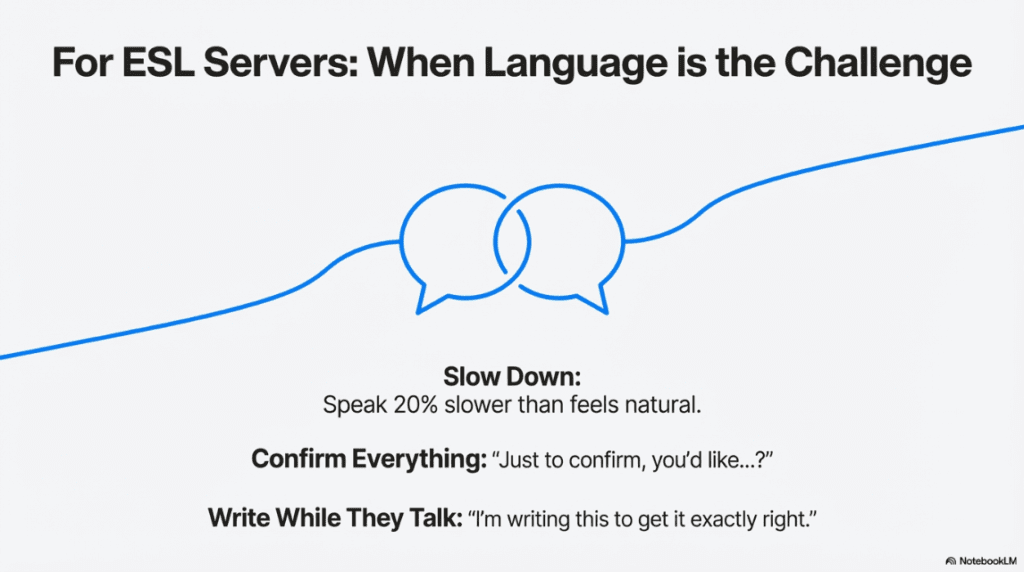
Strategy 1: Slow Down
The mistake: Speaking quickly to “get through” the interaction.
Why it’s bad: Fast + accent = incomprehensible.
The fix: Speak 20% slower than feels natural.
Practice: Record yourself on your phone. If YOU have trouble understanding you, guests will too.
Strategy 2: Confirm Everything
Use these phrases constantly:
- “Just to confirm, you’d like [repeat order]?”
- “Did I understand correctly – you want [modification]?”
- “Let me make sure I have this right – [summary]?”
Why it works: Catches misunderstandings immediately, shows you care about accuracy.
Strategy 3: Write While They Talk
The fix: As the guest orders, write it down in front of them.
What to say: “I’m writing this down to make sure I get it exactly right.”
Why it works: Guest sees you’re being careful, you have written backup if you didn’t hear correctly.
Strategy 4: Practice Problem Phrases at Home
Difficult menu items: Worcestershire, bruschetta, quinoa, charcuterie
Solution: Look up pronunciation on YouTube, practice 10 times out loud.
Pro tip: Many native English speakers mispronounce these too. You’re not alone.
When You Don’t Understand a Guest
Don’t: Guess and bring the wrong thing.
Do: “I want to make sure I get your order exactly right. Could you repeat [the part you didn’t hear]?”
If you still don’t understand: “Let me have you tell my manager – they’ll make sure you get exactly what you want.”
This is professional, not a failure.
Part 10: Building Long-Term Success
Month 2 Goals
Once you survive the first 30 days, focus on:
Efficiency:
- Reduce steps (carry more items per trip)
- Organize your section better
- Anticipate guest needs
Menu expertise:
- Know every item, every modification
- Make confident recommendations
- Upsell naturally
Guest relationships:
- Remember regular customers
- Build rapport quickly
- Create memorable experiences
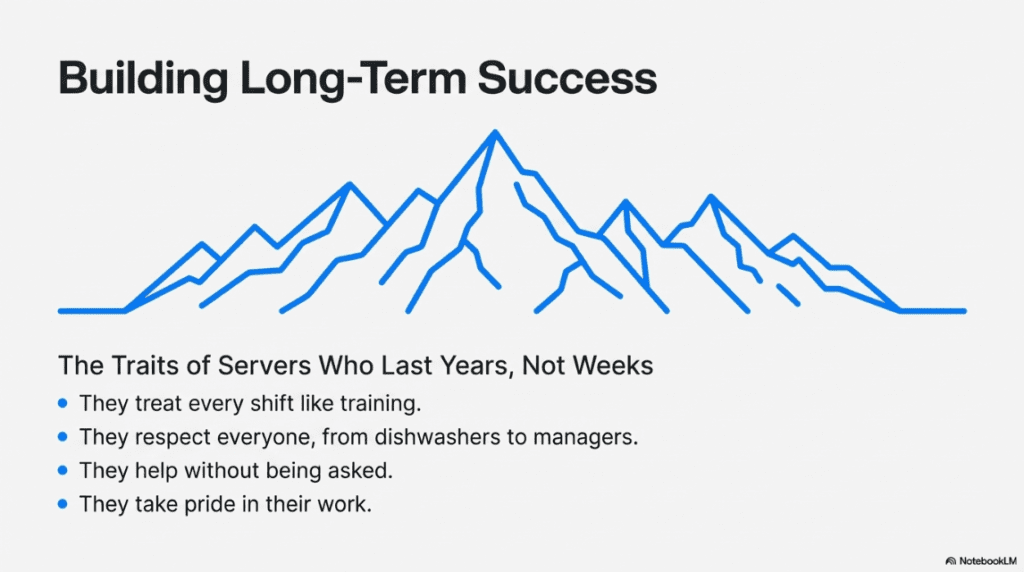
The Traits of Servers Who Last Years (Not Weeks)
1. They treat every shift like training Even after months, good servers are always learning.
2. They respect everyone From dishwashers to managers – everyone gets respect.
3. They don’t complain excessively Venting is normal. Constant negativity is toxic.
4. They help without being asked They see what needs to be done and do it.
5. They take pride in their work Good service isn’t beneath them – it’s a skill they master.
Conclusion: Sofia’s Transformation
Remember Sofia from the introduction? The one who almost quit after her first week?
Here’s what happened next.
After that terrible day five, she went home and re-read her notes. She made a list of what she needed to learn. She practiced menu descriptions in front of a mirror. She arrived 20 minutes early the next shift and asked her trainer to show her the POS split-check function again.
Day six was better. She made mistakes, but different mistakes.
Day ten, she had her first shift where nothing went catastrophically wrong.
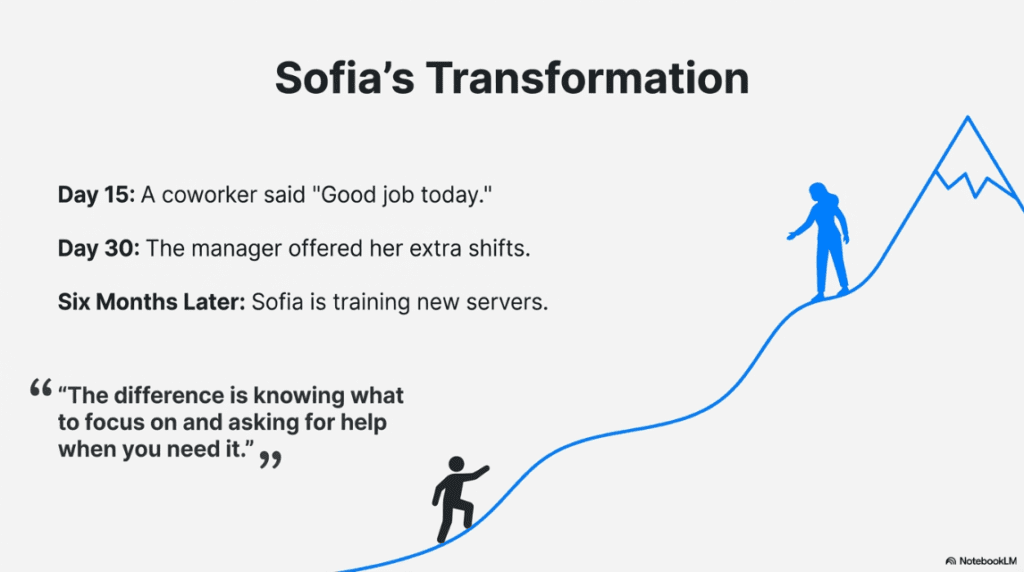
Day fifteen, a coworker said “Good job today” without being asked.
Day thirty, the manager asked if she wanted to pick up extra shifts. “You’re doing really well,” he said.
What changed? Not her English. Not her natural talent. Not even her speed.
What changed was her approach:
- She asked better questions
- She built relationships with kitchen staff
- She learned from mistakes instead of repeating them
- She showed up consistently and worked hard
Six months later, Sofia is training new servers. The ones who are nervous, who don’t know where anything is, who feel overwhelmed.
She tells them the same thing: “Everyone struggles the first month. The difference between people who make it and people who quit is knowing what to focus on and asking for help when you need it.”
Your first 30 days will be hard. Every successful server’s first month was hard.
But if you:
- Learn strategically (prioritize what matters most)
- Build relationships (coworkers, kitchen, managers)
- Ask for help appropriately (right time, right person)
- Learn from mistakes (don’t repeat them)
- Show up consistently (reliability matters most)
You won’t just survive the first 30 days. You’ll build the foundation for a successful restaurant career.
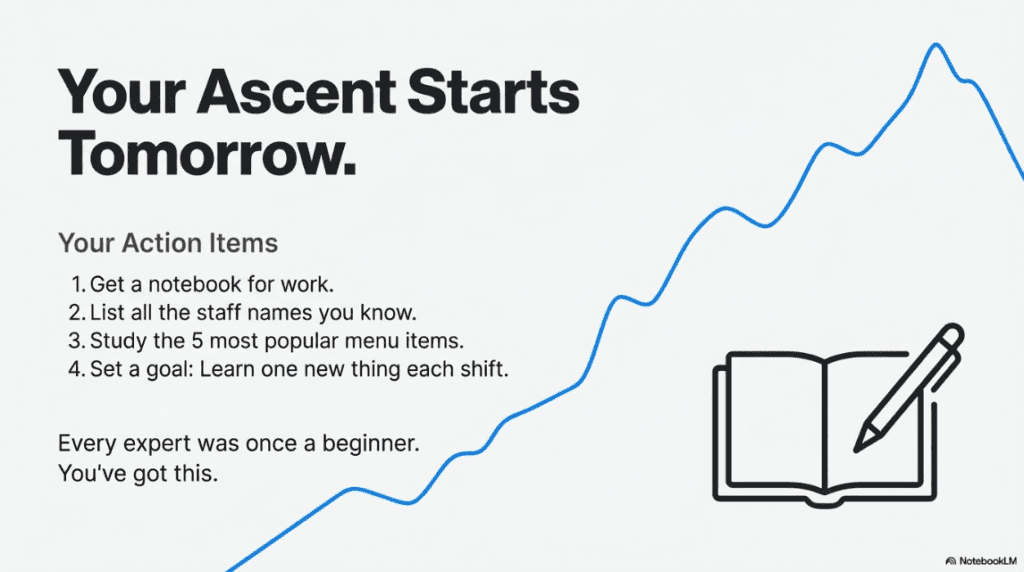
Your action items for tomorrow:
- Buy a notebook dedicated to work notes
- Make a list of all staff names you know (and don’t know)
- Study the 5 most popular menu items
- Set a goal: one thing to learn each shift
You’ve got this. Welcome to the restaurant industry.
Once you’ve established yourself and proven your value over several months, you can learn how to ask for a raise or promotion to advance your career.
Quick Reference: 40 Essential Phrases for New Servers
Asking for Help
- “Can you show me how to [task]?”
- “I think I do it this way – is that correct?”
- “Where can I find [item]?”
- “What’s the best way to [task]?”
- “I’m not sure about this – can you check?”
Communicating with Kitchen
- “Behind!” (walking behind someone)
- “Hot!” (carrying hot items)
- “Ordering [item]”
- “Can you rush [item] please?”
- “Thank you for rushing that”
Guest Service
- “I’ll be right with you”
- “Let me check on that for you”
- “Just to confirm, you’d like [repeat order]?”
- “How is everything tasting?”
- “Can I get you anything else?”
When You Don’t Know Something
- “That’s a great question – let me find out for you”
- “I want to give you the right information – one moment”
- “Let me check with the kitchen about that”
- “I’m still learning the menu – let me get you an answer”
Handling Mistakes
- “I apologize – let me fix that right away”
- “That’s my mistake – I’ll correct it”
- “I’m sorry about the wait – it’s coming right out”
- “Let me get my manager to help with this”
Working with Team
- “Can someone run drinks to table [number]?”
- “I’m in the weeds – can you help?”
- “Thank you for helping me with that”
- “Do you have a minute to show me something?”
Time Management
- “I’ll have that for you in [time]”
- “Your food should be out in about [time]”
- “I’ll check back in a few minutes”
Professional Phrases
- “May I take your order?”
- “I’d recommend [item]”
- “That’s a popular choice”
- “Would you like to start with drinks?”
- “Are you ready for the check?”
End of Shift
- “I completed [task]”
- “Is there anything else you need me to do?”
- “See you [next shift day]”
- “Thank you for training me today”
- “I learned a lot today”
Remember: Your first 30 days are about learning, not perfection. Every expert was once a beginner.
Ready to Master Restaurant English?
These free articles and scenarios are a great start, but if you want a complete, structured system for learning restaurant English, consider our full course.

English for Waiters includes:
✅ 22+ video lessons covering every restaurant situation
✅ Real restaurant scenarios with native pronunciation
✅ Interactive pronunciation practice
✅ Downloadable phrase guides
✅ Lifetime access with free updates