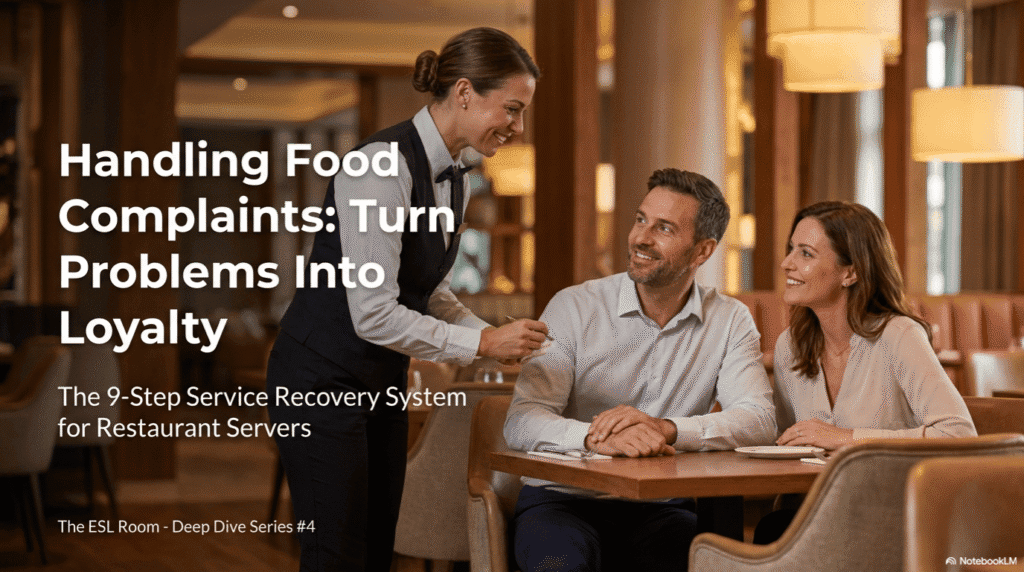
How to Handle Food Complaints Without Losing Your Cool

How to Handle Food Complaints Without Losing Your Cool – Professional Service Recovery Script

Table of Contents

The Moment Every Server Dreads

The table looks happy. They’re chatting, laughing, enjoying their evening. You delivered their food 10 minutes ago. Everything seemed perfect.

Then you walk past and notice it. The untouched steak. The disappointed face. The body language that says “something is wrong.”

Your stomach drops. A complaint is coming.

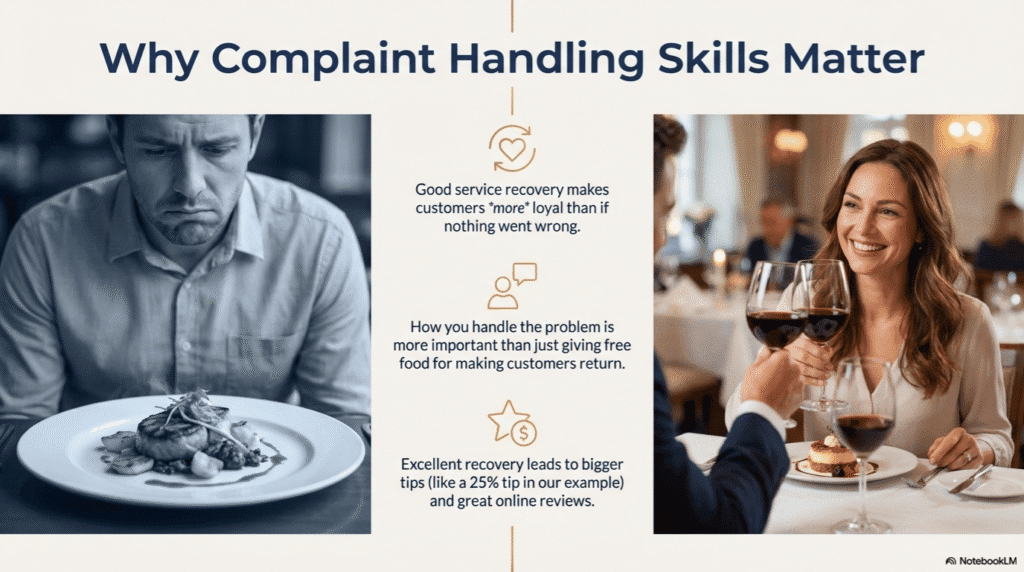
This is the moment that separates average servers from professionals. Handle it badly, and you lose the customer forever. They’ll leave a bad review, tell their friends, and never come back.

Handle it well, and something remarkable happens: the upset customer becomes more loyal than if nothing had gone wrong.

Professional servers know that complaints are opportunities. They have a system for turning problems into wins. They use specific phrases that calm angry customers, fix the situation quickly, and often end up with bigger tips than tables where nothing went wrong.

Research from the Journal of Hospitality Marketing & Management found that recovery strategies involving personal service interaction with customers were more effective than monetary compensation alone in encouraging customers to return. This is why the way you handle the complaint is just as important as what you offer to fix it.

In this real restaurant scenario, you’ll learn the exact process for handling food complaints professionally. These are the techniques that turn disasters into success stories.

Prefer to listen – Here’s the podcast.


How to Handle Food Complaints Without Losing Your Cool

The Situation

Time: 7:45 PM, Saturday evening – fully booked restaurant

Location: Table 12, couple celebrating their anniversary

The Challenge: The gentleman ordered a ribeye steak medium-rare. It arrived well-done. He’s been looking forward to this meal all week. His wife notices he’s upset before he even says anything. They’re trying to decide whether to complain or just suffer through it.

Your Goal: Acknowledge the problem immediately, fix it quickly, make them feel heard and valued, and save their anniversary dinner.


The Complete Dialogue

[Server notices the customer cutting into the steak, looking disappointed, then putting his knife and fork down]

Server: approaching the table within 30 seconds “How is everything? Is the steak cooked okay for you?”

Customer (Male): hesitantly “Well… to be honest, I asked for medium-rare, but this is quite well-done.”

Server: immediate concerned expression, genuine tone “I’m so sorry about that. You’re absolutely right – that’s not what you ordered at all. Let me take care of this for you right away.”

Customer: slightly surprised by quick response “Oh, well… I mean, I suppose I could just—”

Server: gently interrupting “No, please don’t eat something that’s not right. You ordered medium-rare, and that’s exactly what you should get. I’m going to take this back to the kitchen immediately and get you a new one cooked properly.”

Customer’s Wife: “How long will that take? We don’t want to cause trouble…”

Server: warm, reassuring tone “You’re not causing any trouble at all – this is our mistake, not yours. A fresh steak will take about 12-15 minutes. While you’re waiting, can I bring you a complimentary appetizer or some fresh bread? And of course, I’ll make sure your wife’s meal stays warm, or we can prepare her a fresh one too so you can eat together.”

Customer’s Wife: “My salmon is actually perfect, thank you.”

Server: to the wife “I’m so glad. I’ll ask the kitchen to keep it warm for you in the meantime.” turning to the customer “And sir, what can I get you while you wait? Perhaps some extra vegetables, or I can have the chef prepare some mushrooms or onions on the side?”

Customer: more relaxed now “Some sautéed mushrooms would be great, actually.”

Server: writing it down “Perfect. Sautéed mushrooms coming right up. I’m going straight to the kitchen now to speak to the chef personally about your steak. I’ll make absolutely sure it’s cooked medium-rare this time.”

Customer: “Thank you. I appreciate that.”

Server: sincere tone “It’s my pleasure, and again, I’m really sorry about this. It’s your anniversary dinner – it should be perfect. I’ll be back in just a moment with those mushrooms.”

[Server goes to kitchen, speaks with chef, returns with mushrooms within 3 minutes]

Server: “Here are your mushrooms. The chef is preparing your new steak personally – he sends his apologies and wants to make sure this one is exactly how you like it.”

Customer: “That’s very kind. Thank you.”

Server: “Not at all. Can I top up your wine while we wait?”

Customer’s Wife: “Yes please, that would be lovely.”

[Server returns with wine, checks on them at 5 minutes and 10 minutes during the wait]

[12 minutes later – new steak arrives]

Server: presenting the steak “Here we are – ribeye, medium-rare. The chef prepared this one personally. Please enjoy, and I’ll check back with you in just a moment.”

Customer’s Wife: “Thank you so much.”

Server: “My pleasure. I’ll give you a moment to try it.”

[Server steps away, returns 2 minutes later]

Server: approaching “How is the steak this time?”

Customer: cutting into it, pink and juicy center “This is exactly right. Perfect.”

Server: genuinely pleased “I’m so relieved. I’m really glad we got it right this time. Please enjoy the rest of your meal.”

[8 minutes later – both customers have nearly finished eating]

Server: approaching “How was everything? Was the steak cooked properly throughout?”

Customer: “Honestly, it was excellent. Thank you for handling that so well.”

Server: “I’m so happy to hear that. And I hope we haven’t ruined your anniversary dinner.”

Customer’s Wife: “Not at all. You were wonderful about it.”

Server: “Thank you for being so understanding. Now, because of the mix-up with your steak, I’d like to offer you both complimentary desserts this evening. We have a chocolate fondant that’s absolutely incredible, or a lemon posset if you prefer something lighter.”

Customer: “That’s very generous. We’ll share the chocolate fondant.”

Server: “Perfect choice. I’ll get that for you now.”

[After dessert – server speaks with manager about compensation]

[Server returns with bill]

Server: bringing the bill “Here’s your check. My manager has removed the charge for the steak – again, our sincere apologies for the error.”

Customer: surprised “Oh, you really didn’t have to do that.”

Server: “We absolutely did. You came here to celebrate your anniversary, and we let you down. This is our way of saying sorry and hoping you’ll give us another chance in the future.”

Customer’s Wife: “We definitely will. You turned a problem into something really positive.”

Server: warmly “That means the world to me. Thank you both for being so gracious about it. Happy anniversary, and I hope the rest of your evening is wonderful.”

[Customer leaves a 25% tip and writes positive review mentioning server by name]


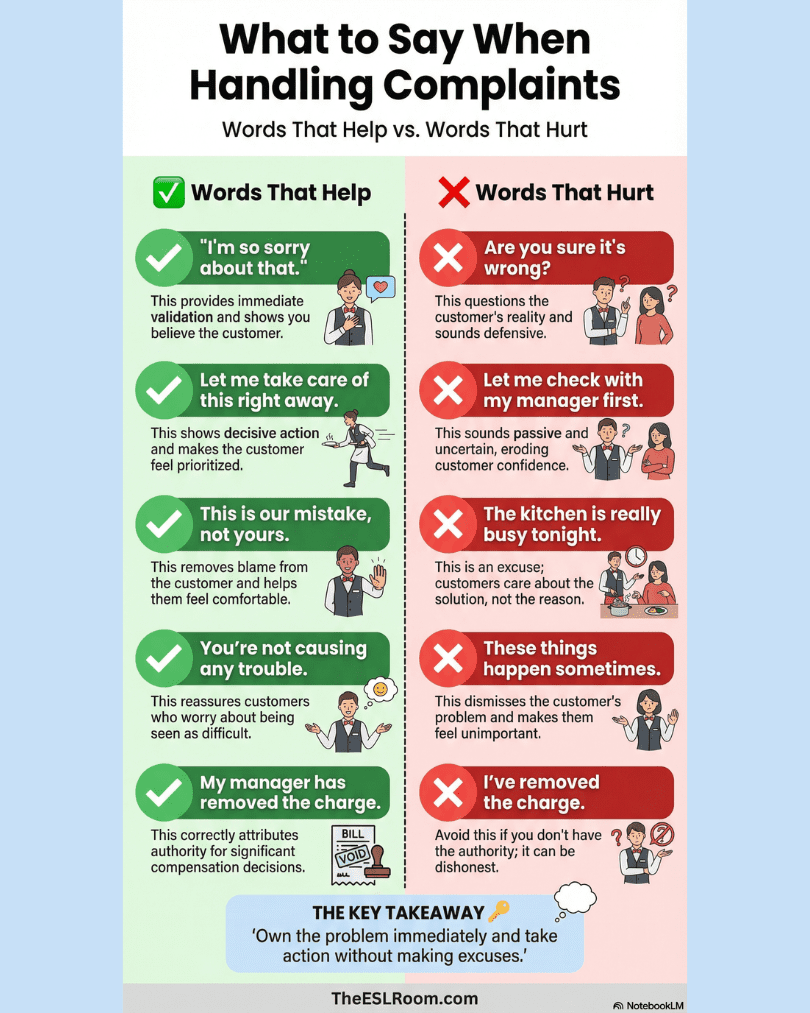
food service recovery Key Phrases Breakdown

Key Phrases Breakdown

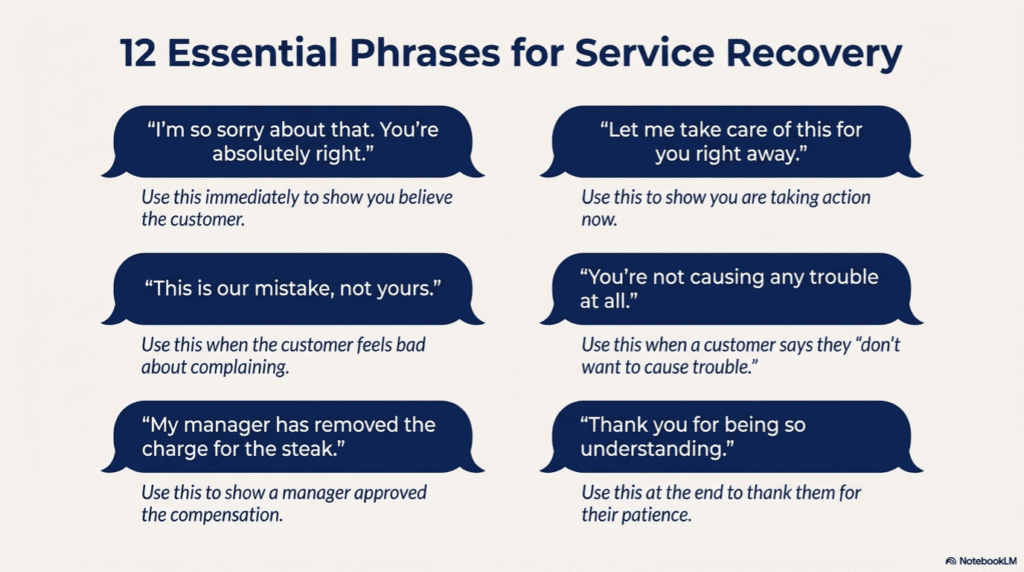
1. “I’m so sorry about that. You’re absolutely right.”

Why this works: Immediate validation. You’re not defending, explaining, or making excuses. You’re acknowledging that the customer is correct and you understand why they’re upset.

The psychology: When people complain, they want to be heard. They want someone to recognize that their complaint is legitimate. This phrase does both instantly.

Timing: Say this within 3 seconds of hearing the complaint. Any delay makes you sound defensive.

What NOT to say:

  • ❌ “Oh really? Let me check…” (sounds like you don’t believe them)
  • ❌ “That’s strange, the kitchen usually gets it right” (making excuses)
  • ❌ “Are you sure you ordered medium-rare?” (questioning them)
  • ✅ “I’m so sorry about that. You’re absolutely right.”

Body language: Concerned facial expression, lean in slightly, make eye contact, nod while they’re speaking.

2. “Let me take care of this for you right away.”

Why this works: Shows immediate action. You’re not asking permission, discussing options, or waiting for approval. You’re solving it now.

Key word: “right away” – Creates urgency. The customer feels prioritized.

Alternative phrases:

  • “I’ll fix this immediately”
  • “Let me sort this out for you straight away”
  • “I’m taking this back to the kitchen right now”

The difference: Compare with weak phrases like “Would you like me to…” or “I can check with the manager…” You sound passive and uncertain. The customer wants decisiveness.

3. “This is our mistake, not yours.”

Why this works: Removes any blame from the customer. Some people feel guilty about complaining. This phrase tells them they’re right to speak up.

When to use: When the customer seems hesitant or apologetic about complaining.

The reassurance: You’re giving them permission to be upset. They didn’t do anything wrong.

Cultural note: In many cultures, people avoid confrontation. Saying “this is our mistake” helps them feel comfortable expressing dissatisfaction.

4. “You’re not causing any trouble at all.”

Why this works: Anticipates their concern. Most customers worry about being “difficult” or “demanding.”

The truth: A legitimate complaint about incorrect food is NOT trouble. It’s feedback. Professionals welcome it.

When they say: “I don’t want to be difficult…” or “Sorry to bother you…” or “Maybe I should just eat it…”

You respond: “You’re not causing any trouble at all. We want you to have exactly what you ordered.”

5. “While you’re waiting, can I bring you…?”

Why this works: Offers compensation proactively. You’re not waiting for them to ask – you’re suggesting it yourself.

The strategy: Give them something while they wait for the replacement. This:

  • Reduces perceived wait time
  • Shows generosity
  • Gives them something to do
  • Demonstrates you care

Good options to offer:

  • Complimentary appetizer
  • Fresh bread
  • Extra side dish
  • Drink refill
  • Amuse-bouche

Bad options:

  • ❌ Nothing (awkward silence while they wait)
  • ❌ Asking if they want to pay for something additional

6. “I’m going straight to the kitchen to speak to the chef personally.”

Why this works: Shows you’re taking personal responsibility. This isn’t being delegated or ignored – YOU are handling it.

The reassurance: They see you care enough to get involved directly.

What it prevents: The customer wondering “Did they actually tell the kitchen?” or “Are they taking this seriously?”

Professional standard: According to research on service recovery in restaurants, customers who see staff take personal ownership of problems report 40% higher satisfaction than when complaints are simply passed along.

7. “Please enjoy, and I’ll check back with you in just a moment.”

Why this works: Sets expectations for follow-up without pressure. You’re not asking them to perform a quality check on the spot – you’re giving them space to enjoy their food.

The timing: “Just a moment” = 2-3 minutes. This is the industry standard check-back time.

What it prevents: The awkward situation of standing over customers while they cut into food. People want to eat at their own pace.

Professional standard: According to hospitality industry guidelines, the “check-back rule” means following up 2-3 minutes after delivering food to give customers a second opportunity to communicate any issues.

When to use: ALWAYS after delivering replacement items. Step away, let them try it privately, then return.

Alternative phrases:

  • “I’ll give you a moment to try it and check back shortly”
  • “Please start eating and I’ll be back in just a minute”
  • “I’ll check on you in a moment”

8. “How is the steak this time?” / “Was the steak cooked properly throughout?”

Why this works: Specific follow-up questions. First check-back is general (“How is the steak?”), second confirms thoroughness (“cooked properly throughout?”).

The two-check system:

  • First check (2-3 minutes): “How is the steak this time?” – catches immediate problems
  • Second check (8-10 minutes): “Was it cooked properly throughout?” – confirms entire experience

Why it matters: Some problems only appear after several bites (uneven cooking, texture issues). The second check catches these.

Professional tip: On replacement items, always do TWO check-backs instead of one. Shows extra care.

9. “I hope we haven’t ruined your [special occasion].”

Why this works: Acknowledges the bigger picture. This isn’t just about a steak – it’s about their anniversary, birthday, celebration.

When to use: If you know it’s a special occasion (birthday, anniversary, promotion, etc.)

The empathy: Shows you understand this meal matters more than a regular Tuesday dinner.

What usually happens: Customers respond positively. They appreciate that you recognize the context.

10. “I’d like to offer you… as our apology.”

Why this works: Proactive compensation. You’re offering before they ask. This feels generous rather than extracted.

What servers can typically offer (without manager approval):

  • Complimentary dessert
  • Free bread or appetizer
  • Drink refills
  • Future discount card

What requires manager approval:

  • Removing expensive entrees from bill
  • Discounting entire meal
  • Entire meal complimentary

Industry standard: According to restaurant management guidelines, most restaurants allow servers to comp small items but require manager authorization for significant discounts or removing main courses from bills.

The key: Offer something meaningful enough to match the severity of the problem, within your authority level.

11. “My manager has removed the charge for the steak.”

Why this works: Correctly attributes the compensation decision to management. Shows proper authorization hierarchy.

Professional standard: When removing expensive items from bills, always mention manager involvement. This shows:

  • The decision was authorized properly
  • Management cares about the customer’s experience
  • The restaurant has proper systems in place

Alternative phrases:

  • “The manager has taken care of the steak charge”
  • “Management has comped your entree”
  • “My manager asked me to remove that from your bill”

What NOT to say:

  • ❌ “I’ve removed the steak” (implies you had authority you may not have)
  • ✅ “My manager has removed the steak” (correct attribution)

Why it matters: Guests appreciate knowing management is involved in significant service recovery decisions.

12. “Thank you for being so understanding / gracious / patient.”

Why this works: Acknowledges their good behavior. You’re not just apologizing – you’re recognizing they handled it well too.

The psychology: People like being told they’re reasonable and kind. It reinforces positive behavior.

When to use: At the end, after the problem is resolved.

What it creates: Mutual respect. You fixed the problem professionally, they responded graciously, everyone wins.


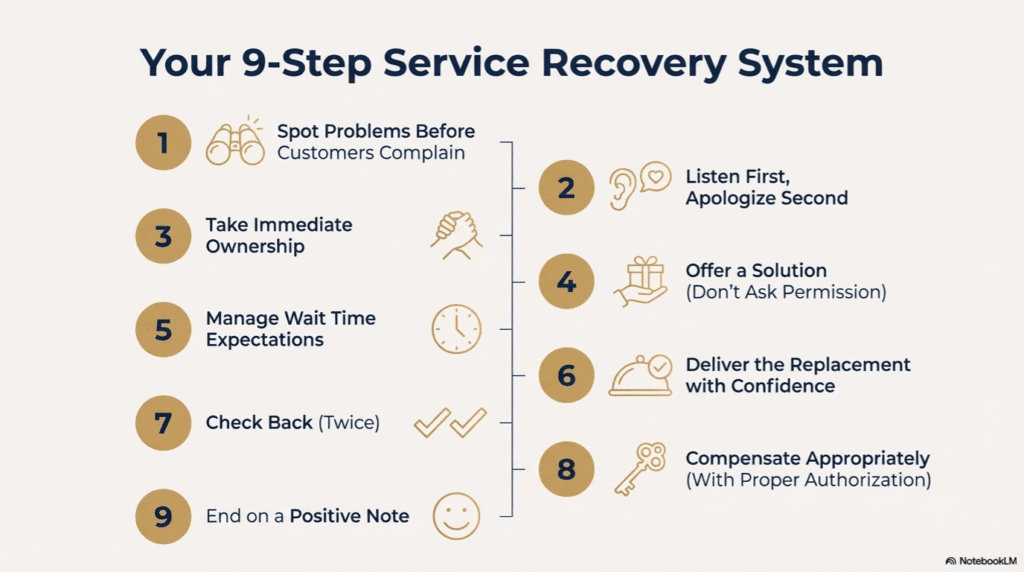
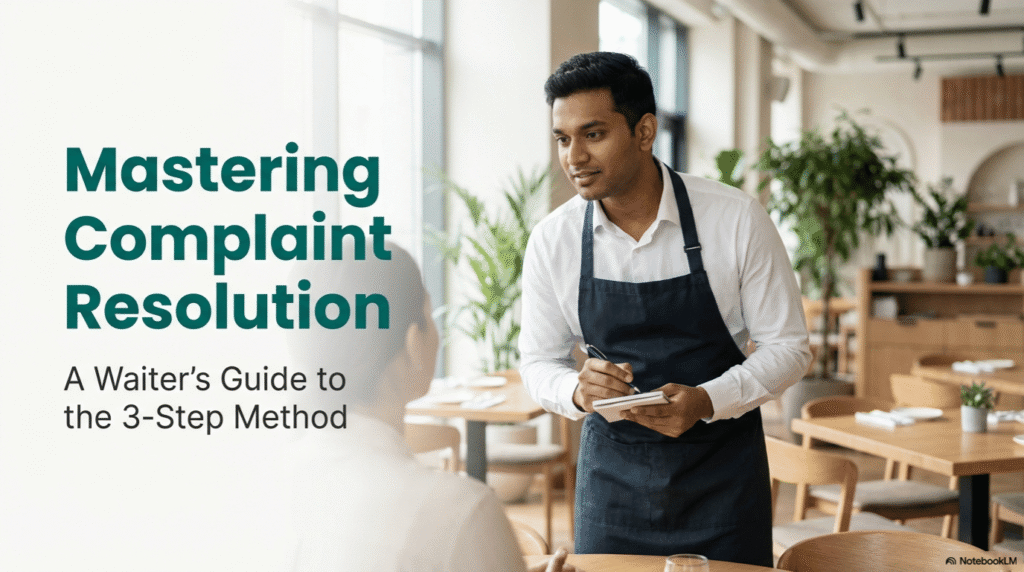
The Service Recovery Strategy (Step-by-Step)

The Service Recovery Strategy (Step-by-Step)

Step 1: Spot Problems Before Customers Complain

Proactive checking beats reactive damage control.

How to spot unhappy customers:

  • Food untouched after 2-3 minutes
  • Cutting into food but not eating it
  • Pushing food around the plate
  • Negative facial expressions
  • Hushed conversation between dining partners
  • Looking around for server
  • Body language: crossed arms, leaning back from table

What to do: Approach within 30-60 seconds. Don’t wait for them to flag you down.

Opening: “How is everything? Is the [specific dish] cooked okay for you?”

Why “How is everything?” is weak: Easy to say “fine” even when it’s not.

Better: “Is the steak cooked okay for you?” – Specific question, harder to dismiss.

Step 2: Listen First, Apologize Second

The mistake: Jumping straight to “I’m sorry” before understanding the problem.

The right way:

  1. Let them fully explain (don’t interrupt)
  2. Acknowledge: “I understand” or “I see”
  3. Then apologize: “I’m so sorry about that”
  4. Validate: “You’re absolutely right”

Why this order matters: They feel heard BEFORE the apology. An apology before listening sounds automatic and insincere.

Step 3: Take Immediate Ownership

Don’t:

  • ❌ Blame the kitchen: “The chef must have made a mistake”
  • ❌ Blame other staff: “The last server must have written it wrong”
  • ❌ Make excuses: “We’re really busy tonight”
  • ❌ Defend: “Usually we get it right”

Do:

  • ✅ Use “we” and “our”: “This is our mistake”
  • ✅ Take responsibility: “I’m going to fix this”
  • ✅ Show urgency: “Right away” / “Immediately”

The principle: You represent the restaurant. When anything goes wrong, it’s “our” problem to fix.

Step 4: Offer a Solution (Don’t Ask Permission)

Weak approach: “Would you like me to take this back?”

Strong approach: “I’m taking this back to the kitchen right now to get you a new one.”

Why: Decisiveness inspires confidence. Asking permission makes you sound uncertain.

The exception: If there are options (remake vs. refund vs. different dish), present them clearly: “I can get you a new one prepared correctly, or if you’d prefer something else entirely, that’s absolutely fine.”

Step 5: Manage Wait Time Expectations

Critical: Tell them how long the fix will take. Don’t guess if you’re unsure – check with the kitchen.

Template: “A fresh [dish] will take about [time]. While you’re waiting, can I bring you [compensation]?”

If it’s a long wait (15+ minutes):

  • Offer substantial compensation (appetizer, bread, drink)
  • Check on them halfway through the wait
  • Update them if it’s taking longer than expected

The psychology: Knowing how long something will take makes the wait feel shorter. Unknown wait time feels endless.

Step 6: Deliver the Replacement with Confidence

What to say: “Here we are – [dish], cooked [specification]. Please enjoy, and I’ll check back with you in just a moment.”

What NOT to do: Ask them to cut into it while you watch. This is not standard practice and makes customers uncomfortable.

Industry practice: Deliver the replacement confidently, step away to give them privacy, then return 2-3 minutes later.

Why this works better: Customers want to eat at their own pace, not perform a quality inspection on command.

Step 7: Check Back (Twice)

First check-back (2-3 minutes after delivery):

  • “How is the steak this time?”
  • Catches immediate problems
  • Shows you care about the outcome

Second check-back (8-10 minutes later):

  • “Was everything cooked properly throughout?”
  • Confirms entire experience, not just first bite
  • Catches problems that appear after several bites

Why two checks: Replacement items deserve extra attention. One check isn’t enough to ensure complete satisfaction.

Step 8: Compensate Appropriately (With Proper Authorization)

The compensation should match the problem:

Minor issue (slow service, forgotten drink): → Server can offer: Complimentary drink refill or bread

Medium issue (incorrect dish, cold food, wrong temperature): → Server can offer: Free dessert → Manager can authorize: Remove item from bill

Major issue (very long wait, multiple mistakes, special occasion ruined): → Requires manager approval: Remove item AND free dessert OR discount entire meal

Authorization levels:

  • Servers can comp: Drinks, bread, small appetizers, desserts (up to £8-10 value typically)
  • Manager must approve: Entrees removed from bill, meal discounts, full comps

Professional practice: When offering compensation beyond your authority, say: “Let me speak with my manager about taking care of your bill.” Then return with: “My manager has removed the steak charge.”

Step 9: End on a Positive Note

Before they leave:

  • Thank them for their patience/understanding
  • Reference the special occasion if applicable
  • Express hope they’ll return

Script: “Thank you so much for being so understanding about this. I hope we haven’t ruined your anniversary, and I really hope we’ll see you again.”

Why it works: Ends the interaction on warmth and appreciation, not apology and negativity.


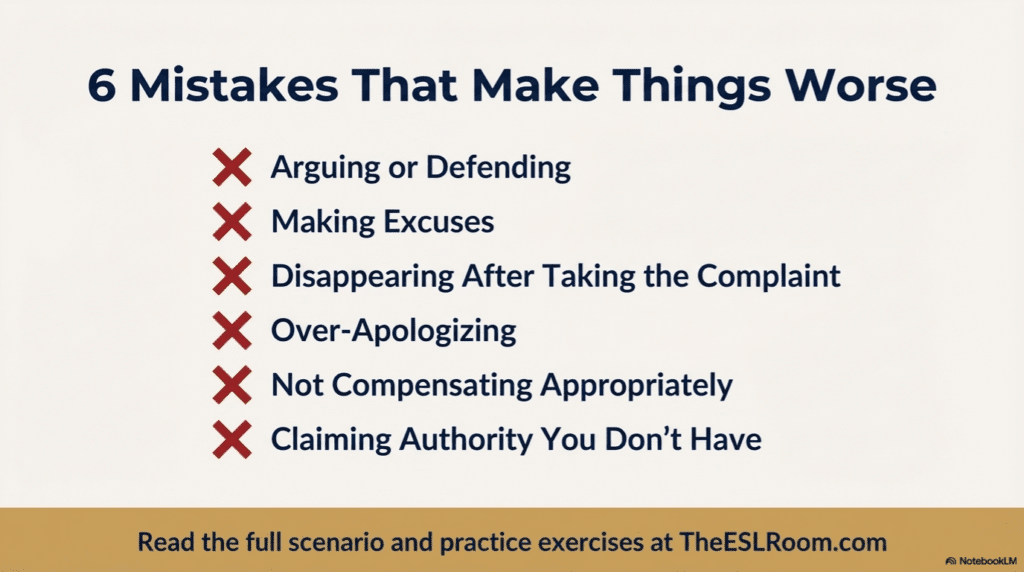
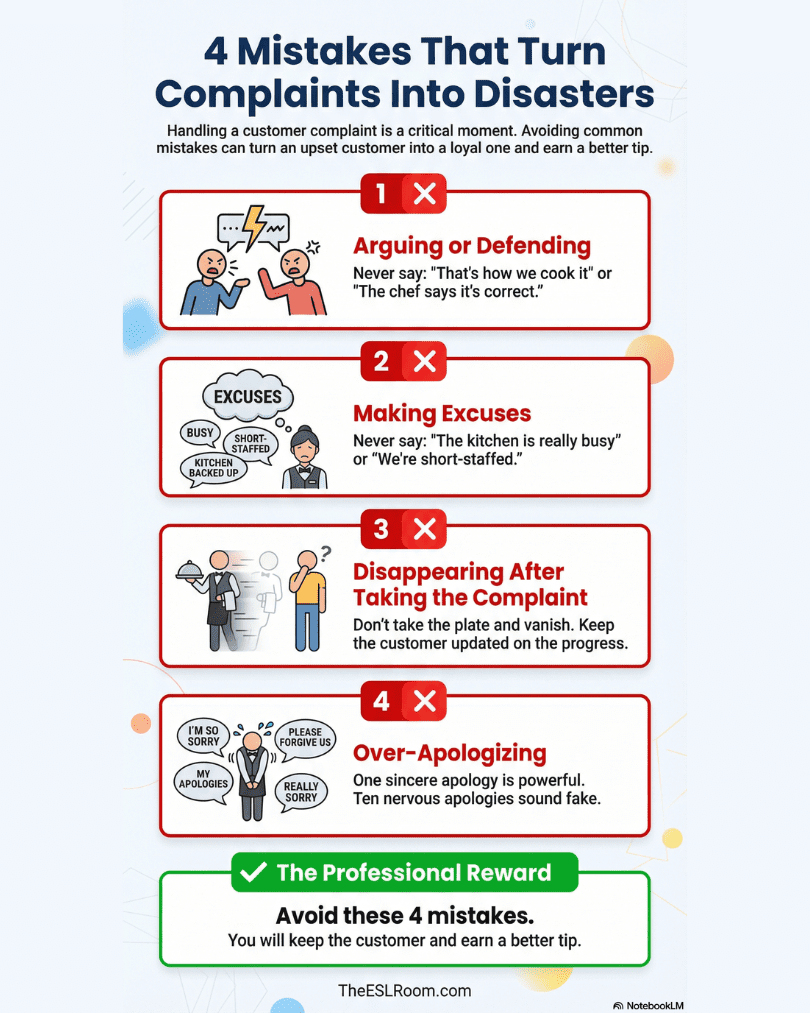
restaurant service recovery. Common Mistakes to Avoid

Common Mistakes to Avoid

❌ Mistake 1: Arguing or Defending

Wrong: Customer: “This steak is overcooked.” Server: “Are you sure? The chef said it was perfect.”

Why it’s wrong: You’re challenging their perception. Even if you think they’re wrong, arguing guarantees they’ll never come back.

Right: “I’m sorry – let me get you a new one prepared exactly how you want it.”

The rule: The customer’s experience is their reality. Respect it.

❌ Mistake 2: Making Excuses

Wrong: “We’re really busy tonight, so the kitchen is running behind.”

Why it’s wrong: The customer doesn’t care why it went wrong. They care about getting it fixed.

Right: “I’m so sorry about the wait. Let me check on your order right now.”

The principle: Explanations sound like excuses. Save them for after the problem is solved, if they ask.

❌ Mistake 3: Disappearing After Taking the Complaint

Wrong: Taking food back to the kitchen and not returning for 15 minutes.

Why it’s wrong: Customer sits there wondering “Did they forget? Are they fixing it? How much longer?”

Right: Return within 3-5 minutes with an update, even if it’s just “The chef is preparing it now – about 10 more minutes.”

The anxiety: Unknown wait time creates stress. Updates reduce anxiety.

❌ Mistake 4: Over-Apologizing

Wrong: “I’m SO sorry. This is TERRIBLE. I feel AWFUL. I can’t BELIEVE this happened. I’m SO SORRY.”

Why it’s wrong: Makes you sound insecure and incompetent. One genuine apology is enough.

Right: “I’m sorry about that. Let me take care of it for you right away.”

The balance: Acknowledge the problem, apologize once sincerely, then focus on solutions.

❌ Mistake 5: Not Compensating Appropriately

Wrong: Fixing the problem but offering nothing extra.

Why it’s wrong: They’ve lost time, their meal rhythm is disrupted, their experience is tainted. “Sorry” isn’t enough.

Right: Fix the problem AND offer something (removed from bill, free dessert, discount).

Service recovery paradox: Customers whose problems are handled exceptionally well often become MORE loyal than customers who had no problems at all.

❌ Mistake 6: Claiming Authority You Don’t Have

Wrong: “I’ve removed the steak from your bill” (when you actually need manager approval).

Why it’s wrong: If manager questions it later, you look dishonest. Or worse, the charge appears on their bill and they feel lied to.

Right: “Let me speak with my manager about your bill.” Then return: “My manager has taken care of the steak charge.”

Professional integrity: Never promise what you can’t authorize. Always involve management for expensive comps.

Many food complaints start with order-taking errors. Use our complete order-taking script for complex tables to prevent mistakes before they happen.


Practice This Scenario

Step 1: Memorize the Core Phrases

Write these on a small card. Review before every shift:

  • “I’m so sorry about that. You’re absolutely right.”
  • “Let me take care of this for you right away.”
  • “This is our mistake, not yours.”
  • “You’re not causing any trouble at all.”
  • “I’m going straight to the kitchen to speak to the chef personally.”
  • “Please enjoy, and I’ll check back with you in just a moment.”

Step 2: Role-Play Different Complaints

Practice with colleagues. Try scenarios like:

  • Steak cooked wrong
  • Hair in food
  • Food too salty
  • Dish takes too long
  • Wrong dish delivered
  • Food is cold
  • Customer has allergy concern

Step 3: Know Your Compensation Authority

Ask your manager:

  • What can I comp without asking? (usually drinks, bread, small sides)
  • What requires manager approval? (usually removing entrees, major discounts)
  • What’s our policy on special occasions? (birthdays, anniversaries)

Step 4: Practice Problem-Spotting

During shifts, train yourself to notice:

  • Untouched food
  • Negative body language
  • Customers looking around for servers
  • Quiet conversations with concerned faces

The goal: Catch problems before customers have to complain.

Step 5: Track Your Success

After handling complaints, note:

  • What went well
  • What you’d do differently
  • How the customer responded
  • What compensation worked
  • Tip percentage (often higher after well-handled complaints)

Why This System Works (The Psychology)

When food goes wrong, customers experience:

  • Disappointment: They’re hungry and looking forward to their meal
  • Frustration: They’ve waited, now have to wait longer
  • Anxiety: “Will this ruin our evening? Should I complain?”
  • Doubt: “Will they believe me? Will they think I’m difficult?”

Your job is to address ALL of these emotions, not just fix the food.

When you:

  • Apologize immediately → You validate their disappointment
  • Take ownership → You remove their anxiety about being believed
  • Show urgency → You reduce their frustration about waiting
  • Offer compensation → You demonstrate their experience matters
  • Follow up twice → You prove you genuinely care

…the customer feels VALUED, not just serviced.

The result: They remember how you made them feel more than they remember the mistake.

Studies published in the Journal of Service Research have documented the ‘service recovery paradox’—customers who experience a service failure followed by excellent recovery can actually become more satisfied than customers who never experienced a problem at all. However, this only works when the recovery is swift, sincere, and exceeds expectations.

This approach is recommended by professional hospitality training programs because it transforms negative experiences into loyalty-building moments.


The Numbers (Why This Matters to Your Career)

Scenario 1: Server Who Handles Complaints Poorly

Result:

  • Customer leaves unsatisfied
  • Writes 1-star review
  • Never returns
  • Tells 10 friends about bad experience
  • Tips 10% or less

Cost to restaurant: Lost customer lifetime value (£500-2,000+)

Cost to you: Poor tip, bad reputation, possible disciplinary action


Scenario 2: Server Who Handles Complaints Professionally

Result:

  • Customer leaves impressed by service recovery
  • Writes 5-star review mentioning server by name
  • Returns multiple times
  • Tells friends about “amazing server who fixed a problem”
  • Tips 25%+ (often MORE than tables with no problems)

Benefit to restaurant: Retained customer, positive review, word-of-mouth marketing

Benefit to you: Higher tips, manager recognition, customer loyalty, professional reputation

Service recovery paradox: Studies show that customers whose problems are resolved exceptionally well are often more loyal than customers who had perfect service with no issues.


Final Thoughts

Complaints are inevitable. Food gets cooked wrong. Kitchens make mistakes. Orders get confused.

The difference between successful servers and struggling servers isn’t avoiding problems – it’s handling them professionally.

The best servers know that a complaint is an opportunity:

  • To show professionalism under pressure
  • To turn an upset customer into a loyal one
  • To demonstrate problem-solving skills
  • To earn higher tips through exceptional recovery

Master these phrases. Practice the system. Know your authorization limits. Stay calm when problems arise.

You’ll be surprised how often your biggest tips come from tables where something went wrong – because you fixed it brilliantly.


Remember: People don’t expect perfection. They expect you to care when things go wrong. Show them you care, and they’ll become your most loyal customers.


Want to practice more real restaurant scenarios? Start with Deep Dive #1: Greeting an Angry Customer to master de-escalation techniques, try Deep Dive #2: Taking Orders from Large Groups to handle complex tables with dietary restrictions, or learn Deep Dive #3: Upselling Without Being Pushy to increase your tips naturally. Coming soon: Deep Dive #5 on managing payment and split checks!


Ready to Master Restaurant English?

These free articles and scenarios are a great start, but if you want a complete, structured system for learning restaurant English, consider our full course.

learn english for waiters

English for Waiters includes:

✅ 22+ video lessons covering every restaurant situation
✅ Real restaurant scenarios with native pronunciation
✅ Interactive pronunciation practice
✅ Downloadable phrase guides
✅ Lifetime access with free updates