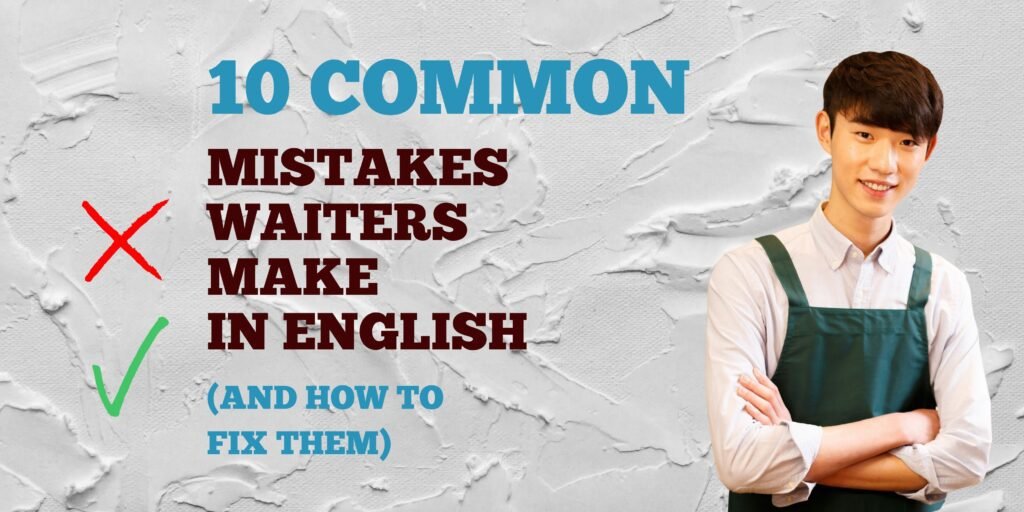
These 10 common mistakes waiters make in English are small, but guests notice them. The good news: each one is easy to fix.
For every mistake, you get the right phrase to say instead. Tap 🔊 to hear each one.
Want to practise this with video? See the English for Waiters course →
Why these mistakes happen: translation
Most of these mistakes come from your first language. You think of the sentence in your language, then translate it word by word.
The result is correct words in the wrong shape: “You want water?” or “Good night!” when guests arrive. Learn the whole English phrase as one piece, and the problem goes away.

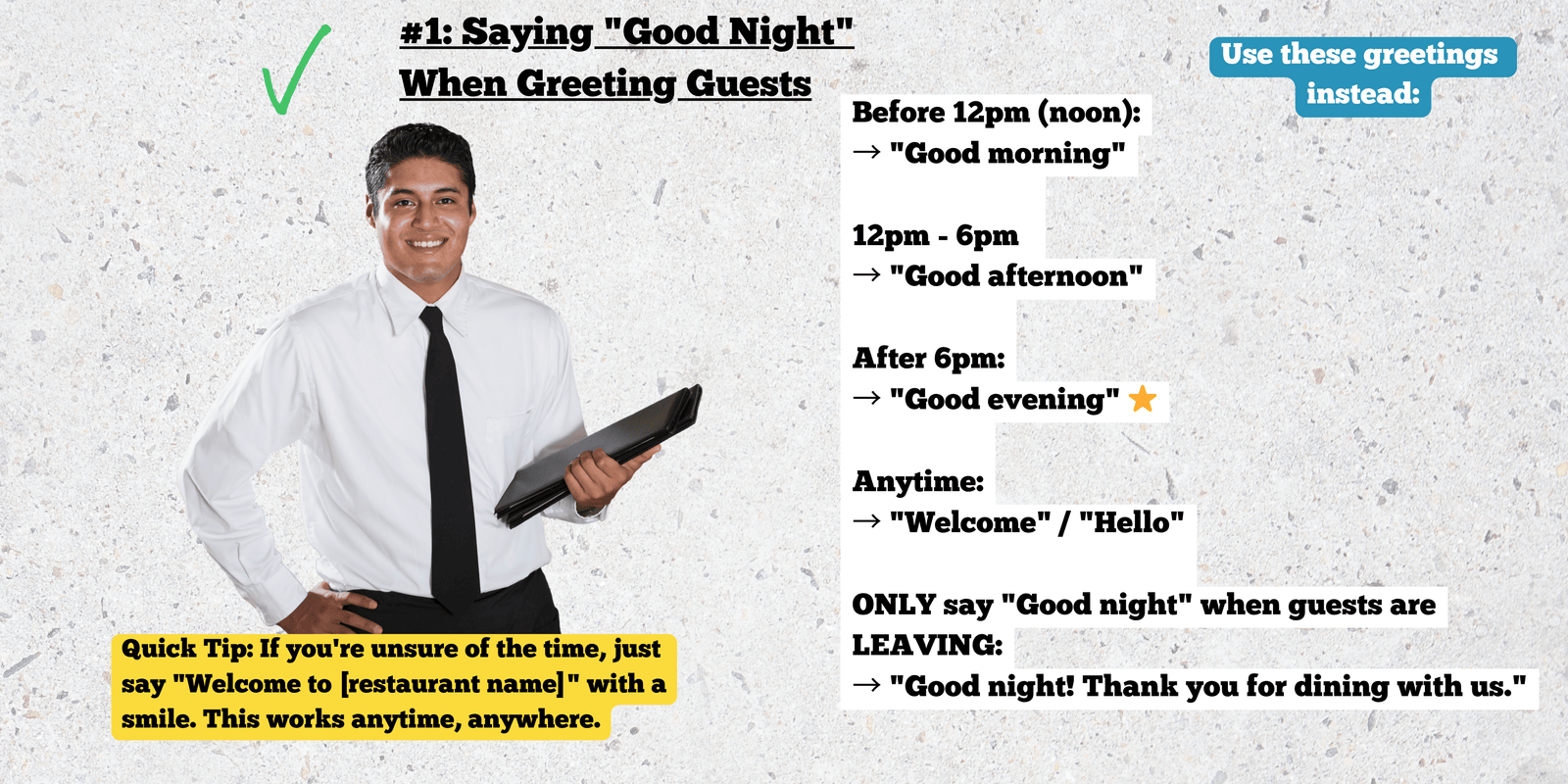
Mistake 1: “Good night” as a hello
In English, “good night” only means goodbye, or “sleep well”. When guests arrive in the evening, say “good evening”.
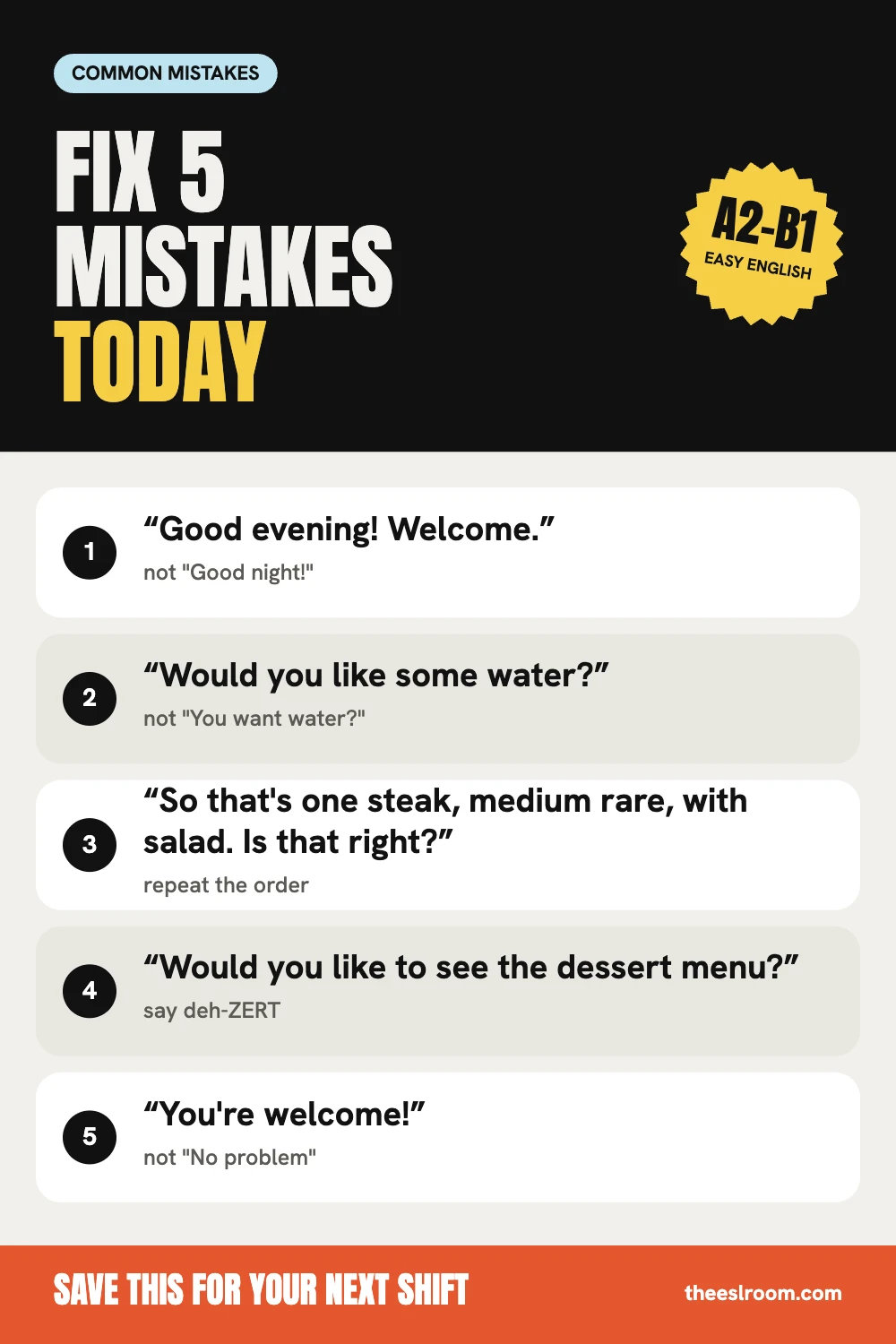
“Good evening! Welcome.”
For guests arriving after about 6 pm.
“Hello! How are you today?”
Safe at any time of day.
Mistake 2: “You want…?”
“You want water?” sounds rude in English, even with a smile.
“Would you like some water?”
The polite form. Works in every restaurant.
“Can I get you something to drink?”
Friendly and polite.
Mistake 3: Not repeating the order
“So that’s one steak, medium rare, with salad. Is that right?”
Say the order back every time. It stops kitchen mistakes.
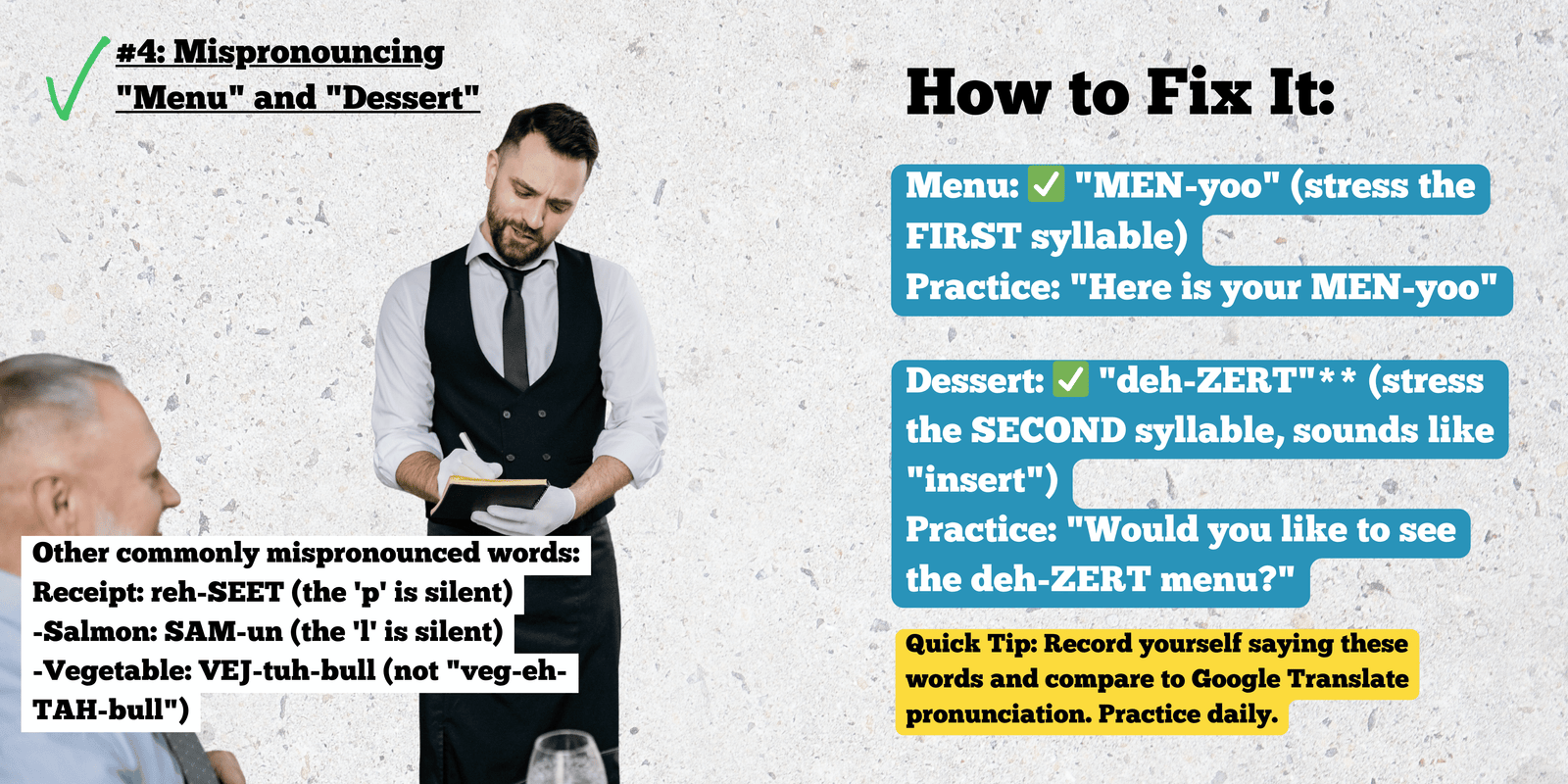
Mistake 4: Saying “menu” and “dessert” wrong
“Menu” = MEN-yoo. “Dessert” = deh-ZERT (stress at the end). A desert (DEZ-ert) is a hot, sandy place!
“Here’s the menu.”
MEN-yoo.
“Would you like to see the dessert menu?”
deh-ZERT. Tap 🔊 and copy it.
Mistake 5: Sounding too direct
“Wait here” or “Give me your order” sound like commands. Add a soft start.
“Could you wait here for just a moment, please?”
Instead of “Wait here.”
“Whenever you’re ready, I can take your order.”
Instead of “Give me your order.”
Mistake 6: Getting defensive about complaints
“I’m so sorry about that. Let me fix it right away.”
Never say “It’s not my fault.” Say sorry, fix it, check back.
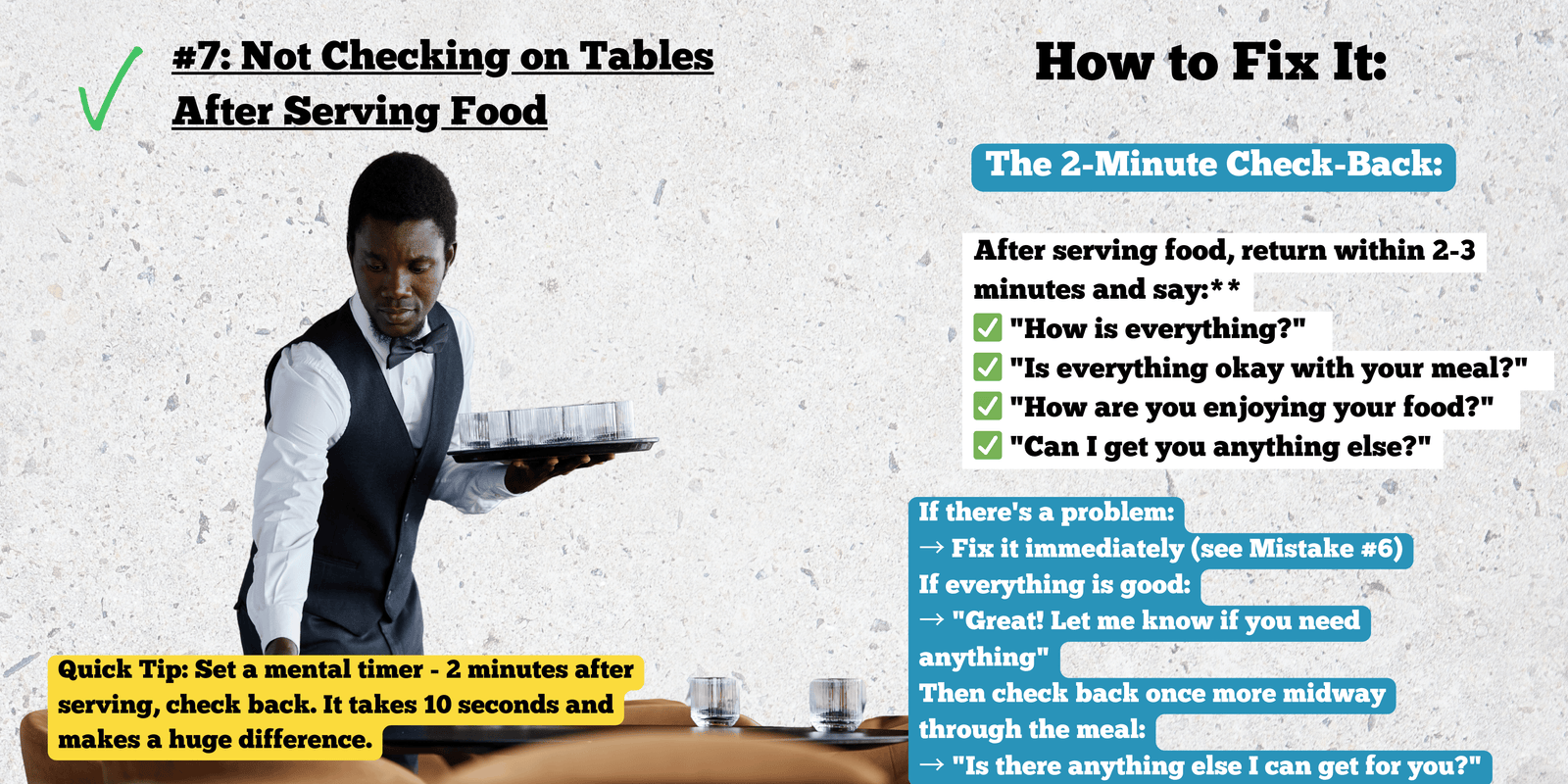
Mistake 7: Not checking back
“How is everything tasting?”
Come back about two minutes after the food arrives. Small problems are easy to fix early.
Mistake 8: Pushy upselling
“Can I tempt you with dessert? The tiramisu is homemade.”
Name one dish and give one reason. Not “You should get dessert.”
Mistake 9: Slang in the wrong place
“Hey guys!”, “Yep” and “Cool” are fine in a casual café. In a nice restaurant, they sound unprofessional.
“Certainly. I’ll bring that right away.”
Instead of “Yep, cool.”
Mistake 10: “No problem” instead of “You’re welcome”
“No problem” is common, but some guests (often older ones) don’t like it. It suggests the request could have been a problem.
“You’re welcome!”
Always safe.
“My pleasure.”
Warm and a little more formal.
Save this card and look at it before your next shift. On Pinterest? Pin it so you can find it fast.
10 common mistakes waiters make in English: example dialogue
Waiter: Good evening! Welcome. Can I get you something to drink?
Guest: Two sparkling waters, please.
Waiter: Of course. Whenever you’re ready, I can take your order.
Guest: I’ll have the steak, medium rare, with salad.
Waiter: So that’s one steak, medium rare, with salad. Is that right?
Guest: That’s right. Thank you.
Waiter: You’re welcome!
Seven lines, and none of the 10 mistakes. That’s what guests hear as “professional”.
Learn 100+ phrases like these.
Short video lessons for waiters. Self-paced. $19.99, one payment.
Get the course →Common mistakes: quick list

Quick quiz
1. Guests arrive at 8 pm. You say…
“Good night” only means goodbye in English.
2. Which is polite?
“Would you like” is the polite form waiters use.
3. A guest says “Thank you!” The safest answer is…
“You’re welcome” is polite with every guest.
FAQ
What are the most common English mistakes waiters make?
Saying “good night” as a hello, “you want…?” instead of “would you like…?”, and not repeating the order back.
How do you pronounce “dessert”?
Say deh-ZERT, with the stress at the end. DEZ-ert is a “desert”, a hot, sandy place.
Is “no problem” rude?
Not really, but some guests don’t like it. “You’re welcome” or “My pleasure” are always safe.
Related guides
- 10 things you should never say to a restaurant guest
- Formal vs casual restaurant English
- Taking orders script: 12 phrases waiters can use
Ready to Go Further?
Ready to Master Restaurant English?
These free articles and scenarios are a great start, but if you want a complete, structured system for learning restaurant English, consider our full course.
English for Waiters includes:
✅ 22+ video lessons covering every restaurant situation
✅ Real restaurant scenarios with native pronunciation
✅ Interactive pronunciation practice
✅ Downloadable phrase guides
✅ Lifetime access with free updates