
Introduction
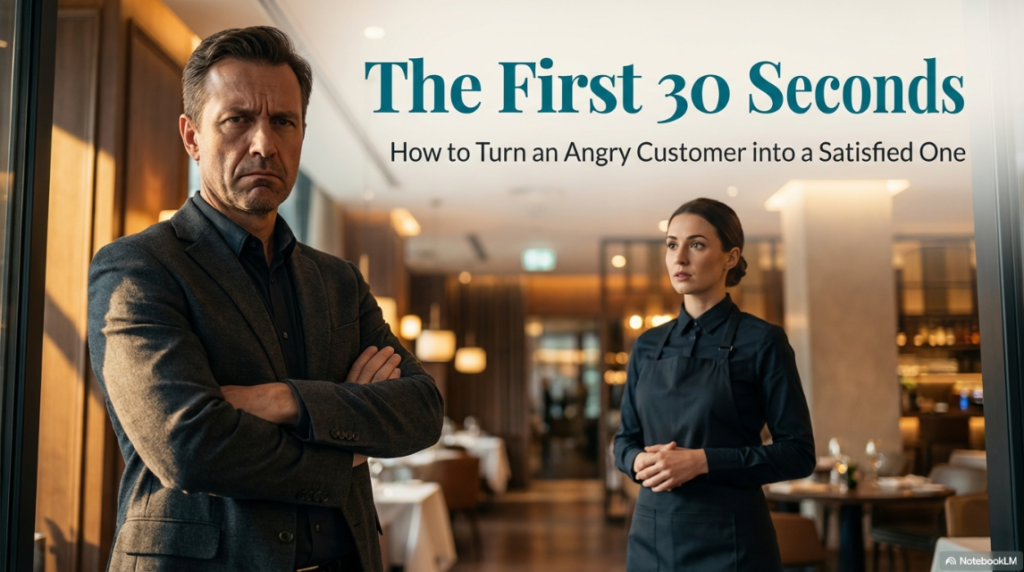
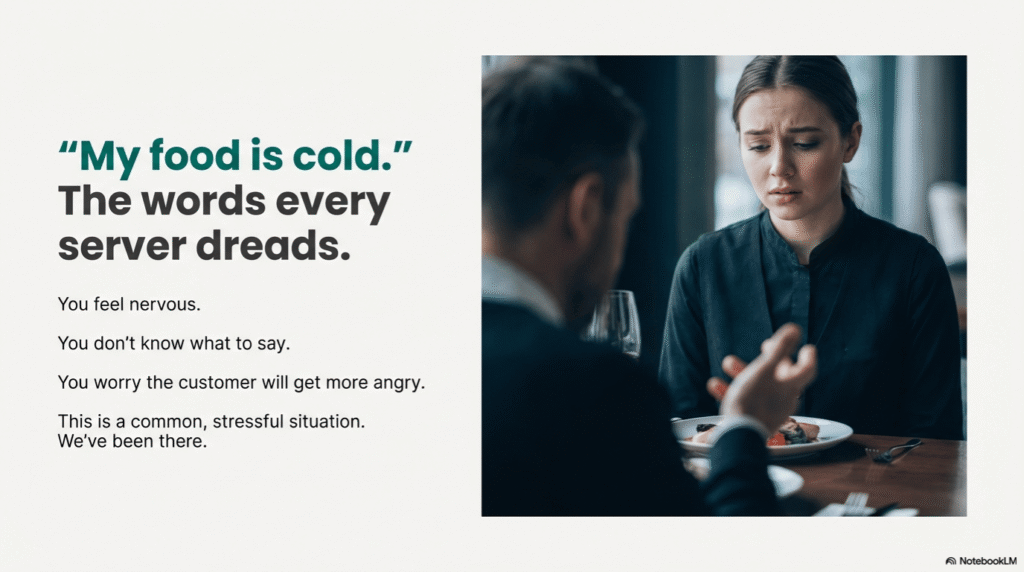
Maria is a waiter in a busy London restaurant. Last night, a customer was angry. His food was cold.
Maria felt nervous. English is not her first language. She didn’t know what to say.
She said: “It’s not my fault. The kitchen is busy.”
The customer got more angry. He asked to speak to the manager. Maria felt terrible.
Maria is not alone. In fact, 96% of unhappy customers don’t complain – they just leave and never return. When customers DO complain, it’s actually a gift – they’re giving you a chance to fix the problem.
This happens to many waiters.
When you work in a restaurant, complaints happen. Food gets cold. Orders are wrong. Service is slow.
These situations are stressful for everyone. They are even MORE stressful when English is not your first language.
You worry about:
- Saying the wrong thing
- Making the customer more angry
- Losing your tip
- Getting in trouble with your manager
But here’s the good news:
Handling complaints in English is NOT difficult. You don’t need perfect English. You need the right phrases and the right method.
In this guide, you will learn:
- A simple 3-step method to handle ANY complaint
- The exact English phrases to use
- Real examples from restaurant situations
- Common mistakes to avoid
Let’s start.
Why Handling Complaints is Hard (And Why Most Waiters Do It Wrong)
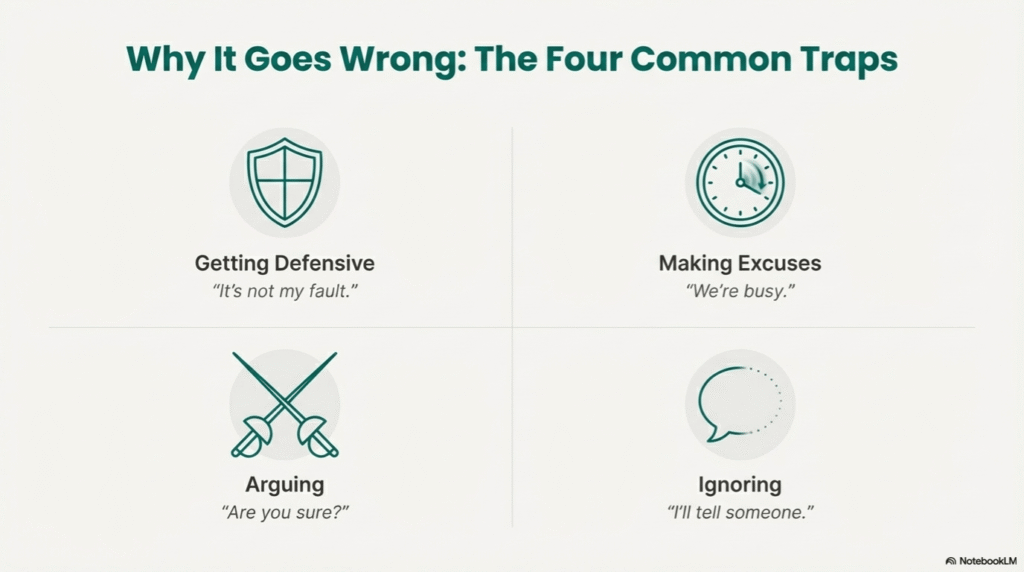
The Common Mistakes
Many waiters make the same mistakes when customers complain:
❌ Mistake 1: Getting defensive
- “It’s not my fault”
- “The kitchen is busy”
- “You ordered this”
❌ Mistake 2: Making excuses
- “We’re understaffed today”
- “It’s always like this on Fridays”
- “The chef is new”
❌ Mistake 3: Arguing
- “But you said…”
- “Are you sure?”
- “That’s impossible”
❌ Mistake 4: Ignoring the problem
- “I’ll tell someone”
- Walking away quickly
- Hoping they forget about it
Why these don’t work:
When customers complain, they want three things:
- Someone to listen to them
- Someone to understand their problem
- Someone to fix the problem
When you get defensive or make excuses, you give them NONE of these things. Here’s a shocking fact: For every complaint you hear, there are 26 other unhappy customers who said nothing. This means every complaint is a chance to fix a problem that affects many customers.
The customer feels:
- Not heard
- Not important
- More angry
There is a better way.
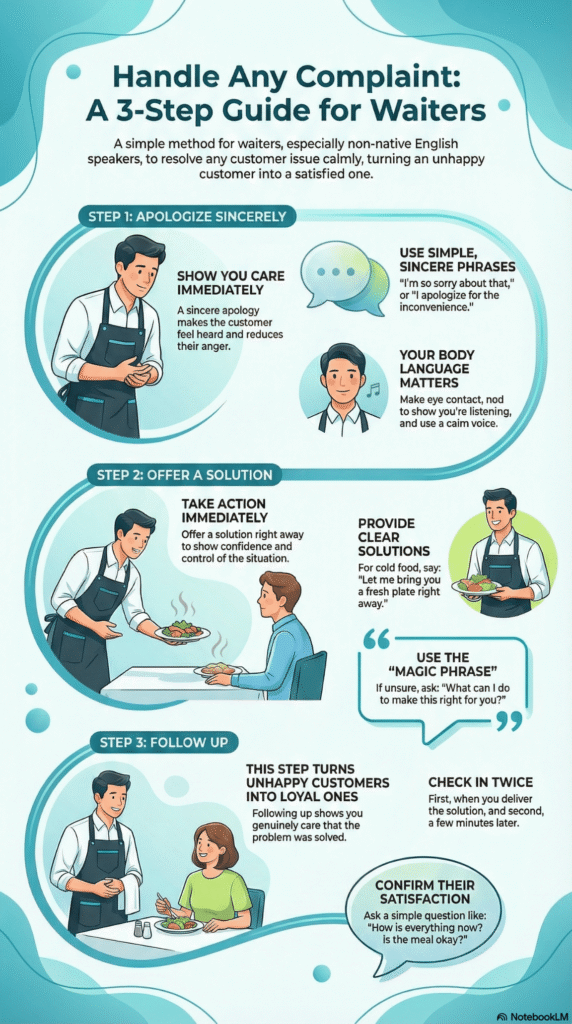
The 3-Step Method to Handle Any Complaint
This method works for ALL complaints:
- Cold food
- Wrong orders
- Slow service
- Rude staff
- Bad quality
- Anything
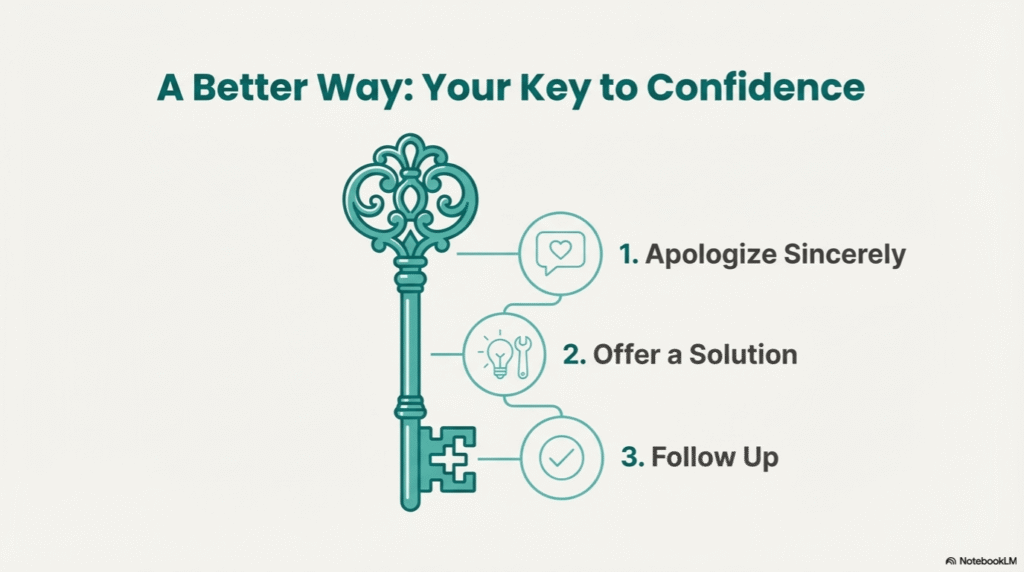
The three steps are:
- Apologize sincerely
- Offer a solution
- Follow up
Let’s learn each step.
Step 1: Apologize Sincerely
Why This Works
An apology does three important things:
- Shows you care about the customer
- Makes the customer feel heard
- Reduces their anger immediately
Important: Your apology must be SINCERE. Customers know when you don’t mean it.
The Right Phrases to Use
For any complaint:
- “I’m so sorry about that.”
- “I apologize for the inconvenience.”
- “I’m really sorry this happened.”
For specific situations:
Cold food:
- “I’m so sorry your food is cold. That’s not acceptable.”
Wrong order:
- “I apologize for the mix-up with your order.”
Long wait:
- “I’m really sorry about the wait. I know it’s frustrating.”
Bad quality:
- “I’m so sorry the food wasn’t up to standard.”
What NOT to Say
❌ “I’m sorry, but…” (Never use “but” after an apology – it sounds like an excuse)
❌ “Sorry, we’re really busy” (This is an excuse, not an apology)
❌ “Oh, okay” (This is not an apology at all)
Body Language Tips
Your words are important. Your body language is ALSO important.
Do this:
- ✅ Make eye contact
- ✅ Stand still and listen
- ✅ Nod to show you understand
- ✅ Use a calm, quiet voice
- ✅ Look concerned (not bored)
Don’t do this:
- ❌ Look at your phone
- ❌ Look away or roll your eyes
- ❌ Cross your arms
- ❌ Speak loudly
- ❌ Smile (this looks like you don’t care)
Example Dialogue
Customer: “Excuse me, this steak is completely cold!”
Waiter (OLD WAY – WRONG): “Oh, really? It just came from the kitchen. Are you sure?”
Waiter (NEW WAY – RIGHT): “I’m so sorry about that. A cold steak is not acceptable. Let me fix this for you right away.”
See the difference?
The first waiter argues. The customer gets more angry.
The second waiter apologizes sincerely. The customer feels heard.
Step 2: Offer a Solution
Why This Works
After you apologize, the customer wants to know: “What are you going to do about it?”
This is where you offer a solution.
Important: Offer a solution IMMEDIATELY. Don’t say “I’ll ask my manager” unless you really need to.
Customers want YOU to solve the problem. When you offer a solution quickly, you look confident and professional.
Speed matters. Hotels that respond to complaints within 24 hours see significantly better guest satisfaction scores. Don’t wait – act immediately.
Solutions for Common Complaints
Cold food:
- “Let me bring you a fresh plate right away.”
- “I’ll have the kitchen remake this for you immediately.”
- “Would you like me to heat this up, or would you prefer something else?”
Wrong order:
- “I’ll bring your correct order right away.”
- “Let me fix this immediately. Would you like to keep this dish while you wait?”
- “I’ll get your [correct dish] for you now.”
Long wait time:
- “Your food will be ready in 5 minutes. Can I bring you some bread while you wait?”
- “Let me check with the kitchen right now and get you an exact time.”
- “I’ll bring your drinks on the house while you wait.”
Poor quality food:
- “This isn’t good enough. Let me bring you something else.”
- “Would you like to try a different dish? This one is on us.”
- “I can have the chef prepare this again, or you can choose something else.”
Rude staff:
- “That’s not acceptable. I’m very sorry. Let me get the manager for you.”
- “I apologize for my colleague’s behavior. That’s not how we treat guests.”
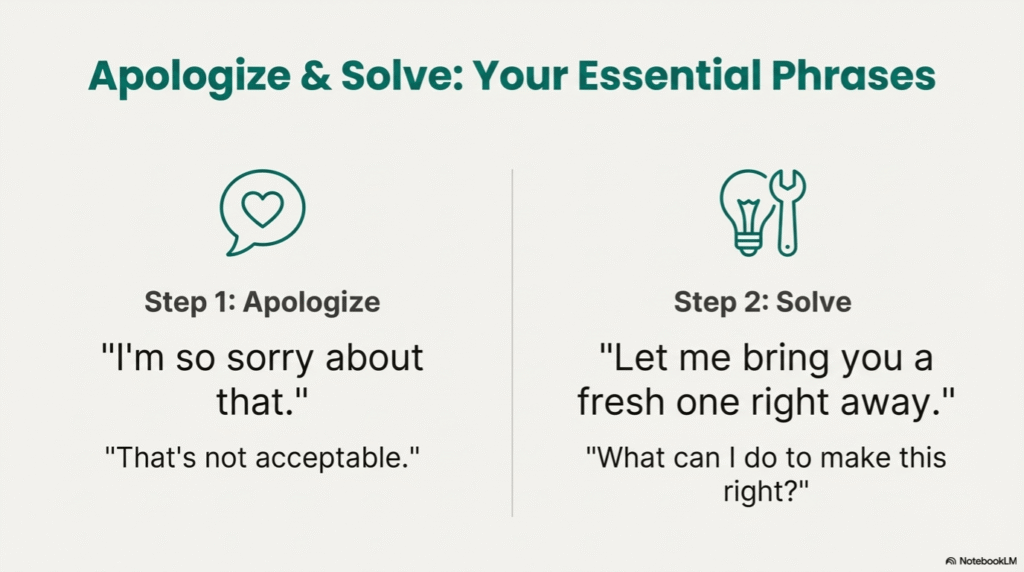
The Magic Phrase: “What can I do to make this right?”
If you’re not sure what to offer, ask this question:
“I’m so sorry about this. What can I do to make this right for you?”
This phrase:
- Shows you care
- Gives the customer control
- Often leads to a simple solution
Most customers will ask for something reasonable:
- “Just bring me a new one”
- “Can we get some free drinks?”
- “Just take it off the bill”
When to Get Your Manager
Sometimes you SHOULD get your manager:
Get your manager if:
- The customer wants money back
- The customer is extremely angry
- You don’t have authority to solve it
- The complaint is about another staff member
- You’re not sure what to do
How to say it:
- “Let me get my manager for you. They can help with this.”
- “I’d like to get my manager involved to make sure we solve this properly.”
Don’t say:
- ❌ “That’s not my problem”
- ❌ “I can’t do anything about it”
- ❌ “You’ll have to talk to my manager”
Example Dialogues
Example 1: Cold Food
Customer: “This soup is cold.”
Waiter: “I’m so sorry about that. Let me bring you a fresh, hot bowl right away. It will be ready in 2 minutes.”
Customer: “Thank you.”
Example 2: Wrong Order
Customer: “I ordered the chicken, not the fish.”
Waiter: “I apologize for the mix-up. I’ll bring your chicken right away. Would you like to keep the fish while you wait, or shall I take it back?”
Customer: “Just bring the chicken, please.”
Waiter: “Of course. It will be 5 minutes.”
Example 3: Long Wait
Customer: “We’ve been waiting 30 minutes for our food!”
Waiter: “I’m really sorry about the wait. That’s too long. Let me check with the kitchen right now.”
(Waiter checks with kitchen)
Waiter: “Your food will be ready in 3 minutes. Can I bring you some complimentary bread and olives while you wait?”
Customer: “Okay, thank you.”
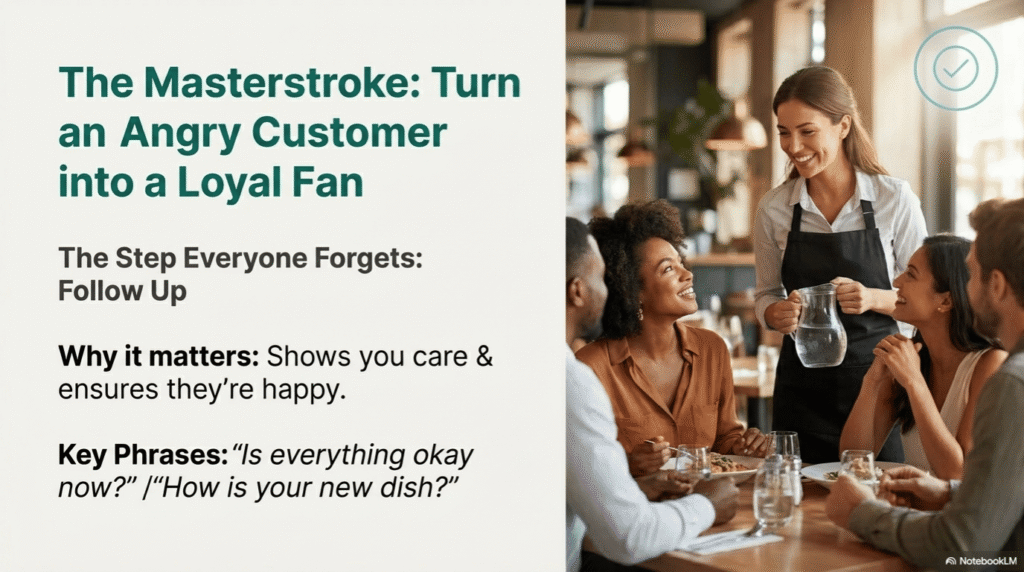
Step 3: Follow Up
Why This Works
Most waiters forget this step. This is a BIG mistake.
Following up shows:
- You care about the customer
- You want to make sure they’re happy
- You’re professional
This step often turns an angry customer into a happy customer.
When to Follow Up
Follow up twice:
First follow-up: When you bring the solution
- “Here’s your fresh steak. Is everything okay now?”
- “Here’s your correct order. Is this what you wanted?”
Second follow-up: A few minutes later
- “How is everything now? Is the steak cooked properly?”
- “Is everything okay with your meal?”
The Right Phrases
When bringing the solution:
- “Here’s your [item]. I made sure it’s perfect.”
- “This is much better. Please let me know if you need anything else.”
- “Is this okay for you?”
A few minutes later:
- “How is everything now?”
- “Is your meal okay?”
- “Are you happy with everything?”
- “Can I get you anything else?”
What to Do If They’re Still Unhappy
Sometimes the customer is STILL not happy. This is rare, but it happens.
If they’re still unhappy:
- Apologize again
- Get your manager
- Stay calm and professional
Say this:
- “I’m very sorry we couldn’t solve this for you. Let me get my manager right away.”
Don’t say:
- ❌ “I already fixed it, what more do you want?”
- ❌ “There’s nothing else I can do”
- ❌ Show frustration
Example Dialogue – Full Process
Let’s see all three steps together:
Customer: “This pasta is cold and the sauce tastes strange.”
Step 1: Apologize Waiter: “I’m so sorry about that. That’s not acceptable at all.”
Step 2: Offer Solution Waiter: “Let me bring you a fresh plate right away. Would you like the same dish, or would you prefer to try something else?”
Customer: “The same dish is fine.”
Waiter: “Perfect. I’ll make sure the kitchen prepares it properly. It will be 5 minutes.”
(5 minutes later – brings new dish)
First Follow-up: Waiter: “Here’s your pasta. I made sure it’s fresh and hot. Is this better?”
Customer: “Yes, this looks much better. Thank you.”
(3 minutes later)
Second Follow-up: Waiter: “How is your pasta now? Is everything okay?”
Customer: “Yes, it’s delicious now. Thank you for taking care of it.”
Waiter: “I’m glad we could fix it for you. Enjoy your meal!”
Result: Happy customer. Good tip. No manager needed.
Common Complaint Situations: Full Scripts
Here are complete scripts for the most common complaints:
Situation 1: Food is Cold
Customer: “This is cold.”
You: “I’m so sorry about that. Let me bring you a fresh, hot plate right away.”
(Bring new plate)
You: “Here you go. This is much better. Please let me know if you need anything else.”
(2 minutes later)
You: “How is everything now?”
Situation 2: Wrong Order
Customer: “I ordered the salmon, not the chicken.”
You: “I apologize for the mix-up. I’ll bring your salmon right away. Would you like to keep this while you wait?”
Customer: “No, just bring the salmon.”
You: “Of course. It will be ready in 5 minutes.”
(Bring correct order)
You: “Here’s your salmon. I’m sorry about the confusion earlier.”
(3 minutes later)
You: “Is the salmon okay?”
Situation 3: Food Quality is Poor
Customer: “This doesn’t taste right. The chicken is dry.”
You: “I’m sorry to hear that. This isn’t up to our standard. Would you like me to bring you something else? We have a delicious grilled salmon, or I can have the kitchen prepare the chicken differently.”
Customer: “I’ll try the salmon.”
You: “Great choice. I’ll have it ready in 8 minutes. This is on us.”
(Bring salmon)
You: “Here’s your salmon. I hope this is better.”
(A few minutes later)
You: “How’s the salmon?”
Situation 4: Service is Too Slow
Customer: “We’ve been waiting 40 minutes!”
You: “I’m really sorry about the long wait. That’s not acceptable. Let me check with the kitchen right now.”
(Check with kitchen)
You: “Your food is almost ready. It will be 2 more minutes. Can I bring you some complimentary drinks while you wait?”
Customer: “Okay.”
(Bring food)
You: “Here’s your meal. Again, I apologize for the wait. Please enjoy.”
(Later)
You: “How is everything? I hope the food was worth the wait.”
Situation 5: Hair in Food (Serious Complaint)
Customer: “There’s a hair in my food!”
You: “I’m extremely sorry about that. That’s completely unacceptable. Let me get you a fresh meal immediately and speak to my manager.”
(Get manager, bring new meal)
You: “Here’s your new meal. This is on the house, and we’ve added a complimentary dessert. I’m very sorry this happened.”
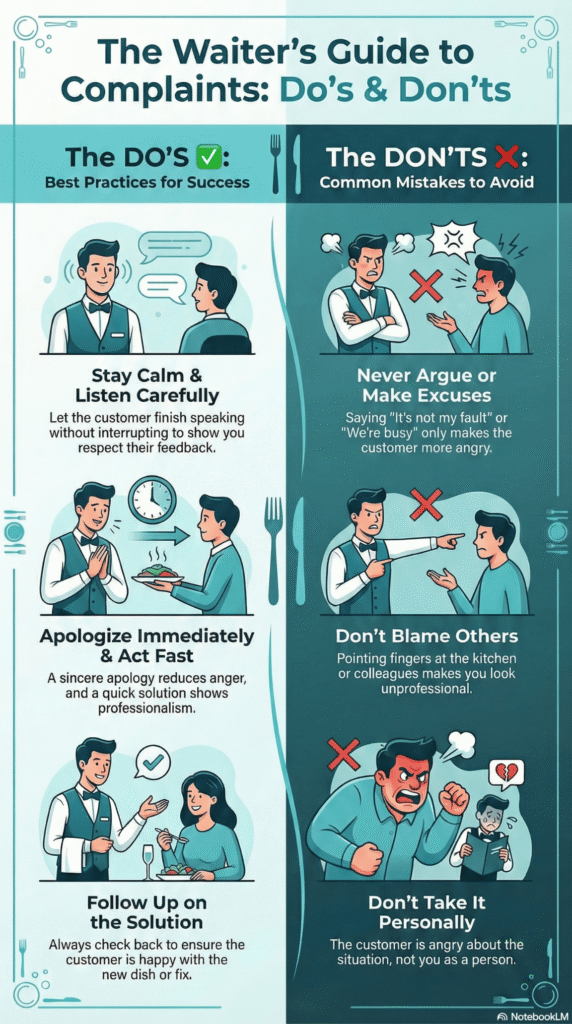
Important Tips to Remember
Do’s ✅
- Stay calm – Don’t panic or get emotional
- Listen carefully – Let the customer finish speaking
- Apologize immediately – Don’t wait or hesitate
- Act fast – Fix the problem quickly
- Follow up – Check they’re happy with the solution
- Be professional – Even if the customer is rude
- Tell your manager – Keep them informed about complaints
Don’ts ❌
- Don’t argue – Never say the customer is wrong
- Don’t make excuses – The customer doesn’t care why it happened
- Don’t blame others – “The kitchen…” “My colleague…”
- Don’t ignore it – Hoping they forget makes it worse
- Don’t take it personally – They’re not angry at YOU, they’re angry at the situation
- Don’t promise what you can’t deliver – Only offer solutions you can actually provide
- Don’t gossip – Don’t talk about the complaint with other customers or staff
Cultural Differences in Handling Complaints
Different cultures handle complaints differently. Understanding this helps you serve customers better.
British Customers
British customers are often very polite when they complain.
They might say:
- “This is a bit cold, if you don’t mind…”
- “I hate to bother you, but…”
- “Sorry to trouble you…”
What to do:
- Don’t think it’s not important because they’re polite
- Respond quickly and seriously
- Match their politeness
American Customers
American customers are usually more direct about complaints.
They might say:
- “This is cold.”
- “This isn’t what I ordered.”
- “We’ve been waiting too long.”
What to do:
- Don’t think they’re rude – this is normal in American culture
- Respond quickly and confidently
- Be friendly and solution-focused
European Customers
European customers have different expectations in different countries.
What to do:
- Be professional and respectful
- Solve the problem quickly
- Don’t be too casual or too formal
Asian Customers
Asian customers might not complain directly.
They might:
- Look unhappy but not say anything
- Leave most of their food
- Ask for the bill early
What to do:
- Check on them regularly
- If they look unhappy, ask: “Is everything okay?”
- Make it easy for them to tell you if something is wrong
Remember: Every customer is different. These are general patterns, not rules.
How to Practice These Skills
Practice at Home
Method 1: Script Practice
Write out the three steps for each complaint situation. Practice saying them out loud.
Example:
- Cold food: “I’m so sorry…” → “Let me bring…” → “How is it now?”
Method 2: Mirror Practice
Stand in front of a mirror. Practice your:
- Facial expressions (concerned, not smiling)
- Body language (open, not defensive)
- Tone of voice (calm, sincere)
Method 3: Role-Play with Friends
Ask a friend to pretend to be an angry customer. Practice the 3 steps:
- Apologize
- Offer solution
- Follow up
Do this 5-10 times. It becomes natural.
Practice at Work
Start Small
When you get a small complaint (cold coffee, no napkins), use the 3-step method.
It’s easier to practice on small problems. Then you’re ready for big problems.
Learn from Others
Watch experienced waiters handle complaints. Notice:
- What phrases they use
- How they stay calm
- What solutions they offer
Ask for Feedback
After handling a complaint, ask your manager:
- “Did I handle that okay?”
- “What could I do better?”
What If Your English Isn’t Perfect?
Good news: You don’t need perfect English to handle complaints well.
You need:
- The right phrases (you now have them)
- A calm attitude
- A sincere apology
If you forget a word or make a grammar mistake, it’s okay.
Customers care more about:
- Do you care about their problem?
- Are you trying to help?
- Are you polite and professional?
Your accent doesn’t matter. Your attitude does.
The Results: What Happens When You Do This Well
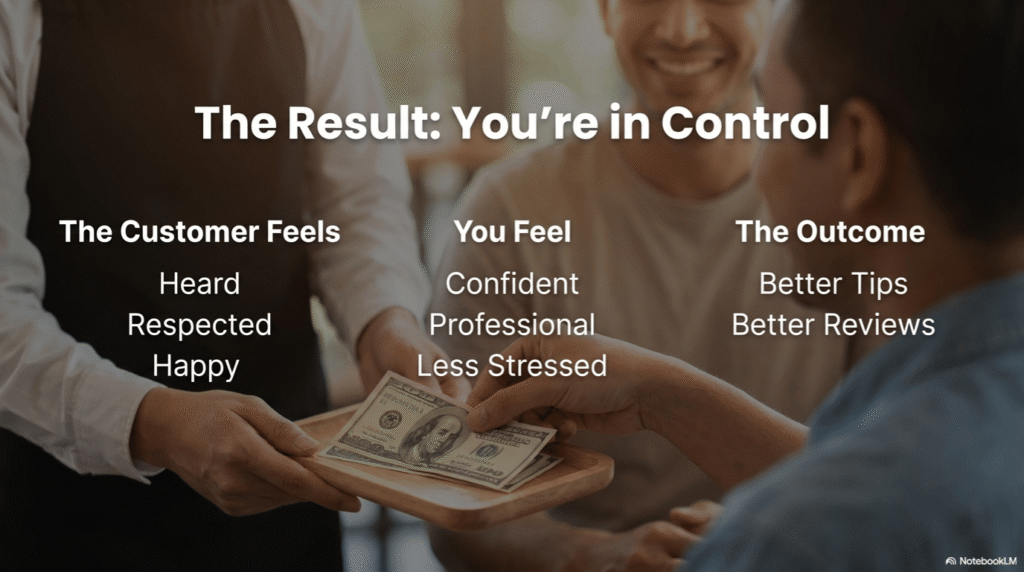
When you handle complaints using this method: Research shows that effective complaint handling actually increases customer loyalty. Harvard Business Review found that customers who complained and received a good response were more loyal than customers who never complained.
For the Customer
- They feel heard and respected
- Their problem gets solved quickly
- They leave happy (not angry)
- They often leave good reviews
- They come back to the restaurant
For You
- Less stress and anxiety
- Better tips (even after complaints!)
- Confidence in your English skills
- Respect from your manager
- Better job security
For the Restaurant
- Happy customers
- Good reputation
- More business
- Less staff turnover
One complaint handled well can turn an angry customer into a loyal customer.
Common Questions
Q: What if the customer is still angry after I apologize?
A: Stay calm. Repeat your apology and solution. If they’re still angry, get your manager. Some people need to vent their frustration. Let them speak, listen, and stay professional.
Q: What if I can’t understand the customer’s complaint because of their accent?
A: Say politely: “I’m sorry, I want to help you. Could you please repeat that?” Most customers will be patient if you’re trying to help.
Q: What if the complaint is about me personally?
A: Don’t get defensive. Apologize and try to fix it. If it’s serious, get your manager. Example: “I’m sorry if I seemed rude. That wasn’t my intention. Let me get my manager.”
Q: What if I think the customer is lying or trying to get free food?
A: It’s not your job to decide if they’re lying. Treat every complaint as real. Your manager can make decisions about free food. Your job is to be polite and helpful.
Q: Should I offer free food or drinks?
A: This depends on your restaurant’s policy. Ask your manager what you’re allowed to offer. Common options:
- Free drinks
- Free dessert
- Discount on the bill Usually, you can offer small things (bread, coffee) without asking.
Conclusion: You Can Do This
Handling complaints in English is a skill. Like all skills, you can learn it.
You don’t need:
- Perfect English
- Perfect accent
- Years of experience
You need:
- ✅ A simple method (you now have it)
- ✅ The right phrases (you now know them)
- ✅ A calm, professional attitude
- ✅ Practice
Remember the 3 steps:
- Apologize sincerely
- Offer a solution
- Follow up
Use these steps every time. Soon, it becomes automatic.
The next time a customer complains:
- Take a deep breath
- Stay calm
- Follow the 3 steps
- You’ve got this
Ready to Master Restaurant English?
Handling complaints is just ONE skill you need as a waiter.
What about:
- Taking orders confidently?
- Describing food professionally?
- Making small talk with customers?
- Handling payment and tips?
- Understanding different accents?
My complete English for Waiters course covers ALL of these situations.
You get:
- ✅ 22 video lessons with real restaurant scenarios
- ✅ Complete phrase guide (60+ pages)
- ✅ Pronunciation coaching
- ✅ Practice dialogues for every situation
- ✅ Free 1-on-1 coaching session with me
- ✅ Certificate of completion
- ✅ 30-day money-back guarantee
Price: $67 (one-time payment, lifetime access)
Hundreds of waiters have used this course to:
- Feel more confident at work
- Communicate better with customers
- Earn bigger tips
- Get promoted faster
Check out the English for Waiters course here →
What to Do Next
- Save this guide – Bookmark this page or print it out
- Practice the phrases – Say them out loud 5-10 times
- Use it at work – Try the 3-step method on your next shift
- Share this guide – Help other waiters who struggle with complaints
Questions? Comments?
Leave a comment below or email me at: dan@theeslroom.com
I read every message and I’m here to help.
About The ESL Room
We help hospitality workers master practical English for real-world success. No boring grammar rules. No textbook exercises. Just the language you actually need to excel in restaurants, hotels, and cafes.
Visit: theeslroom.com Follow: @theeslroom on Instagram, TikTok, and Facebook
Related Posts:
- 10 Common Mistakes Waiters Make in English (And How to Fix Them)
- How to Describe Food Like a Professional Waiter: 20 Adjectives You Need
- 20 Upselling Phrases Waiters Can Use (That Don’t Sound Pushy)