Knowing how to say no to a customer politely is a big skill. A hard “no” can make a guest feel unwelcome.
The restaurant is full. The salmon is gone. The kitchen is closed. Here are 12 easy phrases for these moments. Tap 🔊 to hear each one.
Want to practise this with video? See the English for Waiters course →
The rule: every “no” needs a “can”
Guests don’t remember the “no”. They remember what came next.
So use three small steps: Sorry + No + Can.
Sorry: “I’m sorry…” or “I’m afraid…”
No: say the problem in a few words. No long excuses.
Can: say what you can do. Then ask a question.
Why the question? Because now the guest’s next word is often “yes”. You end on a yes, not a no.
Example: “I’m sorry, we’re fully booked at eight. I can offer you nine fifteen. Would that work?”
When you’re fully booked
Fully booked = every table has a reservation.
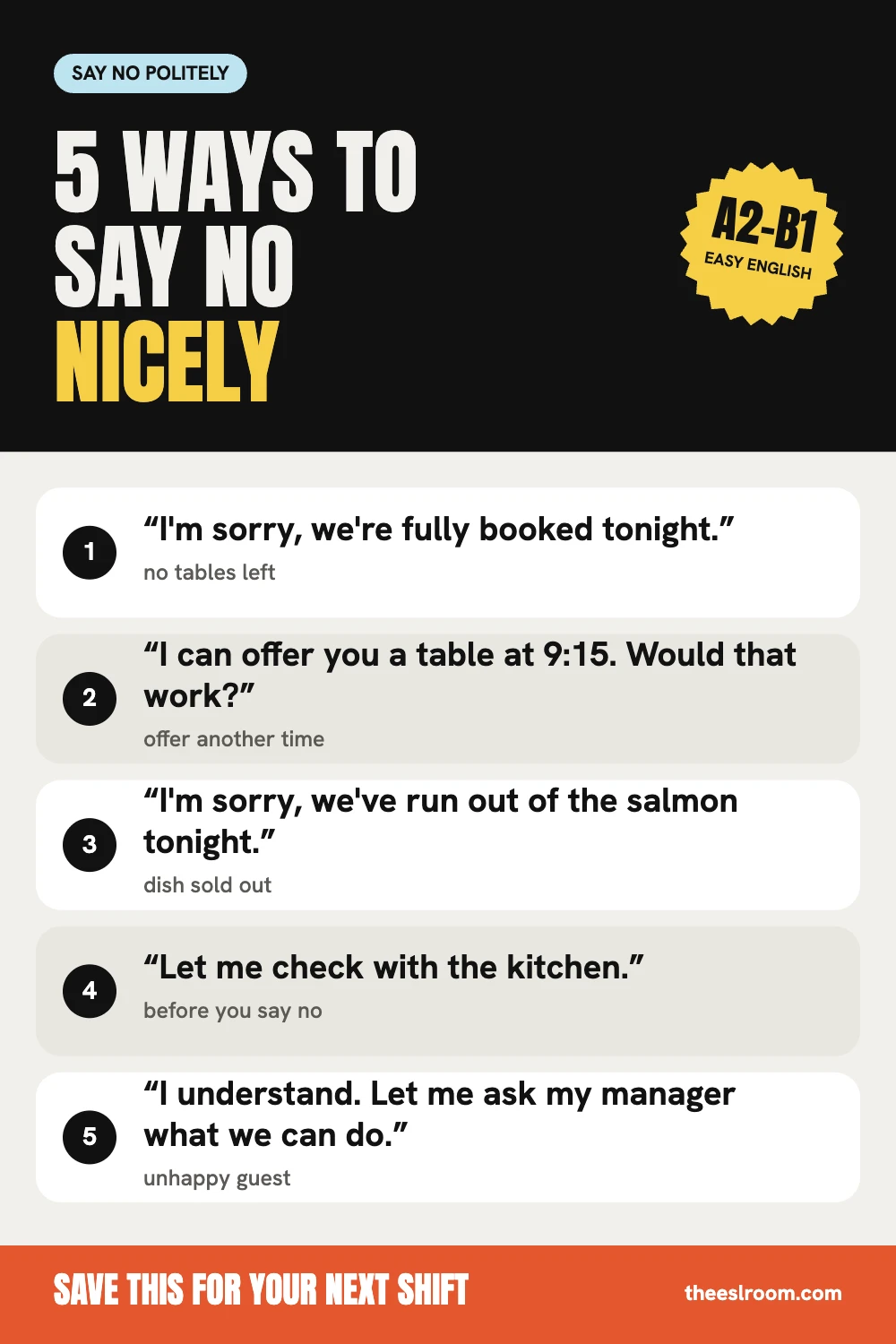
“I’m sorry, we’re fully booked tonight.”
Step one. Short and clear. Don’t stop here!
“I can offer you a table at 9:15. Would that work?”
Give a different time. The question makes it easy to say yes.
“I can put your name on the waiting list and call you if a table opens up.”
For guests who really want tonight. Never promise a table.
“Would you like to book for another night?”
When tonight is impossible. Take the booking now.
When something is not available
“I’m sorry, we’ve run out of the salmon tonight.”
Run out of = there is none left. Sounds natural and calm.
“The sea bass is very similar. Would you like to try that?”
Always follow with a close option from the menu.
“I’m afraid the kitchen is closed, but we still have desserts and drinks.”
Late at night. Offer what is still open.
“We don’t serve cocktails, I’m afraid, but we have a great wine list.”
When a guest asks for something you never have.
When you can’t change the rules
“Let me check with the kitchen.”
Before you say no, check. Many “no” answers become “yes”.
“I’m afraid we can’t change that dish, but you can have the sauce on the side.”
When the chef says no to a change. Offer a small change instead.
“I’m sorry, that table is reserved. Can I offer you this one by the window?”
A guest wants a table that is booked.
“I understand. Let me ask my manager what we can do.”
When the guest is not happy with your answer.
Save this card and look at it before your next shift. On Pinterest? Pin it so you can find it fast.
How to say no to a customer politely: a real dialogue
Guest: Hi! Do you have a table for four?
Waiter: Good evening! I’m sorry, we’re fully booked right now.
Guest: Oh no. We really wanted to eat here.
Waiter: I can put your name on the waiting list. It’s about forty minutes.
Guest: Hmm, that’s a bit long.
Waiter: I understand. I can also offer you a table at 9:15. Would that work?
Guest: That’s too late for us, I’m afraid.
Waiter: No problem. Would you like to book for tomorrow night instead?
Guest: Yes! Tomorrow at seven would be perfect.
Waiter: Great. May I have your name, please?
See it? Every “no” came with a “can”. The guests left with a booking.
Learn 100+ phrases like these.
Short video lessons for waiters. Self-paced. $19.99, one payment.
Get the course →Common mistakes
These come from direct translation. In English, they sound cold.
Quick quiz
1. The salmon is sold out. What do you say?
“Run out of” is natural. “It’s finished” sounds like a direct translation.
2. What should come after your “no”?
Sorry + No + Can. Always offer an option.
3. “I’m afraid we’re full.” What does it mean?
“I’m afraid” is a polite way to give bad news.
FAQ
How do you say “we’re fully booked” politely?
Say “I’m sorry, we’re fully booked tonight.” Then offer another time, the waiting list or another night.
Is “sold out” polite?
Yes. “I’m sorry, the salmon is sold out” is fine. “We’ve run out of the salmon” sounds a little softer.
Should I explain why I’m saying no?
Give a short reason, not a long story. Then say what you can do.
Related guides
- How to seat guests: a simple host script
- Phone reservations in restaurant English
- 10 things you should never say to a restaurant guest
Ready to Go Further?
Ready to Master Restaurant English?
These free articles and scenarios are a great start, but if you want a complete, structured system for learning restaurant English, consider our full course.
English for Waiters includes:
✅ 22+ video lessons covering every restaurant situation
✅ Real restaurant scenarios with native pronunciation
✅ Interactive pronunciation practice
✅ Downloadable phrase guides
✅ Lifetime access with free updates