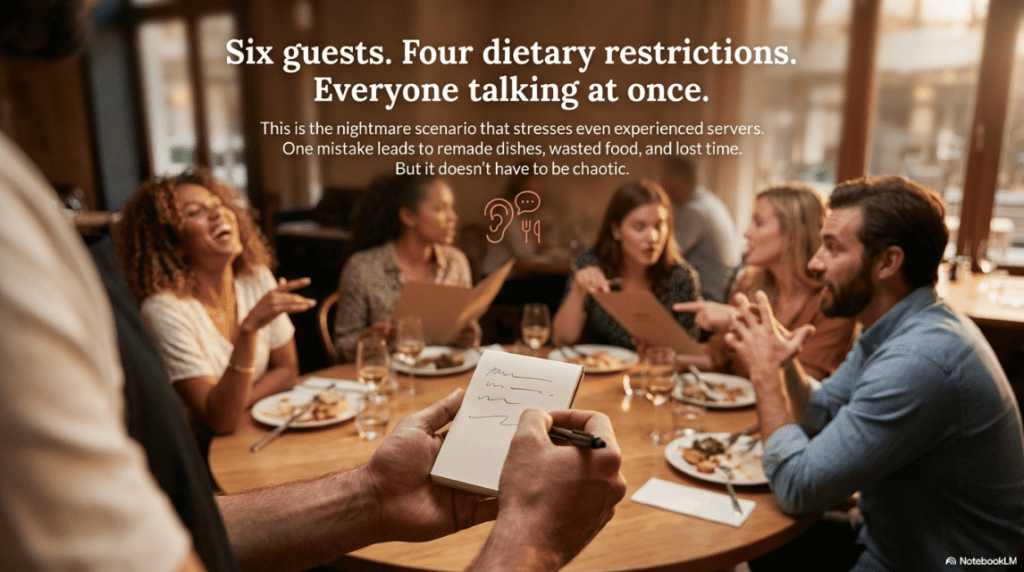
Six people. Four different dietary restrictions. Seven modifications to standard menu items. Everyone talking at once.
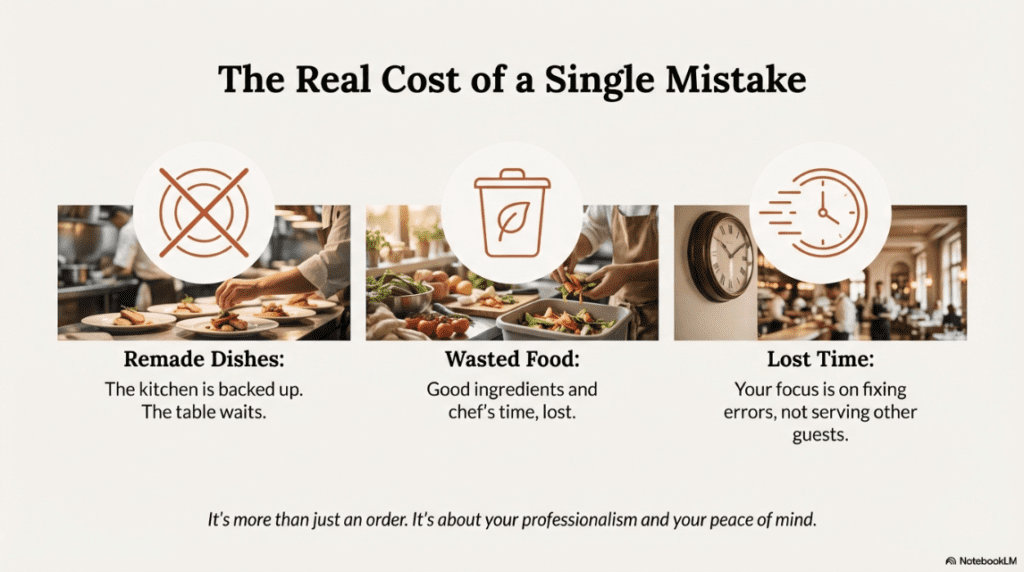
This is the nightmare scenario that makes even experienced servers feel stressed. You’re trying to remember who ordered what, who’s gluten-free, who wants no onions, and who asked for dressing on the side. One mistake and you’ll have to remake dishes, waste food, and lose valuable time during a busy shift.
But taking complex orders doesn’t have to be chaotic. Professional servers have a system. They use specific phrases that organize the chaos, confirm details, and ensure accuracy—even with the most complicated tables.
In this real restaurant scenario, you’ll learn the exact process for handling a table of six with multiple dietary needs and modifications. These are the techniques taught in professional hospitality training programs worldwide.
Prefer audio. Listen to the podcast here
The Situation
Time: 6:30 PM, Saturday evening – getting busy
Location: A booth table, six guests seated
The Challenge: Birthday celebration. The group includes vegetarians, someone gluten-free, someone dairy-free, and multiple specific requests. They’re excited, talking over each other, and not looking at their menus carefully.
Your Goal: Get everyone’s order correctly, accommodate all restrictions, keep them happy, and avoid kitchen errors.
The Complete Dialogue
Server: “Good evening everyone! I’m Sarah and I’ll be taking care of you tonight. I can see we’re celebrating—is this a special occasion?”
Guest 1 (Birthday person): “Yes! It’s my birthday!”
Server: “Wonderful! Happy birthday! We’ll make sure you have a fantastic evening. Before we start with orders, can I get everyone something to drink?”
Guest 2: “I’ll have a glass of Pinot Grigio.”
Guest 3: “Do you have any non-alcoholic options?”
Server: “Absolutely. We have fresh juices, soft drinks, and some lovely mocktails. Our passion fruit mocktail is very popular.”
Guest 3: “I’ll try that, thanks.”
Guest 4: “Water for me, please.”
Server: “Perfect. I’ll get those started for you. Just so I can serve you better tonight—does anyone have any dietary requirements I should know about? Allergies, vegetarian, vegan, anything like that?”
Guest 1: “I’m vegetarian.”
Guest 5: “I’m gluten-free—is that going to be a problem?”
Server: “Not at all! We have excellent gluten-free options. Let me grab some drinks and I’ll be right back to go through the menu with you.”
[Server returns with drinks]
Server: “Here we are. Now, are we ready to order, or would you like a few more minutes?”
Guest 2: “I think we’re ready. Can we start with some appetizers to share?”
Server: “Of course! What would you like?”
Guest 2: “Can we get the calamari and the bruschetta?”
Server: “Great choices. Just to confirm—the bruschetta comes with parmesan cheese. Is everyone okay with dairy?”
Guest 6: “Actually, I’m dairy-free. Can you make it without the cheese?”
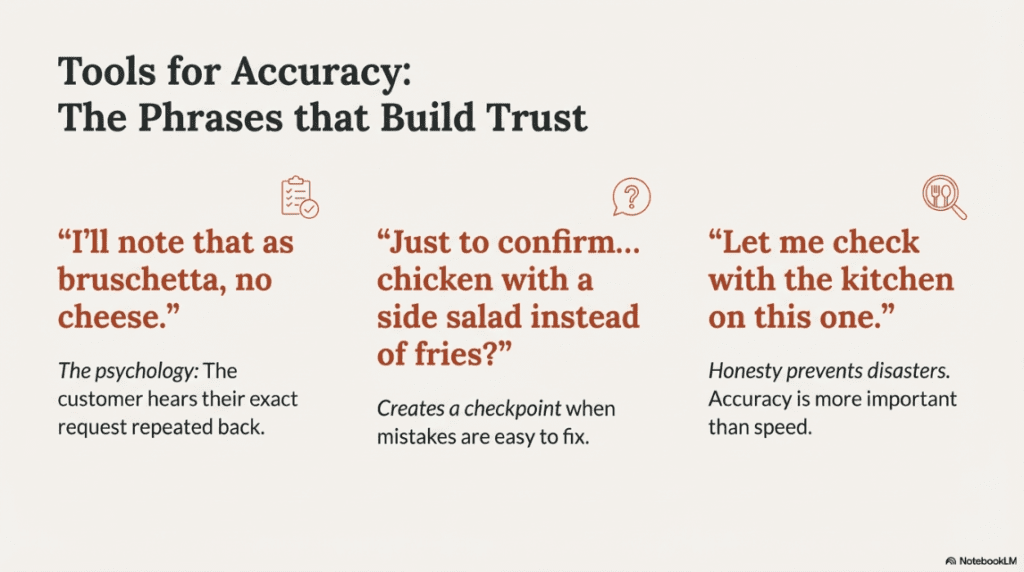
Server: “Absolutely, no problem at all. I’ll note that as bruschetta, no cheese. So that’s calamari for the table, and bruschetta without cheese. Perfect.”
Server: turning to Guest 1 “And for you? I remember you mentioned you’re vegetarian, so I can point out our vegetarian mains if that helps?”
Guest 1: “Yes please! What do you recommend?”
Server: “Our mushroom risotto is fantastic—it’s creamy, rich, and very popular. We also have a roasted vegetable pasta and a Mediterranean quinoa bowl.”
Guest 1: “The risotto sounds perfect.”
Server: “Excellent choice. I’ll note that as one mushroom risotto.” writes clearly “And for you?” gesturing to Guest 2
Guest 2: “I’ll have the salmon, but can I get it without the sauce? Just plain grilled?”
Server: “Of course. So that’s salmon, grilled plain with no sauce. How would you like that cooked? We usually do medium, but I can ask the kitchen for your preference.”
Guest 2: “Medium is fine.”
Server: “Perfect. Salmon, medium, no sauce.” writes “Next?”
Guest 3: “Can I get the chicken, but instead of fries, can I have a side salad?”
Server: “Absolutely. Chicken with side salad instead of fries. Any dressing preference? We have balsamic, Caesar, ranch, and honey mustard.”
Guest 3: “Balsamic, please. On the side.”
Server: “Got it. Balsamic dressing on the side.” writes “And for you?”
Guest 4: “I’ll take the steak, medium-rare. But can you ask the chef not to put any butter on it?”
Server: “No problem at all. Steak, medium-rare, no butter. That comes with seasonal vegetables and your choice of potato—mashed, roasted, or fries?”
Guest 4: “Roasted, please.”
Server: “Perfect. Steak medium-rare, no butter, roasted potatoes.” writes
Guest 5 (gluten-free): “Okay, so I’m gluten-free. What can I have?”
Server: “Great question. Our gluten-free options include the grilled fish with vegetables, the steak you just heard, and we can also do the chicken without the breadcrumb coating. All served with gluten-free sides.”
Guest 5: “I’ll have the fish then.”
Server: “Excellent. One grilled fish, and I’ll make sure the kitchen knows it’s gluten-free so there’s no cross-contamination. That comes with steamed vegetables and rice—both naturally gluten-free.”
Guest 5: “Perfect, thank you for being so careful.”
Server: “Of course, we take allergies and dietary needs very seriously. And finally…” turning to Guest 6
Guest 6: “I’ll have the pasta primavera, but I’m dairy-free, remember? So no cheese, no cream sauce.”
Server: “Absolutely. Let me check with the kitchen on this one—our primavera sauce does have cream in it. Would you be okay with a tomato-based sauce instead, or we can do it with olive oil and garlic?”
Guest 6: “Olive oil and garlic sounds great.”
Server: “Perfect. So that’s pasta primavera with olive oil and garlic, no cheese, no dairy. I’ll make sure that’s very clear to the kitchen.”
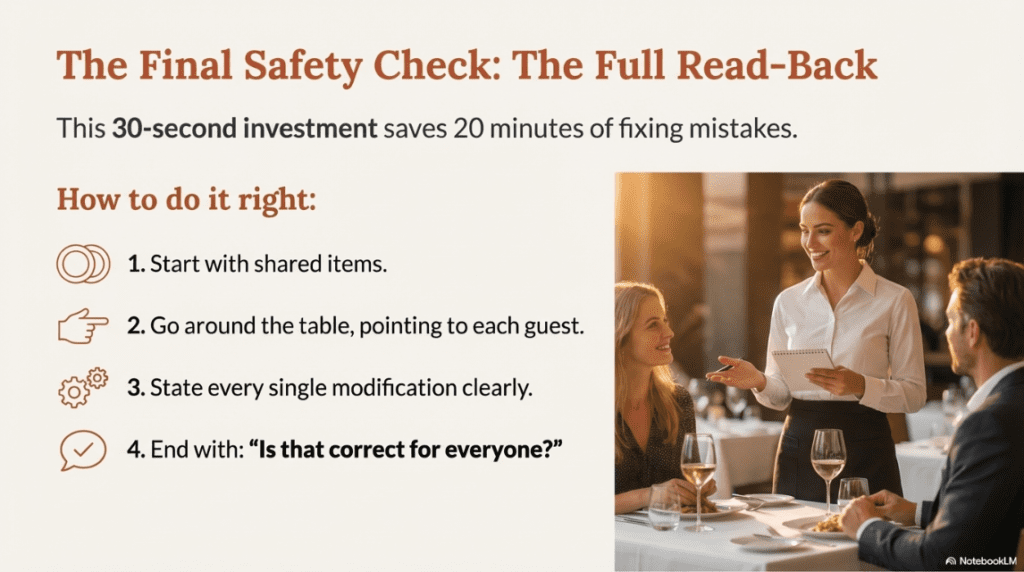
Server: reading back the entire order “Okay, let me just confirm everything so we get this exactly right:
To share: Calamari and bruschetta with no cheese.
For mains:
- Mushroom risotto for you
- Salmon, medium, no sauce
- Chicken with side salad, balsamic dressing on the side
- Steak medium-rare, no butter, with roasted potatoes
- Grilled fish, gluten-free
- Pasta primavera, olive oil and garlic, no dairy
Is that correct for everyone?”
Group: nods and confirms
Server: “Brilliant. This will be about 20 minutes for the appetizers and then 15 minutes after that for mains. I’ll check back on you in a few moments. Enjoy!”
Key Phrases Breakdown
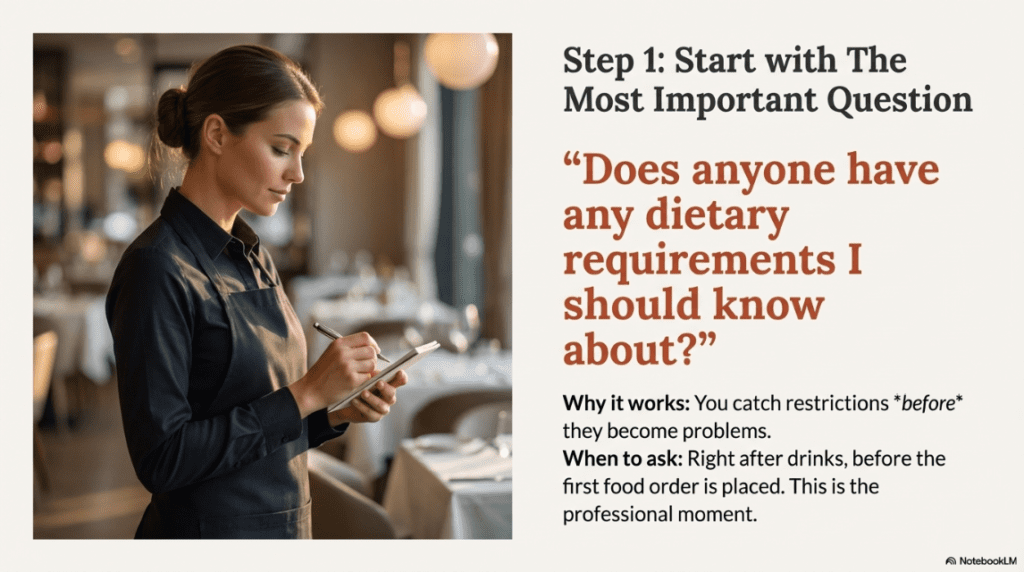
1. “Does anyone have any dietary requirements I should know about?”
Why this works: Asking upfront prevents problems later. You catch restrictions BEFORE people order unsuitable dishes.
Timing: Ask right after drinks, before food orders. This is the professional moment to inquire.
Cultural note: In British English, we say “dietary requirements.” Americans might say “dietary restrictions” or “food allergies.” Both are fine.
Alternative phrases:
- “Before we start, are there any allergies or dietary needs I should be aware of?”
- “Does anyone need to avoid any particular ingredients?”
2. “Let me make sure I have this correct”
Why this works: Shows you’re being careful and professional. Gives you permission to repeat/clarify without seeming incompetent.
When to use: Before reading back a complicated order, or when someone gives you multiple modifications.
Body language: Make eye contact, pen ready. Show you’re concentrating.
What NOT to say:
- ❌ “Wait, what did you want again?” (sounds like you weren’t listening)
- ❌ “I’m confused” (undermines confidence)
- ✅ “Let me confirm those details” (sounds professional)
3. “I’ll note that as…”
Why this works: This phrase confirms you’ve understood AND written it down correctly. The customer hears their exact request repeated back.
Examples from dialogue:
- “I’ll note that as bruschetta, no cheese”
- “I’ll note that as one mushroom risotto”
- “Salmon, medium, no sauce” while writing
The psychology: People trust servers who visibly write things down. The act of writing shows professionalism.
4. “Just to confirm…” / “So that’s…”
Why this works: Creates a checkpoint. You’re verifying details BEFORE sending to kitchen, when mistakes are easy to fix.
When to use:
- After each person orders (mini-confirmation)
- After entire table orders (full read-back)
- When modifications are involved
Professional tip: Always read back modifications. “Salmon, no sauce” is clearer than just “salmon.”
5. “Let me check with the kitchen on this one”
Why this works: Honesty prevents mistakes. If you’re unsure whether something can be modified, ASK. Don’t guess.
When to use:
- Complex modifications you’re uncertain about
- Dietary restrictions that might involve cross-contamination
- Substitutions you haven’t done before
What happens next: “I’ll be right back” → check with kitchen → return with answer. Takes 2 minutes, saves disasters.
According to professional hospitality standards, accuracy is more important than speed.
6. “I’ll make sure the kitchen knows…”
Why this works: Reassures customers with serious dietary needs that you understand the importance. Especially critical for allergies.
Examples:
- “I’ll make sure the kitchen knows it’s gluten-free so there’s no cross-contamination”
- “I’ll make sure that’s very clear to the kitchen”
- “I’ll personally tell the chef about your dairy allergy”
Legal importance: Allergy mistakes can be life-threatening. This phrase shows you take it seriously.
7. Reading back the entire order
Why this works: Final safety check. Six people can catch errors better than you alone. Prevents remakes and complaints.
How to do it:
- Start with shared items
- Go around table in order
- Point at each person as you read their order
- Include ALL modifications
- Ask “Is that correct for everyone?”
Time investment: 30 seconds now saves 20 minutes of fixing mistakes later.
Common Mistakes to Avoid
❌ Mistake 1: Not Writing Things Down
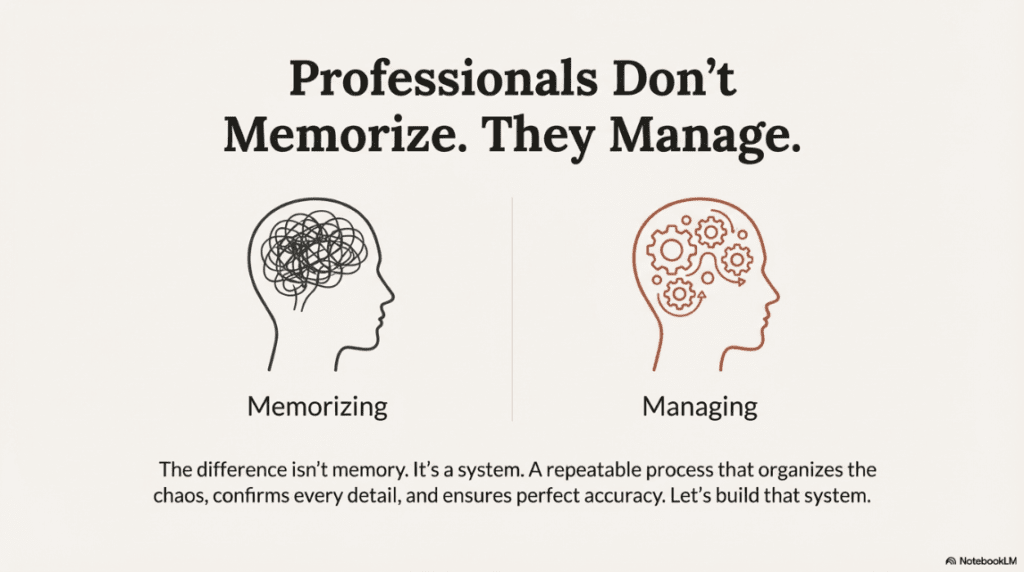
Wrong: Trying to memorize six orders with modifications in your head.
Why it’s wrong: You WILL forget something. Even experienced servers write complex orders down.
Right: Write every order clearly. Use abbreviations if needed, but write legibly.
Server confession: “I once tried to memorize a table of eight. I got three orders completely wrong. Never again.”
Professional standard: Writing = professional. Memorizing = risky.
❌ Mistake 2: Asking “Any allergies?” Too Casually
Wrong: Rushing through “Anyallergies?” as one word while looking at your notepad.
Why it’s wrong: People with serious allergies need to see you taking it seriously. Casual = they don’t trust you.
Right: Make eye contact. Speak clearly. Pause for answers. Show it matters.
Legal note: Allergy mistakes can be fatal. This is the most important question you’ll ask.
❌ Mistake 3: Getting Confused About Who Ordered What
Wrong: Taking all orders, then when reading back, saying “Who had the salmon?”
Why it’s wrong: Looks disorganized and unprofessional. Creates confusion.
Right: Use a numbering system (seat numbers) or a table map. Always know who ordered what.
Professional trick: Number the table mentally. Seat 1 is always closest to the door (or pick any consistent system). Write seat numbers on your notepad.
❌ Mistake 4: Saying “I Don’t Know” and Leaving It There
Wrong: Customer: “Can I get this without dairy?” Server: “I don’t know.” walks away
Why it’s wrong: Customer is left hanging. You haven’t solved their problem.
Right: “Let me check with the kitchen on that for you. I’ll be right back.”
Solution-focused language: Even when you don’t know, you show how you’ll FIND OUT.
❌ Mistake 5: Not Repeating Modifications Back
Wrong: Customer says “Chicken with salad instead of fries, balsamic on the side,” you just write it down silently.
Why it’s wrong: Customer doesn’t know if you heard correctly. No confirmation = anxiety.
Right: “Perfect. Chicken with side salad instead of fries, and balsamic dressing on the side.”
Bonus: Repeating prevents the customer from having to ask “Did you get that?”
This approach is recommended in professional communication in hospitality because it reduces errors and improves customer satisfaction.
Practice This Scenario
Step 1: Study the Phrases
Print or write down the 7 key phrases. Read them aloud five times each.
Step 2: Role-Play Different Versions
Practice with colleagues or friends. Create different scenarios:
- What if someone has a nut allergy?
- What if two people want to share a dish?
- What if someone changes their mind mid-order?
Step 3: Practice Your Note-Taking System
Develop a consistent way to write orders. Use abbreviations that work for you and your team. IMPORTANT: Most restaurants will have a code of best practice for facilitating dietary requirements. It’s extremely important that you learn this so that mistakes are avoided at all times.
- GF = gluten-free
- DF = dairy-free
- V = vegetarian
- N/S = no sauce
- O/S = on the side
Even with perfect systems, mistakes happen. When they do, use our complete mistake recovery guide to fix issues professionally.
Step 4: Practice Reading Back Orders
Record yourself reading back the complete order from the scenario. Listen to yourself. Are you clear? Organized? Confident?
Step 5: Test It on Real Tables
Next shift, try these phrases on actual complex tables. Notice how customers respond when you’re organized and professional.
Why This System Works (The Psychology)
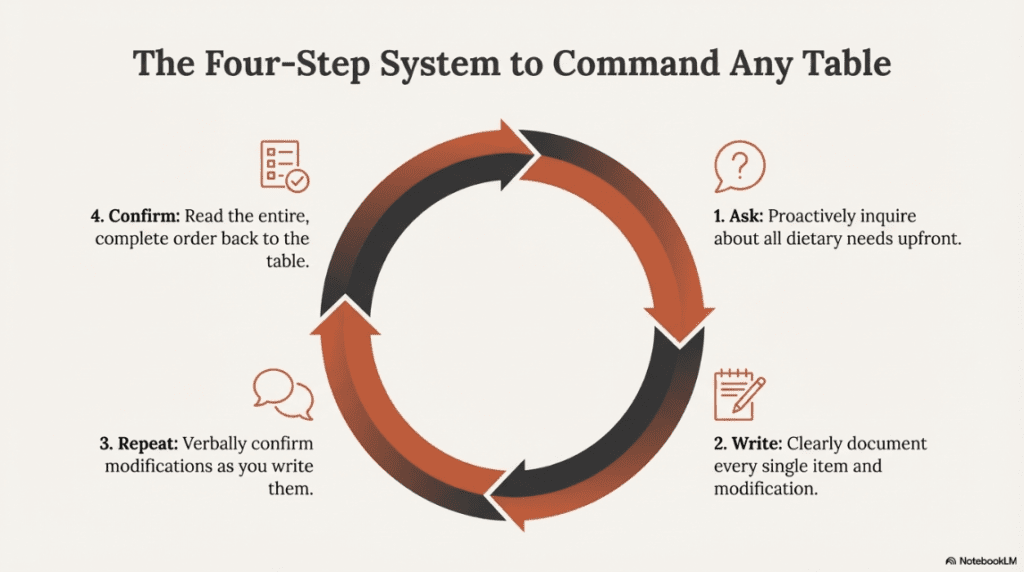
Large groups are naturally chaotic. Everyone’s talking, excited, distracted. Your job is to create ORDER from chaos.
When you:
- Ask about dietary needs upfront → You show foresight and care
- Write everything down visibly → You show professionalism
- Repeat modifications back → You show accuracy
- Read the full order back → You show thoroughness
…the table RELAXES. They trust you. They know their food will be correct.
This confidence reduces complaints, increases tips, and makes your job easier.
This approach is recommended in professional communication in hospitality because it reduces errors and improves customer satisfaction.
Related Scenarios
Want more practical English guides for restaurant work? Check out these popular articles:
How to Greet an Angry Customer at Your Restaurant – Learn the exact de-escalation phrases that turn upset customers into satisfied ones in the first 30 seconds.
How to Describe Food Like a Professional Waiter – Master the exact adjectives and phrases that make menu recommendations irresistible to customers.
20 Upselling Phrases Waiters Can Use (That Don’t Sound Pushy) – Natural upselling techniques that increase your tips by £800-£1,000 per month without making customers feel pressured.
Free Learning Resources for Hospitality Workers – Curated list of the best free English learning websites, hospitality training programs, and professional development resources for restaurant staff.
Master Restaurant English with Audio Training
📧 Want to hear this scenario with perfect pronunciation?
This dialogue will soon be available as a professional audio recording where you can hear natural English pronunciation, appropriate tone and pacing, and exactly how to deliver these phrases under pressure.
While you’re waiting for the audio version, get immediate help with these free resources:
Download: 10 Common Mistakes Waiters Make – This free guide shows you the most expensive English errors servers make and how to fix them today. Small mistakes cost you £15+ per table in tips.
Browse All Restaurant English Guides – Access our complete library of practical articles covering greetings, order-taking, upselling, complaints, and more.
Ready to Master Restaurant English?
These free articles and scenarios are a great start, but if you want a complete, structured system for learning restaurant English, consider our full course.

English for Waiters includes:
✅ 22+ video lessons covering every restaurant situation
✅ Real restaurant scenarios with native pronunciation
✅ Interactive pronunciation practice
✅ Downloadable phrase guides
✅ Lifetime access with free updates
Not ready for the full course yet? Start with our free learning resources or read more practical restaurant English guides on our blog.
💡 Bookmark this page and review it before taking orders from large groups. The first time you smoothly handle a complicated table using this system, you’ll feel like a professional.