How to Seat Guests Professionally

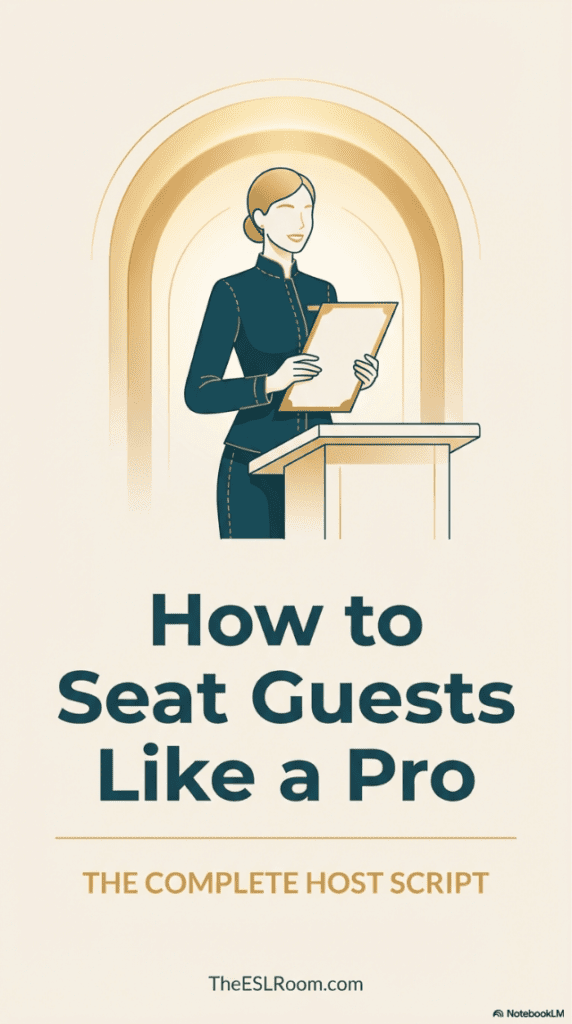
How to Seat Guests Professionally: The Host’s Complete Script

Table of Contents

Your First 30 Seconds Change Everything

You see them the moment they walk through the door. A couple on a date night. A family with tired children. A business group checking their watches. In the next 30 seconds, you will set the tone for their entire evening.

As a restaurant host or hostess, you are not just opening a door or pointing to a table. You are creating the first impression that guests will remember. A warm greeting can turn a stressed guest into a relaxed one. A professional seating process can prevent complaints before they start.

But here’s the problem: many restaurant workers learn how to seat guests by watching others. Nobody gives them a clear script or system. They learn phrases like “Follow me” or “Table for two?” but they don’t understand when to say what, or how to handle difficult situations.

This guide will teach you the complete professional seating system, step by step. You will learn:

  • The exact phrases to use when greeting guests
  • How to handle reservations vs walk-ins fairly
  • What to do when there is a wait time
  • How to seat guests who have special requests
  • How to communicate with servers about seating flow

By the end of this article, you will have a clear script in your mind for every seating situation. Let’s start with the greeting.


How to Seat Guests Professionally

Part 1: The Professional Greeting (First 15 Seconds)

Why the Greeting Matters

According to Toast, a leading restaurant technology company, “Your restaurant host is commonly the first person guests make contact with when entering your restaurant business. They have the ability to kick off a great dining experience.”

Think about it from the guest’s perspective. They just walked in from a busy street, or they drove through traffic, or they’re celebrating something special. The first person they see is you. Your greeting tells them: “You are welcome here” or “This place is disorganized.”

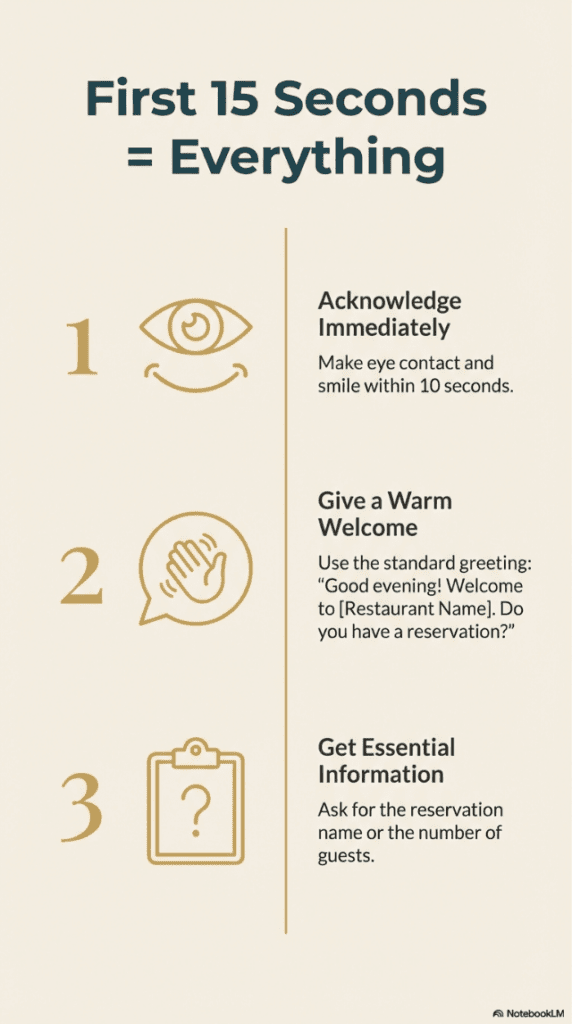
The 3-Step Greeting System

Step 1: Acknowledge Immediately (Within 10 Seconds)

Even if you are busy with another guest, make eye contact and smile. Raise your hand slightly to show “I see you, I’ll be with you in one moment.” This stops guests from feeling ignored.

Bad example:
Host is looking down at the reservation book. Guests stand at the door for 30 seconds. Nobody says hello. Guests feel awkward.

Good example:
Host looks up immediately, smiles, and says: “Good evening! I’ll be right with you.” Then finishes with the current guest and turns to the new arrivals within 10 seconds.

Step 2: Give a Warm Welcome

Toast recommends giving your host a standard greeting script such as “Welcome to [restaurant name]! Do you have a reservation tonight?” This ensures all guests receive consistent, professional service.

The Standard Greeting: “Good [morning/afternoon/evening]! Welcome to [Restaurant Name]. Do you have a reservation with us today?”

Why this works:

  • It’s friendly but professional
  • It immediately identifies reservation vs walk-in guests
  • It uses simple, clear English (B1-B2 level)
  • It works for any type of restaurant (formal or casual)

Step 3: Get Essential Information

Depending on their answer, ask one follow-up question:

If they have a reservation:
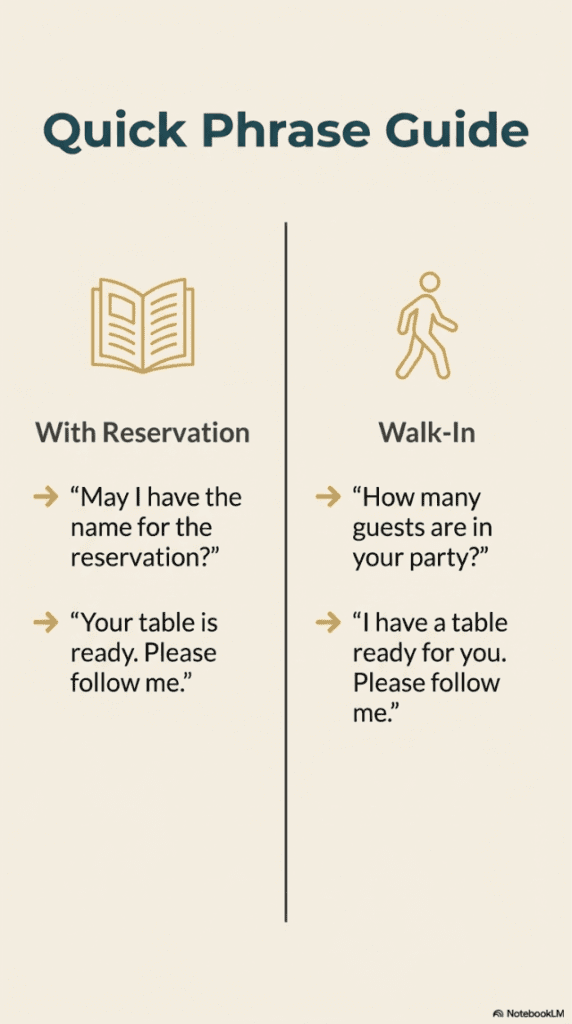
“Perfect! May I have the name for the reservation?”

If they don’t have a reservation:
“No problem! How many guests are in your party today?”

How to Seat Guests Professionally

Part 2: Handling Reservations (The Organized Way)

Checking the Reservation Book

When a guest gives you their name, here’s what to say:

While you’re looking:
“Thank you, Mr. Smith. Let me check our system for you.”
(Or: “One moment while I find your reservation.”)

If you find it immediately:
“Yes, here we are! Party of four at 7:00pm. Your table is ready—please follow me.”

If you need a moment to find it:
“Thank you for your patience. I’m checking our book now.”
(Don’t apologize too much—just be calm and professional.)

If you can’t find the reservation:
“I’m not seeing a reservation under that name. Can I double-check the date and time with you?”

Sometimes guests make mistakes:

  • They booked for the wrong date
  • They booked at your other location (if you have multiple)
  • They think they made a reservation but didn’t complete it
  • They’re at the wrong restaurant entirely

The diplomatic response:
“I don’t have a reservation in our system, but let me see what I can do for you. How many guests do you have?”

Then treat them as a walk-in. Don’t blame them or argue. Just solve the problem professionally.

Confirming Special Requests

According to Courtney Anderson, Former Corporate Guest Relations Manager for Fabio Trabocchi Restaurants, “Go through all reservations based on ‘Guest Requests,’ whether that’s a seating preference, particular server, birthday, anniversary, first-time diner, VIP, or a regular.”

If the reservation notes show a special request, confirm it:

For a window table:
“I see you requested a window table. I have a lovely one ready for you.”

For a birthday:
“I see we’re celebrating a birthday today! Congratulations!”

For a quiet table:
“You asked for a quiet area—I have the perfect table away from the kitchen.”

This shows guests you pay attention to details. It makes them feel important.


Part 3: Handling Walk-In Guests (When There’s No Reservation)

Assessing Availability

When guests arrive without a reservation, you need to know:

  1. How many people are in their group
  2. If they have any special seating preferences
  3. How long they might need to wait (if at all)

The opening questions:
“How many guests are in your party?”
“Do you have any seating preferences today? Inside or outside? Booth or table?”

When You Have Immediate Availability

The smooth transition:
“Great! I have a table ready for you right now. Please follow me.”

That’s it. Simple, clear, professional. Don’t over-complicate it.

How to Seat Guests Professionally

When There’s a Short Wait (5-15 Minutes)

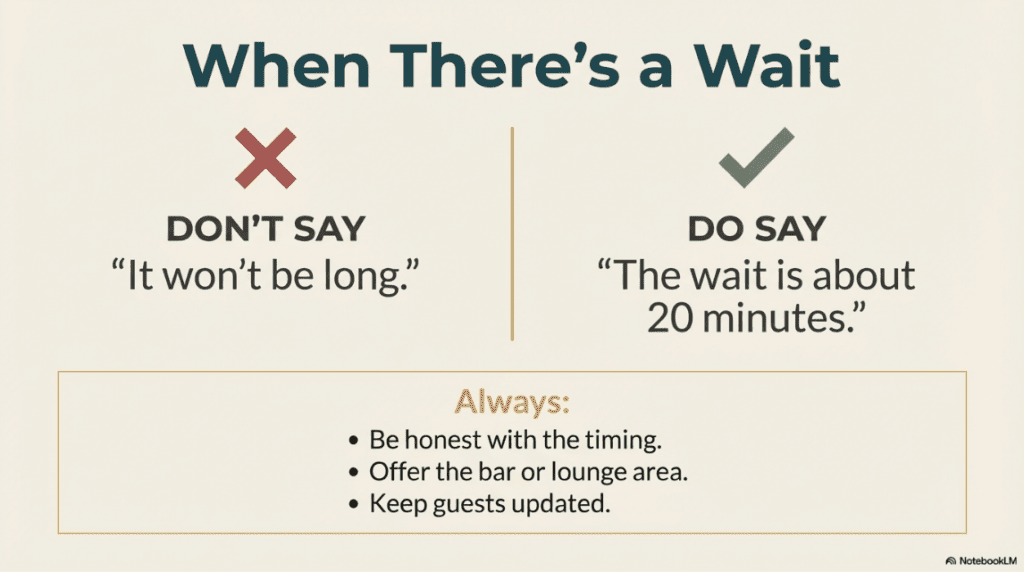
Be honest about timing:
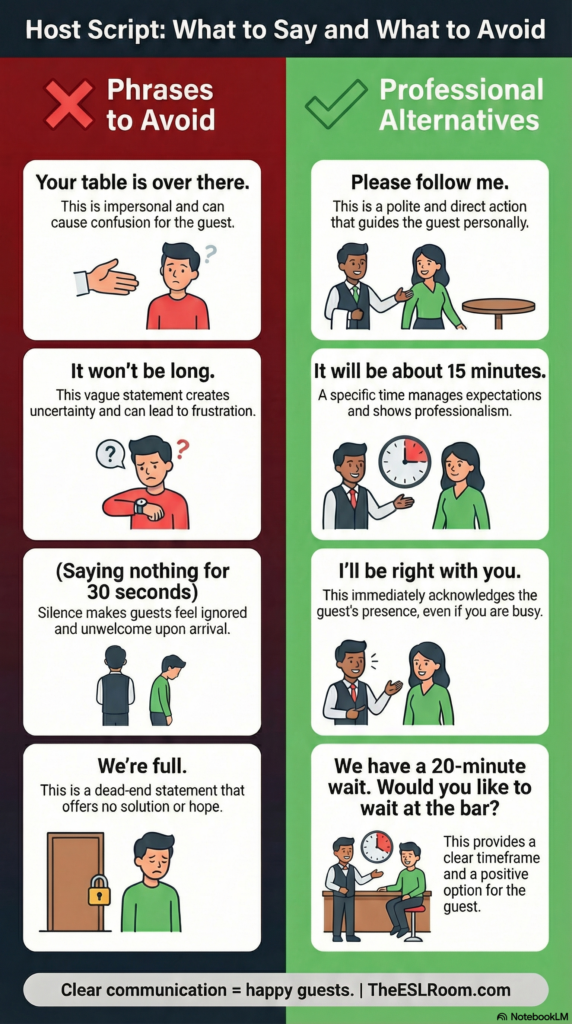
“We have a table available, but it’s being cleaned right now. It should be ready in about 10 minutes. Would you like to wait at the bar, or would you prefer to wait here?”

Why this works:

  • You give a specific time (not “it won’t be long”)
  • You offer options (bar or waiting area)
  • You sound confident, not apologetic

After 10 minutes, update them:
“Thank you for waiting. Your table is ready now.”

When There’s a Long Wait (20+ Minutes)

This is when things get tricky. Some guests will wait. Others will leave. Your job is to be honest and helpful.

The professional approach:
“Right now, we have about a 20 to 30 minute wait. I can add your name to our waitlist, or if you’d prefer, there’s [nearby option] with shorter waits. What would you prefer?”

Important phrases for managing wait times:

If guests agree to wait:
“Perfect. May I have a name for the waitlist?”
“I’ll call you as soon as your table is ready. Feel free to enjoy a drink at the bar while you wait.”

If guests ask “How much longer?”:
“Let me check on the tables for you. It looks like about 10 more minutes.”

Culinary Agents emphasizes that “Communication is the most critical factor for managing a wait at the door. Keep guests updated on the status of their table. If there’s a longer wait than expected, a complimentary gesture should be offered to thank them for their patience.”


How to Seat Guests Professionally

Part 4: Walking Guests to the Table (The Right Way)

Leading, Not Pointing

Bad example:
Host: “Your table is over there.” (Points across the room)
Guest: (Walks alone, isn’t sure which table, looks confused)

Good example:
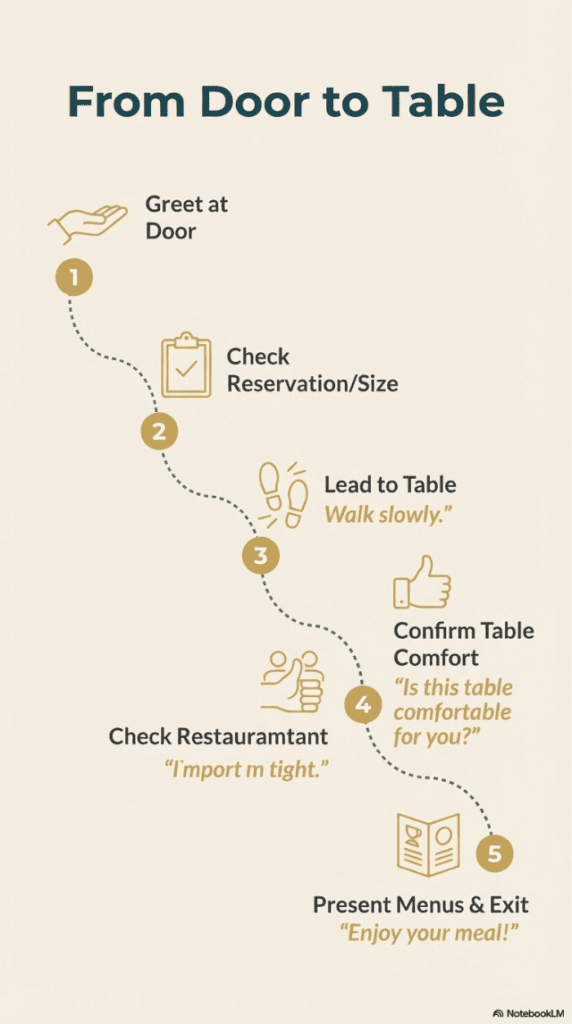
Host: “Your table is ready. Please follow me.”
(Walks slightly ahead, makes eye contact occasionally to ensure guests are following, arrives at table first)

The Walking Script

As you start walking:
“Right this way, please.”
(Or: “Please follow me.”)

If there are obstacles (stairs, tight spaces):
“Please watch your step here.”
“We’ll go upstairs to the second floor.”

If you’re walking through a crowded dining room:
Walk slowly enough that guests can follow easily. Don’t rush. Make sure elderly guests or families with children can keep up.

Arriving at the Table

Presenting the table:
“Here we are. This is your table for this evening.”
(Gesture to the table with an open palm, not pointing with one finger)

Asking for confirmation:
“Is this table comfortable for you?”
(Or: “Will this table work for you?”)

Why ask this question?

  • It gives guests a chance to request a different table if they’re unhappy
  • It’s better to know now than have them complain to the server later
  • It shows you care about their comfort

If Guests Request a Different Table

Stay calm and helpful:
“Of course. Would you prefer a table [by the window / in a quieter area / in a booth]?”

If you have another table available:
“I have another table over here. Let me show you.”

If you don’t have what they want:
“I understand. Right now, all of our [window tables / booths] are occupied. I can add you to our waitlist for the next one that becomes available, or you’re welcome to take this table. What would you prefer?”


After seating your guests, the next critical moment is taking their order correctly. Learn the complete process in our guide to taking orders from large groups.

Part 5: Assisting Guests Once Seated

The Chair Pull (When and How)

In fine dining restaurants, hosts often pull out chairs for guests, especially for women or elderly guests. In casual restaurants, this is usually not expected.

How to do it correctly:

  1. Stand behind the chair
  2. Say: “Please, allow me”
  3. Pull the chair back as the guest approaches
  4. Push it gently forward as they sit down
  5. Don’t push too hard or too fast

When NOT to pull the chair:

  • If the guest is already sitting down
  • If the guest clearly prefers to do it themselves
  • In very casual restaurant settings

Offering Menus and Final Service

Presenting menus:
“Here are your menus. Your server will be with you shortly to take your drink order.”
(Or: “Your server [Name] will be right with you.”)

The professional exit:
“Enjoy your meal!”
(Or: “Have a wonderful evening!”)

Then step away. Don’t linger at the table. The host’s job is done—now it’s the server’s turn.


Part 6: Special Situations and How to Handle Them

Situation 1: VIP Guests or Regular Customers

If you recognize a regular customer or know this is a VIP:

“Welcome back, Mr. Johnson! It’s wonderful to see you again.”
“We have your favorite table ready for you.”

This personal touch makes guests feel valued.

Situation 2: Large Groups (6+ People)

Large groups need special attention:

“Welcome! Party of eight? Perfect, I have a large table prepared for you.”
(Lead them to a table that can accommodate everyone comfortably)

Important for large groups:

  • Make sure they have enough space
  • Check if they need high chairs or booster seats for children
  • Tell the server immediately so they can prepare (large groups = complex orders)

[Internal link opportunity: Reference Deep Dive #2: Taking Complex Orders]

Situation 3: Guests with Mobility Issues

If you see a guest using a cane, wheelchair, or walker:

Be proactive:
“I have a table with easy access right here.”
(Choose a table near the entrance, away from stairs, with plenty of space)

Don’t make a big deal of it. Just be quietly helpful.

Situation 4: Guests Who Are Unhappy Before They Sit Down

Sometimes guests arrive already upset. Maybe they’re late, or they had trouble parking, or they’re stressed.

Your response:
Stay calm. Be extra warm. Don’t take it personally.

“I’m glad you made it! Let me get you seated right away.”

[Internal link opportunity: Reference Deep Dive #1: Greeting an Angry Customer]

Situation 5: Walk-Ins Who Want to “Squeeze In” During Peak Hours

The request:
Guest: “I know you’re busy, but can you fit us in? We’ll be quick.”

Your honest response:
“I’d love to help you. Right now we have a 30-minute wait. I can add you to the waitlist if you’d like, or you’re welcome to check back later when we’re less busy.”

Don’t lie or make false promises. If you say “5 minutes” and it takes 25 minutes, guests will be angry.


Part 7: Communicating with Servers About Seating

Why Server Communication Matters

You’re not just seating guests randomly. You’re managing the flow of the entire restaurant. Servers need time to handle each table properly. If you seat three tables in one server’s section within 5 minutes, that server becomes overwhelmed.

The Rotation System

According to hospitality experts, “Rotate the sections in which you seat customers. In a restaurant that has four servers, this ensures that each server gets one of every four tables.”

How rotation works:

  1. You have 4 servers (Server A, B, C, D)
  2. First table → Server A’s section
  3. Second table → Server B’s section
  4. Third table → Server C’s section
  5. Fourth table → Server D’s section
  6. Fifth table → Server A’s section (cycle starts again)

This keeps service quality high because no server is overwhelmed.

Giving Servers a Heads-Up

When seating a large party:
(Walk to the table, then find the server and say:)
“Hey, I just sat a party of 8 at table 12. They’re your next table.”

When seating a difficult guest:
“Quick heads-up—table 7 seems a bit stressed. Just wanted you to know.”

[Internal link opportunity: Reference Deep Dive #4: Handling Food Complaints]


How to Seat Guests Professionally

Part 8: Common Mistakes Hosts Make (And How to Fix Them)

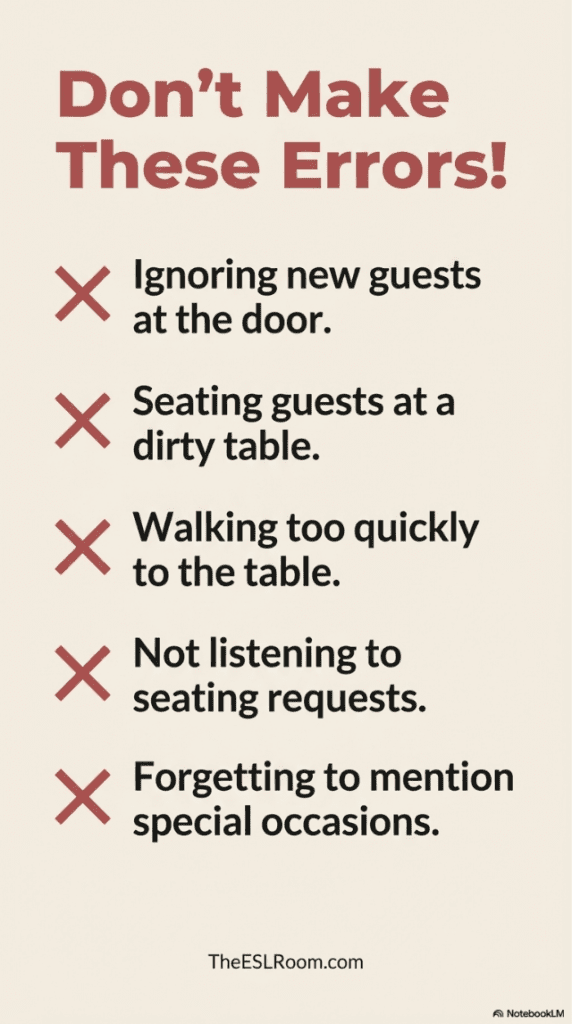
Mistake #1: Ignoring Guests at the Door

The problem:
Host is busy with computer or phone. Guests wait 30+ seconds without acknowledgment.

The fix:
Always look up within 10 seconds. Even if you can’t help immediately, make eye contact and say “I’ll be right with you.”

Mistake #2: Seating Guests at Dirty Tables

The problem:
Host seats guests at a table that hasn’t been cleaned yet. Guests see leftover plates, crumbs, or dirty glasses.

The fix:
Always check the table visually before walking guests over. If you arrive and see it’s dirty, say: “Oh, this table isn’t ready yet. Let me find you a clean one.”

Mistake #3: Walking Too Fast

The problem:
Host walks quickly through the restaurant. Elderly guests, families with children, or guests with mobility issues can’t keep up.

The fix:
Walk at a moderate pace. Look back occasionally to make sure everyone is still following you.

Mistake #4: Not Listening to Guest Requests

The problem:
Guest: “Can we sit by the window?”
Host: “Follow me.” (Leads them to a middle table)
Guest: “I asked for a window table.”
Host: “Oh, sorry, those are all taken.”

The fix:
Listen to the request FIRST. If you can’t accommodate it, explain immediately: “I’d love to seat you by the window, but those tables are occupied right now. Would you like to wait for one, or should I seat you here?”

Mistake #5: Forgetting Special Occasions

The problem:
The reservation says “Birthday – needs dessert candle” but the host forgets to tell the server.

The fix:
When you seat the table, immediately find the server and say: “Table 5 is celebrating a birthday tonight. They’ll need a dessert with a candle.”


How to Seat Guests Professionally

Part 9: Building Confidence in Your English

Simple Phrases Are Professional

You don’t need fancy vocabulary to be a great host. Clear, simple English is better than complicated phrases that you’re not comfortable saying.

You don’t need to say:
“If you would be so kind as to follow me to your designated table location.”

Just say:
“Please follow me to your table.”

Both are professional. The second one is easier for you and easier for guests to understand.

Practice Pronunciation

As a host, you say the same phrases dozens of times per shift. Practice these key phrases until they feel natural:

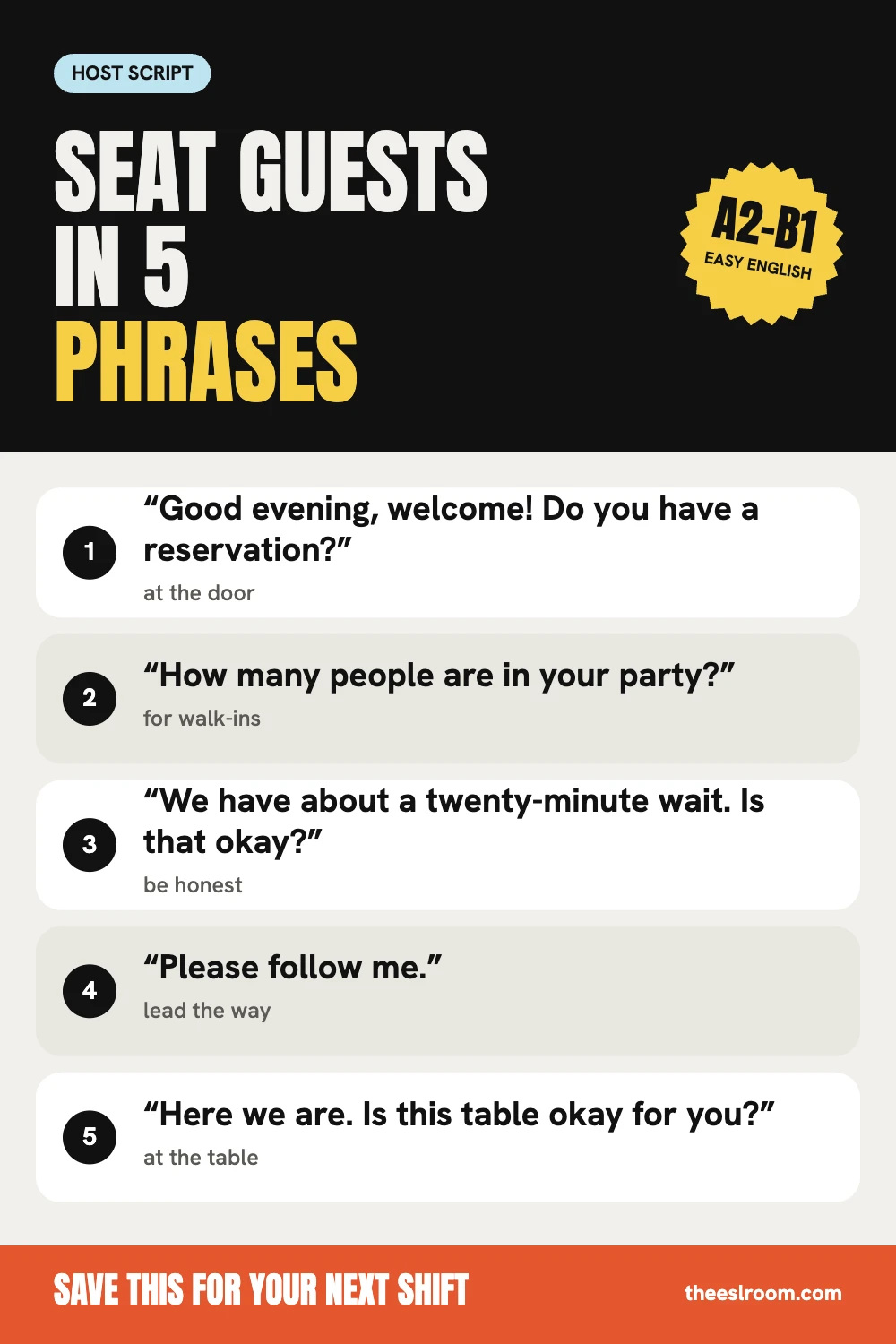
  • “Good evening, welcome to [restaurant name]”
  • “Do you have a reservation?”
  • “Your table is ready”
  • “Please follow me”
  • “Is this table comfortable for you?”
  • “Your server will be right with you”
  • “Enjoy your meal”

[Internal link opportunity: Reference “10 Common Mistakes Waiters Make in English” blog]

Don’t Apologize for Your Accent

If you speak English with an accent, that’s perfectly fine. Guests care about clear communication and warm service, not perfect pronunciation. Focus on speaking slowly and clearly, not on hiding your accent.


Part 10: The Complete Host Script (Quick Reference)

For Guests With Reservations

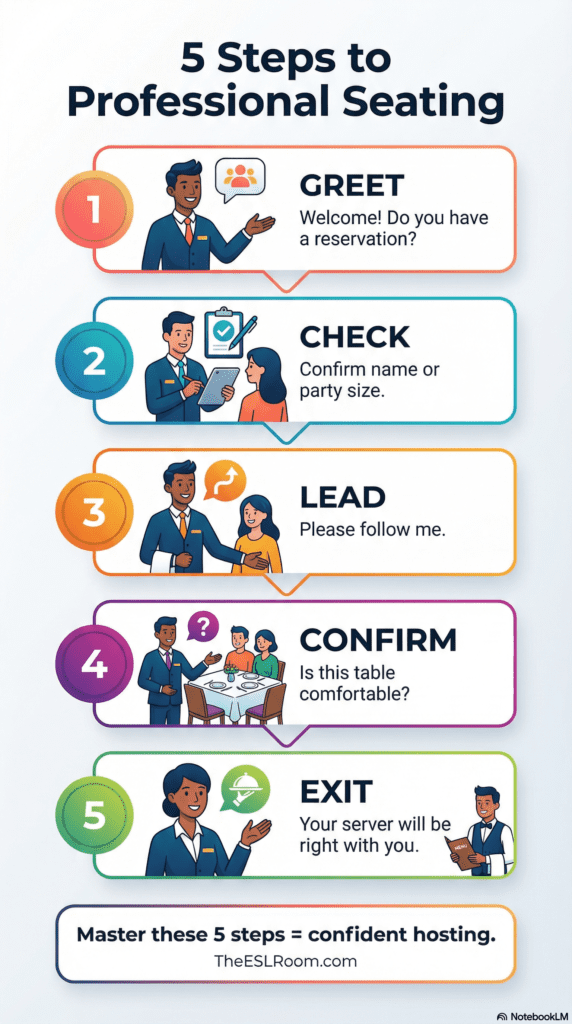
  1. Greeting:
    “Good [time of day]! Welcome to [Restaurant Name]. Do you have a reservation?”
  2. Getting the name:
    “Perfect! May I have the name for the reservation?”
  3. Checking the system:
    “Thank you, let me check our system for you.”
  4. Confirming:
    “Yes, here we are! Party of [number] at [time]. Your table is ready.”
  5. Leading to table:
    “Please follow me.”
  6. Presenting the table:
    “Here we are. Is this table comfortable for you?”
  7. Finishing:
    “Here are your menus. Your server will be with you shortly. Enjoy your meal!”

For Walk-In Guests (No Wait)

  1. Greeting:
    “Good [time of day]! Welcome to [Restaurant Name].”
  2. Getting party size:
    “How many guests are in your party?”
  3. Checking availability:
    “Great! I have a table available for you right now.”
  4. Leading to table:
    “Please follow me.”
  5. Presenting the table:
    “Here we are. Is this table comfortable for you?”
  6. Finishing:
    “Here are your menus. Your server will be with you shortly. Enjoy your meal!”

For Walk-In Guests (With Wait Time)

  1. Greeting:
    “Good [time of day]! Welcome to [Restaurant Name].”
  2. Getting party size:
    “How many guests are in your party?”
  3. Explaining wait:
    “Right now we have about a [time] wait. I can add you to our waitlist if you’d like.”
  4. Getting waitlist information:
    “Perfect. May I have a name for the waitlist?”
  5. Offering options:
    “Feel free to wait at the bar or in our lounge area. I’ll call you as soon as your table is ready.”
  6. Calling when ready:
    “[Name]? Your table is ready now. Please follow me.”

How to Seat Guests Professionally

Conclusion: Your Role Matters More Than You Think

As a restaurant host, you’re not just pointing people to chairs. You’re setting the tone for every guest’s experience. A professional greeting, clear communication, and organized seating flow make the difference between chaos and smooth service.

Remember these key points:

  1. Acknowledge guests within 10 seconds of them walking in
  2. Use simple, clear phrases that feel natural to you
  3. Be honest about wait times—don’t make promises you can’t keep
  4. Communicate with servers about large groups or special situations
  5. Handle problems calmly—if a table isn’t ready or a reservation is missing, stay professional

The script in this article gives you a foundation. Now it’s your job to practice these phrases until they become automatic. After a few weeks, you won’t need to think about what to say—the words will flow naturally.

And when guests compliment you for your warm welcome? That’s when you know you’ve mastered the art of professional seating.

Ready to improve your complete restaurant English skills? Check out our full course “English for Waiters” at TheESLRoom.com.


Ready to Master Restaurant English?

These free articles and scenarios are a great start, but if you want a complete, structured system for learning restaurant English, consider our full course.

learn english for waiters

English for Waiters includes:

✅ 22+ video lessons covering every restaurant situation
✅ Real restaurant scenarios with native pronunciation
✅ Interactive pronunciation practice
✅ Downloadable phrase guides
✅ Lifetime access with free updates