Why the Same English Doesn’t Work Everywhere
Maria started her new job at an upscale steakhouse on Monday. She had three years of experience working at a busy family restaurant. She knew how to take orders, handle complaints, and work quickly during rush hours.
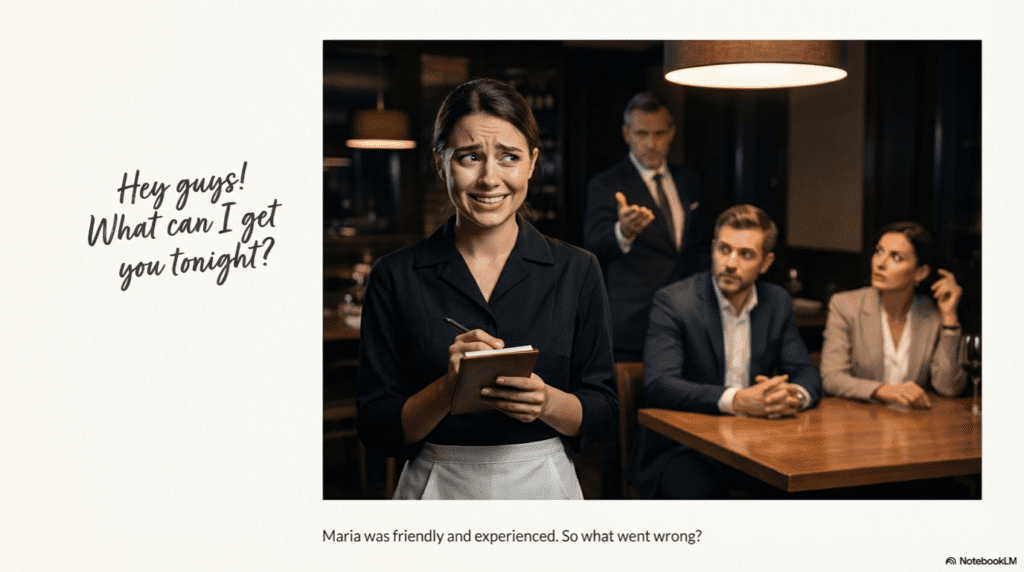
On her first shift, she greeted a table with her usual friendly style: “Hey guys! What can I get you tonight?”
The guests looked uncomfortable. Her manager pulled her aside after 10 minutes.
“Maria, this isn’t that kind of restaurant. You need to speak more formally here.”
Maria felt confused. She was being friendly! What was wrong with “Hey guys”?
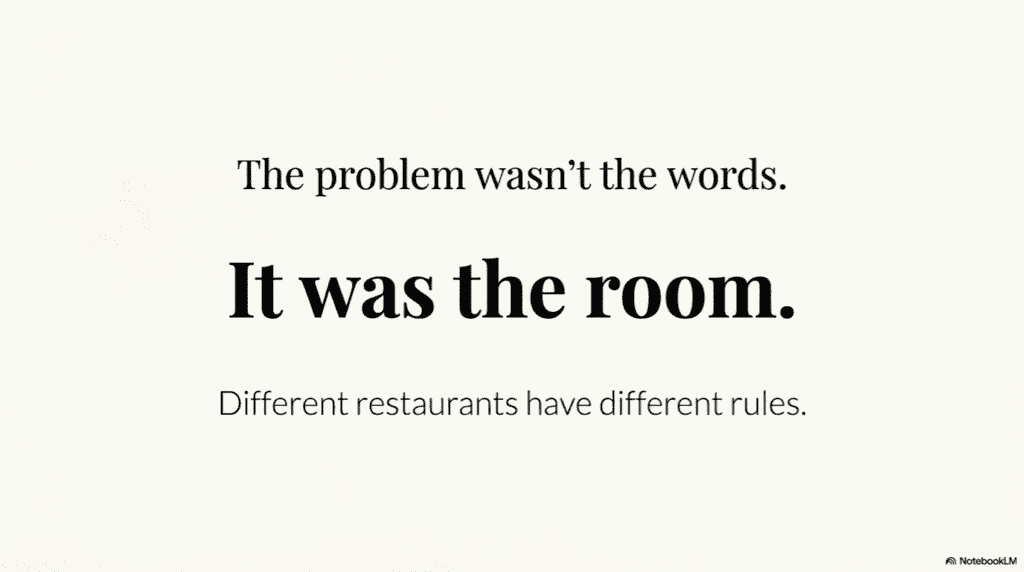
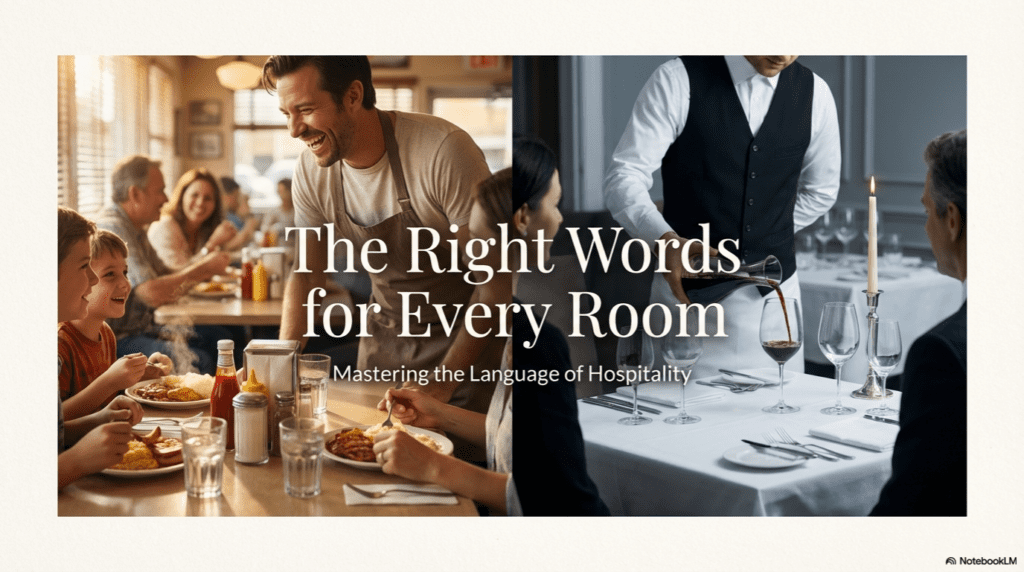
The problem: Maria didn’t understand that restaurant language changes based on the type of restaurant. The casual, friendly English that worked perfectly at her old job sounded unprofessional in a fine dining setting.
This is one of the biggest challenges for ESL restaurant workers. You learn English phrases for serving guests. But nobody teaches you when to use formal language and when to use casual language. You don’t understand why “Can I get you anything else?” works in one restaurant but sounds wrong in another.
Prefer to listen – Here’s the podcast

This guide will teach you:
- The 5 main types of restaurants and their language styles
- 40 phrases compared (formal vs casual versions)
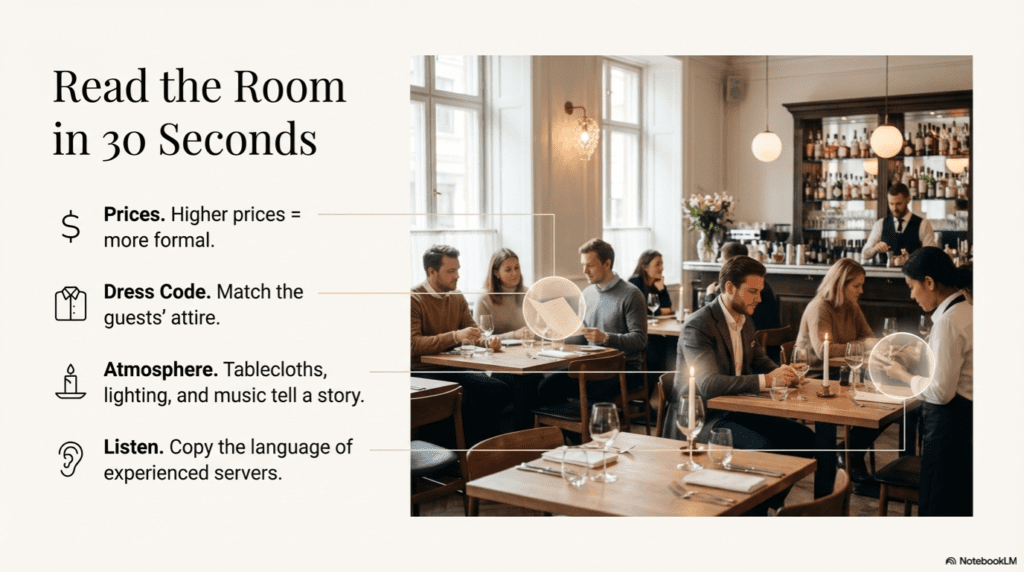
- How to read a restaurant’s style in 30 seconds
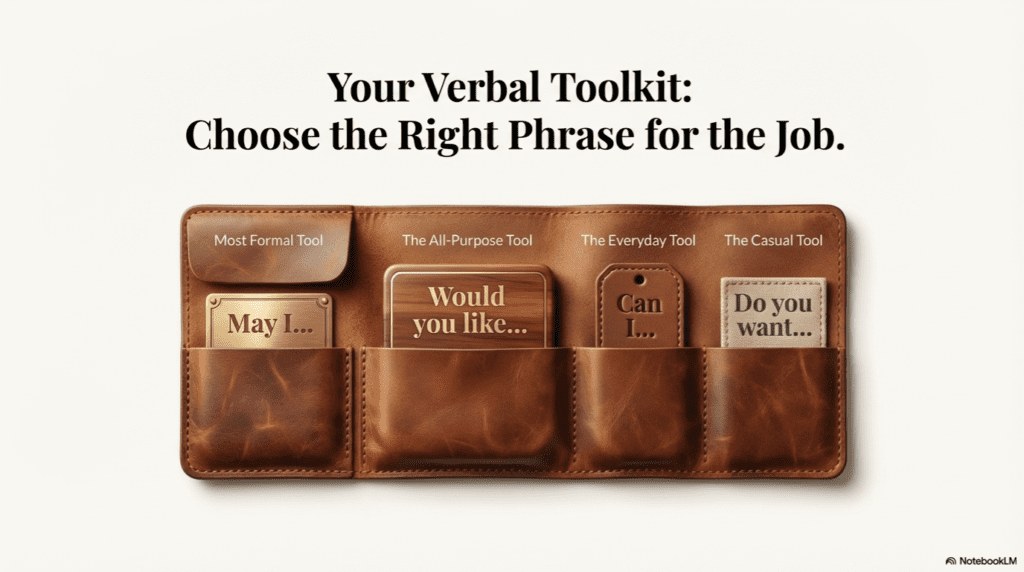
- When to use “May I” vs “Can I” vs “Do you want”
- Common mistakes that make you sound unprofessional
By the end of this article, you will know exactly which English to use in any restaurant.
Let’s start by understanding the different types of restaurants.

Part 1: The 5 Restaurant Types (And Their Language Styles)
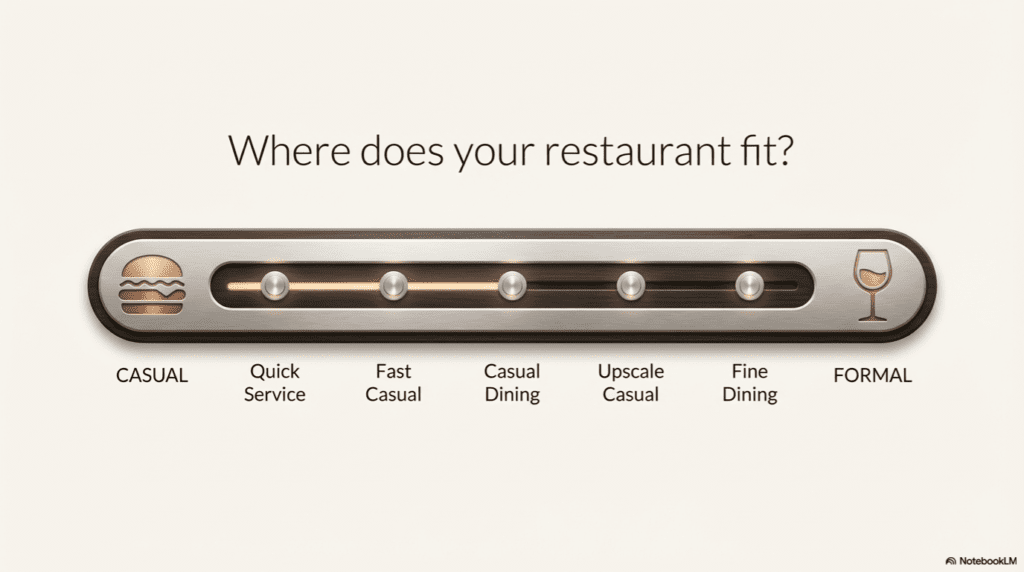
Understanding restaurant types helps you choose the right language. Here are the five main categories:
Type 1: Fine Dining (Very Formal Language)
Characteristics:
- White tablecloths
- Multi-course meals
- Expensive ($100+ per person)
- Wine list with sommelier
- Dress code (suits, dresses)
- Quiet atmosphere
- Formal table settings (multiple forks, wine glasses)
Language style: Very formal, polite, sophisticated
Example restaurants: Michelin-star restaurants, high-end steakhouses, upscale French or Italian restaurants
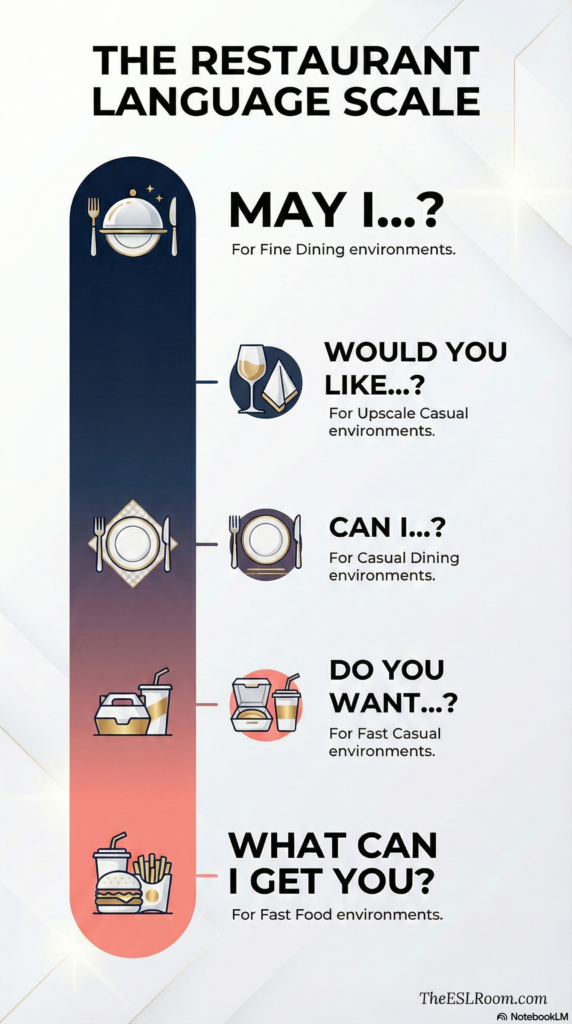
Key rule: Always use “May I” and “Would you”.
According to Toast, a leading restaurant technology company, fine dining servers must “tailor the tone to your concept—formal greetings for fine dining, casual and upbeat for relaxed spots.” This principle applies across all restaurant types.
Type 2: Upscale Casual (Moderately Formal Language)
Characteristics:
- Nice but relaxed atmosphere
- Moderate prices ($30-60 per person)
- Some wine/cocktails
- Semi-formal dress acceptable
- Table service (not counter service)
Language style: Polite and professional, but warmer than fine dining
Example restaurants: Modern bistros, mid-range steakhouses, nicer Italian restaurants
Key rule: Mix formal and casual (start formal, relax if guests are friendly)
Type 3: Casual Dining (Informal but Polite Language)
Characteristics:
- Family-friendly
- Moderate prices ($15-30 per person)
- Relaxed atmosphere
- Casual dress (jeans acceptable)
- TVs might be playing
- Kids’ menus available
Language style: Friendly, conversational, warm
Example restaurants: Chain restaurants (Applebee’s, Chili’s), family diners, neighborhood pizzerias
Key rule: Use “Can I” and be friendly
Type 4: Fast Casual (Very Informal Language)
Characteristics:
- Counter service (order at register)
- Quick service
- Moderate quality
- Low to moderate prices ($10-15 per person)
- Casual atmosphere
Language style: Quick, friendly, efficient
Example restaurants: Chipotle, Panera Bread, Shake Shack
Key rule: Be fast and clear, less formal
Type 5: Quick Service/Fast Food (Minimal Formality)
Characteristics:
- Counter or drive-through service
- Very fast
- Low prices (under $10)
- Paper plates
- Very casual
Language style: Simple, direct, efficient
Example restaurants: McDonald’s, Burger King, Subway
Key rule: Speed matters more than formal language

Part 2: The Language Comparison Chart (40 Phrases)
Here is a side-by-side comparison of formal vs casual restaurant language. Study these carefully.
GREETINGS
| Formal (Fine Dining) | Casual (Family Restaurant) |
|---|---|
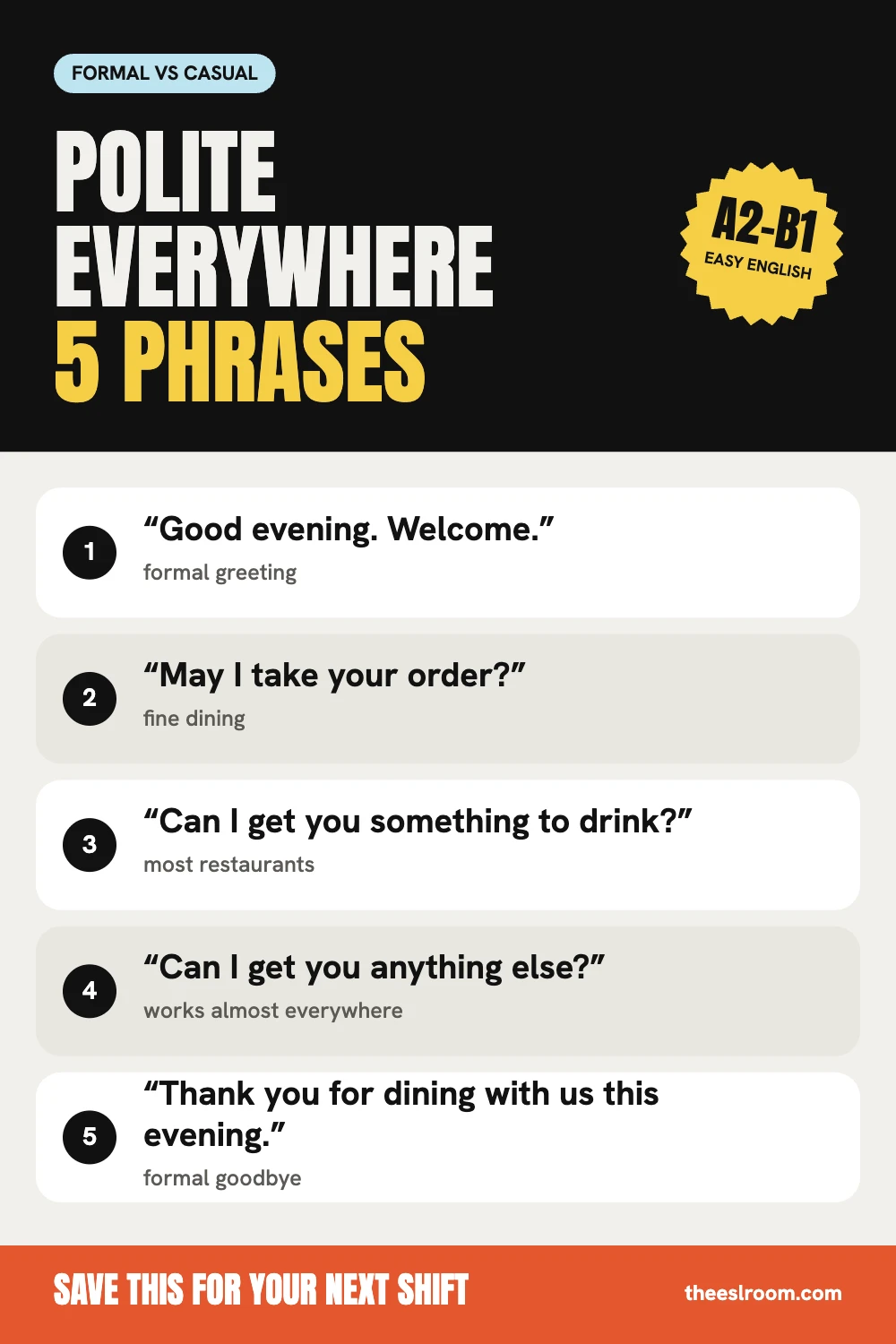
| “Good evening, sir/madam. Welcome to [Restaurant].” | “Hi folks! Welcome!” |
| “May I show you to your table?” | “Follow me, I’ll show you to your table.” |
| “It’s a pleasure to have you with us this evening.” | “Thanks for coming in!” |
| “Allow me to assist with your coat.” | “Can I take your coat?” |
Why it matters: According to WebstaurantStore, a leading restaurant supply company, “Fine dining establishments are characterized by an elegant ambiance, sophisticated table settings, and a menu featuring premium offerings.” The greeting sets the tone for this elegant experience.
INTRODUCING YOURSELF
| Formal (Fine Dining) | Casual (Family Restaurant) |
|---|---|
| “Good evening. My name is James, and I shall be your server this evening.” | “Hey! I’m Sarah, I’ll be taking care of you tonight.” |
| “I will be delighted to assist you this evening.” | “I’ll be your server today.” |
| “Please do not hesitate to ask if you require anything.” | “Just let me know if you need anything!” |
OFFERING DRINKS
| Formal (Fine Dining) | Casual (Family Restaurant) |
|---|---|
| “May I offer you an aperitif while you review the menu?” | “Can I get you something to drink to start?” |
| “Would you care for still or sparkling water?” | “Want some water?” |
| “May I suggest our signature cocktail?” | “You should try our house margarita!” |
| “Certainly, I shall return with your beverages momentarily.” | “Sure, I’ll be right back with those drinks.” |
PRESENTING THE MENU & SPECIALS
| Formal (Fine Dining) | Casual (Family Restaurant) |
|---|---|
| “Allow me to describe this evening’s special offerings.” | “Let me tell you about today’s specials.” |
| “Our chef has prepared a pan-seared Dover sole.” | “The chef made a really good fish special today.” |
| “May I recommend the lamb, which is expertly prepared?” | “The lamb is awesome, you should try it.” |
| “This dish features locally sourced ingredients.” | “This comes with fresh, local stuff.” |
[Internal link opportunity: Reference “How to Describe Food” blog]
TAKING ORDERS
| Formal (Fine Dining) | Casual (Family Restaurant) |
|---|---|
| “May I take your order?” | “What can I get for you?” |
| “Have you made your selection?” | “Ready to order?” |
| “Excellent choice, madam.” | “Great choice!” |
| “How would you prefer your steak prepared?” | “How do you want your steak cooked?” |
| “Would you care for any accompaniments?” | “Do you want any sides with that?” |
CHECKING IN DURING THE MEAL
| Formal (Fine Dining) | Casual (Family Restaurant) |
|---|---|
| “Is everything to your satisfaction?” | “How is everything?” / “Everything good?” |
| “May I offer you anything further?” | “Can I get you anything else?” |
| “Are you enjoying your meal?” | “How’s the food?” |
| “Please let me know if I may be of any assistance.” | “Let me know if you need anything!” |
CLEARING PLATES
| Formal (Fine Dining) | Casual (Family Restaurant) |
|---|---|
| “May I remove your plate?” | “Are you finished with this?” |
| “Have you finished with this course?” | “All done here?” |
| “I shall clear these for you.” | “I’ll get these out of your way.” |
HANDLING PROBLEMS
| Formal (Fine Dining) | Casual (Family Restaurant) |
|---|---|
| “I sincerely apologize for the inconvenience.” | “I’m so sorry about that.” |
| “Allow me to remedy this situation immediately.” | “Let me fix that for you right away.” |
| “I shall inform the kitchen at once.” | “I’ll tell the kitchen right now.” |
| “Please accept our apologies.” | “Sorry about that!” |
[Internal link opportunity: Reference Deep Dive #4 “Handling Food Complaints”]
UPSELLING
| Formal (Fine Dining) | Casual (Family Restaurant) |
|---|---|
| “May I suggest a wine pairing for your meal?” | “Want to add a glass of wine?” |
| “Our dessert selection is quite exceptional.” | “Our desserts are really good!” |
| “I highly recommend the chocolate soufflé.” | “You gotta try the chocolate cake!” |
| “Would you care to begin with an appetizer?” | “Want to start with an appetizer?” |
[Internal link opportunity: Reference Deep Dive #3 “Upselling Without Being Pushy”]
PRESENTING THE CHECK
| Formal (Fine Dining) | Casual (Family Restaurant) |
|---|---|
| “I shall bring your bill presently.” | “I’ll grab your check.” |
| “Here is your check. There is no hurry.” | “Here’s your check, no rush.” |
| “I trust you enjoyed your evening with us.” | “Hope you enjoyed everything!” |
| “We look forward to welcoming you again soon.” | “Come back and see us!” |
SAYING GOODBYE
| Formal (Fine Dining) | Casual (Family Restaurant) |
|---|---|
| “Thank you for dining with us this evening.” | “Thanks for coming in!” |
| “We hope to see you again soon.” | “See you next time!” |
| “Have a pleasant evening.” | “Have a good night!” |
| “It was our pleasure to serve you.” | “Thanks, you guys!” |

Part 3: The “May I” vs “Can I” vs “Do You Want” Rule
This is the most confusing part for ESL workers. When do you use each phrase?
“MAY I” (Most Formal)
Use in: Fine dining restaurants, upscale establishments, formal situations
Why: “May” is the most polite and formal way to ask permission or offer assistance
Examples:
- “May I take your coat?”
- “May I offer you a dessert menu?”
- “May I suggest the wine pairing?”
- “May I remove your plate?”
Important: In formal settings, “May I” shows respect and professionalism
“CAN I” (Moderately Formal/Casual)
Use in: Most restaurants (casual dining, upscale casual, some moderate fine dining)
Why: “Can” is friendly, warm, and professional without being stiff
Examples:
- “Can I get you something to drink?”
- “Can I take that plate for you?”
- “Can I get you anything else?”
- “Can I bring you some dessert?”
Important: This is the “safe” choice for most restaurants
“DO YOU WANT” (Very Casual)
Use in: Casual dining, fast casual, very friendly atmosphere
Why: Direct, warm, conversational
Examples:
- “Do you want some more water?”
- “Do you want to start with an app?”
- “Do you want ketchup with that?”
Important: Don’t use this in fine dining—it sounds too casual
“WOULD YOU LIKE” (Formal but Warmer than “May I”)
Use in: All types of restaurants (versatile)
Why: Polite but not as stiff as “May I”
Examples:
- “Would you like to see the dessert menu?”
- “Would you like another drink?”
- “Would you like me to box that up for you?”
Important: This is safe in ANY restaurant type

Part 4: How to Read Your Restaurant’s Style (In 30 Seconds)
You walk into a new restaurant for your first shift. How do you know which language to use? Look for these clues:
Clue #1: Look at the Menu Prices
Fine Dining: Entrées $40+
Upscale Casual: Entrées $20-40
Casual Dining: Entrées $12-20
Fast Casual: Items under $15
Higher prices = more formal language
Clue #2: Check the Dress Code
Guests in suits and dresses? → Use formal language
Guests in business casual? → Use moderately formal language
Guests in jeans and t-shirts? → Use casual language
Guests in shorts and flip-flops? → Very casual language is fine
Clue #3: Observe the Atmosphere
Indicators of FORMAL restaurants:
- White tablecloths
- Classical music or no music
- Dim lighting, candles on tables
- Multiple pieces of silverware per place setting
- Wine glasses already on the table
- Quiet atmosphere (people speak softly)
Indicators of CASUAL restaurants:
- Paper napkins
- Pop music or TVs playing
- Bright lighting
- Simple table settings (one fork, one knife)
- Louder atmosphere (people laughing, kids playing)
Clue #4: Listen to Other Servers
On your first day, pay attention to how experienced servers speak:
- Do they say “Hey folks” or “Good evening”?
- Do they say “Can I” or “May I”?
- Do they use first names or “Sir/Madam”?
- Are they chatty and casual, or professional and formal?
Copy their style until you learn the restaurant’s culture.
Clue #5: Watch the Manager’s Behavior
If your manager is formal and serious → The restaurant expects formal service
If your manager is relaxed and friendly → Casual service is acceptable

Part 5: Common Mistakes (That Make You Sound Unprofessional)
Mistake #1: Using “Hey” at a Fine Dining Restaurant
Wrong: “Hey guys! What can I get you?”
Right: “Good evening. May I take your order?”
Why it’s wrong: “Hey” is too casual for upscale settings. It makes the restaurant seem less professional.
Mistake #2: Using “May I” at a Burger Joint
Wrong: “May I offer you a beverage to commence your dining experience?”
Right: “Can I get you something to drink?”
Why it’s wrong: Over-formal language at a casual restaurant sounds ridiculous. Guests will think you’re being sarcastic or weird.
Mistake #3: Mixing Formal and Casual Randomly
Wrong:
“Good evening, madam. May I take your order?”
[Two minutes later]
“Want some more water, guys?”
Why it’s wrong: Inconsistency is confusing. Pick a style and stick with it throughout the meal.
Mistake #4: Being Too Casual with Older Guests
Even in casual restaurants, older guests (60+) often prefer more formal service.
Better approach:
Young couple at casual restaurant → “Can I get you guys anything else?”
Older couple at same restaurant → “Can I get you anything else?” (skip “guys”)
Mistake #5: Using Slang
Wrong: “The burger is sick!” (meaning “really good”)
Wrong: “Wanna grab some apps?”
Wrong: “That’ll be awesome!”
Right: “The burger is excellent!”
Right: “Would you like to start with an appetizer?”
Right: “That sounds great!”
Why: Slang is unprofessional in any restaurant
Part 6: The “Sir” and “Madam” Question
Should you call guests “sir” and “madam”? It depends on the restaurant.
When to Use “Sir/Madam”
Fine dining: Always use it
Example: “Certainly, madam. I shall bring that immediately.”
Upscale casual: Use it with older guests or if guests seem formal
Example: “Of course, sir. I’ll get that for you.”
Casual dining: Usually not necessary, but acceptable
Example: “Sure thing!” (no sir/madam needed)
When NOT to Use “Sir/Madam”
- With young guests (under 30) at casual restaurants
- If the guest says “Please, call me John”
- In very casual, friendly atmospheres
- If it feels forced or unnatural
Alternatives to “Sir/Madam”
If you’re uncomfortable with “sir/madam” but want to be polite:
- Use their name if you know it: “Certainly, Mr. Johnson”
- Use general polite language: “Of course, I’ll get that for you”
- Just smile and be warm: “Absolutely, I’ll bring that right away”
Part 7: Adjusting Your Language Style Mid-Conversation
Sometimes you need to change your language style based on how the guest responds to you.
Scenario 1: Guest Wants You to Be More Casual
You: “Good evening. May I take your order?”
Guest: “Hey, no need to be so formal! We’re just here for burgers.”
You: [Switch to casual] “Okay, sounds good! What can I get for you?”
Lesson: If guests tell you to relax, do it. Match their energy.
Scenario 2: Guest Wants You to Be More Formal
You: “Hey guys! What can I get you?”
Guest: [Looks uncomfortable, doesn’t respond warmly]
You: [Switch to formal] “May I bring you something to drink while you look at the menu?”
Lesson: If guests seem uncomfortable with casual language, become more professional.
Scenario 3: Different Guests at the Same Table
You’re serving:
- A young couple (casual)
- An older couple (formal)
Solution: Use moderately formal language with everyone
Example: “Would you like to start with some drinks?” (works for both)
Don’t: Use “Hey guys” with young couple and “Good evening, madam” with older couple. It sounds weird.
Part 8: Cultural Differences in Formality
Different countries have different expectations for restaurant formality.
United States
- Casual dining is very common (most restaurants are casual)
- Servers introduce themselves (“Hi, I’m Maria”)
- First names are normal (servers don’t use last names)
- Friendly, warm service expected
Key phrase: “How are you folks doing today?”
United Kingdom
- More formal than US in similar restaurant types
- “Madam/Sir” used more often
- Less chatty small talk (get to the point)
- Polite but professional
Key phrase: “May I take your order?”
Australia
- Very casual, even in nice restaurants
- First names always used
- Friendly, relaxed atmosphere
- “Mate” sometimes acceptable (depending on the setting)
Key phrase: “What can I get for you?”
Asia (general)
- More formal service culture
- Bowing in some countries (Japan, Korea)
- Respectful titles important
- Less personal chitchat
Note: If you work in an Asian restaurant in a Western country, ask your manager about the expected service style.

Part 9: Practice Exercise (Test Yourself)
For each scenario, choose the correct phrase:
Question 1:
You work at a Michelin-star restaurant. A guest asks for more water. What do you say?
A) “Want some more water?”
B) “Can I refill your water?”
C) “May I refill your water glass?”
Answer: C
Question 2:
You work at a family diner. A young couple asks what you recommend. What do you say?
A) “I highly recommend the chef’s special preparation.”
B) “The burger is really good!”
C) “May I suggest the house specialty?”
Answer: B
Question 3:
You work at an upscale casual bistro. An older gentleman finishes his meal. What do you say?
A) “All done with that?”
B) “May I remove your plate, sir?”
C) “Are you finished?”
Answer: B (formal but not overly stiff)
Question 4:
You work at a fast casual restaurant. A customer orders a sandwich. What do you say?
A) “Certainly. I shall prepare that for you presently.”
B) “Great! That’ll be ready in just a few minutes.”
C) “Excellent choice. Allow me to submit your order.”
Answer: B
Part 10: Building Confidence with Different Language Styles
Tip #1: Practice Both Styles at Home
Write out common phrases in both formal and casual versions:
Greeting:
Formal: “Good evening, welcome to [Restaurant]”
Casual: “Hi! Welcome!”
Taking orders:
Formal: “May I take your order?”
Casual: “What can I get for you?”
Checking in:
Formal: “Is everything to your satisfaction?”
Casual: “How is everything?”
Practice saying both versions out loud until they feel natural.
Tip #2: Watch Videos of Different Restaurant Types
BoldVoice, a professional English training platform, recommends that “a simple ‘Hey there!’ is enough, especially in an informal setting like a local pub or a waffle house” while formal settings require refined language.
Watch YouTube videos of:
- Fine dining service
- Casual restaurant service
- Fast food service
Notice the language differences.
Tip #3: Ask for Feedback
After your first few shifts at a new restaurant, ask your manager:
- “Am I using the right level of formality?”
- “Should I be more casual or more formal?”
- “Are there any phrases I should avoid?”
Don’t be embarrassed to ask. Good managers want you to succeed.
Tip #4: Start More Formal, Then Relax
The safe strategy: When you’re unsure, start with moderately formal language. If guests respond warmly and casually, you can relax your language a bit.
Example:
First interaction: “Good evening, how are you today?” [Formal]
Guest: “Hey, we’re great! Just here for a quick bite.”
Your response: “Awesome! What can I get for you?” [More casual]
This approach prevents you from being too casual at a formal restaurant.
Formal language matters most when handling sensitive situations. Learn exactly what to say when handling customer complaints with our 3-step method.

Part 11: The Complete Quick Reference Guide
Fine Dining (Very Formal)
Always use:
- “May I…”
- “Certainly”
- “I shall…”
- “Sir/Madam”
- Full sentences
Never use:
- “Hey” or “Guys”
- Slang
- Contractions (don’t, can’t)
- Casual greetings
Example sentence: “Good evening, madam. May I offer you a cocktail this evening?”
Upscale Casual (Moderately Formal)
Use:
- “Can I…” or “May I…”
- “Certainly” or “Of course”
- “Would you like…”
- First names okay
Avoid:
- Very casual slang
- “Hey guys”
Example sentence: “Hi! Can I start you off with some drinks?”
Casual Dining (Friendly and Warm)
Use:
- “Can I…”
- “Sure!” or “No problem!”
- “Would you like…” or “Do you want…”
- First names always
- Contractions okay
Avoid:
- Overly formal language
Example sentence: “Hey folks! I’m Sarah, I’ll be taking care of you. What can I get you to drink?”
Fast Casual/Fast Food (Simple and Quick)
Use:
- Simple, direct language
- “Can I…” or “Do you want…”
- Speed over formality
Example sentence: “Hi! What can I get for you today?”
Conclusion: Match Your Language to Your Restaurant
The key to professional restaurant English is understanding that there is no “one right way” to speak. The right language depends on:
- The type of restaurant (fine dining vs casual)
- The guest’s age and style (formal older guests vs casual young guests)
- The restaurant’s culture (what your manager and coworkers do)
- The situation (greeting vs handling a complaint)
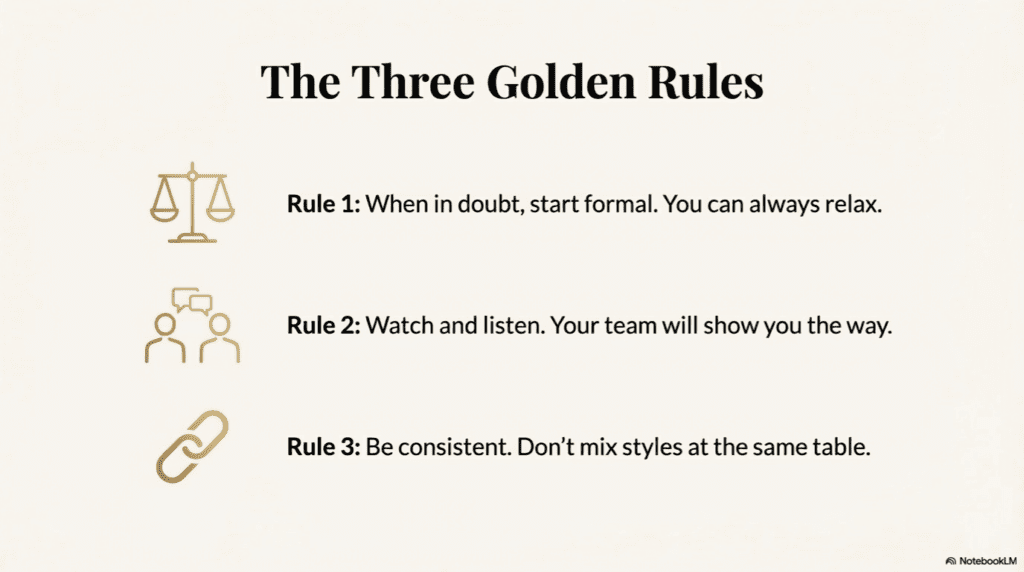
Remember these three golden rules:
Rule 1: When in doubt, start moderately formal. You can always become more casual, but it’s hard to become more formal after being too casual.
Rule 2: Watch and listen to experienced servers. Copy their language style until you learn the restaurant’s culture.
Rule 3: Be consistent. Don’t switch between “May I” and “Hey guys” at the same table.
Your English doesn’t need to be perfect. What matters is:
- Clarity (guests understand you)
- Politeness (you’re respectful)
- Appropriateness (you match the restaurant’s style)
Master these three things, and you will succeed in any restaurant.
Ready to Master Restaurant English?
These free articles and scenarios are a great start, but if you want a complete, structured system for learning restaurant English, consider our full course.
English for Waiters includes:
✅ 22+ video lessons covering every restaurant situation
✅ Real restaurant scenarios with native pronunciation
✅ Interactive pronunciation practice
✅ Downloadable phrase guides
✅ Lifetime access with free updates