Most servers spend more time talking to their coworkers than talking to guests.
You communicate with managers about schedule changes. You ask the chef about special orders. You coordinate with other servers during busy shifts. You check in with bussers and food runners. You work with the host about table assignments.
These workplace conversations happen in English all day, every day.
But here’s the interesting part: the English you use with coworkers is completely different from the English you use with guests.

With guests, you’re polite and formal. With coworkers, you’re direct and efficient. With guests, you have time to be careful with your words. With coworkers, you need to communicate fast because everyone is busy.
This guide teaches you the real workplace English that servers, managers, chefs, and support staff use to communicate effectively. You’ll learn how to speak confidently to your manager, coordinate with kitchen staff, and work smoothly with your team—even during the busiest shifts.
What you’ll learn:
- How to speak to managers professionally (without being too formal)
- Kitchen communication phrases that chefs actually understand
- Team coordination language for busy shifts
- How to ask for help or report problems clearly
- The difference between “front of house” and “back of house” communication styles
Let’s build your workplace communication confidence.
Prefer to listen – Here’s the podcast

Part 1: Understanding Restaurant Workplace Communication
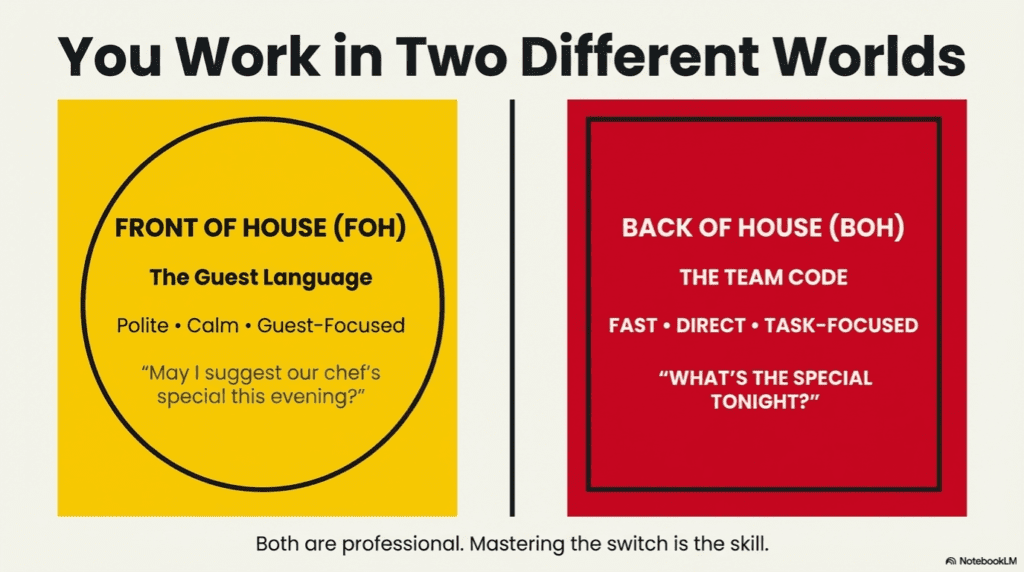
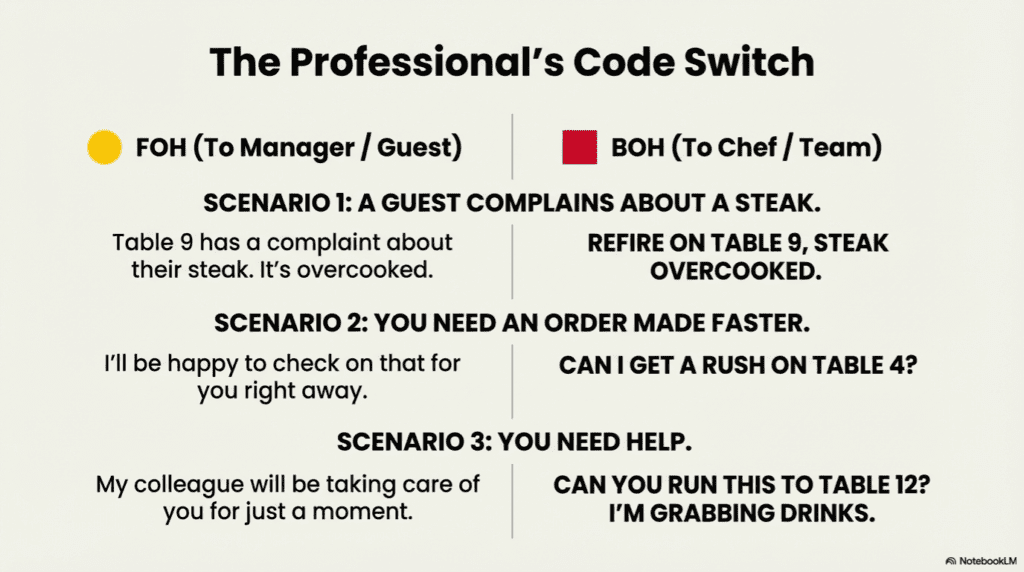
The Two Communication Worlds
In restaurants, you operate in two completely different communication worlds:
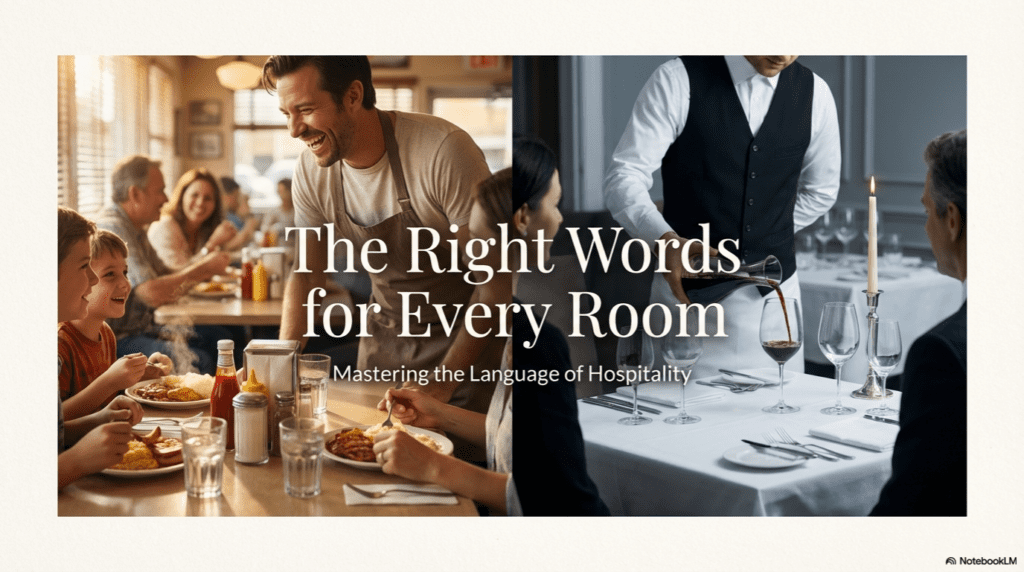
Front of House (FOH): The dining room, bar, and any area guests can see. Communication here is polite, calm, and guest-focused. You use formal phrases and keep your voice pleasant.
Back of House (BOH): The kitchen, prep area, dishwashing station, and storage. Communication here is fast, direct, and task-focused. You use short phrases and speak clearly over kitchen noise.
The language changes completely when you move between these two worlds.
With guests:
- “Would you like me to recommend a wine pairing?”
- “I’ll be happy to bring that right out for you.”
- “May I suggest our chef’s special this evening?”
With coworkers:
- “Table 12 needs wine recommendations.”
- “Firing table 5.”
- “What’s the special tonight?”
Both are professional. But the style is totally different.

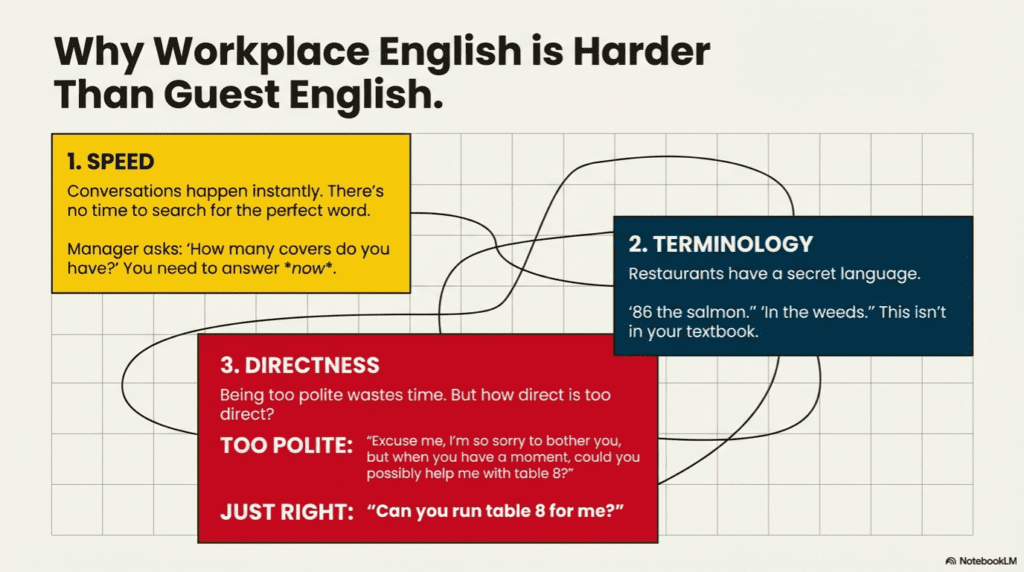
Why Workplace English Feels Difficult
Three reasons why speaking to managers and coworkers can feel harder than speaking to guests:
1. Speed: Workplace conversations happen fast. A manager asks, “How many covers do you have?” You need to answer immediately. You don’t have time to think about perfect grammar.
2. Terminology: Restaurants use specific words that you won’t find in textbooks. “86 the salmon” means something very specific. “In the weeds” has nothing to do with gardens.
3. Directness: With coworkers, being too polite wastes time. Compare:
- Too polite: “Excuse me, I’m so sorry to bother you, but when you have a moment, could you possibly help me with table 8?”
- Just right: “Can you run table 8 for me?”
You need to find the balance between professional and efficient.
Part 2: Speaking to Your Manager
Daily Manager Conversations
Most manager conversations are quick check-ins about practical topics:
Scheduling:
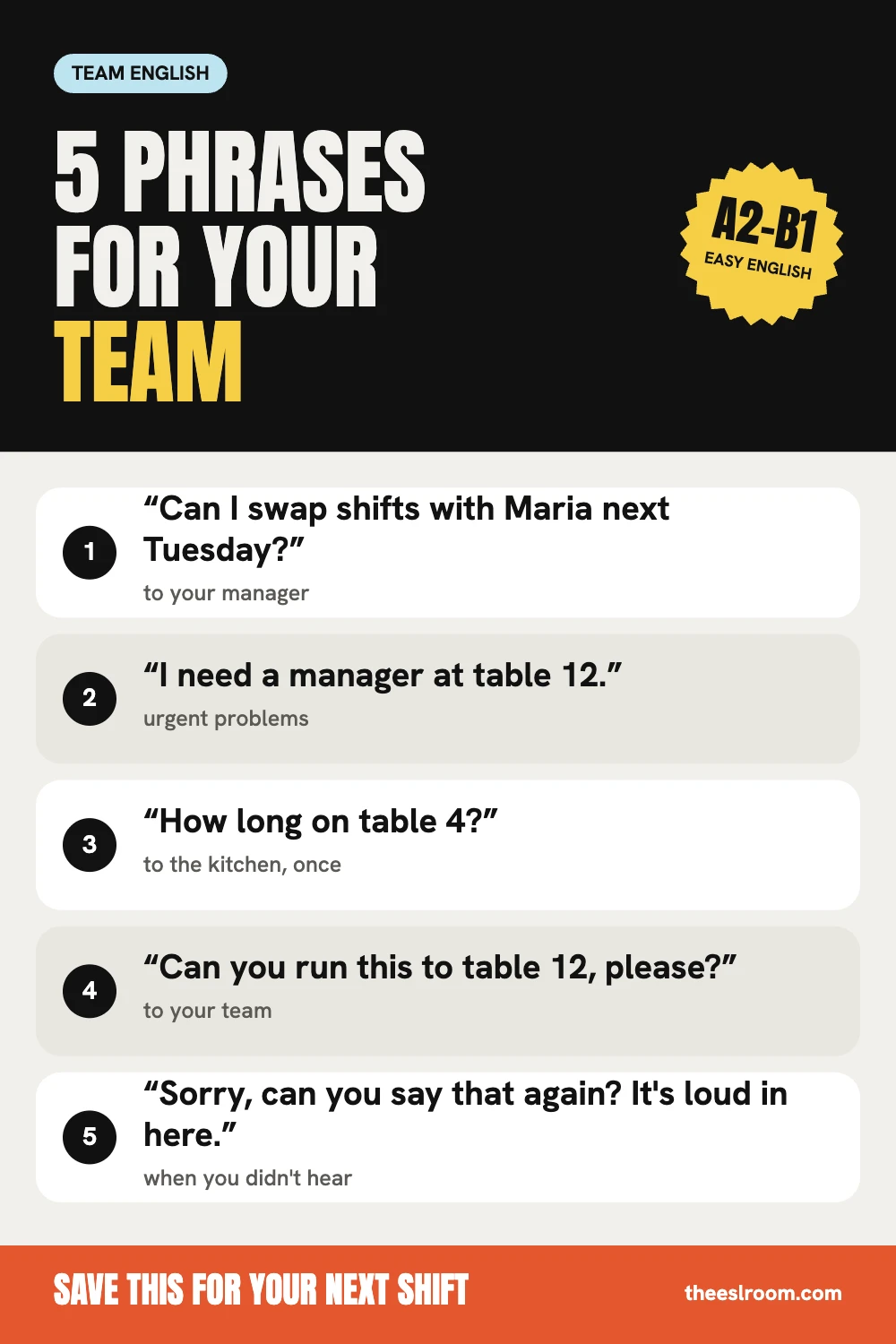
- “Can I swap shifts with Maria next Tuesday?”
- “I need to leave 30 minutes early on Friday. Is that okay?”
- “Are you looking for someone to cover Sunday brunch?”
- “Can I pick up an extra shift this week?”
Table Management:
- “I’m ready for another table.”
- “Can you double-seat me?” (Give me two tables at once)
- “Table 6 asked to speak to a manager.”
- “I need help with table 14.”
Problems or Questions:
- “We’re running low on clean forks.”
- “The espresso machine isn’t working.”
- “Table 9 has a complaint about their steak.”
- “Do we have a highchair available?”
End of Shift:
- “My section is clean and side work is done.”
- “Can I cash out?”
- “Do you need me to stay later?”
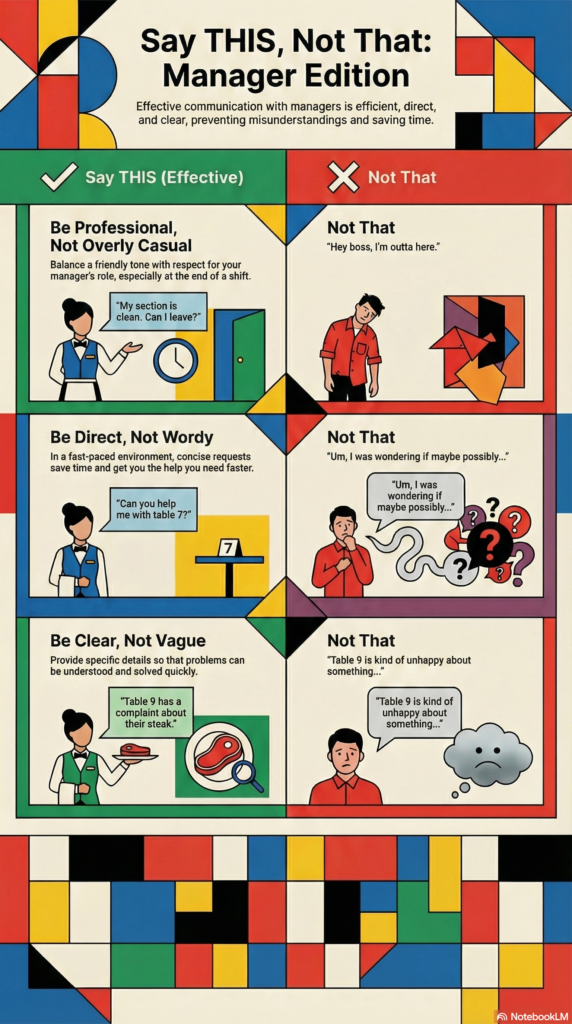
Professional Tone with Managers
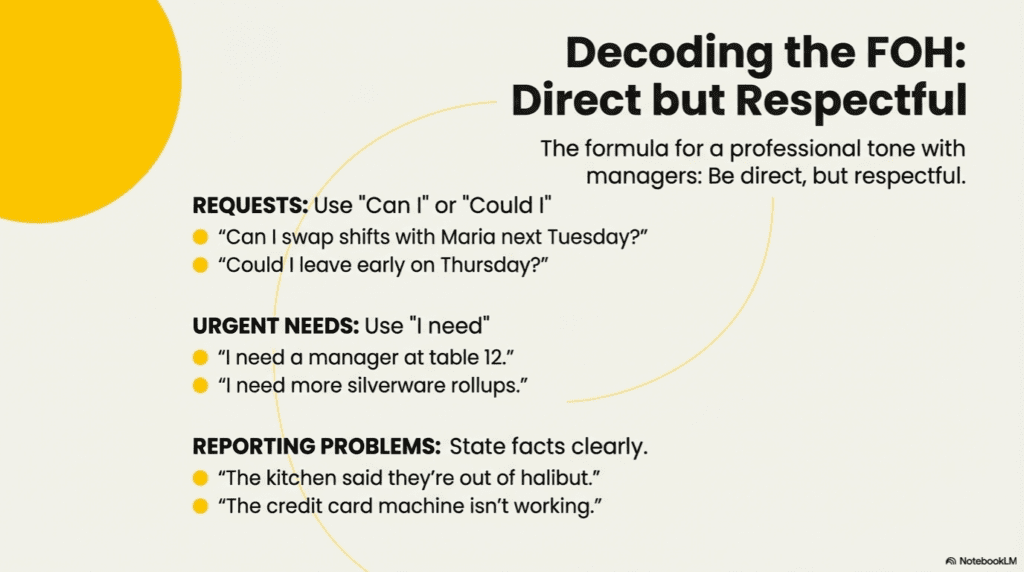
With managers, you want to sound professional but not stiff. Here’s the formula:
Be direct but respectful:
- Good: “I have a question about the new menu.”
- Too casual: “Hey, what’s up with this menu?”
- Too formal: “I apologize for the interruption, but might I inquire about the menu?”
Use “Can I” or “Could I” for requests:
- “Can I take my break now?”
- “Could I leave early on Thursday?”
- “Can I switch sections with Tom?”
Say “I need” for urgent situations:
- “I need a manager at table 12.”
- “I need more silverware rollups.”
- “I need help with a difficult guest.”
Report problems clearly:
- “The kitchen said they’re out of halibut.”
- “Table 7’s order has been waiting for 20 minutes.”
- “The credit card machine isn’t working.”
When Your Manager Gives Instructions
Managers give instructions all shift long. How you respond matters:
If you understand:
- “Got it.”
- “Okay, I’ll do that now.”
- “No problem.”
If you don’t understand:
- “Can you explain that again?”
- “Sorry, what did you say?” (if it’s noisy)
- “Where do I find that?”
If you disagree (be careful):
- “I understand, but table 12 has been waiting for 30 minutes.”
- “Okay, but I’m already taking care of five tables.”
- “Can we talk about this after the rush?”
Never argue with a manager in front of guests or during busy service. If you have a serious concern, ask: “Can we talk about this later?”

Part 3: Communicating with Kitchen Staff
The Kitchen Communication Challenge
The kitchen is loud, hot, and fast-paced. Communication must be clear and direct.
Key rules:
- Speak loudly and clearly
- Use standard kitchen terminology
- Don’t waste the chef’s time
- Never argue during service
Essential Kitchen Phrases
Placing Orders: When you enter orders into the POS system, the kitchen receives them. But sometimes you need to communicate directly:
- “Firing table 10.” (Starting the order)
- “Table 6 is ready for entrees.”
- “Can I get a rush on table 4?” (Make it faster)
- “Table 8 needs no onions on the burger.”
Checking on Orders: Ask once. Then wait. Don’t ask repeatedly.
- “How long on table 12?”
- “Is table 5 ready?”
- “Chef, what’s the wait time on the salmon?”
The chef will give you a time:
- “Two minutes.”
- “It’s working.” (It’s cooking now)
- “Five more minutes.”
Here are 5 effective ways chefs can communicate with wait staff
Accept the answer. Say “Thank you” or just “Thanks.” Then leave the kitchen. Coming back after one minute to ask again will make the chef angry.
Special Requests: Some requests are reasonable. Some are not. Learn which is which.
Reasonable:
- “Can we make the pasta vegetarian?”
- “Guest is allergic to shellfish. Is there any in this dish?”
- “Can we do the steak medium-rare instead of medium?”
Often Not Reasonable:
- “Can we add chicken to the salad?” (if it’s not on the menu)
- “Can we completely change this dish?”
- “Can we make something that’s not on the menu?”
Ask politely: “Is it possible to…” If the chef says no, accept it and offer the guest an alternative.
Problems with Orders:
- “Table 9 said their steak is overcooked.”
- “This isn’t what table 4 ordered.”
- “Table 11 is still waiting for their appetizers.”
State the problem clearly. Don’t blame. Don’t apologize for the guest. Just communicate the facts.
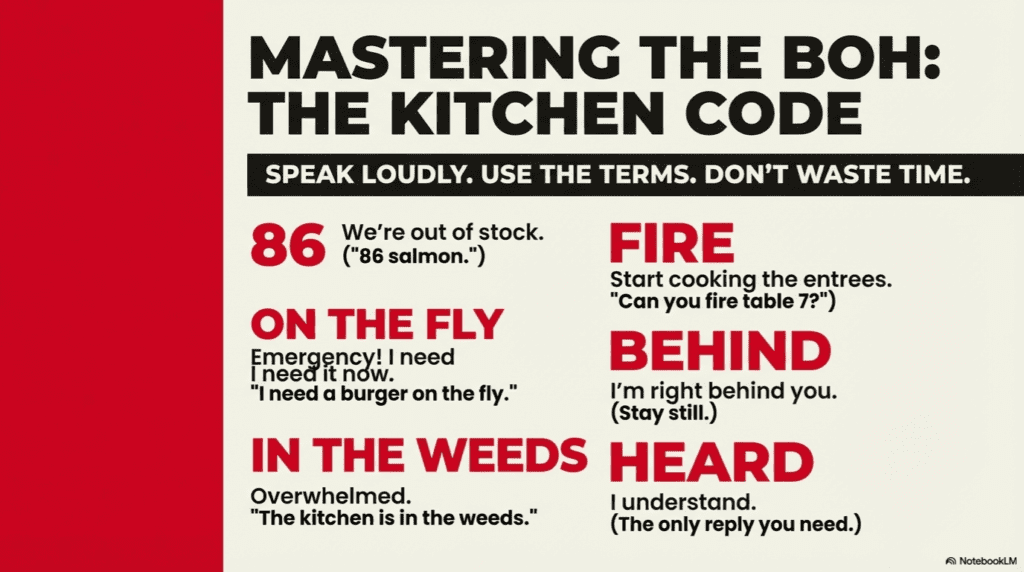
Understanding Kitchen Language
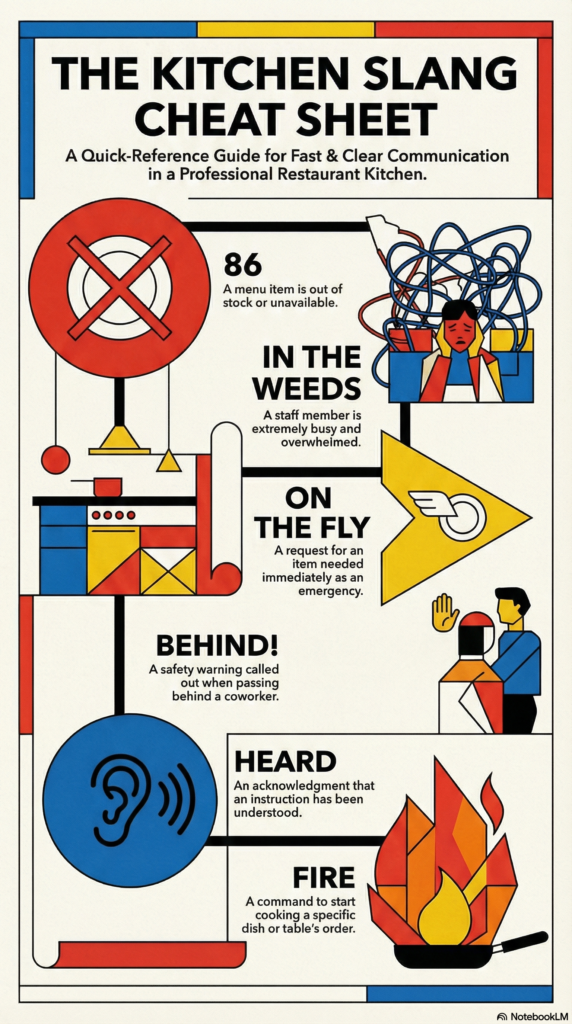
Common kitchen terms you need to know:
“86” (eighty-six): Out of stock
- Chef: “We’re 86 salmon.”
- You: “Okay, no more salmon tonight. Got it.”
“On the fly”: Make it as fast as possible (emergency)
- You: “I need a burger on the fly. I forgot to put in the order.”
- Use this rarely. It means you made a mistake and need help.
“In the weeds”: Very busy, overwhelmed
- Chef: “We’re in the weeds back here.”
- You: “Okay, I’ll tell the host to slow down seating.”
“Fire”: Start cooking
- You: “Can you fire table 7?”
- This tells the kitchen to start cooking the entrees.
“All day”: Total count of an item
- Chef: “How many steaks all day?”
- You: “Three steaks all day.” (Three total steaks across all current orders)
“Behind you!” or “Behind”: Warning that someone is passing behind you
- Anyone: “Behind!” or “Behind you!”
- You: Stay still for one second so they can pass safely.
“Heard”: I understand
- You: “Table 6 needs the steak well-done.”
- Chef: “Heard.”
When the kitchen 86’s an item, you’ll need to handle guest disappointment. Our guide to handling food complaints shows you exactly what to say.

Part 4: Working with Other Servers
Supporting Each Other
Servers work as a team. Good communication makes everyone’s shift easier.
Asking for Help:
- “Can you run this to table 12? I’m grabbing their drinks.”
- “Can you watch my section? I need to use the bathroom.”
- “Can you help me clear table 5? They’re in a hurry.”
Offering Help:
- “Do you need me to run anything?”
- “I can help with your tables if you want.”
- “I’m going to the kitchen—do you need anything?”
Coordinating During Busy Times:
- “I’ve got tables 1-8.”
- “Can you take the next table? I’m full.”
- “Who has table 10?”
- “I’ll cover the patio if you handle inside.”
Communicating About Guests
Sometimes you need to tell another server about a guest situation:
Positive:
- “Table 4 is celebrating an anniversary.”
- “Table 7 is a regular. They always order the ribeye.”
- “Table 12 is really nice.”
Warnings:
- “Table 9 is difficult. Just a heads up.”
- “Table 6 complained about everything.”
- “Table 3 seems upset about the wait time.”
Keep these conversations private. Never let guests hear you talking about other guests.
Part 5: Communicating with Support Staff
Bussers and Food Runners
These team members keep the restaurant running smoothly. Treat them with respect.
To bussers:
- “Can you clear table 8 when they leave?”
- “Table 5 needs water.”
- “I need table 10 reset as soon as possible.”
To food runners:
- “Table 6 is ready for their entrees.”
- “Can you run the desserts to table 9?”
- “This goes to table 4, seat 2.”
Always say “please” and “thank you” to support staff. They make your job easier.
Hosts and Hostesses
Good communication with the host makes your shift smoother.
About seating:
- “I’m ready for another table.”
- “Give me five minutes before you seat me again.”
- “Can you slow down seating? The kitchen is backed up.”
- “Can you double-seat me? I need to make more money tonight.”
About guests:
- “Table 8 asked for a booth.”
- “Table 12 has a birthday—can we get a dessert ready?”
- “The party of six at table 3 will need high chairs.”
Bartenders
If you’re not working in the bar, you’ll need to communicate with bartenders about drink orders.
Ordering drinks: Most restaurants use a POS system, so you don’t need to verbally communicate every drink order. But sometimes you need to:
- “How long on the martinis for table 5?”
- “Table 9 wants to know what IPAs you have on tap.”
- “Can you make table 4’s drinks first? They’ve been waiting.”
During busy times:
- “I have a big drink order coming through.”
- “Table 7 needs their drinks on the fly.”
Be patient. The bartender is handling orders from servers AND bar guests.
Part 6: Problem-Solving Communication
Reporting Problems
Problems happen every shift. How you communicate them matters.
Equipment problems:
- “The espresso machine isn’t working.”
- “The credit card reader is down.”
- “The printer ran out of paper.”
Supply problems:
- “We’re running low on clean forks.”
- “We’re almost out of bread.”
- “We need more wine glasses.”
Guest problems:
- “Table 12 has a complaint about their food.”
- “Table 7 asked to speak to a manager.”
- “Table 9 seems unhappy with the service.”
Report clearly and factually. Don’t exaggerate. Don’t minimize. Just state what’s happening.
Asking Questions
You’ll have questions every shift. Ask them clearly:
About the menu:
- “What’s in the special tonight?”
- “Is the soup vegetarian?”
- “What comes with the salmon?”
- “Can we make substitutions on this dish?”
About procedures:
- “How do I split a check three ways in the system?”
- “Where do I find more napkins?”
- “What’s the policy on employee meals?”
About guests:
- “Did table 8 pay already?”
- “Who took table 12’s order?”
- “Is table 5 part of a reservation?”
Never pretend to know something you don’t know. Ask.

Part 7: Workplace Communication Mistakes to Avoid
Don’t Do These Things
1. Complaining loudly where guests can hear Bad: Standing in the dining room saying “Table 9 is so difficult!” Good: Talk privately in the back if you need to vent
2. Using overly casual language with managers Bad: “Hey boss, I’m out of here.” Good: “My section is clean. Can I leave?”
3. Arguing during service Bad: Stopping to argue with the chef during dinner rush Good: “Okay, we’ll talk about this later.”
4. Asking the kitchen repeatedly Bad: “How long?” (You asked 30 seconds ago) Good: Ask once, get an answer, wait
5. Talking about tips in front of other servers Bad: “I made $200 tonight! How much did you make?” Good: Keep your earnings private
6. Gossiping about coworkers Bad: Talking badly about another server Good: Keep workplace relationships professional
Communication Red Flags
If you find yourself saying these phrases often, you might have a communication problem:
- “Nobody told me that.” → Ask more questions
- “That’s not my job.” → Be a team player
- “I don’t know.” (without finding out) → Find the answer
- “I’m too busy.” (when asked to help) → Manage your time better
Part 8: Professional Communication Skills
Active Listening
Good communication isn’t just about speaking. It’s about listening.
When someone is talking to you:
- Stop what you’re doing (if possible)
- Make eye contact
- Don’t interrupt
- Confirm you understood: “Got it” or “Okay”
If you didn’t hear:
- “Sorry, can you repeat that? It’s loud in here.”
- “What was that?”
- “One more time?”
The restaurant is noisy. It’s completely normal to ask people to repeat themselves.
Clear, Direct Communication
Instead of: “Um, so, I was thinking maybe if it’s okay, could I possibly leave a little bit early? But only if you don’t need me. I mean, if you need me I can stay…”
Say: “Can I leave 30 minutes early tonight?”
Instead of: “So, the thing is, table 9 is kind of unhappy about something, I’m not really sure what, but they seem upset about their food or something…”
Say: “Table 9 has a complaint about their steak. It’s overcooked.”
Direct doesn’t mean rude. Direct means clear and efficient.
Positive Language
Even when you’re busy or stressed, use positive language:
Instead of:
- “I can’t do that right now.” Say:
- “I can do that in five minutes.”
Instead of:
- “That’s not my section.” Say:
- “I’ll find out whose section that is.”
Instead of:
- “I don’t know.” Say:
- “Let me find out for you.”
Positive language makes you easier to work with.
Part 9: Communication During Different Shifts
Pre-Shift Meetings
Many restaurants have brief meetings before service starts.
You might hear:
- “Today’s special is pan-seared halibut with lemon butter sauce.”
- “We’re running low on the ribeye. Push the salmon instead.”
- “We have a large party of 15 at 7:00 PM.”
- “The new dessert menu starts tonight.”
What to do:
- Listen carefully
- Take notes if needed
- Ask questions if something isn’t clear
Good questions to ask:
- “What sides come with the special?”
- “Are there any allergens I should know about?”
- “What’s the price on the new dessert?”
During Slow Times
Use slow times to improve communication:
Check in with the kitchen:
- “Chef, do we have everything for tonight’s service?”
- “Any changes to the menu I should know about?”
Check in with your manager:
- “Is there any side work you need me to do?”
- “Do you need me to stay the full shift?”
Help your coworkers:
- “Do you need help rolling silverware?”
- “Want me to refill the sugar caddies?”
During Busy Times
When it’s busy, communication must be fast and clear:
With managers:
- “I need a manager at table 7.” (Problem)
- “I’m full. Stop seating me for now.” (Can’t take more tables)
- “Kitchen is backed up.” (Slow down seating)
With the kitchen:
- “How long on table 12?” (Quick check)
- “Rush on table 4.” (Emergency)
With other servers:
- “I’ve got your table 6.”
- “Can you grab my drinks?”
- “I’m going to help clear your section.”
No long conversations. Just essential communication.
Part 10: Cultural Communication Differences
Understanding Communication Styles
Different cultures communicate differently at work. Learning these differences helps you work better with everyone.
Direct vs. Indirect:
Some cultures are very direct:
- “You need to clean your section better.”
- “This is wrong. Do it again.”
- “No, we can’t do that.”
Some cultures are more indirect:
- “Maybe we could improve the cleaning a little bit.”
- “Let’s try this a different way.”
- “That might be difficult.”
Both styles are normal. Don’t take direct communication as rude. Don’t interpret indirect communication as unclear.
Hierarchy:
Some workplaces are very hierarchical:
- Always call managers “sir” or “ma’am”
- Don’t question decisions
- Wait to be addressed before speaking
Some workplaces are more casual:
- Call managers by first name
- Ask questions freely
- Speak up with ideas
Watch how others communicate and follow their lead.
When English Isn’t Your First Language
If you’re learning English, working in a restaurant actually helps:
You hear the same phrases every day:
- “How long on table 5?” (You’ll hear this 20 times per shift)
- “86 the salmon.” (You’ll learn this term quickly)
- “Can you run this?” (Common request)
You can ask people to repeat:
- “Sorry, what was that?”
- “Can you say that again?”
- “I didn’t understand. Can you explain?”
You learn by doing:
- Week 1: You ask, “What does ’86’ mean?”
- Week 2: You understand it when others say it
- Week 3: You use it yourself
Tips for non-native speakers:
- Listen to how native speakers communicate
- Write down new phrases you hear
- Practice important phrases before your shift
- Ask questions when you don’t understand
- Don’t apologize for your English—just communicate clearly
Part 11: Building Workplace Relationships
Why Good Relationships Matter
Working in a restaurant is a team sport. Good relationships make:
- Shifts more enjoyable
- Communication easier
- Problems smaller
- Tips better (happy teams create happy guests)
How to Build Good Relationships
Be reliable:
- Show up on time
- Do your side work
- Help when you can
- Don’t call in sick unless you’re actually sick
Be respectful:
- Say “please” and “thank you”
- Don’t talk badly about coworkers
- Respect everyone’s role
- Learn people’s names
Be positive:
- Don’t complain constantly
- Appreciate when others help you
- Celebrate good shifts together
- Support coworkers during tough shifts
Be professional:
- Don’t bring personal drama to work
- Keep romantic relationships private
- Don’t gossip
- Focus on work during work hours
Communication That Builds Trust
Give compliments:
- “You handled that difficult table really well.”
- “Thanks for helping me during the rush.”
- “Your section always looks perfect.”
Admit mistakes:
- “I messed up that order. My bad.”
- “I forgot to tell you about table 9. Sorry.”
- “That was my fault.”
Offer specific help:
- “I can cover your shift on Tuesday.”
- “Want me to show you how to use the new POS system?”
- “I’ll teach you how to open wine bottles.”

Part 12: Practice Exercises
Exercise 1: Match the Situation to the Phrase
Situations:
- You need to leave early
- The printer is broken
- You need help with a table
- The kitchen is out of salmon
- You’re ready for another table
Phrases: A. “Can I get another table?” B. “The printer isn’t working.” C. “We’re 86 salmon.” D. “Can I leave 30 minutes early?” E. “Can you help me with table 7?”
Answers: 1-D, 2-B, 3-E, 4-C, 5-A
Exercise 2: Make It More Direct
Rewrite these phrases to be clearer and more direct:
- “Um, I was wondering if maybe you could possibly help me…”
- “So, there’s kind of a problem with table 9, they’re sort of unhappy…”
- “I’m not really sure, but I think we might be running low on glasses…”
Better versions:
- “Can you help me?”
- “Table 9 has a complaint.”
- “We’re running low on glasses.”
Exercise 3: Choose the Right Phrase
Situation: Speaking to your manager
Which is better? A. “Hey, I’m outta here.” B. “My section is clean. Can I leave?”
Answer: B (professional but not too formal)
Situation: Asking the chef about an order
Which is better? A. “Excuse me, I’m so sorry to bother you, but when you have a moment…” B. “How long on table 5?”
Answer: B (direct and efficient for kitchen communication)
Part 13: Your Workplace Communication Action Plan
Week 1: Listen and Learn
Goals:
- Listen to how managers, chefs, and experienced servers communicate
- Write down 10 new workplace phrases you hear
- Ask one question per shift to clarify something you don’t understand
Focus on:
- How people speak to managers
- What kitchen terminology they use
- How servers coordinate during busy times
Week 2: Practice Basic Communication
Goals:
- Use 3 of the phrases you learned in Week 1
- Speak to your manager at least twice per shift
- Communicate clearly with the kitchen about orders
Practice:
- “Can I take my break now?”
- “How long on table X?”
- “Can you help me with table X?”
Week 3: Build Confidence
Goals:
- Speak up during pre-shift meetings (ask questions)
- Offer to help coworkers
- Report problems clearly when they happen
Challenge yourself:
- Ask the chef a question about the menu
- Request a schedule change from your manager
- Help train a newer server
Week 4: Become a Strong Communicator
Goals:
- Communicate clearly during busy shifts
- Build positive relationships with all team members
- Handle communication problems professionally
Advanced practice:
- Lead a side work task and direct others
- Explain something to a new employee
- Resolve a miscommunication calmly

Conclusion: Communication Is Your Professional Skill
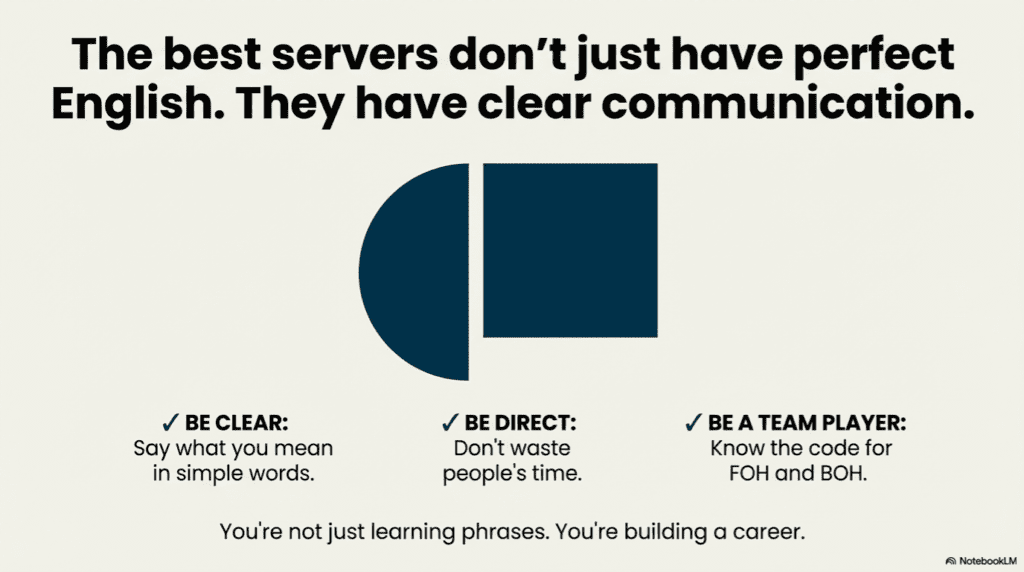
Speaking confidently to managers, chefs, and coworkers isn’t just about English. It’s about:
Being clear: Say what you mean in simple words Being direct: Don’t waste people’s time Being respectful: Use professional language Being reliable: Follow through on what you say Being positive: Make working with you easy
Every shift gives you opportunities to practice these skills.
Every conversation with your manager makes you more professional. Every coordination with the kitchen makes you more efficient. Every interaction with coworkers makes you a better team member.
The servers who succeed aren’t always the ones with perfect English. They’re the ones who communicate clearly, listen carefully, and work well with everyone.
You’re not just learning workplace phrases. You’re building professional communication skills that will help you throughout your entire hospitality career.
Start with one small change:
- This week, practice being more direct with one phrase
- Tomorrow, listen more carefully during pre-shift meeting
- Today, say “thank you” to three coworkers
Good communication builds confidence. Confidence builds careers.
Your workplace communication journey starts now.

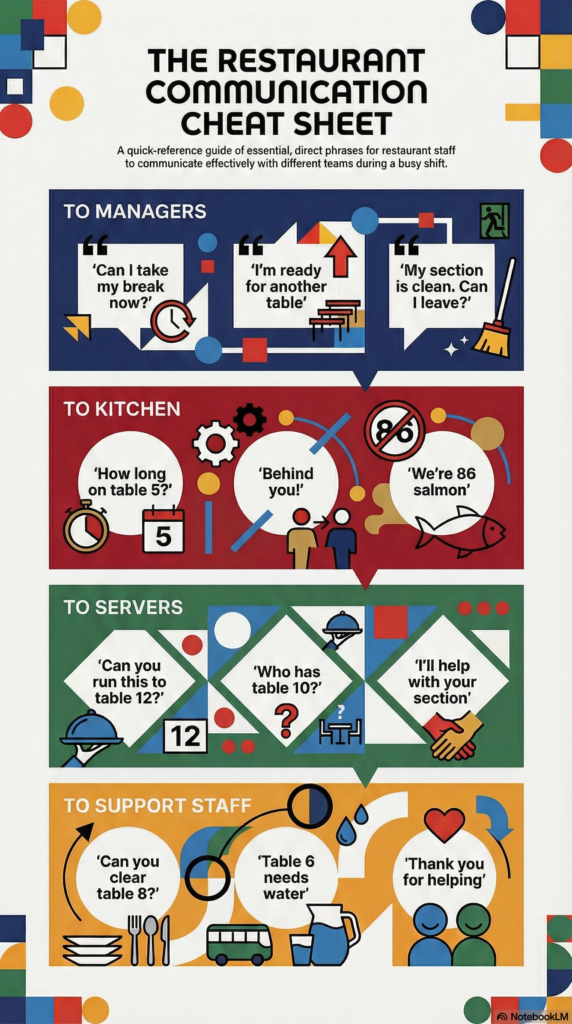
Quick Reference: 50 Essential Workplace Phrases
To Managers:
- “Can I take my break now?”
- “I’m ready for another table.”
- “Can I swap shifts with [name]?”
- “Table X asked for a manager.”
- “I need help with table X.”
- “Can I leave 30 minutes early?”
- “My section is clean and side work is done.”
- “Can I cash out?”
- “Do you need me to stay later?”
- “I have a question about the menu.”
To Kitchen Staff:
- “How long on table X?”
- “Can I get a rush on table X?”
- “Firing table X.”
- “Is table X ready?”
- “We’re 86 the salmon.”
- “Can we make this vegetarian?”
- “Guest is allergic to shellfish.”
- “Table X said their steak is overcooked.”
- “What’s the special tonight?”
- “Behind you!”
To Other Servers:
- “Can you run this to table X?”
- “Can you watch my section? I need to use the bathroom.”
- “Do you need me to run anything?”
- “I’ve got tables 1-8.”
- “Who has table X?”
- “Can you take the next table? I’m full.”
- “I’ll help with your section.”
- “Table X is celebrating an anniversary.”
- “I’m going to the kitchen—do you need anything?”
- “Can you help me clear this table?”
To Support Staff:
- “Can you clear table X when they leave?”
- “Table X needs water.”
- “Can you reset table X?”
- “Table X is ready for entrees.”
- “Can you run the desserts to table X?”
- “This goes to table X, seat 2.”
- “Thank you for helping.”
- “I need table X reset as soon as possible.”
To Hosts:
- “I’m ready for another table.”
- “Give me five minutes before you seat me again.”
- “Can you slow down seating?”
- “Can you double-seat me?”
- “Table X asked for a booth.”
- “Table X has a birthday.”
General Workplace:
- “Got it.”
- “No problem.”
- “I’ll do that now.”
- “Can you explain that again?”
- “Let me find out for you.”
- “We’ll talk about this later.”
Remember: Clear, direct, professional communication builds confidence and makes you invaluable to your team.
Ready to Master Restaurant English?
These free articles and scenarios are a great start, but if you want a complete, structured system for learning restaurant English, consider our full course.

English for Waiters includes:
✅ 22+ video lessons covering every restaurant situation
✅ Real restaurant scenarios with native pronunciation
✅ Interactive pronunciation practice
✅ Downloadable phrase guides
✅ Lifetime access with free updates