Why Numbers and Money Feel Different in English
Carlos had been a server for six months. He could take orders perfectly. He knew every dish on the menu. Guests complimented his service.
But every time a table asked to split the bill four ways, his heart raced.
“Can we split this three ways with cash and one card?”
Carlos froze. His English was good, but numbers under pressure felt impossible. Did they want three equal parts? Or three people paying different amounts? Cash first or card first?
He smiled nervously: “Uh… yes… one moment please.”
At the POS system, he spent five minutes trying to figure out what they actually wanted. The guests looked impatient. Carlos felt stressed. This happened several times every shift.
The problem: Numbers and money conversations in restaurants happen fast, involve mental math, and use specific vocabulary that ESL workers often haven’t learned. You might know “twenty dollars” but freeze when someone says “Can you split it three ways?” or “What’s 20% on $47.80?”
Prefer to listen – Here’s the podcast
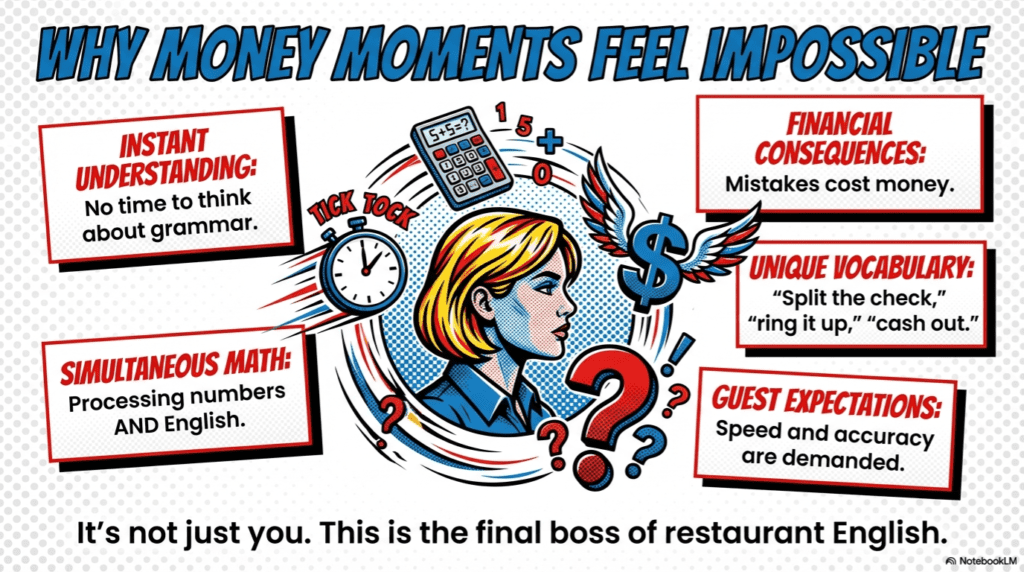
Money conversations are different from other restaurant English because:
- They require instant understanding – No time to think about grammar
- They involve math – You’re processing numbers AND English simultaneously
- They have financial consequences – Mistakes cost money (yours or the restaurant’s)
- They use unique vocabulary – “Split the check,” “ring it up,” “cash out”
- Guests expect speed and accuracy – Slow money handling frustrates people
This guide teaches you the real English servers use for money, payments, bills, and tips. You’ll learn:
- How to talk about prices clearly and confidently
- Payment vocabulary for cash, cards, and digital payments
- How to handle split bills (the #1 money challenge for servers)
- Tip language and etiquette
- How to explain charges and handle payment problems
- Mental math shortcuts in English
By the end of this article, money conversations won’t make you nervous anymore.
Let’s start with the foundation: how to say prices clearly.
Part 1: Saying Prices Clearly and Confidently
The Basics: How to Say Money Amounts
In American English, we say prices in specific ways:
Dollars only:
- $15.00 = “fifteen dollars”
- $32.00 = “thirty-two dollars”
- $100.00 = “one hundred dollars” or just “a hundred dollars”
Dollars and cents:
- $4.50 = “four fifty” OR “four dollars and fifty cents”
- $12.75 = “twelve seventy-five” OR “twelve dollars and seventy-five cents”
- $28.99 = “twenty-eight ninety-nine” OR “twenty-eight dollars and ninety-nine cents”
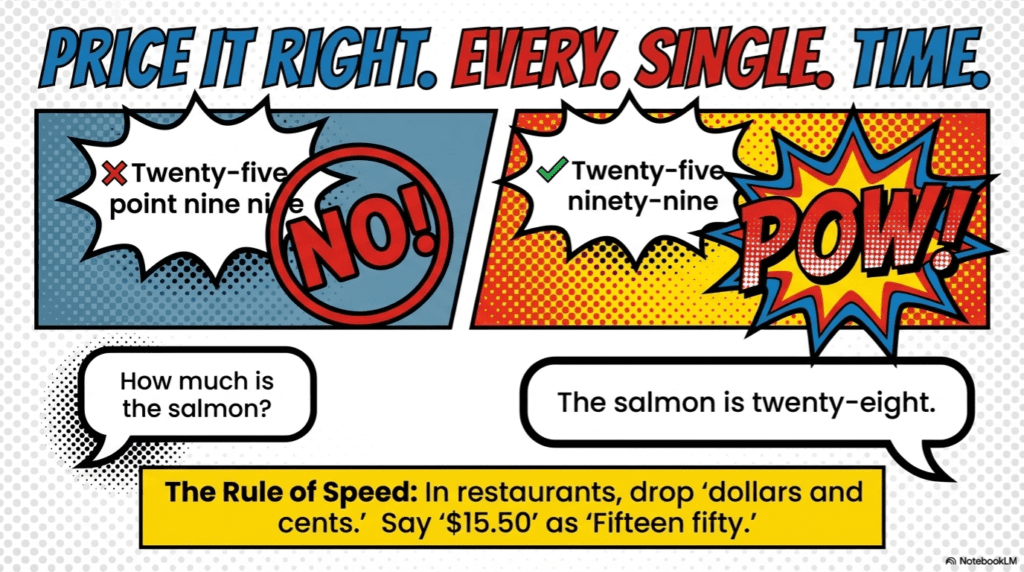
Important: In casual restaurant conversation, we usually drop “dollars and cents”:
- $15.50 = “fifteen fifty” (NOT “fifteen dollars and fifty cents”)
- $23.25 = “twenty-three twenty-five”
With cents only:
- $0.50 = “fifty cents”
- $0.75 = “seventy-five cents”
Common Mistakes When Saying Prices
❌ Mistake: “Fifteen dollar and fifty”
✅ Correct: “Fifteen fifty” OR “Fifteen dollars and fifty cents”
❌ Mistake: “Twenty-five point nine nine”
✅ Correct: “Twenty-five ninety-nine”
❌ Mistake: “Three euros fifty”
✅ Correct: “Three fifty” (in the US, we don’t say the currency unless comparing)
When Guests Ask About Prices
Guest: “How much is the salmon?”
You: “The salmon is twenty-eight dollars.” OR “The salmon is twenty-eight.”
Guest: “What’s the price on the ribeye?”
You: “The ribeye is forty-five.” OR “That’s forty-five dollars.”
Guest: “How much for a glass of the Cabernet?”
You: “The Cabernet is twelve dollars a glass.”
Describing Price Ranges
Sometimes guests ask general price questions:
Guest: “How expensive is this place?”
You: “Most entrées are between twenty-five and forty dollars.”
Guest: “What’s your price range?”
You: “Entrées range from eighteen to thirty-five dollars.”
Guest: “How much should we expect to spend per person?”
You: “Most people spend around fifty to seventy dollars per person with drinks.”
Practice Exercise: Say These Prices Out Loud
- $8.50 = _______________
- $34.99 = _______________
- $12.75 = _______________
- $0.85 = _______________
- $127.00 = _______________
Answers:
- “eight fifty”
- “thirty-four ninety-nine”
- “twelve seventy-five”
- “eighty-five cents”
- “one hundred twenty-seven dollars” or “a hundred twenty-seven”
Part 2: Payment Methods – The Complete Vocabulary
Understanding Payment Types
Modern restaurants accept multiple payment methods. You need to know the English vocabulary for each.
Cash:
- Paper money: bills, dollars
- Coins: change, quarters, dimes, nickels, pennies
Cards:
- Credit card
- Debit card
- Gift card
Contactless:
- Tap to pay
- Contactless payment
- Apple Pay / Google Pay
- Mobile wallet
Asking How Guests Want to Pay
Standard question: “How would you like to pay today?”
Other options:
- “Cash or card?”
- “Will this be cash or card?”
- “How will you be paying?”
- “Are you paying with cash or card?”
Guest Responses You’ll Hear
Cash:
- “Cash, please.”
- “I’ll pay cash.”
- “Can I pay with cash?”
Card:
- “Card, please.”
- “I’ll use my card.”
- “Credit card.”
- “Debit.”
Contactless:
- “Can I tap?”
- “Do you take Apple Pay?”
- “I’ll tap my phone.”
- “Contactless, please.”
Explaining Payment Options
If guests ask what payment methods you accept:
“We accept cash, credit cards, and contactless payments.” “We take all major credit cards plus Apple Pay and Google Pay.” “You can pay with cash, card, or tap to pay.”
When to Mention Payment Limits or Fees
Some restaurants have payment policies:
Minimum for cards: “There’s a ten-dollar minimum for credit cards.”
Cash only: “We’re cash only tonight – the card machine is down.”
No split payments on one check: “We can split the check, but each check needs one form of payment.”
AUTHORITY LINK OPPORTUNITY #1: After this section, link to a restaurant payment methods resource. Consider: https://pos.toasttab.com/blog/on-the-line/check-etiquette OR https://www.lightspeedhq.com/blog/pay-at-the-table/
Part 3: The Bill/Check – Essential Phrases
British vs American English
American English: “check”
British English: “bill”
Both are correct, but in American restaurants, “check” is more common.
American: “Can I get the check?”
British: “Can I have the bill?”
When Guests Request the Check
You’ll hear these phrases:
- “Can we get the check?”
- “Check, please.”
- “We’re ready for the bill.”
- “Could we have the check when you get a chance?”
- “We’d like to pay now.”
How to Respond
Standard responses:
- “Of course, I’ll bring that right out.”
- “Sure, I’ll be right back with that.”
- “No problem, I’ll grab that for you.”
- “Absolutely, one moment.”
If they need more time:
- “No rush, I’ll bring it over when you’re ready.”
- “Take your time – I’ll leave it here.”
Presenting the Check
What to say when you bring it:
- “Here’s your check.” (Simple and professional)
- “Here you go – no rush.” (Friendly, gives them time)
- “Whenever you’re ready.” (After placing it on the table)
- “I’ll be back when you’re ready.” (If paying at the table)
Don’t say:
- ❌ “Here’s your bill, please pay immediately.”
- ❌ “You need to pay now.”
- ❌ “I’ll wait here while you pay.” (Unless you’re taking payment at the table)
Check Vocabulary
Receipt: The paper proof of payment (given AFTER payment)
Check/Bill: The amount owed (given BEFORE payment)
Total: The final amount to pay
Subtotal: The amount before tax and tip
Tax: Government charge (varies by location)
Gratuity/Service charge: Pre-added tip (usually for large parties)
Part 4: Splitting the Check – The #1 Payment Challenge
Why Split Bills Are Difficult
Splitting bills is the most stressful money situation for many servers because:
- Every table splits differently
- Guests change their minds mid-process
- Some POS systems make it complicated
- Math errors are embarrassing
- It slows down service
But with the right English phrases, you can handle any split bill request confidently.
Here’s a great article dedicated to bill splitting.
Understanding Split Bill Requests
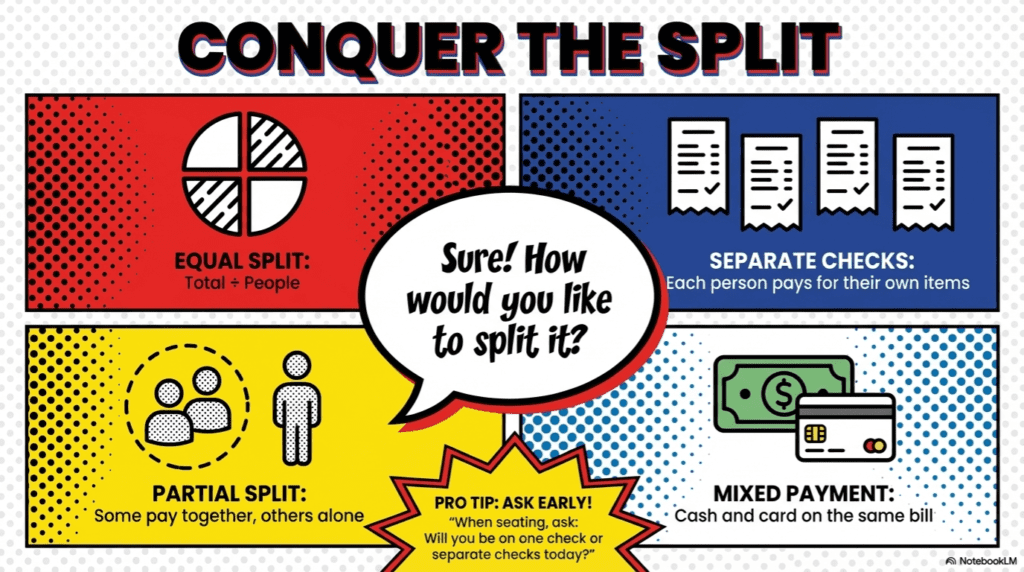
Equal splits: When guests want the bill divided evenly among everyone.
“Can we split this four ways?” = Divide total by 4, everyone pays equal amount
Separate checks: When each person pays only for what they ordered.
“Can we get separate checks?” = Individual bills for each person
Partial splits: When some people pay together, others pay separately.
“Can we get two checks – one for us three, and one for them?” = One check for 3 people, separate check for the others
Mixed payment methods: When people use different payment methods on the same bill.
“Can I pay half with cash and half with card?” = One bill, two payment methods
Essential Split Bill Phrases
When guests ask to split:
Request: “Can we split the check?”
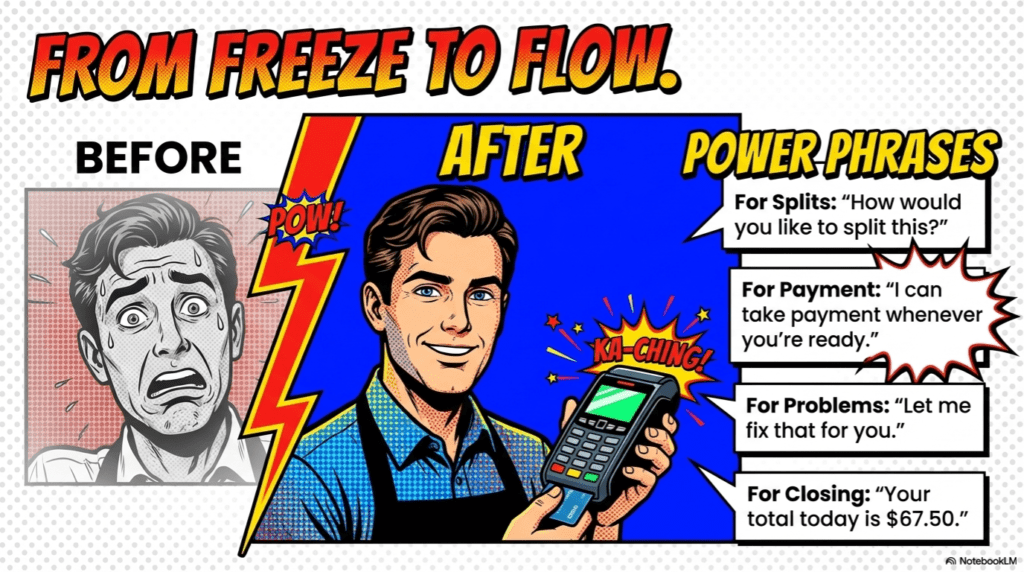
Your response: “Sure! How would you like to split it?”
Request: “Separate checks, please.”
Your response: “No problem. Let me get those for you.”
Request: “Can you split this three ways?”
Your response: “Of course. That’s [amount] each.”
Request: “Can we get separate checks?”
Your response: “Absolutely. I’ll print those out.”
Important: Ask BEFORE or EARLY
The best time to handle splits is before or early in the meal:
When seating: “Will you be on one check or separate checks today?”
When taking orders: “Are you together on one check or separate?”
After ordering: “Just to confirm – is this one check or separate?”
Why this matters: Splitting checks AFTER people order is much harder in the POS system.
Common Split Scenarios and How to Handle Them
Scenario 1: Equal split Guest: “Can we split this four ways?”
Your response:
- “Sure, that’s [total divided by 4] each.”
- Calculate quickly: “$85 split four ways is $21.25 each.”
- “I can run four cards for $21.25 each.”
Scenario 2: Separate checks Guest: “We need separate checks.”
Your response:
- “No problem. Did you want me to split it by seat or by what each person ordered?”
- “I can do that. Let me get those printed for you.”
Scenario 3: Couples split Guest: “Can you split it so each couple pays for their own?”
Your response:
- “Sure, so two checks total?”
- “Got it – I’ll do two separate checks.”
Scenario 4: One person pays partial amount Guest: “I need to pay for just my meal – I’m leaving early.”
Your response:
- “No problem, I can run your portion separately.”
- “What did you have?” (Verify their items)
- Process their portion, leave the rest for the table
Scenario 5: Cash and card combo Guest: “Can I pay $40 in cash and the rest on card?”
Your response:
- “Sure, the total is $67.50. You’re paying $40 cash, so the remaining $27.50 will go on your card.”
- Take the cash first, then process the card for the remaining amount
Scenario 6: Too many splits (restaurant policy) Guest: “Can you split this eight ways?”
If your restaurant allows it:
- “Yes, I can do that. That’s [amount] each.”
If your restaurant has limits:
- “I can split it up to four ways, but for eight people, it’s easier if we do it by couples or groups.”
- “Our system can handle up to four cards. Would it work to have a few people pay and then settle up among yourselves?”
When Splits Get Complicated
Sometimes guests make split requests that are very difficult:
❌ Difficult: “I’ll pay for my salad, my wine, and half of the shared appetizer, but not my dessert because Sarah is treating me to that, and I want to split the tax and tip proportionally based on my actual consumption.”
What to say: “I understand. The easiest way to handle this is if I give you the total, and you all settle up how you’d like. Our system makes it hard to split this specifically.”
Or:
“I can split it a few different ways, but that specific breakdown would be tricky. Would it work if one person paid and everyone sent them money afterward?”
Modern solution: Many guests use Venmo, Cash App, or Zelle to settle up among themselves AFTER one person pays the full bill. This is actually easier for everyone.
For the complete step-by-step process from start to finish, see our detailed guide on managing payment and separate checks.
Part 5: Taking Payment – The Complete Process
Payment at the Table vs. Payment at POS
Payment at the table (handheld device): You bring a card reader to the table. Guest pays right there.
Payment at POS (Point of Sale terminal): You take the payment method to your POS station and process it there.
Step-by-Step: Processing Payment at POS
This is the traditional American restaurant payment method.
Step 1: Guest signals they’re ready
- They place their card on top of the check
- They place cash in the check folder
- They say “We’re ready to pay”
Step 2: Collect payment method
- “I’ll take this for you.”
- “I’ll be right back.”
- Pick up the check folder with their card/cash inside
Step 3: Process payment at POS
- Swipe/insert/tap the card
- Process the transaction
- Print the receipt
Step 4: Return with receipt
- “Here’s your card and receipt.”
- “Thank you, I’ll be right back with your change.” (if cash)
- Place items back in check folder on the table
Step-by-Step: Payment at the Table (Handheld Device)
This is becoming more common.
Step 1: Bring the device
- “I have your check here. I can take payment right here if you’d like.”
Step 2: Enter amount (if needed)
- “The total is $47.50.”
- Input amount in the device
Step 3: Guest pays
- “You can insert, swipe, or tap.”
- “Whenever you’re ready.”
Step 4: Add tip
- The device prompts for tip percentage
- “You can add your tip on the screen.”
Step 5: Complete transaction
- “Would you like a receipt?”
- Print or email receipt if requested
Payment Vocabulary
Swipe: Slide the magnetic strip through the reader (old method)
Insert: Put the chip card into the reader
Tap: Touch the contactless card/phone to the reader
Pin: Personal Identification Number (for debit cards)
Sign: Write signature on receipt
Receipt: Proof of payment
Common Payment Phrases
Processing the payment:
- “I’ll run this for you.”
- “One moment while I process this.”
- “This will just take a second.”
If the card is declined:
- “It looks like the card was declined. Do you have another card?”
- “The payment didn’t go through. Would you like to try another card?”
- (Never say: “You don’t have enough money” – be diplomatic)
For cash payments:
- “Out of [amount they gave you].” (Example: “Out of forty” = they gave you $40)
- “Your change is [amount].”
- “Would you like your receipt?”
For card payments:
- “Sign here, please.”
- “Here’s your copy.”
- “Would you like a receipt?”
Part 6: Tips and Gratuity – Money and Etiquette
Understanding American Tipping Culture
Standard tip: 15-20% of the total bill (before tax)
Typical breakdown:
- Bad service: 10-15%
- Average service: 15-18%
- Good service: 18-20%
- Excellent service: 20%+
Important: In the US, servers often earn minimum wage or less, so tips are a major part of their income. This is different from many other countries.
Gratuity vs. Tip
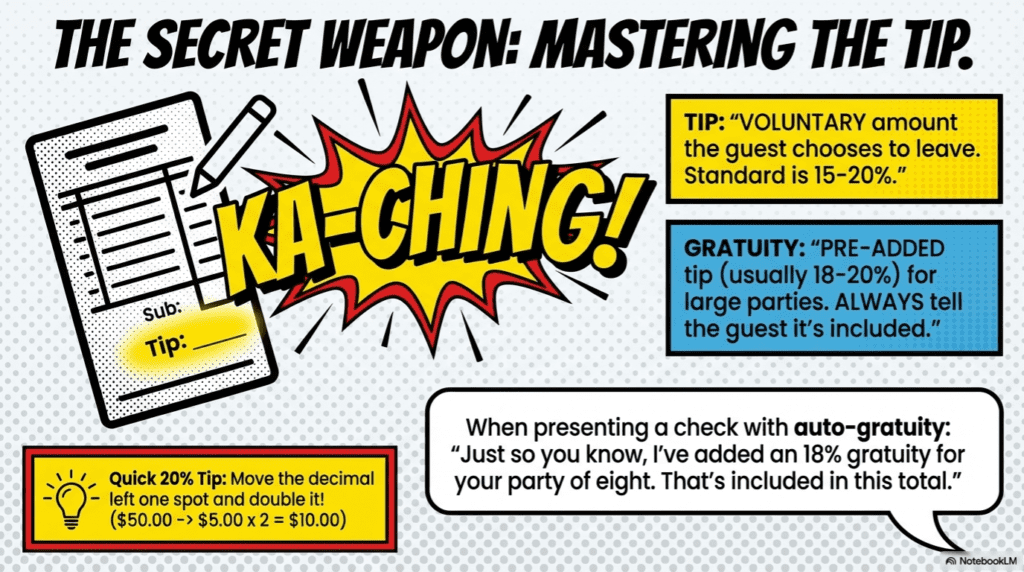
Tip: Voluntary amount the guest chooses to leave
Gratuity: Pre-added tip (usually 18-20% for parties of 6+)
Service charge: Same as gratuity
When Gratuity Is Added Automatically
Most restaurants add automatic gratuity for large parties.
What to say when presenting the check: “I’ve added an 18% gratuity for your party of eight. That’s included in this total.”
“Just so you know, there’s an automatic 20% service charge for parties of six or more.”
“The gratuity is already included – it’s shown here on the check.”
Why this matters: If you don’t tell guests that gratuity is included, they might tip twice (great for you!) or feel deceived when they notice later (bad for the restaurant).
Tip Vocabulary
Tipped out: Money you share with bussers, bartenders, food runners
Tip pool: All tips combined and shared among staff
Cash tip: Tip left in cash on the table
Card tip: Tip added to the credit card payment
Stiff/Stiffed: Get no tip (slang)
Example: “Table 12 stiffed me” = Table 12 left no tip
Guests’ Tip Questions
Question: “Is tip included?”
Answer: “No, gratuity is not included.” OR “Yes, I’ve added 18% for your large party.”
Question: “How much should we tip?”
Answer: “That’s entirely up to you, but 18-20% is standard.” (Be careful – some restaurants don’t allow servers to suggest tip amounts)
Question: “Can I add the tip to my card?”
Answer: “Absolutely, there’s a line for that on the receipt.”
Question: “Do you get to keep all the tips?”
Answer: “I split tips with our support staff, but yes, tips go to the servers.” (Be honest but brief)
Adding Tip to Card Payments
On the printed receipt:
Subtotal:    $45.00
Tax:         $ 3.60
Total:       $48.60

Tip:         _______
Final Total: _______
Guests write in their tip amount and calculate the final total.
Common tip calculations:
- 15% of $50 = $7.50
- 18% of $50 = $9.00
- 20% of $50 = $10.00
Quick tip calculation method: “20% is easy – just move the decimal point left one place and double it.”
- $50.00 → $5.00 → $5.00 × 2 = $10.00
When Guests Leave Cash Tips
If they leave cash on the table:
- Pick it up after they leave
- Don’t assume it’s all tip – they might have left exact change for the bill
If they hand you cash directly:
- “Thank you so much.”
- Don’t count it in front of them
Discussing Tips Professionally
With coworkers:
- “How were your tips tonight?”
- “I made decent money today.”
- “It was a slow night for tips.”
Never:
- Complain about specific tables’ tips
- Discuss exact tip amounts where guests can hear
- Judge guests for low tips
Part 7: Handling Money Problems and Questions
When the Bill Seems Wrong
Guest: “I think there’s a mistake on the bill.”
Your response:
- Stay calm and professional
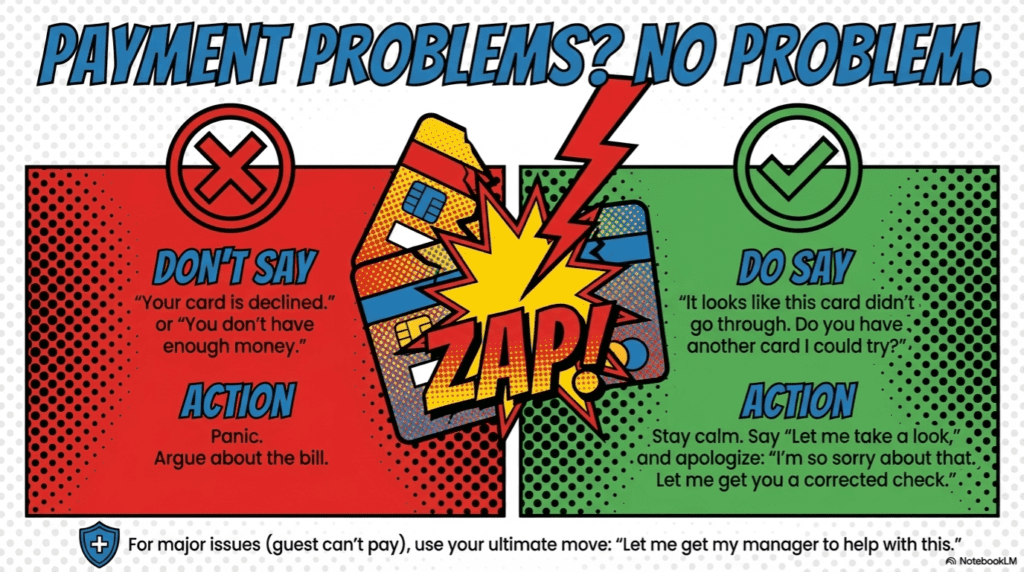
- “Let me take a look.”
- Review the check with them
- “I see the issue. Let me fix that for you.”
Common billing errors:
- Items charged twice
- Wrong prices
- Items they didn’t order
- Tax calculated incorrectly
How to handle:
- Acknowledge the problem
- Fix it immediately
- Apologize (even if it wasn’t your fault)
- “I’m so sorry about that. Let me get you a corrected check.”
When Payment Is Declined
This is awkward but happens regularly.
Card declined – what to say: “It looks like this card didn’t go through. Do you have another card I could try?”
Never say:
- ❌ “You don’t have enough money.”
- ❌ “Your card is declined.”
- ❌ “This card doesn’t work.”
If multiple cards are declined: “The system isn’t accepting cards right now. Do you have cash, or would you like to use a different card?”
Sometimes it’s the restaurant’s card reader, not the guest’s card.
Missing Money / Can’t Pay Situations
Very rarely, guests can’t pay their bill.
Standard procedure:
- Get the manager immediately
- “Let me get my manager to help with this.”
- Don’t argue or accuse
- Let the manager handle it
Never:
- Chase guests who leave without paying
- Accuse them of stealing
- Use aggressive language
This is a security and legal issue – always involve management.
Change-Related Issues
Guest needs change: “I need change for a hundred.”
Your response: “Let me check if I can break a hundred. One moment.”
If you can’t make change: “I’m sorry, we don’t have enough small bills right now. Do you have anything smaller?”
Making change: Always count change back to guests: “Your change is $12.50. Here’s ten, and two-fifty.”
Part 8: Money Math in English – Quick Mental Calculations
Calculating Tips Quickly
20% method (easiest): Move decimal left one place, then double it
- $45.00 → $4.50 → $9.00
10% method: Move decimal left one place
- $45.00 → $4.50 = 10%
- Double it for 20%: $9.00
15% method: Calculate 10%, then add half of that
- $40.00 → 10% = $4.00 → Half of $4.00 = $2.00 → Total = $6.00
18% method: Calculate 20%, then subtract 10% of the original
- $50.00 → 20% = $10.00 → 10% = $5.00 → $10 – $1 = $9.00
Splitting Bills Mentally
Equal splits:
- 2 people: Divide by 2
- 3 people: Divide by 3
- 4 people: Divide by 4
Quick division examples:
- $60 ÷ 2 = $30 each
- $90 ÷ 3 = $30 each
- $80 ÷ 4 = $20 each
For harder numbers:
- $73 ÷ 2 = approximately $36-37 each
- $85 ÷ 3 = approximately $28-29 each
Say: “It comes out to around [amount] each.”
Calculating Tax (varies by location)
Example: 8% tax $50.00 × 0.08 = $4.00 tax
Quick method: 10% = $5.00 8% = a little less than $5.00 = approximately $4.00
Adding Everything Together
Sample bill:
- Subtotal: $42.00
- Tax (8%): $3.36
- Total: $45.36
- Tip (20%): $9.07
- Final: $54.43
Guests often round up, so $54.43 becomes $55.00 or $60.00 total.
Part 9: Digital Payments and Modern Technology
QR Code Payments
Some restaurants now use QR codes for payment.
What to say: “You can scan this QR code to pay directly from your phone.” “Your check has a QR code – scan it to pay.” “We offer QR code payment for your convenience.”
Mobile Wallets
Apple Pay, Google Pay, Samsung Pay, etc.
Guests ask: “Do you take Apple Pay?”
Your response: “Yes, we accept all contactless payments.” “Yes, you can tap your phone here.”
Payment Apps for Splitting
Many guests now use Venmo, Cash App, Zelle to split bills among themselves.
What you might hear: Guest: “Can one person pay and we’ll Venmo each other?”
Your response: “Of course, that works great.”
This is actually the easiest way to handle complicated splits.
Tableside Tablets
Some restaurants have tablets at tables for ordering and payment.
Explaining to guests: “You can pay directly on the tablet when you’re ready.” “The tablet will walk you through payment and adding your tip.” “Just follow the prompts on the screen.”
Here’s a details piece on paying at the table.
Part 10: Professional Money Communication
Being Direct But Polite
Money conversations require clarity, not extra politeness.
Too indirect: “Um, so, like, if you’re maybe ready sometime soon, we could possibly discuss payment?”
Just right: “Are you ready for your check?”
Too aggressive: “You need to pay now.”
Just right: “I’ll bring your check whenever you’re ready.”
When to Follow Up
If guests have had the check for a long time:
After 10-15 minutes: “Can I take that for you?” (gesture to check folder)
If they seem to be waiting: “Were you ready for me to take this?”
If the restaurant is closing: “Just to let you know, we’ll be closing in about 15 minutes.”
Handling Awkward Money Moments
Guest shorts you on cash: The bill is $45, they give you $40.
What to say: “The total is $45, I have $40 here.”
Guest asks for discount: “Can we get a discount?”
Your response: “Let me check with my manager about that.”
(Never offer discounts without manager approval)
Large bill sticker shock: Guest seems surprised by the total.
What to say: “Would you like me to go over the check with you?” “I can break down these charges if that helps.”
Professional Money Phrases
Confirming totals:
- “Your total today is $67.50.”
- “That comes to $82.35 with tax.”
- “All together, that’s $54.20.”
Taking payment:
- “I’ll take care of this for you.”
- “I’ll be right back with your receipt.”
- “I’ll run this and bring back your card.”
Thanking guests:
- “Thank you so much.”
- “I appreciate it, thank you.”
- “Thanks for coming in.”
Part 11: Common Money Mistakes to Avoid
Mistake #1: Not Explaining Charges
❌ Bad: Guest sees unexpected charge, gets angry
✅ Good: “Just so you know, there’s a $3 side substitution charge for the sweet potato fries instead of regular fries.”
When to mention extra charges:
- Side substitutions
- Extra protein
- Premium ingredients
- Split plate charges
- Automatic gratuity
Mistake #2: Counting Money in Front of Guests
❌ Bad: Counting your tips at the table
✅ Good: Wait until you’re in the back to count tips
❌ Bad: Counting change multiple times nervously
✅ Good: Count once carefully, hand it over confidently
Mistake #3: Arguing About Tips
❌ Bad: “You only left 10%! The service was good!”
✅ Good: Say nothing. (Tips are voluntary)
Never:
- Complain about low tips to the guest
- Chase guests who leave low/no tips
- Make faces when you see the tip amount
Mistake #4: Being Unclear About Splits
❌ Bad: Guest says “split it” and you guess what they mean
✅ Good: “How would you like me to split this – equal amounts or separate checks?”
Mistake #5: Not Knowing Your POS System
❌ Bad: Taking 10 minutes to figure out how to split a check
✅ Good: Practice splitting bills during training
Learn these functions:
- How to split equally
- How to move items between checks
- How to process partial payments
- How to void/comp items (with manager approval)
Mistake #6: Confusing Bill and Receipt
Bill/Check: What guests owe (given before payment)
Receipt: Proof of payment (given after payment)
❌ “Here’s your receipt.” (before they’ve paid)
✅ “Here’s your check.”
Part 12: Building Money Confidence – Practice Scenarios
Scenario 1: Split Bill
Guest: “Can we split this three ways?”
You say: “Of course. That’s $28.50 each.”
OR
“Sure, would you like three separate checks or three cards on one check?”
Scenario 2: Card Declined
System: DECLINED
You say: “It looks like this card didn’t go through. Do you have another card I could try?”
Scenario 3: Cash Payment
Guest gives you: $100
Bill is: $67.50
You say: “Out of a hundred. Your change is $32.50.”
Scenario 4: Complicated Split Request
Guest: “Can I pay for my meal plus the appetizer we shared, but not the drinks?”
You say: “The easiest way would be if I split it by seat – you’d have your entrée, half the appetizer, and your drinks would stay on the main check. Does that work?”
Scenario 5: Tip Question
Guest: “Is gratuity included?”
You say: “No, gratuity is not included. That’s optional and up to you.”
OR
“Yes, I’ve added 18% gratuity for your party of eight. That’s shown here on the check.”
Part 13: Your Money English Action Plan
Week 1: Master the Basics
Practice:
- Saying prices out loud (repeat 20 prices per day)
- Payment method vocabulary
- Basic check phrases
Memorize:
- “How would you like to pay?”
- “Here’s your check, no rush.”
- “I can take payment whenever you’re ready.”
Week 2: Handle Splits Confidently
Focus on:
- Understanding different split types
- Asking clarifying questions
- Mental math for equal splits
Practice:
- Split imaginary bills different ways
- Learn your POS system’s split function
- Rehearse: “How would you like to split this?”
Week 3: Perfect the Payment Process
Master:
- The full payment sequence
- Card and cash handling
- Receipt language
Watch:
- How experienced servers handle payments
- Their speed and confidence
- Their word choices
Week 4: Professional Money Communication
Advanced skills:
- Handling payment problems gracefully
- Quick tip calculations
- Digital payment options
Goal:
- Handle any money situation without stress
- Explain charges clearly
- Process payments efficiently
Conclusion: Money Confidence Changes Everything
Money conversations aren’t hard because of English. They’re hard because they combine:
- Speed (guests expect fast service)
- Math (calculating splits and tips)
- Precision (money mistakes have consequences)
- Vocabulary (specific payment terms)
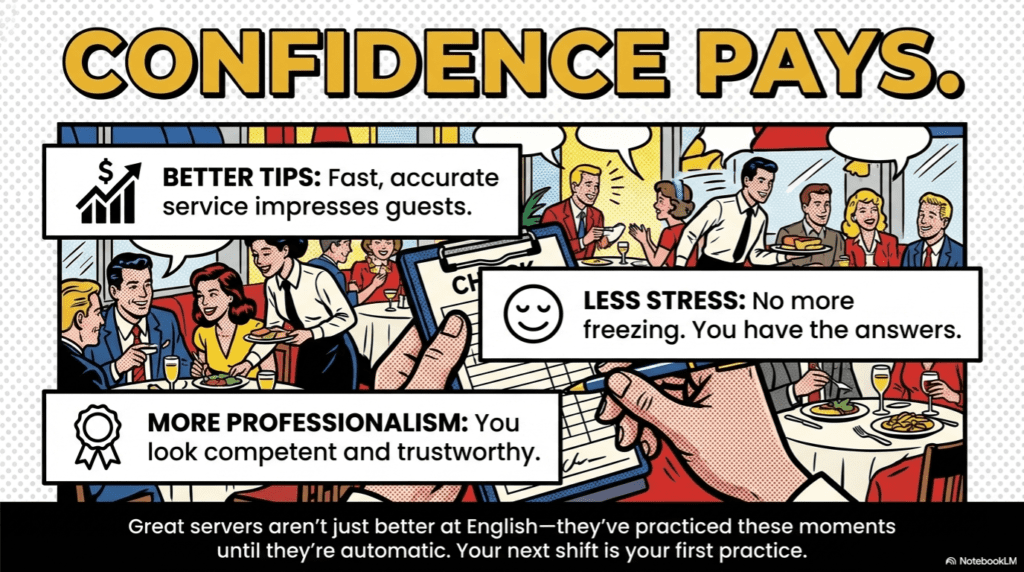
But here’s what confident money handling gives you:
Better tips: Fast, accurate payment handling impresses guests
Less stress: No more freezing when someone asks to split the check
More professionalism: You look competent and trustworthy
Faster service: Efficient payment = more tables = more money
The servers who handle money confidently aren’t necessarily better at English – they’ve just practiced these specific situations until they’re automatic.
Start with one thing this week:
- Say 10 prices out loud every day until it feels natural
- Learn your POS split bill function inside and out
- Memorize three payment phrases and use them every shift
Money English isn’t about perfect grammar. It’s about clear communication, quick math, and professional confidence.
Every time you handle a payment smoothly, you’re building that confidence.
Your money communication journey starts with your next shift.
Quick Reference: 60 Essential Money Phrases
Talking About Prices
- “That’s [amount].”
- “The total is [amount].”
- “It comes to [amount].”
- “Most entrées are between [X] and [Y] dollars.”
- “That’s [amount] per person.”
Payment Methods
- “How would you like to pay?”
- “Cash or card?”
- “We accept all major credit cards.”
- “You can tap your phone here.”
- “Do you have another card?”
The Check
- “Here’s your check, no rush.”
- “I’ll bring that right out.”
- “Whenever you’re ready.”
- “Can I take that for you?”
- “Let me grab that for you.”
Splitting Bills
- “How would you like to split this?”
- “Sure, that’s [amount] each.”
- “I can do separate checks.”
- “One check or separate?”
- “Would you like to split this evenly?”
- “I can split it by seat.”
- “How many ways?”
- “That’s [amount] per person.”
- “I’ll print separate checks for you.”
- “Our system can split up to four ways.”
Processing Payment
- “I’ll run this for you.”
- “One moment while I process this.”
- “I’ll be right back with your receipt.”
- “Here’s your card and receipt.”
- “Sign here, please.”
- “Your change is [amount].”
- “Out of [amount they gave].”
- “Would you like your receipt?”
- “You can insert, swipe, or tap.”
- “The card reader is right here.”
Tips and Gratuity
- “Gratuity is not included.”
- “I’ve added 18% gratuity for your party.”
- “That’s shown here on the check.”
- “You can add the tip on the screen.”
- “There’s a line for tip on the receipt.”
- “Tip is entirely up to you.”
- “18-20% is standard.”
Handling Problems
- “Let me take a look.”
- “I’ll fix that for you.”
- “Let me get you a corrected check.”
- “It looks like the card didn’t go through.”
- “Do you have another card?”
- “Let me get my manager.”
- “I’ll check with my manager about that.”
- “Let me see if I can break this.”
Professional Phrases
- “Your total today is [amount].”
- “That comes to [amount] with tax.”
- “All together, that’s [amount].”
- “I can take payment whenever you’re ready.”
- “Thank you so much.”
- “I appreciate it.”
- “Thanks for coming in.”
Explaining Charges
- “There’s a [amount] charge for [item].”
- “Tax is included in this total.”
- “Would you like me to go over the charges?”
Remember: Clear money communication builds trust, speeds up service, and increases tips. Practice these phrases until they’re automatic, and payment situations will never stress you out again.
Ready to Master Restaurant English?
These free articles and scenarios are a great start, but if you want a complete, structured system for learning restaurant English, consider our full course.

English for Waiters includes:
✅ 22+ video lessons covering every restaurant situation
✅ Real restaurant scenarios with native pronunciation
✅ Interactive pronunciation practice
✅ Downloadable phrase guides
✅ Lifetime access with free updates