Deep Dive #3
The Problem Every Server Faces
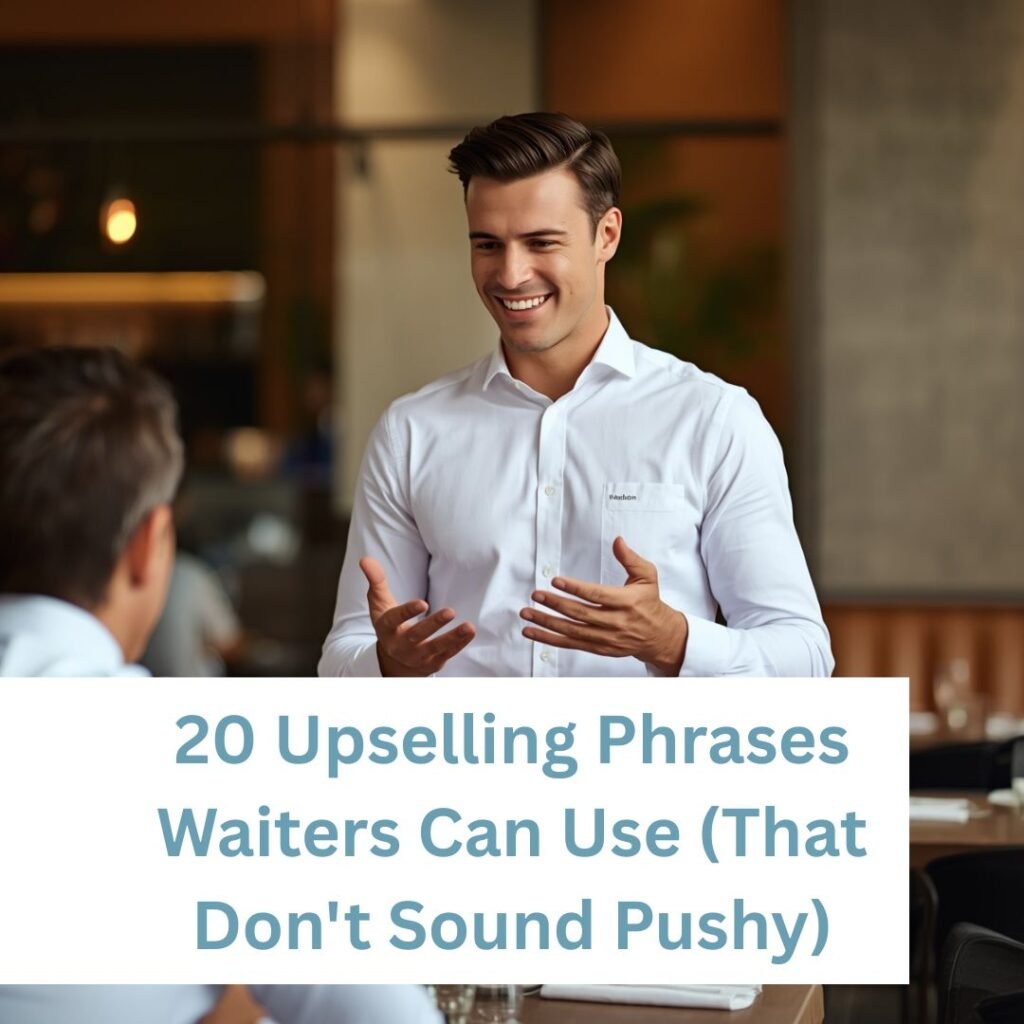
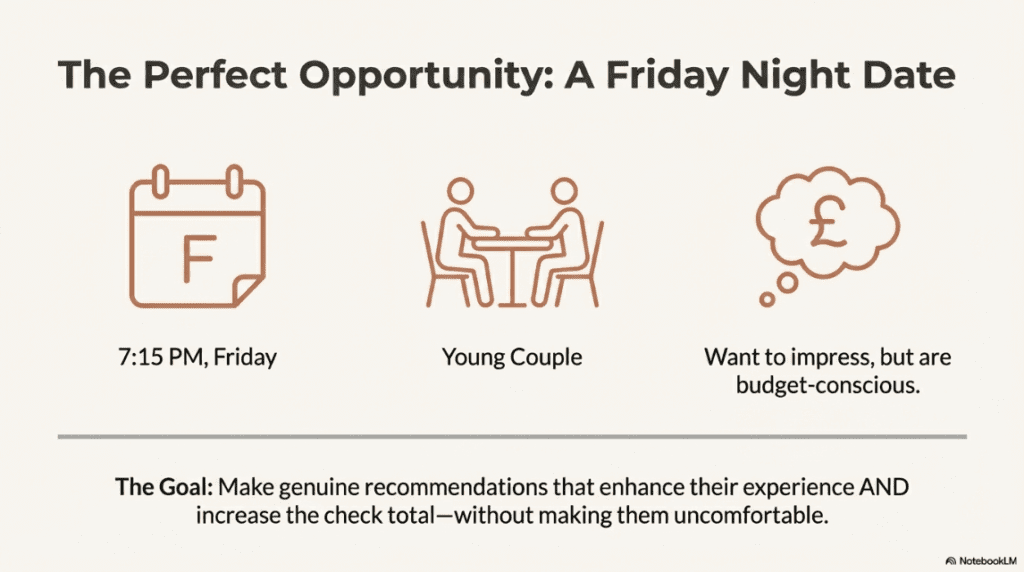
You know upselling increases your tips. Your manager reminds you daily: “Suggest appetizers! Push desserts! Recommend wine!”
But when you try, it feels awkward. You sound like a pushy salesperson. Customers give you uncomfortable looks. They say “No thanks” before you finish your sentence. Or worse – they complain to your manager that you were “too aggressive.”
So you stop trying. You take basic orders. Your tips stay average.
But professional servers upsell successfully on almost every table. They make more money, get better reviews, and customers actually thank them for the suggestions.
What’s their secret? Timing, tone, and technique.
In this real restaurant scenario, you’ll learn the exact process for upselling naturally. These are the techniques that turn average servers into top earners.
The Situation
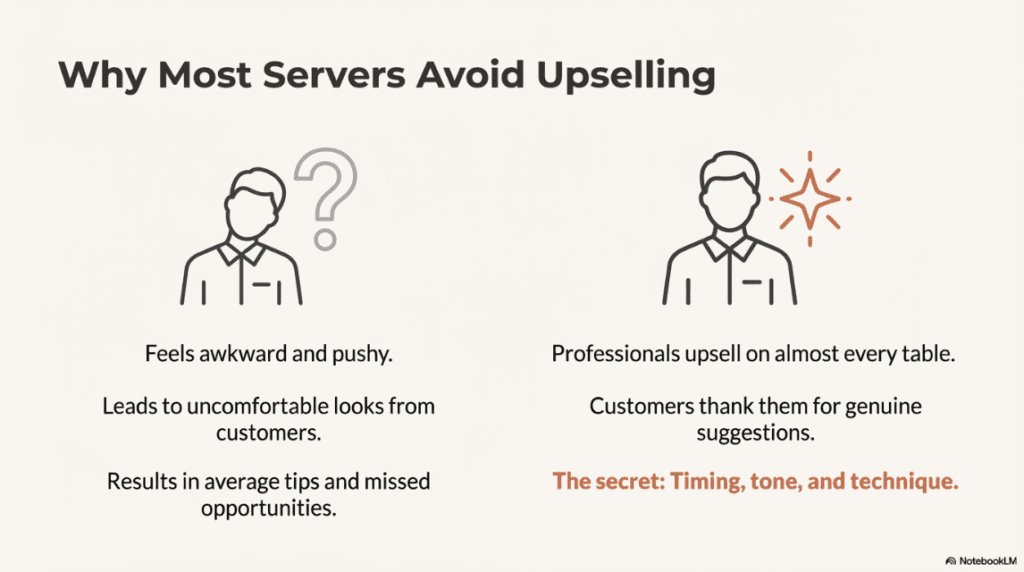
Time: 7:15 PM, Friday evening – date night crowd
Location: Table for two, window seat
The Challenge: Young couple on a date. They want to impress each other but are watching their budget. They haven’t mentioned celebrating anything special, so you don’t want to oversell. But they’re perfect candidates for appetizers, wine, and dessert if approached correctly.
Your Goal: Make genuine recommendations that enhance their experience AND increase your check total – without making them uncomfortable.
The Complete Dialogue
Server: approaching with menus and warm smile “Good evening! Welcome to Riverside. My name is James and I’ll be looking after you this evening. Have you been here before?”
Male Guest: “No, this is our first time.”
Server: “Wonderful! You’re in for a treat. Can I start you both with something to drink? Perhaps some wine, cocktails, or we have an excellent selection of craft beers?”
Female Guest: “I’m not sure yet. What do you recommend?”
Server: “Well, that depends on what you’re in the mood for. Our house wines are excellent value – we have a lovely Sauvignon Blanc that pairs beautifully with seafood, or a smooth Merlot if you’re thinking about steak. Or if you’d like something lighter, our passion fruit spritz is very refreshing.”
Male Guest: “What’s in the passion fruit spritz?”
Server: “It’s sparkling wine with passion fruit purée, fresh mint, and a splash of elderflower. Very light and summery. Perfect for sharing, actually.”
Female Guest: “That sounds lovely. Shall we try that?”
Male Guest: “Sure, let’s do it.”
Server: writing it down “Perfect choice. I’ll get that started for you. While I’m doing that, feel free to look over the menu. If you have any questions about dishes, I’m happy to help when I come back.”
[Server returns with drinks]
Server: serving drinks carefully “Here we are – one passion fruit spritz. Now, have you had a chance to look at the menu, or would you like me to explain any of our specialties?”
Female Guest: “Everything looks so good! What do people usually order?”
Server: “Our menu changes seasonally, but right now our most popular starters are the crispy calamari and the burrata with heritage tomatoes. Both are perfect for sharing if you’d like to start with something before your mains.”
Male Guest: looking at prices “Hmm, we might just go straight to the main course.”
Server: reading the hesitation, backing off gently “Absolutely, no problem at all. The mains are very generous portions. Take your time deciding – I’ll check back with you in a few minutes.”
[Server gives them space – 3 minutes]
Server: returning “How are we doing? Ready to order?”
Female Guest: “Yes, I think so. I’ll have the sea bass.”
Server: “Excellent choice – that’s one of our signature dishes. The chef does it with a lemon butter sauce and it comes with seasonal vegetables and new potatoes. That sound good?”
Female Guest: “Perfect.”
Server: “Wonderful.” turning to male guest “And for you, sir?”
Male Guest: “I’ll go with the ribeye steak, medium-rare please.”
Server: “Great choice. Our ribeye is 10 ounces, aged for 28 days, really tender. That comes with chunky chips and a grilled tomato. How does that sound?”
Male Guest: “Sounds great.”
Server: writing, then looking up naturally “Can I suggest something? Since you’ve got the steak and the fish, our rocket and parmesan salad is absolutely perfect for sharing between those two dishes. It’s light, peppery, cuts through the richness beautifully. Completely optional, but it does work really well.”
Female Guest: looking at male guest “That does sound nice…”
Male Guest: “Yeah, okay, let’s add that.”
Server: “Perfect. I think you’ll really enjoy that combination.” pausing, then casual tone “One more thing – with the steak, we have a few sauce options if you’d like. The peppercorn sauce is incredible, or we do a garlic butter. Both £3, completely optional.”
Male Guest: “I’ll try the peppercorn sauce.”
Server: “Excellent choice – our chef makes it fresh. So just to confirm: one sea bass, one ribeye medium-rare with peppercorn sauce, and the rocket salad to share. I’ll get that started for you – it’ll be about 15-20 minutes for the mains.”
[Later – server delivers food, checks on them after a few minutes]
Server: approaching the table “How is everything? Is the steak cooked okay for you?”
Male Guest: “It’s perfect, really good.”
Female Guest: “The fish is delicious.”
Server: “I’m so glad you’re enjoying it. I’ll leave you to it, but I’ll check back in a bit.”
[10 minutes later – table is nearly finished]
Server: noticing empty plates “Looks like you enjoyed that! Can I clear these plates for you?”
Both Guests: “Yes, thank you.”
Server: clearing plates “Save some room for dessert – we make everything in-house. Our pastry chef does incredible work.” pausing, reading their body language “No pressure, but I can bring the dessert menu just to have a look?”
Female Guest: “Well… what would you recommend?”
Server: leaning in slightly, conspiratorial tone “Honestly? If you’re sharing, the warm chocolate fondant is unreal. It’s got a molten center, comes with vanilla ice cream. It’s rich, so it’s perfect for two people with two spoons. But if you want something lighter, the lemon posset is beautiful – very fresh, cleanses the palate.”
Male Guest: to female guest “The chocolate one sounds amazing…”
Female Guest: smiling “Let’s share it.”
Server: “You won’t regret it. I’ll get that going for you. Coffee or tea with that?”
Female Guest: “Two espressos, please.”
Server: “Perfect. Coming right up.”
[After dessert is finished]
Server: “How was the fondant?”
Male Guest: “Incredible. Best dessert I’ve had in ages.”
Server: “I’m really glad. Would you like anything else, or shall I bring the bill?”
Female Guest: “Just the bill, thank you. This was lovely.”
Server: “My pleasure. I’ll get that for you straight away.”
Confidence is key to natural upselling. If you struggle with formal vs casual language at different restaurants, read our guide on when to say ‘May I’ vs ‘Can I’.
Key Phrases Breakdown
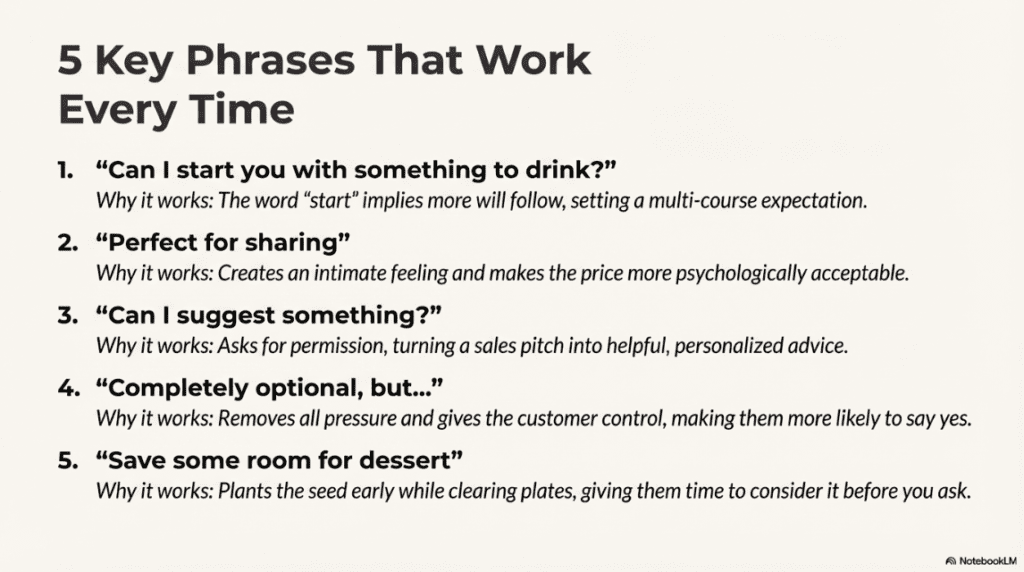
1. “Can I start you with something to drink?”
Why this works: The word “start” implies there will be more to come. It’s psychologically different from “Would you like drinks?” which sounds final.
Timing: Immediately after greeting, before they’ve even opened the menu.
The psychology: People expect to be asked about drinks. This is a comfortable, non-threatening entry point for upselling.
Alternative phrases:
- “What can I get you to drink while you look at the menu?”
- “Would you like something from the bar while you decide?”
2. “Perfect for sharing, actually”
Why this works: The word “sharing” creates a romantic, intimate feeling on a date. It also makes the price more acceptable – splitting a £12 starter feels better than each buying a £6 one.
When to use: When suggesting appetizers, sides, or desserts to couples or small groups.
Cultural note: Sharing plates are very popular in modern British and American dining. This taps into that trend.
What NOT to say:
- ❌ “You should share this” (sounds pushy)
- ❌ “This is meant for two people” (sounds limiting)
- ✅ “This is perfect for sharing” (sounds like helpful advice)
3. “Both are perfect for sharing if you’d like to start with something before your mains”
Why this works: The phrase “if you’d like” gives them choice. You’re not forcing – you’re offering an option they can decline without awkwardness.
Key word: “before” – Plants the idea that appetizers come first, mains come second. Creates a multi-course expectation.
Professional timing: Mention starters AFTER they’ve had drinks, but BEFORE they order mains. This is the sweet spot.
4. “Take your time deciding – I’ll check back with you in a few minutes”
Why this works: When customers hesitate about price, BACK OFF immediately. Give them space. Pushing now loses the sale and the tip.
The psychology: Leaving them alone with drinks builds comfort. They relax, they chat, and they often decide to order more on their own.
What happens next: When you return in 3-4 minutes, they’ve had time to discuss. They might now be ready for the appetizer they declined earlier.
Professional tip: Read body language. If they’re looking at prices with concerned faces, they’re worried about budget. Don’t push expensive items.
5. “Can I suggest something? Since you’ve got the steak and the fish…”
Why this works:
- “Can I suggest” asks permission. It’s polite, not pushy.
- Referencing their existing orders shows you’re thinking about THEIR meal, not just increasing the bill.
- The suggestion becomes helpful advice, not sales pitch.
Timing: Right after they’ve ordered mains, while you still have their attention.
Why it succeeds: They’ve already committed to mains. A small add-on (£6 salad) feels minor compared to the £40 they’ve just spent.
6. “It’s light, peppery, cuts through the richness beautifully”
Why this works: You’re explaining WHY it enhances their meal. This is professional food knowledge, not selling.
The words that matter:
- “Cuts through the richness” – Shows you understand food pairing
- “Beautifully” – Evokes quality, care, artistry
- “Light” – Reassures them they won’t be too full
Professional standard: Always explain the BENEFIT. “It comes with salad” is boring. “The peppery salad cuts through the richness” is appetizing.
7. “Completely optional, but…”
Why this works: These two words remove all pressure. You’re giving information, not demanding a purchase.
When to use:
- After main suggestions (sides, sauces)
- With desserts
- With drinks
- ANY time you want to make a low-pressure suggestion
What it does psychologically: “Optional” makes them feel in control. Paradoxically, this makes them MORE likely to say yes.
8. “Save some room for dessert”
Why this works: This is said while clearing plates – NOT asking them to order yet. You’re planting the seed early.
The psychology: By mentioning dessert now, you give them time to think about it while you’re away. When you return, they’ve already discussed it.
Professional trick: Say this with a warm smile, like friendly advice. “Save some room” sounds caring, not sales-y.
9. “No pressure, but I can bring the dessert menu just to have a look?”
Why this works:
- “No pressure” = permission to decline
- “Just to have a look” = low commitment
- Question format = they feel in control
What usually happens: They say “Sure, why not?” They look at the menu. They’re tempted. They order.
Conversion rate: Professional servers report 60-70% dessert conversion with this phrase, vs 20-30% without.
10. “If you’re sharing, the warm chocolate fondant is unreal”
Why this works:
- “If you’re sharing” = assumes they want dessert, just helps them choose
- “Unreal” = casual, authentic enthusiasm (not fake corporate language)
- Specific recommendation = shows expertise, makes decision easier
Professional voice: Notice how the server sounds genuinely enthusiastic, not scripted. Authenticity sells better than polish.
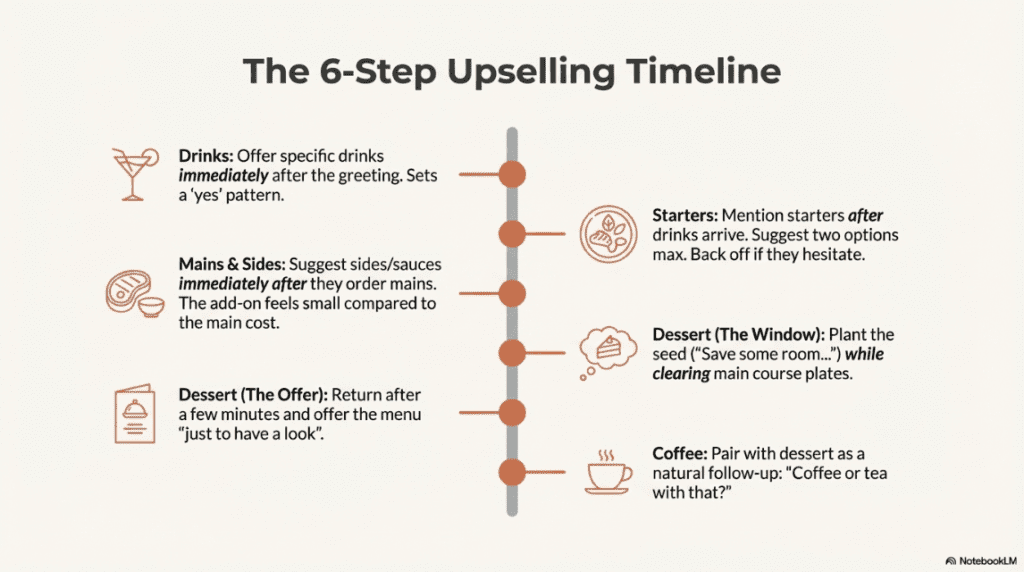
The Upselling Strategy (Step-by-Step)
Step 1: Establish Trust First
Don’t lead with selling. Start with genuine service:
- Warm greeting
- Helpful menu explanation
- Answering questions honestly
Why: If customers like you as a person first, they trust your recommendations later.
Time investment: First 5 minutes = building rapport, not selling.
Step 2: Offer Drinks Early
When: Immediately after greeting, before they’ve opened menus.
Why: Drinks have the highest profit margin. Starting here sets a “yes” pattern.
Pro tip: Suggest specific drinks, not just “would you like drinks?” Generic questions get generic “no” answers.
Step 3: Mention Starters, But Read the Room
When: After drinks arrive, before main course orders.
If they hesitate: BACK OFF. Give them space. Don’t push.
If they’re interested: Describe TWO options maximum. Too many choices paralyze decision-making.
The rule: Suggest once. If declined, move on gracefully.
Step 4: Suggest Sides/Sauces with Mains
When: Immediately after they order the main course, while you’re writing it down.
Why it works: They’ve committed to a £20 steak. Adding a £3 sauce feels insignificant.
How to phrase it: “With the steak, we have [option]. Completely optional, but it’s excellent.”
Success rate: 40-50% take-up if offered; 0% if never mentioned.
Step 5: The Dessert Window (Timing is Everything)
Wrong timing: Asking while they’re still eating mains = too early, they’re full.
Right timing: When plates are nearly empty, but BEFORE you clear them.
The approach:
- “Save some room for dessert” (while clearing)
- Give them 5 minutes
- Return: “Can I bring dessert menus just to look?”
- When they’re interested: Make ONE strong recommendation
Professional tip: Friday/Saturday date night crowds have the highest dessert conversion rates. Midweek lunch crowds are lowest.
Step 6: Pair Dessert with Coffee
When: They’ve agreed to dessert.
How: “Coffee or tea with that?” said as a natural follow-up, not a separate question.
Why it works: Coffee with dessert feels like one decision, not two separate purchases.
Revenue impact: £3.50 coffees x 2 people = £7 extra on the bill for one sentence.
Common Mistakes to Avoid
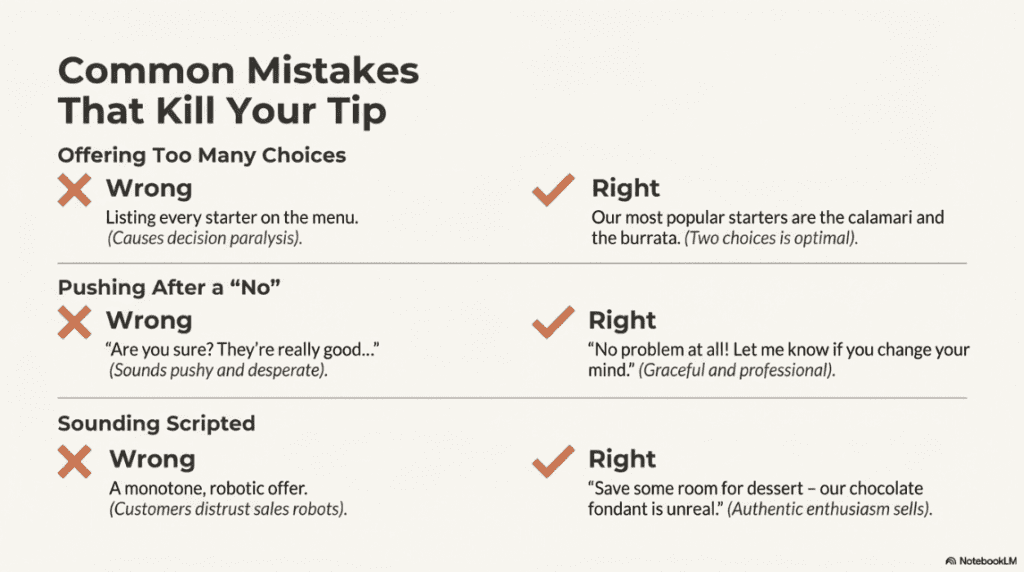
❌ Mistake 1: Offering Too Many Choices
Wrong: “For starters we have calamari, bruschetta, soup of the day, chicken wings, garlic bread, mozzarella sticks, prawn cocktail…”
Why it’s wrong: Decision paralysis. Too many options = overwhelmed customer = “no thanks.”
Right: “Our most popular starters are the calamari and the burrata. Both perfect for sharing.”
The psychology: Two choices is optimal. People can compare them and feel good about deciding. This is supported by research from the University at Buffalo which shows that people faced with more options than they can effectively consider experience a ‘paralyzing paradox’—they want to make a good decision but feel unable to do so, often leading to no decision at all.pare them and feel good about deciding.
❌ Mistake 2: Pushing After a Clear “No”
Wrong: Customer: “No starters, thanks.” Server: “Are you sure? They’re really good…”
Why it’s wrong: Annoying. Pushy. Makes them uncomfortable. Guarantees a bad tip.
Right: “No problem at all! Let me know if you change your mind.”
Professional standard: Suggest once, accept “no” gracefully, move on.
❌ Mistake 3: Sounding Scripted or Robotic
Wrong: monotone voice “Would-you-like-to-see-our-dessert-menu-this-evening?”
Why it’s wrong: Sounds fake. Customers can tell you’re reciting corporate script. They distrust sales robots.
Right: Natural, conversational tone. “Save some room for dessert – our chocolate fondant is unreal.”
The difference: Authenticity. Sound like you’re giving advice to a friend, not reading a telemarketing script.
❌ Mistake 4: Upselling Cheap Items First
Wrong: Suggesting a £4 side salad before they’ve ordered mains.
Why it’s wrong: When they’re making a £20-30 main course decision, a £4 salad seems important. But AFTER they’ve ordered the £30 steak, £4 is nothing.
Right: Get the big commitment (mains) first. Then suggest small add-ons.
The psychology: It’s called “anchoring.” Once they’ve committed to £60 for two mains, adding £12 for sides feels small.
❌ Mistake 5: Failing to Explain the “Why”
Wrong: “Would you like peppercorn sauce with that?”
Why it’s wrong: Sounds transactional. They don’t know why they should want it.
Right: “Our peppercorn sauce is incredible with ribeye – the chef makes it fresh. Would you like to try it?”
The difference: You’ve given them a REASON. The sauce is fresh, it pairs well, the chef makes it. Now it sounds worth £3.
❌ Mistake 6: Asking “Anything Else?” at the Wrong Time
Wrong: They order mains. You ask “Anything else?” immediately.
Why it’s wrong: “Anything else?” implies they’ve ordered enough. It psychologically closes the sale.
Right: Make specific suggestions. “Can I suggest the rocket salad to share? It’s perfect with steak and fish.”
The psychology: Specific suggestions plant ideas. “Anything else?” invites them to say “no.”
Practice This Scenario
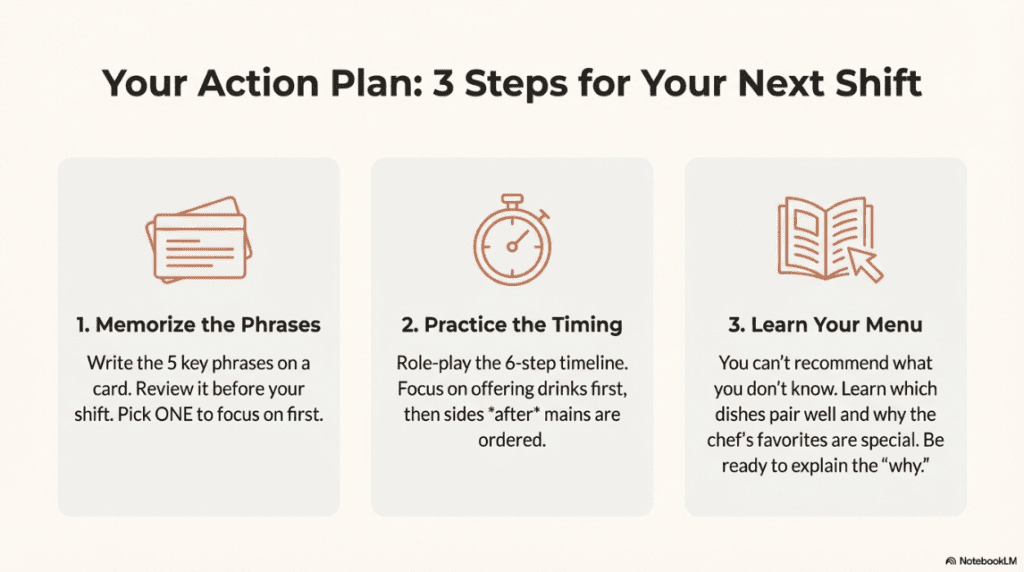
Step 1: Memorize the Key Phrases
Write these on a small card. Review before each shift:
- “Can I start you with…”
- “Perfect for sharing”
- “Can I suggest…”
- “Completely optional, but…”
- “Save some room for dessert”
Step 2: Practice Your Timing
Role-play with colleagues. Practice:
- Offering drinks immediately
- Suggesting starters AFTER drinks
- Suggesting sides AFTER mains are ordered
- Mentioning dessert while clearing plates
Step 3: Work on Your Tone
Record yourself. Listen back. Do you sound:
- Natural and conversational? ✓
- Genuinely enthusiastic? ✓
- Robotic and scripted? ✗
- Pushy or aggressive? ✗
Step 4: Learn Your Menu
You can’t recommend what you don’t know. Study:
- Which dishes pair well together
- What makes each dish special
- Which items are chef favorites
- Food descriptions that sound appetizing
Step 5: Test on Real Tables
Start with obviously comfortable tables (regulars, relaxed groups). Practice your phrases. Notice what works.
Why This System Works (The Psychology)
Professional upselling isn’t about pressure – it’s about service.
When you:
- Suggest drinks that pair with food → You’re helping them enjoy the meal
- Recommend dishes that work well together → You’re using expertise
- Mention desserts with genuine enthusiasm → You’re sharing something you believe in
…customers don’t feel sold to. They feel taken care of.
This approach is recommended by professional hospitality training programs because it increases revenue while maintaining (or improving) customer satisfaction. According to restaurant management experts at 7shifts, when suggestive selling is executed properly, it creates a better guest experience, increases server tips, and leads to higher profits—benefiting everyone involved.
The result:
- Higher check totals = bigger tips for you
- Better dining experience = happy customers
- Genuine recommendations = authentic service
The Numbers (Why This Matters to Your Wallet)
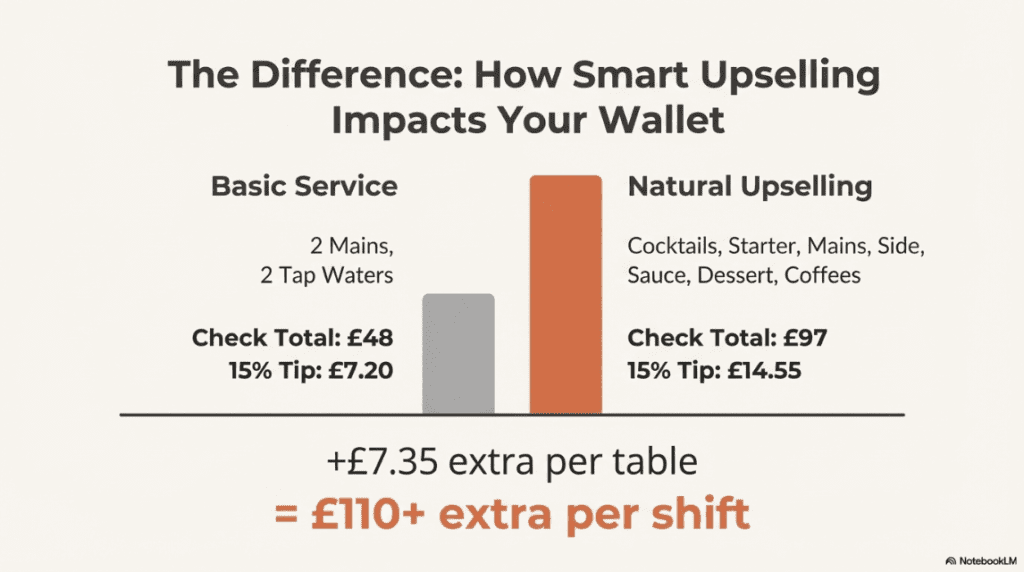
Scenario 1: Server Who Doesn’t Upsell
Check breakdown:
- 2 mains: £48
- 2 tap waters: £0
- Total: £48
- 15% tip: £7.20
Scenario 2: Server Who Upsells Naturally (Using This System)
Check breakdown:
- 2 cocktails: £16
- 1 starter to share: £9
- 2 mains: £48
- 1 sauce: £3
- 1 side: £6
- 1 dessert to share: £8
- 2 coffees: £7
- Total: £97
- 15% tip: £14.55
Difference: £7.35 extra per table
If you do this on 15 tables per shift: £110.25 extra per shift
Over a month (20 shifts): £2,205 extra in tips
This is why top servers earn double what average servers make – and it’s not about working harder, it’s about working smarter.
Final Thoughts
Upselling without being pushy is a skill. Like any skill, it requires:
- Practice – You’ll feel awkward at first. Keep trying.
- Timing – Learn when to suggest, when to back off.
- Authenticity – Only recommend what you genuinely believe enhances the meal.
The servers who earn the most aren’t the pushiest – they’re the most helpful, the most knowledgeable, and the most natural.
Start small. Pick ONE phrase from this guide. Use it for a week. See what happens. Then add another.
You’ll be surprised how quickly this becomes second nature – and how much your tips improve.
Remember: The best upselling doesn’t feel like selling at all. It feels like excellent service.
Want to practice more real restaurant scenarios? Start with Deep Dive #1: Greeting an Angry Customer to master de-escalation techniques, or try Deep Dive #2: Taking Orders from Large Groups to handle complex tables with multiple dietary restrictions. Coming soon: Deep Dive #4 on handling food complaints!“
Ready to Master Restaurant English?
These free articles and scenarios are a great start, but if you want a complete, structured system for learning restaurant English, consider our full course.
English for Waiters includes:
✅ 22+ video lessons covering every restaurant situation
✅ Real restaurant scenarios with native pronunciation
✅ Interactive pronunciation practice
✅ Downloadable phrase guides
✅ Lifetime access with free updates