Everyone Makes Mistakes — But Not Everyone Recovers Well
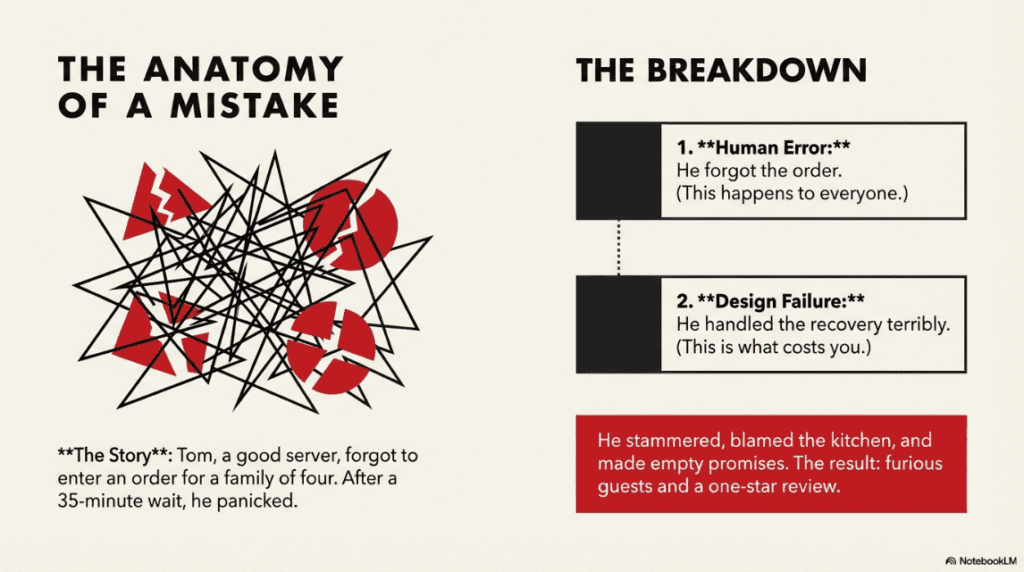
Tom had been a server for two years. He was good at his job. Guests liked him. His tips were solid.
Then one Saturday night, disaster struck.
He forgot to put in table 14’s order. Completely forgot. The family of four sat waiting for 35 minutes while he served other tables, completely unaware.
When they finally asked “Where’s our food?”, his stomach dropped.
He froze. His mind went blank. What do I say? How do I fix this?
“Um… let me… I’ll check on that…”
He ran to the kitchen. No order. Nothing. He had never entered it.
Panic. Complete panic.
He went back to the table, stammered an apology, blamed the kitchen, and promised their food would be “right out.” The guests were furious. They left without eating. One-star review the next day.
Tom made two mistakes that night:
- He forgot the order (human error — happens to everyone)
- He handled the recovery terribly (this is what actually cost the restaurant)
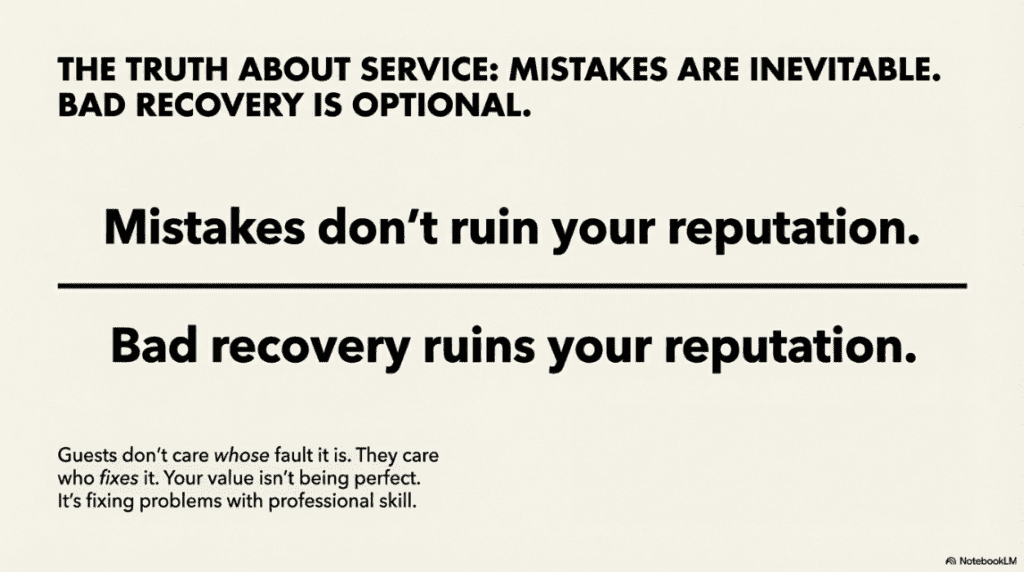
The truth: Mistakes don’t ruin your reputation. Bad recovery ruins your reputation.
In this guide you will find word-for-word scripts for recovering from the most common restaurant order errors and service problems — in English. You will also learn the L.A.S.T. recovery method, a simple 4-step formula used by professional servers worldwide.
What you’ll learn:
- The 4-step L.A.S.T. recovery formula
- Word-for-word scripts for common order errors and service mistakes
- How to apologize (and what NEVER to say)
- When to involve a manager
- How to turn angry guests into loyal customers
By the end of this article, you’ll handle mistakes like a professional — because mistakes are inevitable, but poor recovery is optional.
Prefer to listen? Here’s the podcast.
Quick Reference: Wrong vs Right Recovery Scripts
Before we go into the full method, here is a quick reference table. These are the most common restaurant order errors — with the wrong response and the right script to use instead.
| Situation | ❌ Don’t Say This | ✅ Say This Instead |
|---|---|---|
| Forgot to put in order | “The kitchen is backed up.” | “I’m so sorry. I made a mistake and didn’t put your order in. That’s completely my fault. I’m putting it in now and your meal tonight is on us.” |
| Wrong dish brought | “Are you sure that’s not what you ordered?” | “I’m sorry about that. I’ll bring the correct dish right away and remove this from your bill.” |
| Food quality problem | “That’s how it’s supposed to taste.” | “I’m so sorry. That’s not up to our standard. Would you like me to remake it or try something else? There’ll be no charge.” |
| Long wait time | “We’re really busy tonight.” | “I apologize for the wait. Let me check on your order right now. Can I bring you some bread while you wait?” |
| Wrong modifications | “I don’t think you mentioned that.” | “I’m sorry about that. Let me have them remake it right away.” |
| Billing error | “That’s what the system says.” | “I apologize for that error. Let me fix this for you right now.” |
Now let’s go through the full L.A.S.T. method so you understand why these scripts work — and how to use them in any situation.
Part 1: Understanding Restaurant Mistakes
The Two Types of Mistakes
TYPE 1: Your Mistakes
- Forgot to put in an order
- Brought the wrong dish
- Spilled something on a guest
- Charged incorrectly
- Forgot a special request
TYPE 2: Kitchen/Restaurant Mistakes
- Food cooked incorrectly
- Long wait times
- Wrong temperature
- Missing ingredients
- System errors
Important: Even if it’s not your fault, YOU handle the recovery. Guests don’t care whose fault it is — they care who fixes it.
Most Common Restaurant Order Errors
| Mistake Type | Examples | Frequency |
|---|---|---|
| Order Errors | Wrong dish, forgot item, wrong modifications | Very Common |
| Timing Issues | Long waits, cold food, uneven table service | Very Common |
| Food Quality | Overcooked, undercooked, doesn’t taste right | Common |
| Service Failures | Forgot drinks, ignored table, rude behavior | Common |
| Billing Errors | Wrong charges, incorrect totals, missing discounts | Occasional |
| Accidents | Spills, dropped items, broken dishes | Occasional |
The reality: How you recover determines whether a mistake becomes a disaster or just a small inconvenience.
Part 2: The 4-Step Recovery Formula (L.A.S.T.)
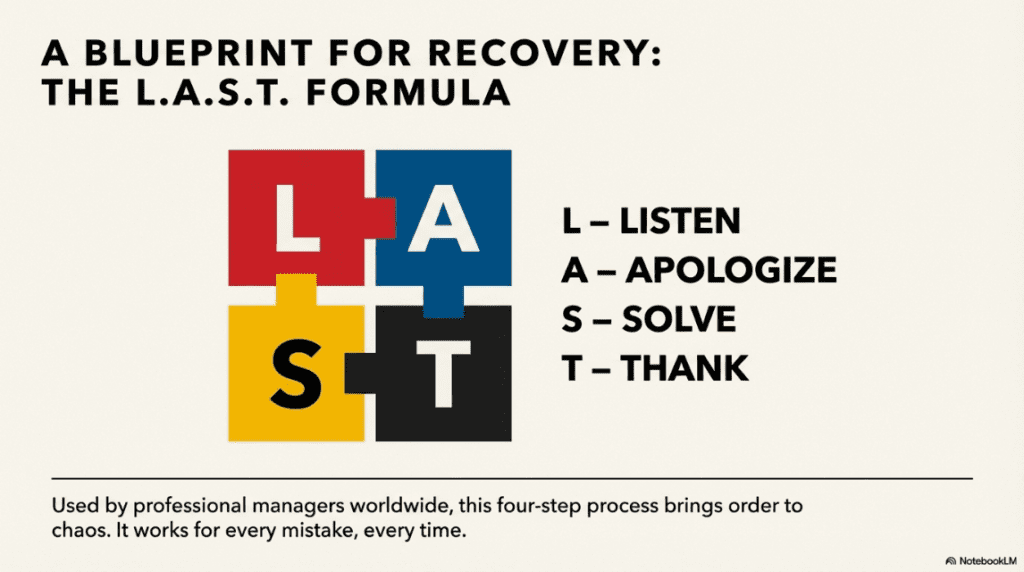
The Formula That Always Works
L — Listen A — Apologize S — Solve T — Thank
This acronym (L.A.S.T.) is used by professional restaurant managers worldwide. It works for every mistake, every time.
STEP 1: LISTEN
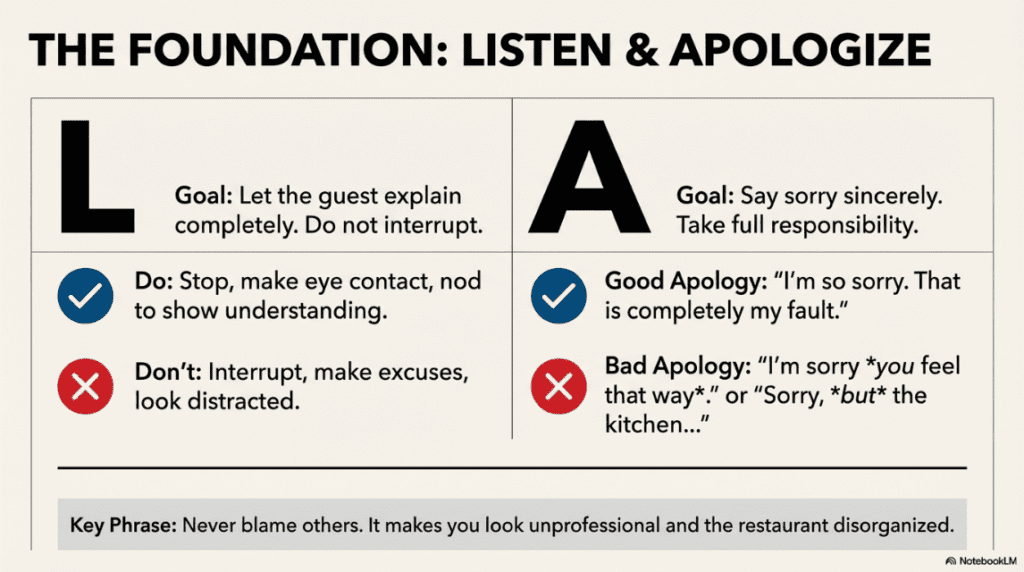
What it means: Let the guest explain the problem completely. Don’t interrupt.
What to do: Stop what you’re doing, make eye contact, nod to show understanding, don’t defend or explain yet, let them finish completely.
What to say while listening: “I understand” “I see” “Yes” [Just nod and listen]
What NOT to do: ❌ Interrupt to explain ❌ Make excuses ❌ Argue about what happened ❌ Look distracted or impatient ❌ Start fixing before they finish
STEP 2: APOLOGIZE
What it means: Say sorry sincerely and directly. Take responsibility.
Good apologies:
- “I’m so sorry about that”
- “I apologize — that should never have happened”
- “I’m really sorry for the mistake”
- “That’s my fault, and I apologize”
Bad apologies: ❌ “I’m sorry you feel that way” (defensive) ❌ “Sorry, but…” (excuse follows) ❌ “I’m sorry the kitchen…” (blaming others) ❌ “Sorry” [said dismissively] (insincere)
The apology formula:
| Element | Example |
|---|---|
| 1. Direct apology | “I’m so sorry” |
| 2. Acknowledge the problem | “I forgot to put in your order” |
| 3. Take responsibility | “That’s completely my fault” |
| 4. Validate their feeling | “I know that’s frustrating” |
Complete apology example: “I’m so sorry. I forgot to put in your order. That’s completely my fault, and I know that’s really frustrating when you’ve been waiting.”
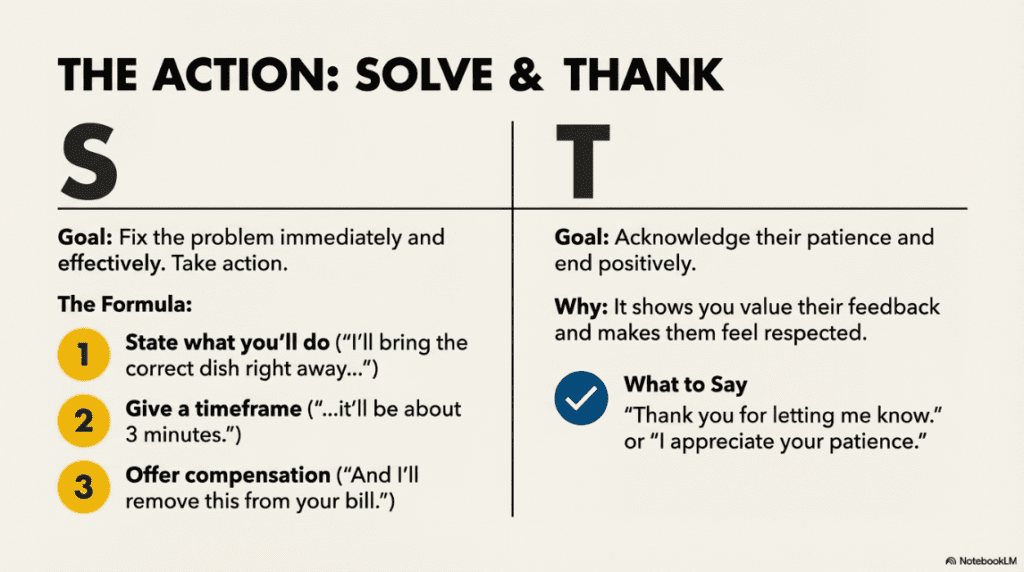
STEP 3: SOLVE
What it means: Fix the problem immediately. Don’t just apologize — take action.
| Problem | Immediate Solution Script |
|---|---|
| Wrong food | “I’ll bring the correct dish right away and remove this from your bill” |
| Forgot order | “I’m putting it in right now. I’ll ask the kitchen to rush it, and your meal will be complimentary” |
| Long wait | “Let me check the status and bring you some bread while you wait” |
| Cold food | “I’ll have them remake this fresh. It’ll be 5 minutes” |
| Overcooked | “I’ll get a new one prepared correctly. This won’t be on your bill” |
| Billing error | “Let me fix that immediately” |
STEP 4: THANK
What it means: Thank them for telling you about the problem and for their patience.
- “Thank you for letting me know”
- “I appreciate your patience”
- “Thank you for giving us a chance to fix this”
- “Thanks for understanding”
Thanking the guest shows you value their feedback, acknowledges their patience, ends the interaction positively, and makes them feel heard and respected.
Part 3: Complete Recovery Scripts for Common Order Errors
Script 1: Forgot to Put in Order
Situation: Guest asks “Where’s our food?” after 30+ minutes
LISTEN: [Guest explains they’ve been waiting]
APOLOGIZE: “I’m so sorry. I made a mistake and didn’t put your order in. That’s completely my fault.”
SOLVE: “I’m putting it in right now and asking the kitchen to rush it. It should be about 10–12 minutes. And because of my mistake, your meals will be complimentary tonight.”
THANK: “Thank you so much for your patience. I really appreciate your understanding.”
Then: Check back in 5 minutes to update them on timing.
Script 2: Brought Wrong Dish
Situation: Guest says “This isn’t what I ordered”
LISTEN: [Guest explains what they actually ordered]
APOLOGIZE: “I’m sorry about that. You ordered the salmon, not the chicken.”
SOLVE: “I’ll bring the salmon right out — it’ll be about 3 minutes. And I’ll remove this charge from your bill.”
THANK: “Thank you for letting me know. I’ll have the correct dish for you right away.”
Then: Bring correct dish personally and confirm it’s right.
Script 3: Food Quality Issue
Situation: Guest complains food is overcooked, cold, or doesn’t taste right
LISTEN: “Tell me what’s wrong with it” [Let them explain]
APOLOGIZE: “I’m so sorry. That’s not up to our standards at all.”
SOLVE: “Would you like me to have them remake it, or would you prefer something else from the menu? Either way, there’ll be no charge for this.”
THANK: “Thank you for letting me know. We want every dish to be perfect.”
Then: Remove bad dish, bring new dish, check back to confirm it’s better.
Script 4: Long Wait Time
Situation: Guest is visibly frustrated about waiting
LISTEN: [If they mention the wait, listen to their concern]
APOLOGIZE: “I apologize for the wait. That’s too long and I’m sorry.”
SOLVE: “Let me check on your order right now. While you wait, can I bring you some bread or an appetizer on the house?”
THANK: “Thank you for your patience. I really appreciate it.”
Then: Return with update AND the complimentary item.
Part 4: What NEVER to Say
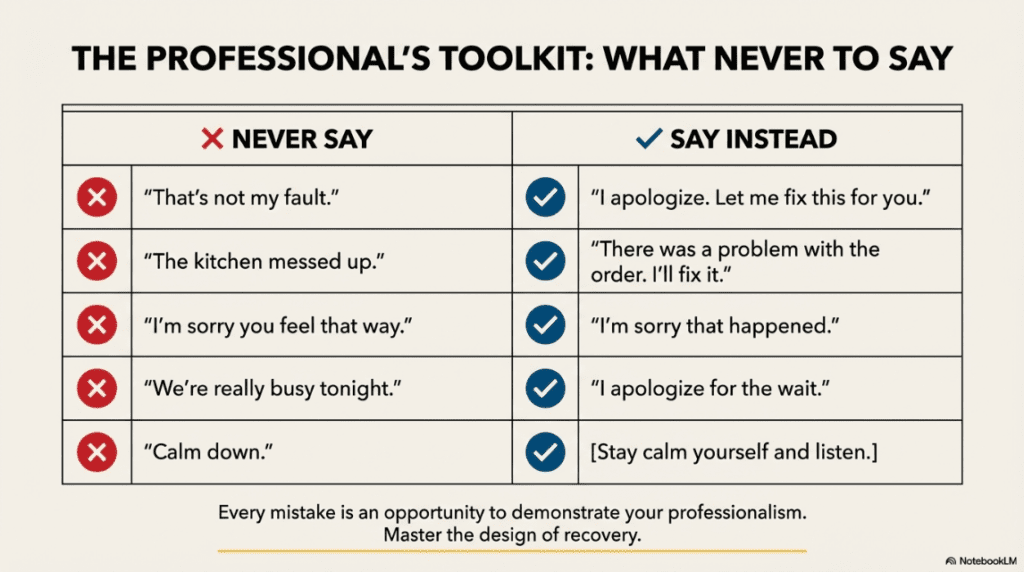
| ❌ NEVER Say | ✅ Say Instead |
|---|---|
| “That’s not my fault” | “I apologize. Let me fix this for you” |
| “The kitchen messed up” | “There was a problem with your order. I’ll fix it” |
| “I’m sorry you feel that way” | “I’m sorry that happened” |
| “That’s not what you said” | “Let me fix this for you” |
| “We’re really busy tonight” | “I apologize for the wait” |
| “Nobody told me” | “I apologize for the confusion” |
| “It’s policy” | “Let me see what I can do” |
| “Calm down” | [Stay calm yourself — never say this] |
Guests don’t care whose fault it is. They want their problem solved. Blaming others makes you look unprofessional and like the restaurant is disorganized. Always say: “There was a problem with your order, and I’m going to fix it right now.”
Part 5: When to Get a Manager
GET A MANAGER WHEN: the guest asks for one, they are extremely angry, the issue involves food safety or illness, you don’t have authority to fix it, the guest demands a refund, or you’re not sure what to do.
DON’T GET A MANAGER FOR: normal mistakes you can fix yourself, minor complaints that need simple solutions, or requests within your authority (small comps, remaking food).
What to say to the guest: “I’d like to get my manager involved to help resolve this for you. One moment.”
What to tell the manager: Give a brief summary of what happened, what you’ve already said and done, what the guest wants, and your opinion on how to fix it.
Example: “Table 7’s steaks came out overcooked. I apologized and offered to remake them, but they’re really upset and asked for you. I think we should comp the steaks.”
Part 6: Accident Recovery Scripts (Spills, Drops, Breakage)
Priority order for accidents: 1. Make sure guest is okay 2. Clean up the mess 3. Apologize 4. Offer compensation
Spill Recovery Script
IMMEDIATE: “Oh no, I’m so sorry! Are you okay?”
APOLOGIZE: “I’m so sorry about that. Let me help clean this up.”
SOLVE: Get clean napkins and towels. “Let me get my manager. We’ll take care of your dry cleaning bill and your meal tonight is on us.”
MANAGER: Get manager immediately for spills on guests — this requires compensation beyond your authority.
Drop or Break Something
APOLOGIZE: “I’m so sorry, I dropped your [item].”
SOLVE: “I’ll bring a new one right away” OR “Let me get my manager to discuss how we can replace this.”
Important: For expensive items (phones, glasses, clothing), get manager immediately.
Part 7: More Common Mistake Scenarios
Scenario 1: Wrong Modifications
Guest: “I said no onions, but there are onions on this.”
You: “I’m sorry about that. Let me have them remake it without onions right away. I’ll bring it out in about 3 minutes.”
Scenario 2: Food Allergy Concern
Guest: “I told you I’m allergic to nuts, and I think there are nuts in this.”
You: “I’m so sorry — let me take this back immediately. Don’t eat any more of it. Let me check with the kitchen about what’s in the dish and get you something completely safe.”
Then: Get manager immediately. Food allergies are serious.
Scenario 3: Completely Forgot About a Table
Guest: “We haven’t even gotten water yet.”
You: “I’m so sorry — I should have checked on you sooner. Let me get your drinks right now. Can I bring you some bread while you look at the menu?”
Scenario 4: Bill Has Wrong Charges
Guest: “We didn’t order this dessert, but it’s on our bill.”
You: “I apologize for that error. Let me fix this for you right now.”
[Fix bill, return with corrected one]
“Here’s the corrected bill. Sorry about the confusion.”
For billing and payment errors specifically, read our comprehensive guide on handling prices, bills, and tips confidently.
Part 8: Turning Mistakes Into Loyalty
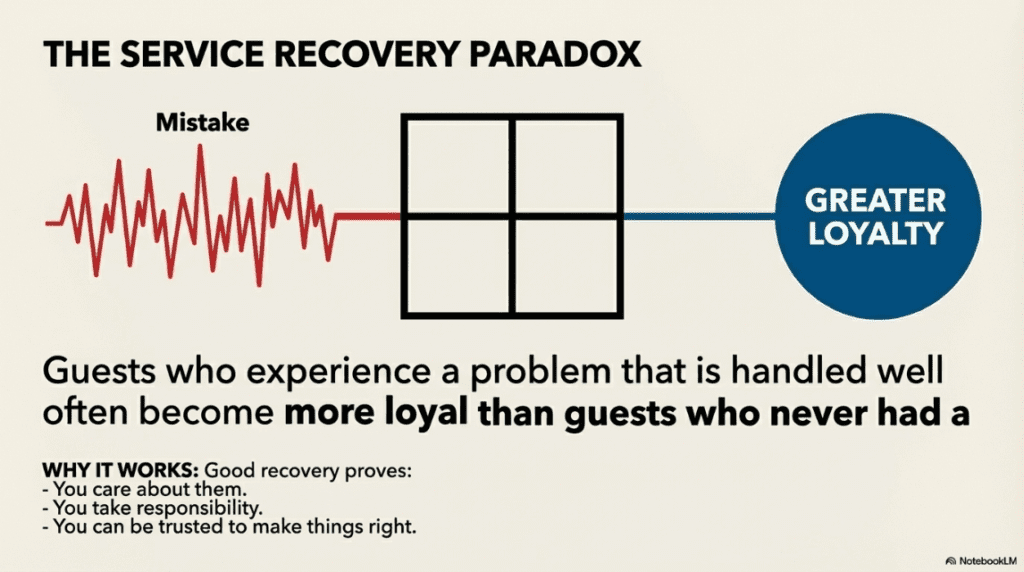
Scientific fact: Guests who experience a problem that’s handled WELL often become MORE loyal than guests who never had a problem. Because good recovery proves you care about them, you take responsibility, and you can be trusted.
Here’s a great read on 5 Basic Steps To Customer Service Recovery.
DO: ✅ Act fast (speed matters) ✅ Over-compensate slightly (remove charge + appetizer) ✅ Follow up (“Is everything okay now?”) ✅ Be genuine and warm
DON’T: ❌ Minimize the problem (“It’s not a big deal”) ❌ Make excuses ❌ Disappear after fixing it ❌ Act defensive
The Follow-Up Check
5 minutes after fixing: “How’s everything now? Is the new steak cooked correctly?”
At the end of the meal: “I just want to make sure everything was good after that issue earlier?”
Part 9: Building Mistake Confidence
| What You Think | What’s Actually True |
|---|---|
| “They’re so angry at me” | They’re frustrated with the situation, not you personally |
| “I’m terrible at my job” | Everyone makes mistakes. Good servers fix them well |
| “They’ll never come back” | If you fix it well, they probably will come back |
| “My manager will be furious” | Managers expect mistakes. They want good recovery |
| “This will ruin my tips” | Good recovery often results in normal tips — or better |
Experienced servers aren’t the ones who never make mistakes. They’re the ones who recover so well that guests barely remember the mistake.
Part 10: Prevention Strategies
Order-Taking: Repeat the order back, confirm modifications clearly, ask about allergies, write everything down — don’t trust memory.
During Service: Check on tables every 2–3 minutes after food arrives, confirm order accuracy before leaving the kitchen, stay organised with table numbers.
Before Dropping the Check: Review charges for accuracy, make sure all items are accounted for, check for any comps that should be applied.
Conclusion: Mistakes Don’t Define You — Recovery Does
Every server has a “disaster shift” story. The night everything went wrong. The table that hated them. The mistake that felt unforgivable.
But here’s what separates good servers from great servers: great servers turn disasters into demonstrations of professionalism.
Remember Tom from the introduction? Here’s what he should have said:
“I’m so sorry — I made a mistake and didn’t put your order in. That’s completely my fault. I’m putting it in right now and asking them to rush it. It’ll be about 10 minutes, and your meals tonight are completely on us. Can I bring you some appetizers while you wait?”
Same mistake. Completely different outcome.
Mistakes happen to everyone. Guests mostly forgive them. Recovery makes or breaks the experience. Your value isn’t in being perfect — it’s in fixing problems well.
Remember: L.A.S.T. — Listen, Apologize, Solve, Thank.
The next time something goes wrong, take a breath, remember L.A.S.T., and show the guest why they should trust your restaurant. You’ve got this.
Quick Reference: 40 Essential Recovery Phrases
Listening & Acknowledging
- “I understand”
- “I see what happened”
- “Tell me more about that”
- “I hear what you’re saying”
- “That makes sense”
Apologizing
- “I’m so sorry about that”
- “I apologize — that should never have happened”
- “That’s completely my fault”
- “I’m really sorry for the mistake”
- “I apologize for the inconvenience”
Taking Responsibility
- “That’s my fault”
- “I made a mistake”
- “I should have caught that”
- “I take full responsibility”
- “That’s on me”
Solving
- “Let me fix this right now”
- “I’ll have them remake this immediately”
- “I’ll remove that from your bill”
- “Let me bring you [solution]”
- “This will be complimentary”
- “I’ll get my manager to help”
- “Give me 5 minutes to solve this”
- “Here’s what I’m going to do”
Following Up
- “Is everything okay now?”
- “How’s the new dish?”
- “Is this better?”
- “Are we good now?”
- “Is there anything else I can do?”
Thanking
- “Thank you for letting me know”
- “I appreciate your patience”
- “Thank you for giving us a chance to fix this”
- “Thanks for understanding”
- “I really appreciate your flexibility”
Manager Escalation
- “Let me get my manager to help with this”
- “I’d like my manager to speak with you”
- “I want to make sure this is handled properly”
- “My manager will want to know about this”
Ready to Master Restaurant English?
Recovering from mistakes is just one skill you need as a waiter. What about taking orders confidently, describing food professionally, handling complaints, or dealing with difficult customers?
The English for Waiters course covers ALL of these situations.
You get: ✅ 16 video lessons with real restaurant scenarios ✅ Complete phrase guide ✅ Practice dialogues for every situation ✅ 30-day money-back guarantee
Price: $19.99 (one-time payment, lifetime access)
Check out the English for Waiters course here →
Related Posts:
- How to Handle Customer Complaints in English: Scripts & Phrases for Restaurant Staff
- How to Handle Food Complaints: Restaurant Server Scripts
- Phrases Waiters Should Never Say in English
Ready to Master Restaurant English?
These free articles and scenarios are a great start, but if you want a complete, structured system for learning restaurant English, consider our full course.

English for Waiters includes:
✅ 22+ video lessons covering every restaurant situation
✅ Real restaurant scenarios with native pronunciation
✅ Interactive pronunciation practice
✅ Downloadable phrase guides
✅ Lifetime access with free updates