Introduction
It’s Saturday night at 8:45 PM. Your six-top has finished their desserts, and you place the check presenter on the table. “We’d like to split this six ways,” one guest says. Another adds, “Actually, I’m paying for my wife too, so make that five separate checks.” A third voice: “And can we split the appetizers evenly between everyone?”
Your heart sinks. You have three other tables waiting, the kitchen is backed up, and you know this payment process could take 20 minutes if you don’t handle it perfectly.
Payment time is the most stressful moment of service – and it’s when your tip is decided. Customers remember how smoothly (or poorly) you handled the bill, and that memory directly affects the amount they leave you.
According to research from Toast POS, payment processing accounts for significant service delays during peak hours, with complex split-check situations adding 10-30 minutes to table turnover time. Servers who master payment management turn tables faster, earn better tips, and avoid the chaos that ruins busy shifts.
This Deep Dive teaches you exactly how to handle payments, split checks, and awkward payment situations using the strategies that experienced servers rely on. You’ll learn the key phrases, timing techniques, and problem-solving approaches that prevent payment disasters and keep your shift running smoothly.
What you’ll master:
- How to ask about payment preferences at the right time
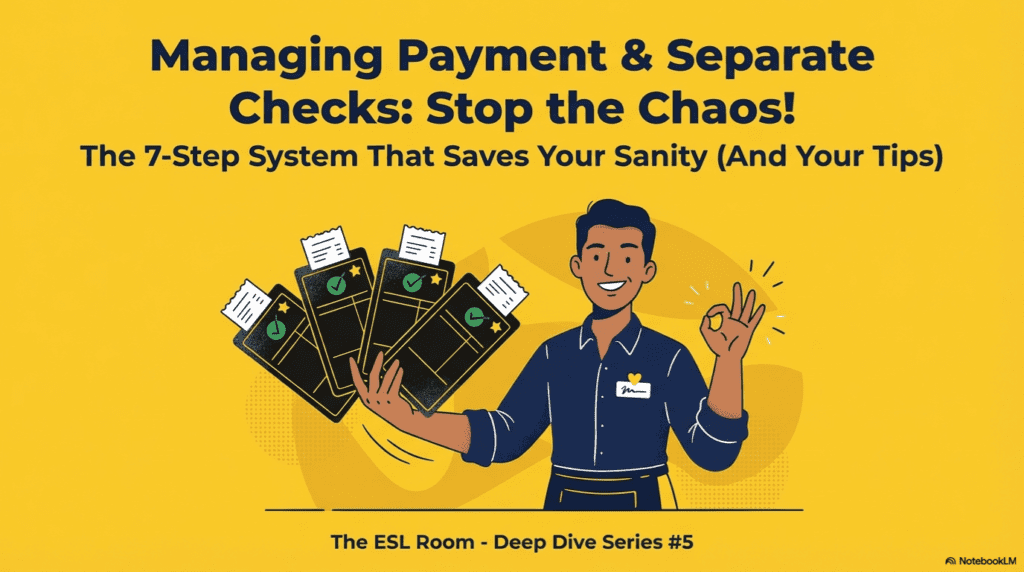
- The 7-step smooth payment system
- Managing split checks without slowing down service
- Handling card declines, disputes, and payment problems
- 10 essential phrases that prevent confusion
- Common mistakes that cost you time and tips
Let’s look at how professional servers handle even the most complex payment situations.
Prefer to listen – Here’s the podcast
The Scenario: A Six-Person Business Dinner
The Setup:
- Saturday night, 8:30 PM
- Table 12: Six business colleagues celebrating a promotion
- Total bill: $285
- They’ve ordered appetizers, entrees, wine, and desserts
- Some items were shared, others were individual
- Your server is Maya, who has been serving for 3 years
Watch how Maya prevents payment chaos by asking ONE simple question at the right time:
The Full Dialogue
[At 7:15 PM – When taking the main course order]
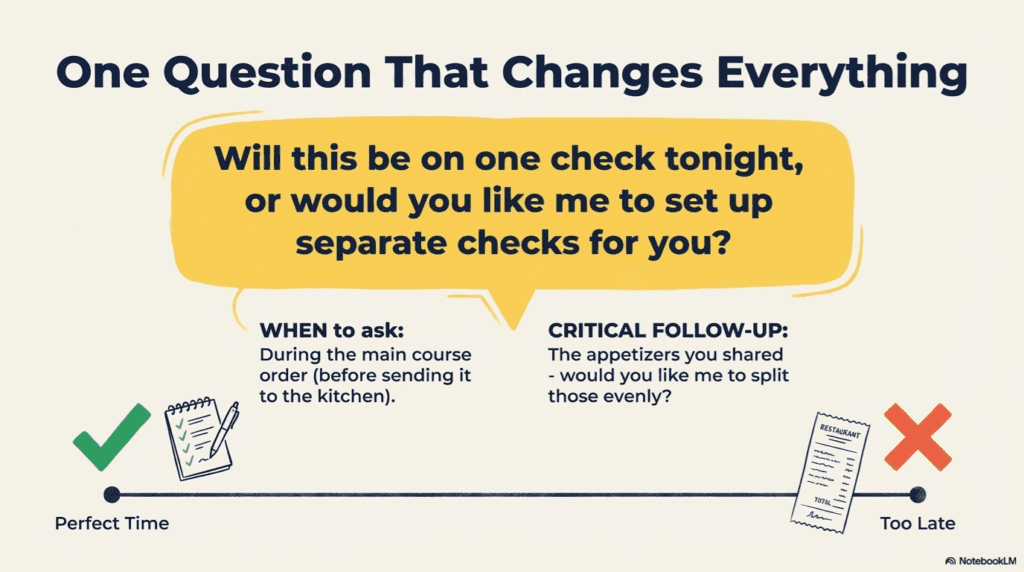
Maya: Perfect, I have two steaks, the salmon, the pasta, the chicken, and the lamb. Before I send this to the kitchen, I want to make sure – will this be on one check tonight, or would you like me to set up separate checks for you?
Guest 1 (Mark): Oh good question. What do you guys think?
Guest 2 (Sarah): I think separate is easier.
Maya: Absolutely, I can do that. Would you like me to split this by person – six separate checks – or would you prefer fewer checks with some people together?
Guest 3 (David): Can we do it by seat?
Maya: Perfect! That’s the easiest way. I’ll keep everyone’s order separate by seat number, so when we get to payment, everyone gets exactly what they ordered. Now, the appetizers you shared earlier – would you like me to split those evenly across all six checks, or should I put them all on one check for someone to handle?
Guest 1 (Mark): Split them evenly between us.
Maya: Got it. So I’ll divide the appetizers six ways, and everything else stays with whoever ordered it. That way there’s no confusion later.
Guest 4 (Lisa): That’s perfect, thank you.
Maya: You’re welcome! And just so you know, when I bring the checks at the end of the meal, they’ll be clearly marked by seat number, so everyone knows which one is theirs. I’ll have them ready to go.
[At 8:45 PM – Clearing the dessert plates]
Maya: How was everything tonight?
Guest 1 (Mark): Excellent, really great meal.
Maya: I’m so glad! I’ll get your checks ready for you. Give me just two minutes to print them, and I’ll be right back with six separate checks.
Guest 5 (Robert): Perfect.
[At 8:47 PM – Delivering the checks]
Maya: [Places six check presenters down, each labeled with seat numbers] Here you are – I’ve labeled each one by seat number so there’s no confusion. Seat 1, that’s you Mark. Seat 2, Sarah. Seat 3, David… [continues around the table]
Maya: The appetizers are split evenly, so you’ll each see one-sixth of that amount on your check. Take your time looking them over, and just let me know when you’re ready. I can take credit cards whenever you’d like.
Guest 2 (Sarah): [Looking at her check] This looks perfect, thank you.
[At 8:52 PM – Collecting payment]
Maya: Is everyone ready, or does anyone need more time?
Guest 3 (David): We’re good to go.
Maya: Great! I’ll take these and be right back with your receipts.
[Maya collects all six check presenters at once, with credit cards inside]
[At 8:55 PM – A problem appears]
[Maya returns to the table]
Maya: [Quietly, to Guest 4, Lisa] Excuse me, I’m so sorry to interrupt, but your card was declined. This happens sometimes – the chip reader can be sensitive. Would you like me to try it again, or would you prefer to use a different card?
Guest 4 (Lisa): [Quietly, slightly embarrassed] Oh no, really? Let me give you my other card.
Maya: No problem at all, happens all the time. I’ll be right back.
[At 8:58 PM – Returning with receipts]
Maya: [Places receipt folders in front of each guest] Here you are. Thank you so much for joining us tonight, and congratulations on the promotion! I hope you all have a wonderful evening.
Guest 1 (Mark): Thank you, this was great service.
Guest 2 (Sarah): Really smooth, we appreciate it.
Why This Worked: The Psychology of Payment Management
This scenario shows perfect payment management from start to finish. Let’s break down why Maya’s approach prevented chaos:
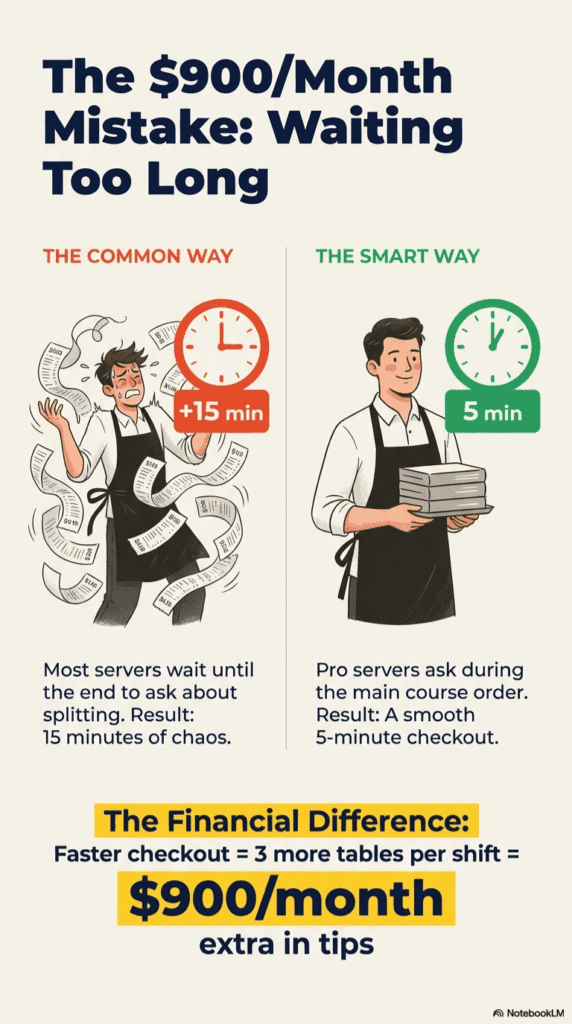
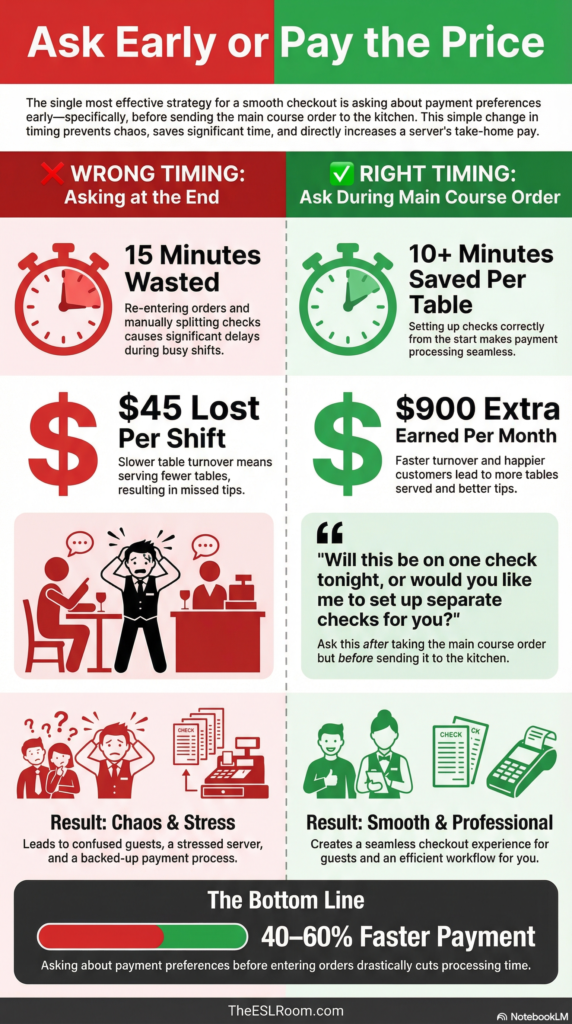
1. She asked about payment early (during main course order) Most servers wait until the check arrives to discuss splitting. By then, it’s too late – the order is already entered as one check in the system, and splitting requires re-entering everything. Maya asked at the perfect moment: after everyone had ordered their main course but before sending the order to the kitchen. This gave her time to set up separate checks properly in the POS system.
2. She offered clear options Maya didn’t just ask “separate checks?” – she offered specific choices: “six separate checks or fewer checks with some people together?” This prevented the confusion that happens when groups haven’t thought through how they want to split.
3. She addressed shared items immediately The appetizers were the danger zone – shared items cause more payment disputes than anything else. Maya asked exactly how to handle them before there could be any confusion, and she confirmed the decision back to the table: “I’ll divide the appetizers six ways.”
4. She set clear expectations “They’ll be clearly marked by seat number, so everyone knows which one is theirs” – this one sentence prevented the chaos of six people trying to figure out which check belonged to whom.
5. She handled the declined card privately and professionally When Lisa’s card was declined, Maya spoke quietly to her alone rather than announcing it to the table. She normalized the situation (“happens all the time”) and offered a simple solution, which preserved Lisa’s dignity and prevented embarrassment.
Research from Clover POS systems shows that restaurants with clear split-check policies and properly trained staff turn tables 15-20% faster during peak hours. The difference isn’t the POS system – it’s servers who know how to ask the right questions at the right time.
The 10 Key Phrases for Payment Success
Here are the essential phrases Maya used, why they work, when to use them, and what NOT to say:
1. “Will this be on one check tonight, or would you like me to set up separate checks for you?”
When to use it: During the main course order, before sending the order to the kitchen
Why it works:
- Asks at the perfect time (early enough to set up properly)
- Offers two clear options
- Uses “set up” which shows you’ll handle it professionally
- The word “tonight” makes it feel natural, not scripted
What NOT to say:
- ❌ “Are you splitting this?” (Too vague – splitting how?)
- ❌ “One check, right?” (Assumes and puts them in an awkward position)
- ❌ Saying nothing and waiting until payment time (Disaster)
2. “Would you like me to split this by person, or would you prefer fewer checks with some people together?”
When to use it: After they say they want separate checks
Why it works:
- Gives them two specific options instead of making them figure it out
- “By person” is clearer than “six ways” or “individually”
- Shows you’re flexible and can handle different arrangements
What NOT to say:
- ❌ “How do you want to split it?” (Too open-ended, creates confusion)
- ❌ “I can only do three checks maximum” (If your restaurant has limits, mention it politely, but don’t lead with restrictions)
3. “The appetizers you shared earlier – would you like me to split those evenly across all checks, or should I put them all on one check?”
When to use it: Immediately after confirming separate checks
Why it works:
- Addresses the biggest problem area (shared items) before it becomes a dispute
- Offers two clean solutions
- Uses “you shared earlier” to remind them why this matters
Alternatives:
- “And for the appetizers you ordered for the table, how would you like those split?”
- “Should I divide the shared appetizers between everyone, or assign them to one person?”
What NOT to say:
- ❌ “Who ordered the appetizers?” (Creates blame/responsibility tension)
- ❌ Saying nothing and splitting them automatically (They might dispute this later)
4. “I’ll divide the appetizers six ways, and everything else stays with whoever ordered it.”
When to use it: After they tell you how to handle shared items
Why it works:
- Confirms the decision back to them clearly
- Prevents misunderstandings later
- “Everything else stays with whoever ordered it” reassures them individual orders are correct
What NOT to say:
- ❌ “Okay” (Too brief – they don’t know if you understood)
- ❌ “Got it” and then walking away (Always confirm the plan)
5. “When I bring the checks at the end of the meal, they’ll be clearly marked by seat number.”
When to use it: Right after confirming the split-check arrangement
Why it works:
- Sets expectations about how payment will work
- “Clearly marked” reassures them it will be easy to figure out
- Prevents the chaos of everyone grabbing random checks
What NOT to say:
- ❌ “You’ll figure out which check is yours” (Sounds like you’re making THEM do the work)
- ❌ Saying nothing about how you’ll organize the checks (They’ll be confused later)
6. “Give me just two minutes to print them, and I’ll be right back with six separate checks.”
When to use it: When you’re clearing dessert plates or they indicate they’re ready for the check
Why it works:
- “Just two minutes” sets a time expectation (prevents them wondering where you are)
- Confirms the number of checks again
- “I’ll be right back” assures them you’re on it
What NOT to say:
- ❌ “Let me go get those” (No time frame given)
- ❌ “This might take a while” (Negative framing)
7. “I’ve labeled each one by seat number so there’s no confusion.”
When to use it: While placing the check presenters down in front of guests
Why it works:
- Explains your system immediately
- “No confusion” reassures them
- Shows you’ve organized it professionally
What NOT to say:
- ❌ Just putting checks down without explanation
- ❌ “Figure out which one is yours” (Makes them do the work)
8. “Take your time looking them over, and just let me know when you’re ready.”
When to use it: After delivering all the checks
Why it works:
- Gives them permission to review carefully
- “Let me know when you’re ready” means you’ll come back (not hovering)
- Reduces pressure
What NOT to say:
- ❌ “I’ll be back in a second” and then immediately returning (Hovering makes them uncomfortable)
- ❌ “Is everything correct?” (Can sound defensive, like you expect problems)
9. “Your card was declined. This happens sometimes – the chip reader can be sensitive. Would you like me to try it again, or would you prefer to use a different card?”
When to use it: Privately, speaking quietly to the guest whose card was declined
Why it works:
- States the problem directly but gently
- Normalizes it (“happens sometimes”)
- Gives them an external reason (chip reader) to save face
- Offers two simple solutions
- Keeps it between you and them
What NOT to say:
- ❌ “Your card doesn’t work” (Too harsh)
- ❌ “Do you have another card?” (Sounds like you’re questioning their ability to pay)
- ❌ Announcing it to the whole table (Major privacy violation)
10. “I can take credit cards whenever you’d like.”
When to use it: After delivering the checks and letting them review
Why it works:
- Offers to collect payment without pressuring them
- “Whenever you’d like” gives them control
- Implies you’ll come back, not hover
What NOT to say:
- ❌ “Are you ready to pay?” (Too direct, sounds pushy)
- ❌ Standing there silently waiting (Awkward and pressuring)
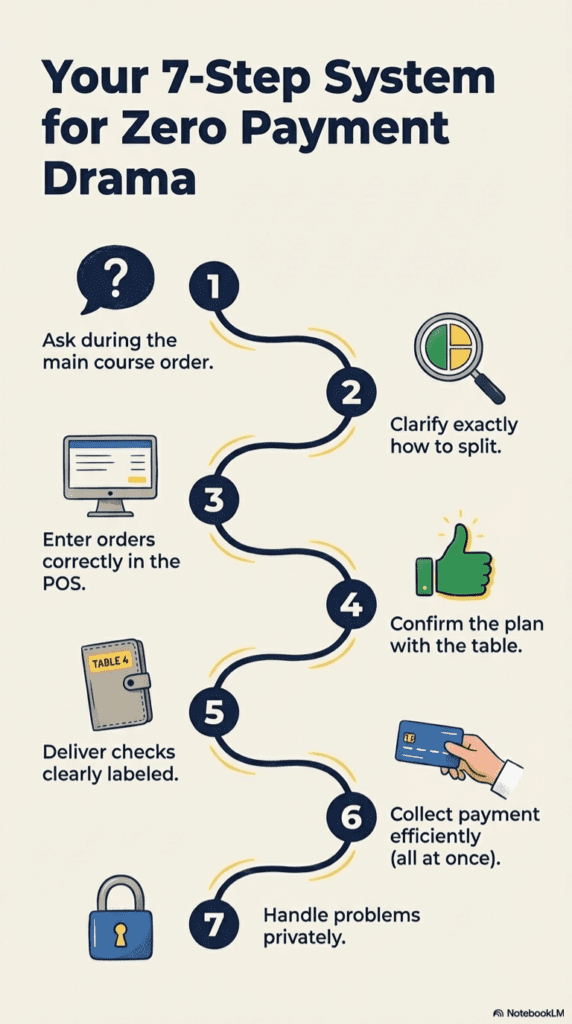
The 7-Step Smooth Payment System
Here’s the complete system that Maya used, from the moment guests sit down to the moment they leave:
Step 1: Ask About Payment During Main Course Order (Not At The End)
Timing: After taking entree orders, before sending to the kitchen
What to do: “Will this be on one check tonight, or would you like me to set up separate checks for you?”
Why this timing:
- Early enough to set up separate checks properly in your POS system
- After the big order decisions are made (they know what they’re getting)
- Before the order is sent (so you don’t have to re-enter everything)
Red flag situations where you MUST ask:
- Tables of 4 or more people
- Business dinners (colleagues usually split)
- Groups of similar age (friends usually split)
- Anyone who asks about splitting when they sit down
According to Toast POS research, asking about payment preferences before entering orders reduces payment processing time by 40-60% compared to splitting checks after the meal.
When billing errors occur, knowing how to recover from mistakes professionally can turn an upset guest into a loyal customer.
Step 2: Clarify Exactly How They Want to Split
What to ask: “Would you like me to split this by person, or would you prefer fewer checks with some people together?”
Follow up with: “The appetizers you shared – would you like me to split those evenly across all checks, or put them all on one check?”
Why this matters: Shared items (appetizers, bottles of wine, desserts for the table) cause 80% of payment disputes. Address them NOW, not later.
Common split arrangements:
- By seat: Each person gets their own check with what they ordered (most common)
- Couples: Three checks for three couples
- One person treating: Everyone separate except one person paying for their partner/friend
- Even split: Total divided equally (rare with servers, more common with Venmo afterward)
Step 3: Enter Orders Correctly in Your POS System
What to do:
- If your POS has seat numbers, use them
- If it doesn’t, create a clear system (Check 1, Check 2, etc.)
- Put shared items on separate checks as discussed
- Add a note if needed: “Apps split 6 ways”
Common POS split-check features:
- Split by seat (each seat becomes a separate check)
- Split by item (drag items to different checks)
- Split evenly (divides total by number of checks)
Important: Learn your restaurant’s POS system before a busy shift. Practice splitting checks during slow times.
Step 4: Confirm the Arrangement Before Leaving the Table
What to say: “Perfect, so I’ll have six separate checks ready at the end of the meal, with the appetizers split evenly between everyone. Everything else stays with whoever ordered it.”
Why confirmation matters:
- Shows you understood correctly
- Prevents disputes later (“But I told you to put the apps on MY check!”)
- Builds trust
Step 5: Prepare and Deliver Checks Clearly
What to do:
- Print all checks together
- Label them clearly (by seat number or name)
- Place them in check presenters
- Deliver them all at once
- Explain your system: “I’ve labeled each one by seat number”
What NOT to do:
- ❌ Dump a pile of checks in the middle of the table
- ❌ Hand them out randomly
- ❌ Make guests guess which check is theirs
Pro tip: If your restaurant doesn’t have enough check presenters for large splits, tell your manager you need more. This is a basic tool for professional service.
Step 6: Give Them Time, Then Collect Payment Efficiently
What to say: “Take your time looking them over, and just let me know when you’re ready.”
Then:
- Step away (don’t hover)
- Check back after 2-3 minutes: “Is everyone ready, or does anyone need more time?”
- Collect ALL payment at once if possible (don’t make separate trips for each person)
Efficiency tip: Most modern POS systems let you process multiple cards at once. Learn how your system handles this.
Step 7: Handle Problems Privately and Professionally
Common problems:
- Card declined
- Guest disputes their bill
- Someone “forgot their wallet”
- Math doesn’t add up on a split
How to handle:
- Pull the person aside or speak quietly
- Never announce problems to the whole table
- Offer simple solutions
- Get manager involved if needed
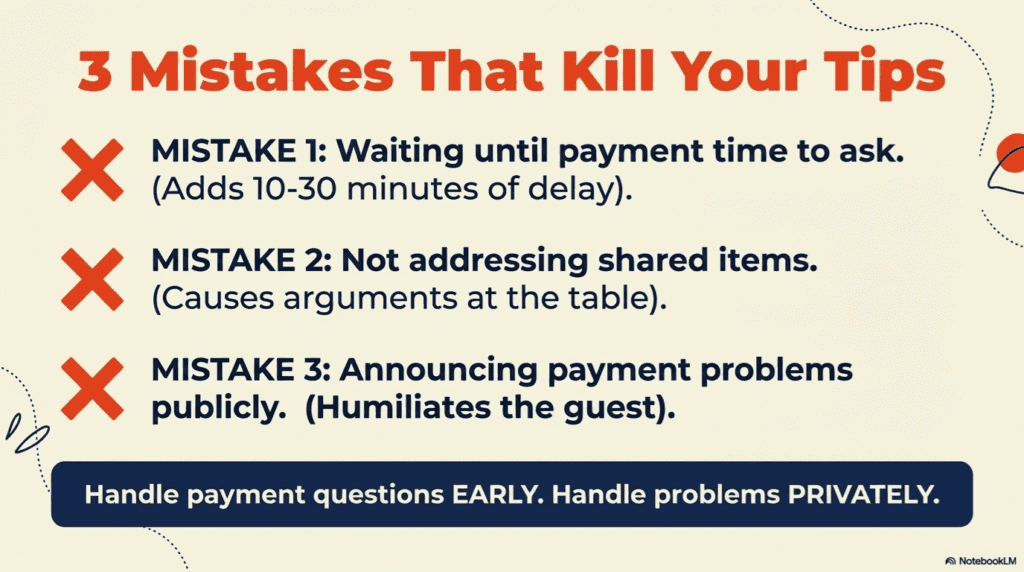
Common Mistakes That Cost You Time and Tips
Mistake 1: Waiting Until Payment Time to Ask About Splitting
Why it’s wrong: By then, the order is already entered as one check. You’ll have to re-enter everything or manually split in the POS, which takes 5-15 minutes.
What to do instead: Ask during the main course order: “Will this be on one check tonight, or would you like me to set up separate checks?”
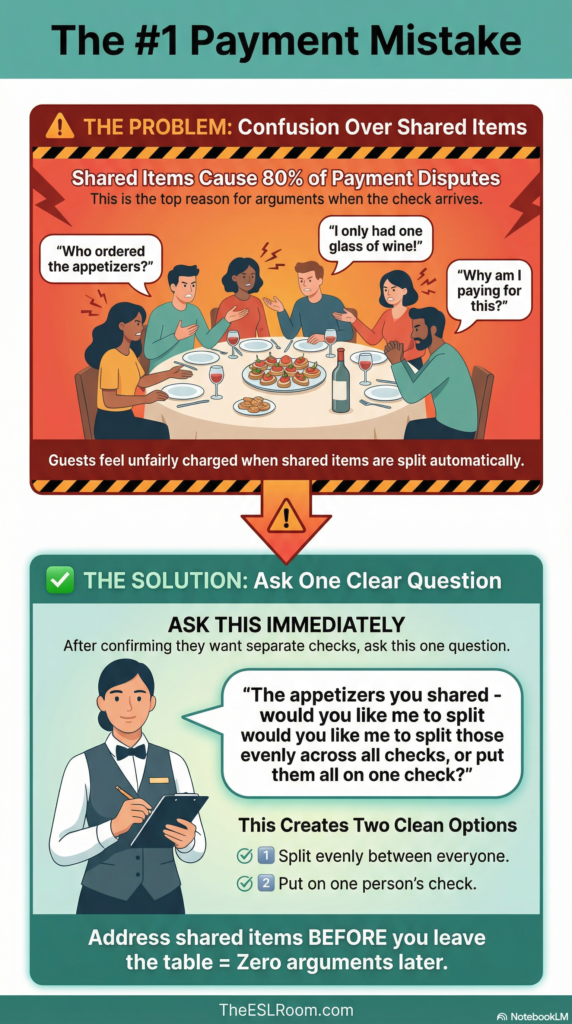
Mistake 2: Not Addressing Shared Items
Why it’s wrong: Shared appetizers, bottles of wine, and desserts for the table cause more payment arguments than anything else.
What happens:
- “Why am I being charged for appetizers? I didn’t want them.”
- “Who ordered this wine? I only had one glass.”
- You end up standing there while they argue
What to do instead: Ask immediately: “For the items you shared, would you like me to split those evenly, or put them all on one check?”
Mistake 3: Splitting More Than 4-6 Ways
Why it’s wrong:
- Takes too long (10-30 minutes extra)
- Increases errors
- Slows down your other tables
- Modern etiquette experts recommend maximum 2-4 credit cards for large groups
Research from NPR’s etiquette experts confirms that servers ‘have enough to deal with’ during busy shifts, and processing multiple cards with different tip percentages creates unnecessary complexity.
What to do instead:
- For groups of 6+, suggest: “Many of our guests find it easier to put down 2-3 cards and use Venmo to settle up afterward. Would that work for your group?”
- If they insist on 6+ separate checks, warn them: “Absolutely, I can do that. It will take about 10-15 minutes to process all the payments, so I wanted to set that expectation.”
Research from NPR’s etiquette experts confirms that servers “have enough to deal with” during busy shifts, and processing multiple cards with different tip percentages creates unnecessary complexity.
Mistake 4: Making Assumptions About Who’s Paying
Why it’s wrong:
- Assuming a man will pay (outdated and offensive)
- Assuming the person who invited everyone will pay
- Assuming couples want one check together
What to do instead: Always ask or place the check in the center of the table neutrally.
Mistake 5: Hovering While They Review Checks
Why it’s wrong: Makes them uncomfortable and rushed. They can’t review carefully or discuss privately.
What to do instead:
- Deliver checks
- Say “Take your time”
- Step away
- Return after 2-3 minutes
Mistake 6: Announcing Payment Problems Publicly
Why it’s wrong:
- “Your card was declined” said loudly = humiliation
- Creates awkward tension at the table
- Damages your tip
What to do instead: Speak quietly and privately: “Excuse me, your card was declined. This happens sometimes – would you like to try again or use a different card?”
Special Situations: How to Handle Tricky Payment Scenarios
Situation 1: “We’re Splitting It, But I Don’t Know How Yet”
What they say: “We’ll figure out the split when the check comes.”
What to do: “No problem! Just so you know, it’s much easier for me to set up separate checks now rather than split them later. Would you like me to set them up by person, or are you planning to use Venmo to settle up afterward?”
If they insist on figuring it out later: “Absolutely, I’ll bring one check and you can let me know how you’d like to split it then. Just keep in mind it may take a few extra minutes to split it afterward.”
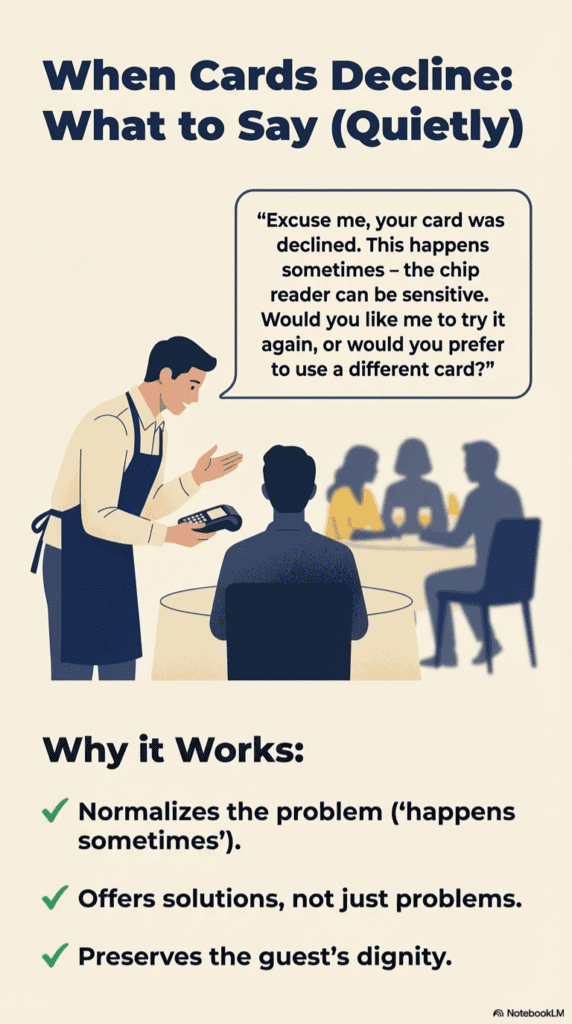
Situation 2: Card Declined
What to say (privately): “Excuse me, I’m sorry to interrupt, but your card was declined. The chip readers can be sensitive sometimes. Would you like me to try it again, or would you prefer to use a different card?”
If they don’t have another card: “No problem at all. Would you like to use a mobile payment like Apple Pay, or would you like a few minutes to arrange payment with one of your friends?”
If they become defensive: “I completely understand, this happens all the time. Take your time, and let me know what works best for you.”
Situation 3: “I Forgot My Wallet”
What they usually do: Look embarrassed and ask their friends to cover them.
What you do: Stay out of it. Let them handle it with their group. Only get involved if they ask you directly:
If they ask you: “No problem at all. Would one of your friends like to cover it and you can pay them back, or would you like to leave your information and come back later to settle the check?”
Manager involvement: If no one can cover and they want to leave without paying, get your manager immediately. This is above your authority level.
Situation 4: Someone Disputes Their Bill
What they say: “This isn’t right. I didn’t order this.”
What to do:
- Look at the check with them
- Stay calm and professional
- If it’s your error: “You’re absolutely right, I made a mistake. Let me fix this immediately.”
- If it’s their error: “Let me double-check my notes. I have you down for [item]. Is it possible there was some confusion?”
- If you can’t resolve it: “Let me get my manager to help us sort this out.”
Never: Argue, get defensive, or insist you’re right even if you are.
Situation 5: The Group Changes Their Mind
What they say: “Actually, can we split this differently than we said?”
What to do:
- If they ask BEFORE you print checks: “Absolutely, no problem. How would you like to split it now?”
- If they ask AFTER you print checks: “I can definitely do that. It will take me about 5 minutes to re-split everything. Is that okay?”
Be honest about timing: If re-splitting will take a while, tell them. Most people are understanding if you set expectations.
The Financial Impact: Why Payment Management Matters
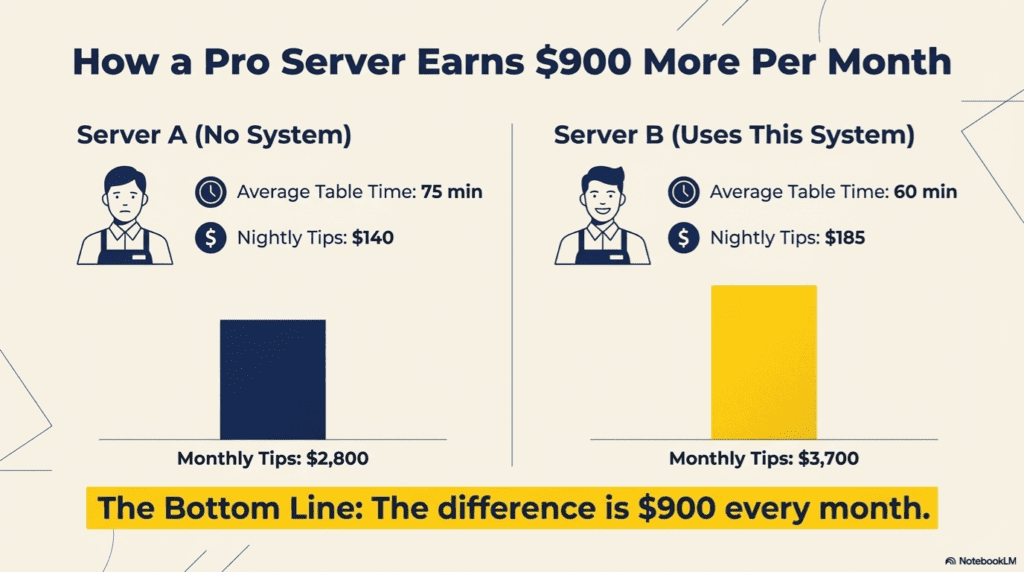
Let’s look at two servers working the same Saturday night shift:
Server A (No Payment Strategy):
- Tables: 15
- Average table time: 75 minutes (payment adds 15 minutes per table due to confusion)
- Tips: $140
- Tables turned away due to long waits: 3
Server B (Uses Payment Management System):
- Tables: 18
- Average table time: 60 minutes (payment is smooth and fast)
- Tips: $185
- Tables turned away: 0
The difference:
- 3 more tables served = $45 extra in tips
- Faster turnover = happier customers = better tips (average 15-20% vs 12-15%)
- Less stress = better attitude = better service overall
Monthly difference (20 shifts):
- Server A: $2,800/month in tips
- Server B: $3,700/month in tips
- Difference: $900/month = $10,800/year
That’s the value of mastering payment management.
Practice Exercises
Exercise 1: Payment Timing
Scenario: You’re taking the entree order from a table of 5 business colleagues. They’ve ordered appetizers and drinks, and now they’re ordering main courses.
Your task: Write out exactly what you would say to ask about payment, and when you would say it.
Exercise 2: Shared Item Crisis
Scenario: A table of 6 ordered 3 appetizers to share at the beginning of the meal. Now they want separate checks, but they haven’t discussed how to handle the appetizers.
Your task: Write out the question you would ask to clarify how they want the appetizers split.
Exercise 3: Card Declined
Scenario: You’re processing payment for a table of 8 separate checks. One guest’s card is declined. The rest of the table is chatting and ready to leave.
Your task: Write out exactly what you would say to the guest whose card declined, and how you would handle the situation.
Exercise 4: Last-Minute Split Request
Scenario: You deliver the check to a table of 4. They all reach for it at once, then one person says “Oh, are we splitting this?” They start discussing whether to split evenly or by item.
Your task: What should you have done earlier to prevent this? What do you do now?
Summary: Your Payment Management Checklist
✅ During main course order:
- Ask: “Will this be on one check tonight, or would you like me to set up separate checks?”
- Clarify exactly how they want to split
- Address shared items immediately
- Confirm the arrangement back to them
✅ When setting up in POS:
- Use seat numbers or clear labels
- Split shared items as discussed
- Double-check everything before sending to kitchen
✅ When delivering checks:
- Print all checks together
- Label them clearly
- Explain your system to the table
- Give them time to review
✅ When collecting payment:
- Ask if everyone is ready
- Collect all payments at once if possible
- Process cards efficiently
- Handle problems privately
✅ Throughout the process:
- Stay calm and professional
- Set clear time expectations
- Communicate clearly
- Prevent confusion before it happens
Final Thoughts
Payment management isn’t just about splitting checks – it’s about controlling the pace of service and protecting your tips. The servers who master payment timing, communication, and problem-solving earn more money and experience less stress.
The key insight: Handle payment questions EARLY, not late. By the time the check arrives, it’s too late to prevent confusion. Ask about splitting during the main course order, address shared items immediately, and set clear expectations about how payment will work.
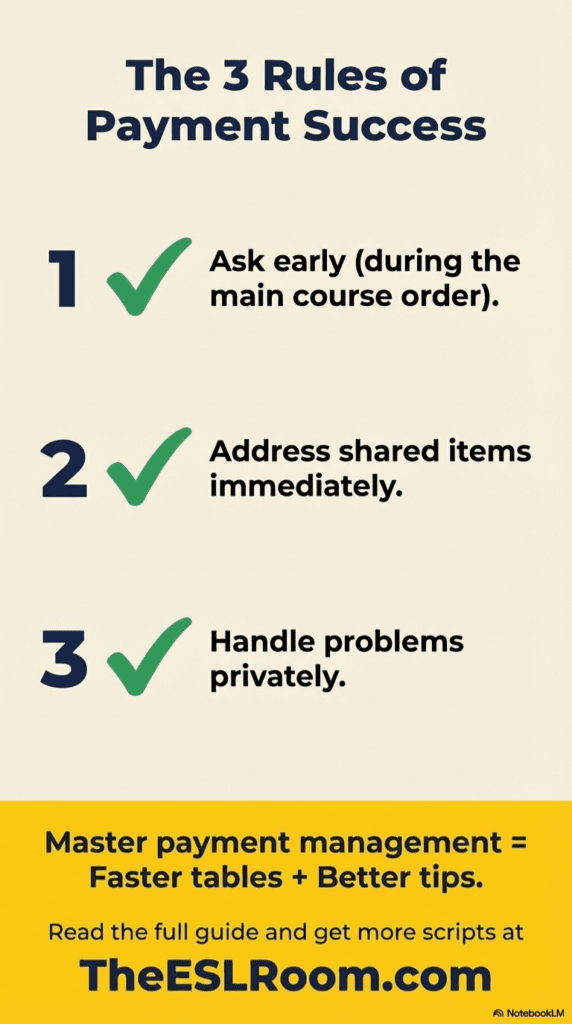
The three rules of payment success:
- Ask early (during main course order, not at the end)
- Address shared items immediately (before they become disputes)
- Handle problems privately (never embarrass guests publicly)
Master these skills, and you’ll turn tables faster, earn better tips, and avoid the payment chaos that makes busy shifts miserable.
Practice these phrases on your next shift. Start with just ONE technique – asking about payment during the main course order – and notice how much smoother your nights become.
Related Articles
Deep Dive #1: Greeting an Angry Customer – Master the first 30 seconds of difficult service encounters
Deep Dive #2: Taking a Complex Order – Handle large groups and special requests professionally
Deep Dive #3: Upselling Without Being Pushy – Natural techniques that increase tips by 100%
Deep Dive #4: Handling Food Complaints – Turn service failures into customer loyalty
Ready to Master Restaurant English?
These free articles and scenarios are a great start, but if you want a complete, structured system for learning restaurant English, consider our full course.

English for Waiters includes:
✅ 22+ video lessons covering every restaurant situation
✅ Real restaurant scenarios with native pronunciation
✅ Interactive pronunciation practice
✅ Downloadable phrase guides
✅ Lifetime access with free updates
About The ESL Room: We specialize in practical English training for hospitality professionals. Our “English for Waiters” course teaches real restaurant scenarios, key phrases, and professional communication skills that help servers increase their tips and advance their careers.